
In This Article
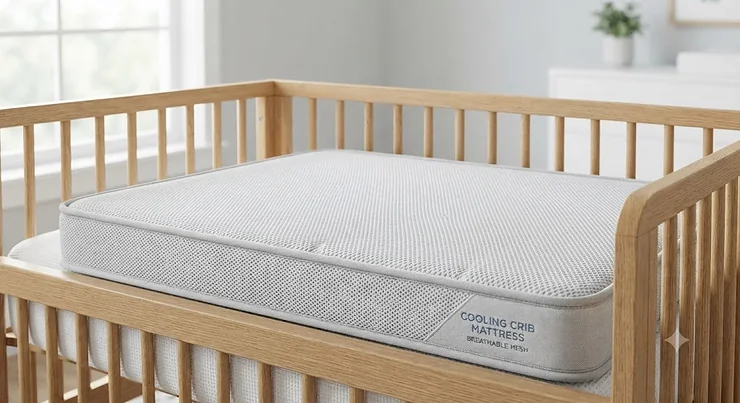
Somewhere around 2 a.m., you tiptoe into the nursery to check on a fussy baby, and your hand brushes the sheet — it’s damp. Not soaked, just warm and clingy in that way that tells you the mattress underneath isn’t doing its job. If that scene sounds familiar, you’re not imagining things: overheating is one of the most common (and most fixable) reasons babies wake up cranky, sweaty, and resistant to going back down. A cooling crib mattress is a crib mattress engineered with breathable cores, gel-infused foam, or airflow-friendly covers that pull heat away from a sleeping baby instead of trapping it against their skin. It won’t replace a properly cooled bedroom, but it changes what happens in the six inches between your baby and the mattress surface, and that six inches matters more than most parents expect.
This guide breaks down seven real, currently available crib mattresses that approach the overheating problem from different angles — some through pure airflow, some through organic wool and latex, and some through actual gel-infused foam. We researched specs, aggregated review sentiment, and safety certifications for each one so you can compare apples to apples instead of guessing from marketing copy. We’ll also walk through what “breathable” actually means on a lab bench, how gel infusion differs from simple ventilation, and where the safety line sits — because, as the American Academy of Pediatrics explains in its safe sleep guidance, a crib mattress surface should never indent when your baby lies on it, no matter how cool it claims to sleep. Affiliate disclosure: this post contains affiliate links, and we may earn a commission if you purchase through them at no extra cost to you.
Quick Comparison Table
| Mattress | Cooling Approach | Price Range | Best For |
|---|---|---|---|
| Newton Baby Original | 90% air Wovenaire core | $250-$350 range | Face-down sleepers & washability |
| Naturepedic Organic Breathable Ultra | Removable breathable organic pad | Around $400-$460 | Organic-focused families |
| Babyletto x Avocado Organic | Wool, latex & coconut coir | $400-$500 range | Natural materials purists |
| Sealy Celestial Cool Ultra-Premium | Cool copper gel foam | $200-$280 range | Hybrid support + gel cooling |
| Moonlight Slumber Luxury Dreamer | OxyFlo CoolGel memory foam | Around $180-$230 | Budget-conscious gel shoppers |
| Dourxi Dual-Sided Comfort | Gel-infused memory foam | Under $160 | Tight-budget first mattress |
| Graco Premium Foam | Ventilated foam core | Under $100 | Bare-bones starter budget |
Looking at the spread above, the split isn’t really “cheap vs. expensive” — it’s airflow-through-design versus gel-added-to-foam. The Newton Baby Original and Naturepedic Organic Breathable Ultra cool by letting air move completely through the structure, while the Sealy Celestial Cool Ultra-Premium and Moonlight Slumber Luxury Dreamer cool by pulling heat into a phase-change or gel layer near the surface. Budget shoppers eyeing the Dourxi Dual-Sided Comfort or Graco Premium Foam should note that both rely on more conventional polyurethane cores, so cooling performance leans on the cover and ventilation channels rather than a specialized core material.
💬 Already narrowing it down? Tap a highlighted pick above to check today’s availability before it sells out.
💬 Just one click — help other golfers find the right club for their game too!😊
Top 7 Cooling Crib Mattresses: Expert Analysis
1. Newton Baby Original Crib Mattress — 90% air core, fully washable
The Newton Baby Original approaches cooling from an unusual angle: instead of adding a gel layer, it removes almost all the material a baby could trap heat against. Its Wovenaire core is roughly 90% air and 10% food-grade polymer, which is why air pockets spread throughout the mattress keep body heat from becoming trapped as the baby sleeps. Independent lab testing commissioned by the brand found 97% more airflow than the leading organic crib mattress it was benchmarked against — a meaningful gap, not a rounding error. What that means in practice: a baby who rolls face-down at 4 months still has clear air access through the mattress itself, on top of following back-sleeping guidance. Reviewers consistently report that both the cover and the core can be rinsed clean, which matters more than it sounds once diaper blowouts enter the picture. Parents who’ve used it long-term note it stays noticeably cooler than the foam mattress it replaced, and that the lighter weight makes 2 a.m. sheet changes far less of a wrestling match.
Pros:
- ✅ Genuinely breathable core, not just a breathable cover
- ✅ Fully washable core and cover for real-life messes
- ✅ Lightweight, easy to lift during sheet changes
Cons:
- ❌ No waterproof layer on the standard Original model
- ❌ Premium pricing compared to basic foam options
At around $250-$350, the Newton Baby Original sits mid-pack price-wise but earns its keep if airflow and washability matter more to you than a waterproof surface — pair it with a separate waterproof pad and you’ve covered both bases.
2. Naturepedic Organic Breathable Ultra 2-Stage — thick removable breathable pad
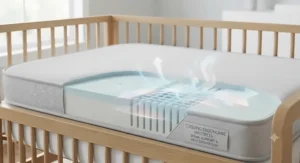
Where the Newton Baby Original builds breathability into the core, the Naturepedic Organic Breathable Ultra takes a different, more conservative route: a thick, removable, machine-washable organic cotton pad that sits on top of a waterproof-backed core. The company’s engineering logic is worth understanding, because it’s a real safety trade-off, not marketing spin — Naturepedic’s breathable layer sits on the surface rather than making the entire mattress breathable through the interior, on the reasoning that if liquid reaches an all-through-breathable interior, cleanup becomes nearly impossible and mold risk climbs. Based on that spec comparison, this is the mattress for parents who want organic materials and waterproofing without compromising on either. The 3D-weave removable cover promotes airflow to help regulate temperature on warm nights, and the core itself, in the innerspring version, uses 252 coils wrapped in organic cotton batting for genuine long-term support. Aggregated reviewer sentiment across independent test labs consistently ranks this among the highest-certified organic options on the market, citing GOTS, MADE SAFE, and Greenguard Gold as the full certification set.
Pros:
- ✅ Certified organic cotton, GOTS and MADE SAFE verified
- ✅ Waterproof backing built into the breathable pad
- ✅ Dual-firmness design lasts from infant to toddler
Cons:
- ❌ Higher price point than most organic competitors
- ❌ Innerspring version runs heavier at close to 19 pounds
In the $400-$460 range, this is a premium pick, but reviewers consistently point to the combination of organic certification and true waterproofing as reasons it lands high on best-of lists year after year.
3. Babyletto x Avocado Organic Dual-Stage Crib Mattress — wool, latex & coconut coir
The Babyletto x Avocado Organic mattress leans hardest into natural materials of any option here, pairing GOTS-certified organic wool and cotton with GOLS-certified organic latex and a coconut husk coir core. What most buyers overlook about wool specifically is that it isn’t just a flame barrier — it wicks away moisture and stays breathable both warm and cool depending on conditions, which is exactly the temperature-regulation function parents are shopping for under a different name. Reviewers who’ve tested it describe the toddler-side latex layer as noticeably cooler and less clammy than foam alternatives, largely because latex’s open-cell structure doesn’t compress into a heat-trapping pocket the way memory foam can. The trade-off is weight: independent testers measured the Avocado at around 25.6 pounds, making it one of the heaviest mattresses in any comparison group, which affects how easily you can flip it during 3 a.m. sheet changes. It’s also the priciest all-natural option on this list, but the 25-year warranty offered on some configurations reflects genuine confidence in the materials’ durability.
Pros:
- ✅ 100% certified organic wool, cotton, latex, and coir
- ✅ Naturally antimicrobial and dust-mite resistant materials
- ✅ Long warranty periods reflecting build confidence
Cons:
- ❌ Among the heaviest crib mattresses tested, around 25 lbs
- ❌ No built-in waterproofing on the base organic model
Expect to pay in the $400-$500 range depending on configuration — a premium tier justified mainly if wool and latex’s natural cooling profile is a non-negotiable for your family.
4. Sealy Celestial Cool Ultra-Premium 2-Stage Hybrid — cool copper gel technology
This is where “cooling gel crib mattress” stops being a marketing phrase and starts being an actual engineered layer. The Sealy Celestial Cool Ultra-Premium pairs copper-infused gel foam with a full steel innerspring base, and copper’s thermal conductivity gives it a genuine physical basis for pulling heat away from the body faster than plain foam alone. Here’s what the spec sheet won’t tell you, but the construction implies: gel infusion cools fastest in the first hour of contact, then performance depends heavily on how well the layer underneath dissipates that absorbed heat — which is exactly why pairing gel foam with an innerspring base (rather than stacking gel on more foam) is the smarter engineering choice. The mattress carries Greenguard Gold and an EPA-approved antibacterial surface treatment, and its fully waterproof cover wipes clean without needing a separate protector. Reviewers note the surface stays firm to the two-finger test standard while still delivering the plush-adjacent feel the “Ultra-Premium” naming promises.
Pros:
- ✅ Copper gel foam plus steel coils for genuine airflow
- ✅ 100% waterproof, antibacterial surface treatment
- ✅ Greenguard Gold certified for low emissions
Cons:
- ❌ Availability fluctuates across retailers and can sell out
- ❌ Sealy’s standard hybrid line tested only fair on cooling, so verify this specific gel model separately
Priced in the $200-$280 range, this hybrid earns its “best for hill-climbing budgets meeting premium gel tech” reputation by not asking you to choose between gel cooling and coil support.
5. Moonlight Slumber Luxury Dreamer — OxyFlo CoolGel memory foam
The Moonlight Slumber Luxury Dreamer takes the gel-infused approach and prices it for the middle of the market rather than the premium tier. Its toddler side uses a dedicated OxyFlo CoolGel memory foam layer, while the infant side keeps a firmer high-density foam untouched by gel — a smart design choice, since infants need firmness first and cooling second, but toddlers spend enough hours in one position to benefit from active heat dissipation. Independent heat-retention testing found the Little Dreamer sibling model cooled from 130 degrees down to average body temperature in roughly 20 seconds, a solid result suggesting the OxyFlo layer isn’t just cosmetic gel marbling. The included bonus Airflow cover adds a second cooling mechanism during the newborn months, when parents are most anxious about overheating risk. One thing reviewers flag honestly: Moonlight Slumber previously faced FTC scrutiny over unverified organic and VOC-free marketing claims, which the company has since corrected — worth knowing, even though it doesn’t affect the cooling gel’s actual performance.
Pros:
- ✅ Dedicated CoolGel layer specifically on the toddler side
- ✅ Bonus removable Airflow cover for extra ventilation
- ✅ Made in the USA with a lifetime product warranty
Cons:
- ❌ Past FTC action over prior marketing claims
- ❌ Polyurethane foam core, not a natural-material option
At around $180-$230, this is a genuinely strong mid-tier pick for parents who want measurable gel cooling without paying premium-hybrid prices.
6. Dourxi Dual-Sided Comfort Memory Foam Mattress — triple-layer gel-infused budget pick
If your budget caps below $200 but you still want an actual gel-infused crib mattress rather than plain foam, the Dourxi Dual-Sided Comfort is the honest budget answer. Its three-layer construction stacks gel-infused memory foam over open-cell foam over a high-density support core, and the open-cell structure genuinely does accelerate airflow compared to closed-cell budget foams. Independent testers who cut into the layers found the marketed “cool gel memory foam” top layer to be a thinner, lower-density product than premium competitors use — worth knowing before you buy, since the gel infusion here is real but noticeably less substantial than what you’d get from the Sealy Celestial Cool Ultra-Premium. The cover is breathable but not waterproof, so budget in a separate waterproof pad from day one. Reviewers who tested it for months describe reasonable comfort and dual-firmness performance for the price, while flagging an initial off-gassing odor and mediocre zipper quality as recurring complaints.
Pros:
- ✅ Actual gel-infused foam layer at a sub-$160 price
- ✅ Dual firmness supports infant-to-toddler transition
- ✅ CertiPUR-US certified foam, free of phthalates and lead
Cons:
- ❌ Gel layer thinner and lower-density than premium rivals
- ❌ No waterproof cover included, needs separate protector
For families budgeting under $160, this is a reasonable starting point — not the class leader, but a legitimate stepping stone if cash is genuinely the constraint.
7. Graco Premium Foam Crib and Toddler Mattress — ventilated core, entry-level price
The Graco Premium Foam mattress represents the no-frills end of this lineup: a straightforward polyurethane foam core without gel infusion or a specialty breathable structure, priced under $100. Independent heat-retention testing found it cooled from 130 to roughly 98 degrees Fahrenheit in about 25 seconds, a result that’s respectable for a foam-only mattress with no added cooling technology. What that spec means in real terms: it won’t sweat your baby out, but it also won’t actively pull heat the way a gel or coil-based competitor will over a full night. The water-resistant, machine-washable cover is a genuine convenience feature, though it requires air-drying rather than a dryer cycle. Reviewers on major retail sites are largely positive about fit and firmness, though independent testers have separately noted the core isn’t highly breathable enough to prevent a sweaty back during warmer months — a fair trade-off given the price point.
Pros:
- ✅ Under-$100 price point with real certifications
- ✅ Greenguard Gold and CertiPUR-US certified foam
- ✅ Water-resistant, machine-washable removable cover
Cons:
- ❌ No dedicated cooling technology in the foam core
- ❌ Lacks reinforced edge support around the perimeter
At under $100, this is squarely the “get a safe, certified mattress into the crib today” option — a fine emergency or budget choice, though not the pick for genuinely hot-sleeping babies.
Practical Usage Guide: Setting Up a Cooling Crib Mattress the Right Way
Buying the right cooling crib mattress solves maybe half the overheating problem — setup and room conditions handle the rest. First, let any foam-core mattress fully expand before use; most manufacturers recommend 24-72 hours at room temperature, and compressing that timeline can leave the foam underperforming on both firmness and airflow for weeks. Second, skip the plush mattress topper entirely, even a “cooling” one — the AAP is explicit that toppers designed to soften a sleep surface aren’t appropriate for infants under one year, regardless of what material claims to cool them. Third, use only the fitted sheet designed for that exact mattress model; a loose or mismatched sheet traps a layer of stagnant, warm air exactly where you don’t want it.
For ongoing maintenance, keep the crib mattress out of direct sun exposure, which can degrade gel-infused foams faster than manufacturers’ warranties account for. Rotate breathable-core mattresses like the Newton Baby Original occasionally to even out compression wear, and spot-clean gel-foam models like the Moonlight Slumber Luxury Dreamer with a damp sponge rather than saturating the surface. A common first-30-days mistake: parents crank the nursery AC to compensate for a mattress they haven’t broken in yet, when the fix is usually just patience plus a properly fitted sheet. Finally, keep the bedroom itself in the 68-72°F range recommended by pediatric sleep specialists — no mattress, however advanced, fully compensates for an 80-degree room.
Real-World Scenarios: Which Cooling Crib Mattress Fits Your Family
Consider a few common household situations. If you’re a first-time parent in a converted one-bedroom apartment with no central air and a newborn prone to sweaty naps, the Dourxi Dual-Sided Comfort or Graco Premium Foam make sense as an affordable, certified starting point — pair either with a portable fan aimed at the room, not the crib directly, and revisit a premium option once you’ve confirmed your baby genuinely runs hot. If you’re a dual-income household in a warm-climate state like Arizona or Florida, where the nursery regularly sits above 74°F even with AC running, the gel-infused Sealy Celestial Cool Ultra-Premium or Moonlight Slumber Luxury Dreamer offer a real performance edge worth the extra $100-150 over basic foam.
Families prioritizing organic materials for a child with eczema or sensitive skin should look at the Babyletto x Avocado Organic or Naturepedic Organic Breathable Ultra — both avoid synthetic foams entirely, which matters more for skin-sensitive babies than raw cooling numbers. And for parents whose baby is an aggressive stomach-sleeper by 4-5 months (a common developmental milestone), the Newton Baby Original‘s fully breathable core adds a genuine airflow safety margin on top of standard back-sleeping practices, since the breathable material may help reduce carbon dioxide rebreathing risk according to third-party study results shared by the manufacturer — while still following every AAP guideline about firm, flat, unobstructed sleep surfaces.
✨ Ready to Beat the Overheating Cycle Tonight?
🔍 Compare any of these seven cooling crib mattress picks side-by-side, click through to check current availability, and give your little one (and yourself) a genuinely cooler night’s sleep.
How to Choose a Cooling Crib Mattress
Picking the right cooling crib mattress comes down to five practical criteria, weighed in this order:
- Firmness first, always. No cooling feature matters if the surface indents under your baby’s weight — the AAP is unambiguous that firm, non-conforming surfaces reduce suffocation risk regardless of temperature performance.
- Cooling mechanism. Decide whether you want airflow-through-design (Newton, Naturepedic) or gel-infused foam (Sealy, Moonlight Slumber, Dourxi) — the first suits face-down sleepers, the second suits families in genuinely hot climates.
- Waterproofing. Built-in waterproofing (Naturepedic, Sealy) saves you buying a separate protector; breathable-only cores (Newton) trade waterproofing for airflow.
- Weight and handling. A 25-pound organic mattress like the Avocado is harder to flip at 3 a.m. than an 11-pound Newton Essential — factor in who’s actually doing the sheet changes.
- Certifications. Greenguard Gold and CertiPUR-US aren’t just badges; they indicate independently verified low-emission materials, which matters given how many hours a baby spends face-down near the surface.
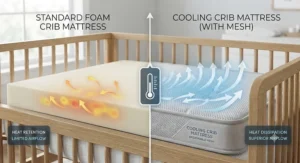
Gel-Infused vs. Breathable Temperature Crib Mattress Designs
The temperature regulation baby product category really splits into two competing engineering philosophies, and understanding the difference helps explain why prices vary so widely. A gel infused crib mattress works by embedding a phase-change or thermally conductive material — often a gel bead suspension or copper particulate — directly into memory foam. The gel layer absorbs heat from contact points faster than plain foam, delaying the point where a sleeping baby feels warm. This is the mechanism behind the Sealy Celestial Cool Ultra-Premium‘s copper gel and the Moonlight Slumber Luxury Dreamer‘s OxyFlo layer. The catch: gel absorption has a ceiling. Once the gel layer saturates with absorbed heat (typically within the first hour or two of contact), it needs somewhere to release that heat, which is why the smartest gel designs pair the foam with an innerspring or ventilated base rather than stacking gel on more foam.
A breathable temperature crib mattress, by contrast, doesn’t try to absorb heat at all — it simply lets air pass all the way through the structure so heat never accumulates against the skin in the first place. This is a fundamentally different physics: the Wovenaire core inside the Newton Baby Original is 90% air by volume, so there’s very little solid material left to hold heat regardless of how long the baby sleeps. Reviewers consistently note that breathable-core mattresses feel cooler over a full 8-hour stretch, while gel-infused mattresses often feel cooler at first touch but converge toward room temperature by morning. Neither approach is objectively “better” — a hot-climate family running the AC inconsistently benefits more from a breathable core’s sustained performance, while a family in a well-conditioned room may prefer the plusher initial feel gel foam provides.
Temperature Regulation for Babies: What the Research Actually Shows
Temperature regulation baby research consistently points to one uncomfortable fact: infants can’t regulate their own core body temperature nearly as efficiently as adults, which is exactly why overheating shows up repeatedly in sleep-safety literature as a modifiable risk factor. The CDC’s guidance on safe infant sleep practices explicitly includes avoiding overheating, alongside back-sleeping and a firm surface — it’s treated as a core safety pillar, not a comfort afterthought. Practically, this means dressing your baby in roughly one layer more than you’d wear yourself, keeping the room at a moderate temperature, and choosing bedding and a mattress surface that don’t compound heat retention from below.
Here’s what the spec sheet won’t tell you: a cooling crib mattress reduces the odds of localized overheating at the point of skin contact, but it doesn’t substitute for basic caregiving practices like avoiding overbundling or blocking airflow with loose blankets. Reviewers and pediatric sources agree that no special mattress has ever been shown to independently reduce the risk of a sleep-related death — cooling technology is a comfort and quality-of-sleep upgrade layered on top of, never a substitute for, standard safe-sleep fundamentals. That’s an important distinction to hold onto while comparing seven different marketing pitches.
Common Mistakes When Buying a Cooling Crib Mattress
A handful of buying mistakes show up again and again in aggregated reviews. First, assuming “gel-infused” automatically outperforms “breathable” — as covered above, they solve overheating through different mechanisms, and the better fit depends on your climate and your baby’s sleep position, not on which term sounds more high-tech. Second, skipping the crib-fit check: even the best cooling crib mattress becomes a safety hazard if it doesn’t fit snugly, since gaps at the edges are exactly what safe-sleep guidelines warn against. Third, adding a plush cooling topper on top of an already-firm mattress — this undoes the firmness the mattress was designed to provide and isn’t recommended for infants under one.
Fourth, ignoring weight when buying for a household where one caregiver handles most sheet changes; a 25-pound organic latex mattress is a genuinely different daily experience than an 11-pound breathable-core option. Fifth, chasing the cheapest gel-infused label without checking gel density — as the Dourxi Dual-Sided Comfort review illustrates, budget gel layers can be considerably thinner than premium versions, so the cooling benefit is real but modest rather than dramatic.
Safety, Regulations & Compliance Guide for Breathable Infant Bedding
Every mattress on this list must meet the same non-negotiable federal baseline before cooling technology even enters the conversation. The AAP recommends a crib with a firm, flat mattress and a fitted sheet, with no other bedding or soft objects in the sleep space, and every reputable crib mattress — cooling or otherwise — must pass Consumer Product Safety Commission standards for firmness and dimensional fit. This matters specifically for breathable infant bedding claims: a mattress cover or core marketed as “breathable” is not the same as a mattress marketed as reducing SIDS risk, and the AAP’s 2022 policy statement on sleep-related infant deaths found no evidence that specialty mattresses claiming to reduce rebreathing risk actually lower the rate of sleep-related death. Read cooling and breathability claims as comfort features layered onto a safety-certified foundation, not as safety features in their own right.
On the certification side, look for Greenguard Gold (low chemical emissions), CertiPUR-US (foam content and durability standards), and GOTS/GOLS (organic material verification) — all seven mattresses reviewed here carry at least one of these, and the premium organic picks carry all three. If you’re using a hand-me-down crib, double-check it against current CPSC standards before pairing it with any new mattress, since slat spacing and drop-side rules have changed materially over the past decade.
Long-Term Cost & Maintenance
Thinking in cost-per-year rather than sticker price changes the calculus considerably. The Graco Premium Foam at under $100 looks like the obvious budget winner, but if your household ends up replacing it once for hygiene reasons around the 18-24 month mark (a common pattern with basic foam-only cores that don’t hold up structurally), the effective cost approaches what a mid-tier gel option would have cost upfront. By contrast, the Naturepedic Organic Breathable Ultra and Babyletto x Avocado Organic, priced at $400-500, both carry warranties measured in decades rather than years, spreading that cost across multiple children or even resale to another family.
Maintenance costs matter too: fully washable options like the Newton Baby Original avoid the recurring cost of replacement mattress pads, while gel-foam mattresses without built-in waterproofing, like the Dourxi Dual-Sided Comfort, require an ongoing budget line for waterproof protectors that need periodic replacement themselves. Factor in that a typical family uses a crib mattress for roughly 2-3 years per child before transitioning to a toddler bed, and the true cost comparison should account for how many children (or how many resale cycles) that investment needs to cover.
What to Expect: Real-World Performance of a Cool Sleep Surface
On paper, every mattress here promises a cooler sleep surface — in practice, and as independent lab reviews of breathable crib mattress cores tend to confirm, the differences show up mostly in how consistent that coolness feels across a full night. Breathable-core options like the Newton Baby Original tend to feel similarly cool at 11 p.m. and at 5 a.m., because there’s no absorption layer to saturate. Gel-infused options like the Sealy Celestial Cool Ultra-Premium typically feel most dramatically cooler in the first hour of contact — that immediate “cool to the touch” sensation parents notice when laying a baby down — with performance gradually leveling off as the gel layer absorbs ambient body heat over the night.
What this means for parents comparing options: if your baby wakes multiple times overnight for feeds, a gel-infused mattress’s strongest cooling advantage (that first-touch coolness) gets repeated each time you resettle the baby, which is a real practical benefit. If your baby sleeps through most of the night in one stretch, a breathable-core mattress’s sustained performance matters more, since there’s no repeated “reset” moment for the gel’s advantage to kick back in.
Features That Actually Matter (And Those That Don’t)
Marketing copy on crib mattresses loves buzzwords, so it’s worth separating genuine performance drivers from filler language. Features that actually matter: verified airflow percentage (Newton’s independently tested 97% airflow gap is a real, lab-measured number, not a claim), gel density and placement (thicker, strategically placed gel outperforms a thin marbled layer), and true waterproofing versus water-resistance (a meaningful distinction when an overnight diaper leak happens). Certifications like Greenguard Gold and CertiPUR-US matter because they’re independently verified, not self-reported.
Features that matter far less than marketing suggests: “hypoallergenic” claims without a specific allergen list behind them, color options, and decorative quilting patterns that add cost without adding function. Also worth some skepticism: any crib mattress claiming to reduce SIDS risk specifically through its material — as covered above, no specialty mattress material has independent evidence supporting that specific claim, even when the cooling or breathability itself is genuinely well-engineered.
Cooling Crib Mattress Picks for Hot Climates and Warm Nurseries
Families in genuinely warm climates — think Phoenix, Houston, or a top-floor apartment nursery that runs hot even with AC — face a different calculation than families in temperate regions. For this audience, the gel-infused hybrids earn their keep: the Sealy Celestial Cool Ultra-Premium‘s copper gel over an innerspring base handles sustained ambient heat better than foam-only construction, because the coil layer beneath keeps air moving even when the room itself stays warm. The Moonlight Slumber Luxury Dreamer‘s bonus Airflow cover adds a second layer of ventilation specifically useful during the newborn stage, before a baby is mobile enough to reposition themselves toward cooler spots on the mattress.
For hot-climate families prioritizing natural materials, the Babyletto x Avocado Organic‘s wool layer performs a genuinely useful dual function — wicking moisture in hot weather while still providing some insulation on the rare cool night, which matters if you’re in a climate with big day-to-night temperature swings. Whatever you choose, pair the mattress with a lightweight, breathable sleep sack rather than any blanket, and keep a fan circulating room air (never pointed directly at the crib) as a genuinely effective complement to any cooling mattress technology.
Frequently Asked Questions
❓ Is a cooling crib mattress actually necessary for a healthy baby?
❓ What's the difference between gel-infused and breathable crib mattresses?
❓ How often should I replace a crib mattress?
❓ Can a mattress topper make a crib mattress cooler and safer?
❓ Does a breathable crib mattress reduce SIDS risk?
Conclusion
Choosing among these seven cooling crib mattress options really comes down to matching mechanism to household reality rather than chasing the flashiest spec sheet. If you want airflow that never saturates or fades, the Newton Baby Original or Naturepedic Organic Breathable Ultra deliver genuinely engineered breathability, verified by independent testing rather than just marketing copy. If your family runs warm and wants that immediate cool-to-the-touch feeling, the Sealy Celestial Cool Ultra-Premium and Moonlight Slumber Luxury Dreamer bring real gel technology at two different price points. Budget-conscious parents can still get legitimate cooling performance from the Dourxi Dual-Sided Comfort, while the Graco Premium Foam remains a safe, certified fallback when cash is the deciding factor. And for households prioritizing natural materials above all else, the Babyletto x Avocado Organic offers wool and latex’s dual-season temperature regulation in a completely synthetic-free package.
Whichever you choose, remember that cooling technology sits on top of — never replaces — the fundamentals: a firm, flat, properly fitted surface with nothing else in the crib. Get that foundation right first, and any of these seven mattresses will genuinely help your baby (and you) sleep through a warm night with a lot less sweat involved.
Recommended for You
- Baby Sleep Insights Mattress: 7 Smart Picks for 2026
- Wifi Enabled Crib Mattress: 7 Smart Picks for Safer Sleep in 2026
- 7 Best Smart Crib Mattress With Sensors Picks for 2026
Disclaimer: This article contains affiliate links. As an Amazon Associate, I earn from qualifying purchases. If you purchase products through these links, we may earn a small commission at no additional cost to you.
✨ Found this helpful? Share it with your friends! 💬🤗
