
In This Article
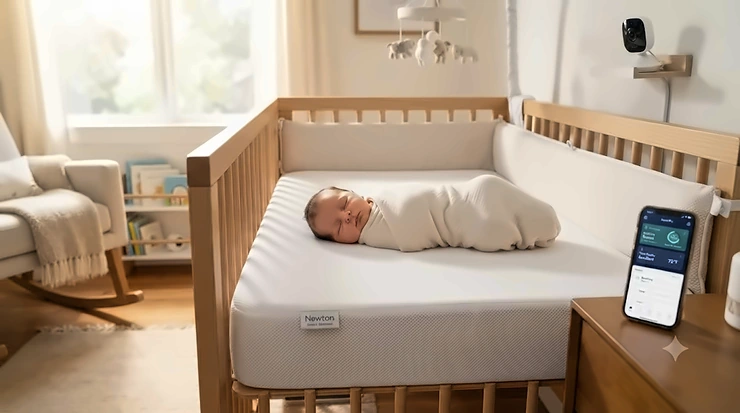
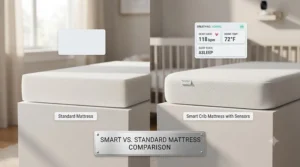
Somewhere around 2 a.m., every new parent has the same thought on loop: is the baby actually breathing right now, or am I just hoping? A smart crib mattress with sensors is a sleep surface or under-mattress pad built with embedded technology — motion sensors, pressure pads, or app-connected monitors — that tracks a baby’s movement, breathing patterns, or sleep cycles and alerts caregivers in real time. It doesn’t replace your eyes or your pediatrician, but it does turn a guessing game into something closer to actual data.
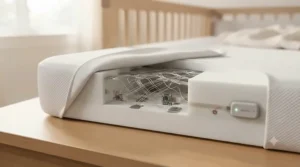
Here’s the thing nobody tells you at the baby shower: this category is a mess of overlapping products. Some are literal sensor pads that slide under whatever mattress you already own. Others are full smart bassinets with the sensor technology baked into the frame. A few are wearables that clip to a sock or a diaper instead of living under the sheet at all. We dug into real specs, aggregated review sentiment, and the safety guidance from pediatric authorities to sort out which options genuinely earn a spot in your nursery — and which are just expensive peace-of-mind theater dressed up in app icons.
Below, you’ll find seven real products spanning budget sensor pads to premium all-in-one smart cribs, a plain-English buying framework, and an honest look at what pediatric authorities actually say about monitoring tech (spoiler: it’s more nuanced than the marketing copy suggests). The CDC’s safe infant sleep guidance is unambiguous that back sleeping on a firm, flat surface stays the baseline regardless of what tech sits underneath — no sensor changes that rule, but the right one can genuinely make the newborn stretch less terrifying.
Quick Comparison Table
| Product | Sensor Type | Best For | Price Range |
|---|---|---|---|
| Cradlewise All-In-One Bassinet | Camera + motion, bounce response | Long-term all-in-one smart crib | $1,400-$2,000 range |
| SNOO Smart Sleeper Bassinet | Microphone cry-detection | Newborns 0-6 months, colicky sleepers | $1,600-$1,800 range |
| HALO BassiNest Connected 3.0 | Motion/sound AutoSoothe sensors | C-section recovery, bedside sleeping | mid-$400s to low-$500s |
| Owlet Dream Sock | Wearable pulse oximetry | Health-anxious parents wanting vitals data | around $300 |
| Babysense 7 | Under-mattress piezo pads | Budget-minded, no-WiFi households | $120-$160 range |
| Bebcare Breathing Sensor Mat | Under-mattress piezo mat | Existing Bebcare monitor owners | $100-$150 range |
| Sense-U Pro Baby Monitor | Diaper-clip motion sensor | Babies who reject socks or mattress pads | $99-$129 range |
Looking at the spread above, the real dividing line isn’t price — it’s philosophy. The under-mattress pads (Babysense, Bebcare) work with any crib mattress you already own, while the smart bassinets (Cradlewise, SNOO, HALO) sell you the whole sleep surface as one integrated system. Wearables like the Dream Sock and Sense-U Pro sidestep the mattress question entirely by putting the sensor on the baby instead of underneath them, which matters if you’ve already bought a crib and don’t want to replace it.
💬 Found a product that fits your family? Bookmark this table so you can compare specs side by side before you buy.
Top 7 Smart Crib Mattress and Sensor Systems: Expert Analysis
| Product | Key Spec | Approx. Price Range | Best For |
|---|---|---|---|
| Cradlewise All-In-One Bassinet | Bounce-response sensors, VOC-free mattress | $1,400-$2,000 | 2-year use span |
| SNOO Smart Sleeper Bassinet | Cry-detection microphone, swaddle lock | $1,600-$1,800 | Newborn sleep training |
| HALO BassiNest Connected 3.0 | AutoSoothe motion/sound sensors | mid-$400s-low-$500s | Bedside recovery |
| Owlet Dream Sock | FDA-cleared SpO2/pulse sensor | around $300 | Vitals monitoring |
| Babysense 7 | Dual under-mattress piezo pads | $120-$160 | No-WiFi households |
| Bebcare Breathing Sensor Mat | Piezoelectric breathing mat | $100-$150 | Ecosystem add-on |
| Sense-U Pro Baby Monitor | Diaper-clip movement sensor | $99-$129 | Sock-resistant babies |
A few patterns jump out once you line these up. Every premium option (Cradlewise, SNOO, HALO) bundles sensors into a full sleep environment rather than selling the sensor alone, which explains most of the price gap versus the standalone pads. Meanwhile, the three budget-to-mid options let you keep the crib mattress you’ve already researched and just add monitoring on top — a meaningfully different value proposition if you’re not in the market for new furniture.
1. Cradlewise All-In-One Bassinet — smart crib that grows with baby
The standout here is longevity: this is one of the few sensor-equipped sleep systems designed to last from newborn through early toddlerhood instead of aging out at six months. Cradlewise pairs a VOC-free mattress and waterproof cover with sensors that learn a baby’s sleep patterns and pick up early wake cues, triggering a gentle bounce to calm the baby before full-blown crying kicks in. In practice, that means fewer 3 a.m. sprints down the hallway, since the crib is doing some of the early-stage soothing before you’re even needed. Based on the spec comparison, this is the only bassinet-to-crib convertible in this roundup, which matters for parents who hate re-buying nursery furniture every few months. Reviewers consistently note that the mattress core is built from coconut coir and natural rubber latex rather than polyurethane foam, a detail that matters to parents avoiding synthetic foams near a newborn’s face. What most buyers overlook is that the free monitoring plan is time-limited — the crib includes two years of the Nurture Core subscription, and deeper analytics require a paid upgrade afterward.
Pros:
- ✅ Converts from bassinet to full crib for 24-month use
- ✅ Sensors detect early wake cues before full crying
- ✅ Mattress made without polyurethane foam
Cons:
- ❌ Nurture Core advanced analytics require a paid upgrade
- ❌ Cannot ship outside the contiguous United States
Cradlewise sits at the top of this list price-wise, in the $1,400-$2,000 range depending on current promotions, but the value case is strongest for parents who want one purchase to cover two full years instead of buying a bassinet and a separate crib.
2. SNOO Smart Sleeper Bassinet — most clinically studied cry-response bassinet
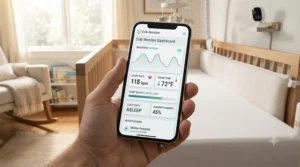
The standout feature is responsiveness: SNOO’s onboard microphone picks up crying and cues a robotic motor that rocks at increasing intensities in response, adjusting in real time rather than running a fixed program. Here’s what the spec sheet won’t tell you outright — the soothing only works if the included swaddle sack is clipped in correctly, since the swaddle’s tabs hook onto either side of the bassinet to keep the baby centered and on their back. That’s a meaningful setup step, not a plug-and-play feature. On the data side, the companion app logs day sleep, night sleep, total sleep, longest stretch, and number of wakings, giving parents genuine sleep-tracking value beyond the soothing motion itself. Aggregated review sentiment is mixed on cost versus benefit: independent testers have noted the bassinet emits measurable EMF, a factor not present in competing products, which some parents weigh seriously when deciding. Worth flagging honestly — availability has been inconsistent lately, with some retailers reporting manufacturer supply issues, so confirm current stock before counting on it for a due date.
Pros:
- ✅ Microphone-based cry detection responds within seconds
- ✅ Detailed nightly sleep-log data through the app
- ✅ FDA De Novo authorization as a safe-sleep bassinet
Cons:
- ❌ Only usable for roughly the first six months
- ❌ Recent supply and availability issues reported by retailers
At $1,600-$1,800 range when in stock, SNOO is the priciest short-term option on this list — you’re paying a premium for a narrow six-month window, which only pencils out if colic or short sleep stretches are a real problem in your house.
3. HALO BassiNest Connected Swivel Sleeper 3.0 — best for bedside c-section recovery
The standout advantage is physical access: the 360° swivel and patented lowering wall let a recovering parent reach the baby without bending or twisting, which is a genuinely different value proposition than the sensor tech alone. On the monitoring side, AutoSoothe technology automatically responds to a baby’s cry with a customizable mix of rocking, vibration, and calming sounds, and parents can toggle between hundreds of manual combinations or expert-designed presets for colic and weaning stages. What most buyers overlook is the mattress pad construction: it’s a foam-core pad with a 100% cotton fitted sheet, not the sensor-embedded surface some shoppers expect from “smart bassinet” branding — the sensing is sound- and motion-based from the frame, not pressure-based from inside the mattress. Reviewers who upgraded from HALO’s non-connected models describe the AutoSoothe response as a genuine step up in convenience during those brutal first six weeks. The bassinet carries a firm weight ceiling, useful context before you assume you’ll get a full year out of it.
Pros:
- ✅ 360° swivel plus lowering wall for bedside access
- ✅ AutoSoothe cry detection with expert-designed programs
- ✅ Breathable mesh sides for airflow and visibility
Cons:
- ❌ 20-pound weight limit ends use earlier than a crib
- ❌ Sensing is sound/motion-based, not an embedded mattress sensor
Typically listed in the mid-$400s to low-$500s range, the Connected 3.0 lands as the most accessible “smart bassinet” on this list, though it’s worth checking current pricing since HALO runs frequent promotions.
4. Owlet Dream Sock — only FDA-cleared vitals tracker in this lineup
The standout claim is regulatory: this was the first consumer baby monitor to receive FDA De Novo clearance as a Class II medical device, which is a meaningfully higher bar than the general-wellness labeling most nursery tech uses. Because it’s a wearable, the Dream Sock works alongside literally any crib mattress you already own — it tracks the baby, not the bed. Reviewers consistently report that the base station glows green when readings sit within normal range and flashes red with an alarm the moment oxygen or pulse drift outside preset zones, giving a clear visual cue instead of a confusing string of app notifications. Here’s what the spec sheet won’t tell you plainly: Owlet itself is explicit that the sock does not claim to prevent SIDS and functions as a monitoring tool rather than a diagnostic device, a distinction that matters enormously for how much reassurance to place in it. On the data side, its predictive sleep feature surfaces wake-window trends over time inside the free app, though deeper historical reports sit behind the optional Owlet360 subscription. Some parents flag occasional false alarms that can be startling in the middle of the night, a real tradeoff for medical-grade sensitivity.
Pros:
- ✅ FDA De Novo cleared for pulse rate and oxygen tracking
- ✅ Works with any crib mattress since it’s wearable
- ✅ No subscription required for core live readings
Cons:
- ❌ Occasional false alarms reported by users
- ❌ Full analytics history requires Owlet360 subscription
At around $300, the Dream Sock is a mid-tier investment that buys clinical-style monitoring without committing to an entirely new crib or bassinet purchase.
5. Babysense 7 — most trusted under-mattress movement pad
The standout feature is universality: this is a genuine under-the-mattress sensor system, meaning two ultra-sensitive pads slide beneath your existing crib mattress to track breathing micro-movements without ever touching the baby. What that means in practice is you keep whatever crib mattress you already bought and simply retrofit monitoring underneath it — no new furniture required. On the reliability side, aggregated review sentiment repeatedly praises the lack of WiFi dependency; the system runs on a private, closed-loop connection with no internet required, which effectively makes it hack-proof. Based on the spec comparison, the alarm threshold is specific and testable: an alert triggers if no movement is detected within 20 seconds, or if the movement rate slows below roughly 10 micro-movements per minute. One practical catch reviewers flag often — the sensor pads won’t read accurately through memory foam mattresses — so check your mattress type before buying. Babysense has been in the movement-monitor category since 1992, which gives it a longer track record than most app-connected newcomers.
Pros:
- ✅ Works underneath most existing crib mattresses
- ✅ No WiFi or internet connection required for alerts
- ✅ Clear, testable 20-second no-movement alarm threshold
Cons:
- ❌ Incompatible with memory foam mattresses
- ❌ No app-based sleep-trend history like camera-based options
In the $120-$160 range, Babysense 7 delivers genuine under-mattress sensor technology at roughly a third the cost of the smart bassinets on this list, making it the strongest budget pick if your crib mattress already fits its compatibility requirements.

6. Bebcare Breathing Sensor Mat — piezo sensor mat for any crib
The standout feature is sensor precision: three sensitive piezoelectric sensors per board are designed to detect abnormal breathing patterns and sound an alarm for pauses or irregularities, using the same underlying sensor science hospitals rely on for vital-sign monitoring, scaled down for home use. Practically speaking, the mat senses movement through the mattress using patented piezo-film technology with no direct skin contact, so there’s nothing to strap on or clip to a fussy newborn. What most buyers overlook is that this mat is designed as part of a broader ecosystem — it connects to Bebcare’s wider monitor lineup, including its WiFi HD camera, video monitor, and audio monitor units — so the mat alone is really the sensor layer of a larger system rather than a standalone gadget. That’s worth knowing before you buy, since getting full functionality may mean pairing it with one of those companion units rather than using the mat in isolation. Honest framing here: independent, large-sample review data on this specific mat is thinner than on Babysense or Owlet, so treat manufacturer claims with a bit more scrutiny until broader third-party testing catches up.
Pros:
- ✅ Uses hospital-style piezoelectric breathing detection
- ✅ No skin contact required, senses through the mattress
- ✅ Compatible with multiple Bebcare monitor models
Cons:
- ❌ Best functionality requires a separate Bebcare monitor unit
- ❌ Limited independent long-term review data available
Priced around $100-$150, the Bebcare mat is a reasonable mid-budget entry, particularly for households already invested in or considering the wider Bebcare monitor ecosystem.
7. Sense-U Pro Baby Monitor — budget pick for sock-resistant babies
The standout advantage is fit tolerance: instead of a sock some babies kick off within minutes, this monitor clips directly onto the diaper and tracks breathing movement, rollover position, and skin temperature. That single design choice solves a real, common complaint about wearable monitors — compliance. A baby who won’t keep a sock on all night generates zero useful data, no matter how good the sensor inside it is. On practicality, this is meaningfully cheaper than Owlet’s sock while still tracking multiple data points instead of just movement alone, which is a solid value trade for budget-conscious parents who still want more than a basic pad. Here’s what the spec sheet doesn’t emphasize: it lacks FDA clearance, unlike the Dream Sock, so treat its readings as general wellness data rather than medical-grade monitoring. Reviewers who switched from sock-style monitors report fewer nighttime false-alarm wakeups tied to a sock slipping off, since a diaper clip has less room to migrate during sleep.
Pros:
- ✅ Clips to diaper instead of a sock for better compliance
- ✅ Tracks breathing, rollover position, and skin temperature
- ✅ Notably cheaper than FDA-cleared wearable alternatives
Cons:
- ❌ Not FDA-cleared, unlike the Owlet Dream Sock
- ❌ Rollover detection can’t fully replace back-sleeping habits
At $99-$129, the Sense-U Pro is the most budget-friendly wearable in this roundup, best suited to parents who tried a sock monitor and struck out on baby compliance.
Practical Usage Guide: Setting Up a Sleep Monitoring Crib Mattress System
Getting a sleep monitoring crib mattress system right on night one saves a lot of 2 a.m. troubleshooting later. Start by confirming mattress compatibility before you buy anything — under-mattress pads like Babysense specifically won’t read accurately through memory foam, so check your existing mattress core material first. Once the sensor is placed, do a test run during a daytime nap rather than debuting it overnight, so you can confirm the app or base station is actually picking up readings while you’re alert enough to troubleshoot.
For the first 30 days, resist the urge to check the app every ten minutes — most false-alarm complaints in aggregated reviews trace back to loose sensor placement or low battery, not an actual baby emergency, and constant re-checking mostly just erodes your own sleep. Set a maintenance reminder to wipe down sensor pads and swap wearable socks or clips weekly, since lint and spit-up buildup are common causes of degraded readings. Finally, keep firmware and app updates current; several manufacturers push meaningful accuracy improvements through software rather than hardware swaps.
✨ Ready to set up your nursery? Compare the full lineup above and pick the system that matches your crib mattress before your next 2 a.m. check-in.
Real-World Scenarios: Matching a Baby Sleep Tracker Mattress to Your Family
Consider three different households shopping this exact category. A first-time parent living in a 600-square-foot apartment with a newborn who startles awake from every sound is probably best served by SNOO or Cradlewise — the active soothing response, not just monitoring, does the heavy lifting overnight in a space where you can’t always get to the crib in ten seconds. A budget-conscious family who already owns a solid innerspring crib mattress and just wants breathing-pattern peace of mind is the textbook Babysense 7 or Bebcare Breathing Sensor Mat buyer — no new furniture, just a retrofit sensor layer underneath what they’ve already got.
Then there’s the family with a NICU graduate or a baby flagged for closer vitals monitoring by their pediatrician, where a baby sleep tracker mattress alone isn’t enough — that’s where the Owlet Dream Sock’s FDA-cleared pulse and oxygen tracking earns its higher price tag, since it’s measuring actual physiological data rather than inferring status from movement alone. None of these scenarios is objectively “right” — they’re matched to real constraints: apartment size, existing mattress investment, and medical risk level.
Problem → Solution: Fixing Common Infant Sleep Technology Headaches
False alarms topping the complaint list? Reposition the sensor pad or sock according to the manufacturer’s placement guide — most brands report that a majority of “false” alerts are actually fit or positioning issues, not genuine device failure. WiFi dropouts interrupting monitoring? Under-mattress pads like Babysense sidestep this entirely since they run without an internet connection, which is worth switching to if a shaky home network keeps breaking your camera-based monitor’s feed.
Baby refusing to keep a wearable on? Swap to a diaper-clip design like Sense-U Pro instead of fighting a sock every night — compliance beats sensor sophistication if the device isn’t actually staying on the baby. Worried the crib mattress itself is too soft for a sensor pad to read accurately? Confirm it meets a firm, non-indenting standard first, since a too-soft surface undermines both sensor accuracy and basic safe-sleep guidance. Overwhelmed by app notifications? Most systems let you narrow alerts to critical thresholds only, cutting nuisance pings without losing real safety coverage.
How to Choose a Smart Crib Mattress With Sensors
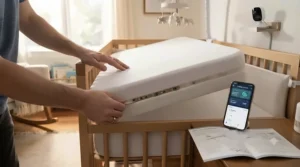
- Confirm mattress compatibility first. Check your current mattress core material, since piezo pads often can’t read through memory foam accurately.
- Decide between retrofit and all-in-one. A sensor pad works with any crib; a smart bassinet replaces the whole sleep surface.
- Weigh wearable versus embedded sensing. Wearables track the baby directly and travel anywhere; embedded sensors stay with the crib.
- Check for FDA clearance if vitals matter to you. Only pulse-oximetry devices like the Dream Sock currently carry that distinction in this category.
- Test the alert threshold logic. Look for a specific, published trigger point (like a 20-second no-movement window) rather than vague “smart alerts” language.
- Factor in subscription costs. Several systems bundle free monitoring for a year or two, then require a paid tier for full analytics.
- Read the safety fine print. Confirm the base mattress or bassinet itself meets current CPSC crib safety standards, independent of any added sensor tech.
Common Mistakes When Buying a Health Monitoring Mattress
The most frequent mistake buyers make is assuming any device labeled “smart” is a substitute for basic safe-sleep practices. It isn’t, and pediatric guidance from HealthyChildren.org is unambiguous on this point: babies belong in a crib, bassinet, portable crib, or play yard that meets Consumer Product Safety Commission standards, fitted with a mattress designed for that specific product and nothing more than a tight sheet — no monitor changes that baseline. A second common error is buying a sensor pad without checking mattress material compatibility, then blaming the device for inaccurate readings that were actually a memory-foam incompatibility issue from the start.
Third, plenty of parents underestimate ongoing subscription costs, only to discover the “free” year of analytics they loved is now a recurring monthly charge. Fourth, some buyers assume wearables and embedded sensors are interchangeable, when in reality a sock tracks a baby’s actual vitals while an under-mattress pad only infers status from movement — different data, different confidence levels. Finally, don’t skip the return-window fine print; premium bassinets often carry restocking fees, so read the return policy before your baby’s due date, not after a rough first week convinces you to send it back.
Smart Crib Mattress With Sensors vs Traditional Baby Monitors
| Factor | Sensor-Equipped Systems | Traditional Video/Audio Monitors |
|---|---|---|
| Data provided | Breathing, movement, or vitals | Live video and sound only |
| Alert type | Threshold-based (movement/vitals) | Manual — parent must be watching |
| Mattress interaction | Under-mattress or embedded sensing | None; camera-based only |
| Typical price | $100-$2,000 depending on tier | $50-$300 typically |
A traditional video monitor tells you what’s happening; a sensor-equipped system tells you when something might need attention, even if you’re not staring at the screen. The tradeoff is cost and complexity — a basic audio-video monitor is cheaper and simpler, but it puts the entire monitoring burden on a parent who has to keep checking in, whereas sensor-based systems do at least some of that watching automatically. For many families, the ideal setup pairs a basic camera for reassurance with one sensor layer (wearable or under-mattress) for data, rather than relying on either category alone.
💬 Not sure which category fits your budget? Scroll back to the comparison table above and match your must-haves to a product.
What to Expect: Real-World Performance of Data Tracking Crib Mattress Systems
On paper, sensor specs look reassuring — 20-second alert windows, FDA clearance, hospital-grade piezo sensors. In practice, most parents describe a two-week adjustment period where false alerts are more common simply because they haven’t yet dialed in sensor placement or sock fit. Reviewers across the products in this roundup consistently mention that accuracy improves noticeably once placement is optimized, which is a maintenance issue more than a design flaw.
Battery life and connectivity also play out differently than the spec sheet implies. WiFi-dependent camera systems tend to generate more nuisance alerts during router hiccups than the closed-loop pads that skip the internet entirely. And subscription-gated analytics mean the “smart” insights you saw in a product demo may not match what you get on the free tier at 3 a.m. six months in — read the fine print on what’s included long-term, not just during the trial window.
Safety, Regulations and Compliance Guide
This is the section where honesty matters most. Pediatric authorities are consistent and specific here: the American Academy of Pediatrics specifically advises against home cardiorespiratory monitors and special crib mattresses marketed as SIDS prevention, noting that none have been shown to reduce SIDS risk and that some introduce their own hazards, including false alarms that can cause a real issue to be missed. That guidance applies broadly across this category, not to any single product — sensors are a monitoring convenience, not a proven prevention tool.
What the AAP does recommend, regardless of what technology sits under or on the mattress, is unchanged: back sleeping, a firm and flat surface, and a bare crib with nothing but a fitted sheet. On the regulatory side, it’s worth noting the meaningful gap between products: the FDA’s own De Novo classification order for the Dream Sock authorizes it specifically as a Class II infant pulse rate and oxygen saturation monitor for over-the-counter home use, a formal clearance most competitors in this space simply don’t hold. That doesn’t make FDA-cleared devices infallible, but it does mean their accuracy claims went through a documented regulatory review rather than marketing self-certification alone.
Before buying any product in this category, confirm it hasn’t been recalled by checking the current Consumer Product Safety Commission database, and always prioritize a mattress that fits the crib snugly with no gaps, since that fit issue causes more real infant injuries annually than any monitoring gap ever could.
Long-Term Cost and Maintenance of Sleep Monitoring Crib Mattress Systems
Sticker price is only part of the equation here. Premium smart bassinets like Cradlewise bundle a year or two of free analytics, after which ongoing subscription tiers typically run somewhere in the $10-$20 monthly range for advanced features — multiply that out over a year and it meaningfully narrows the gap versus a one-time-purchase wearable like the Dream Sock, which requires no subscription for core alerts. Under-mattress pads carry the lowest total cost of ownership by far: aside from occasional AA batteries, there’s essentially no recurring expense once you’ve bought the pad itself.
Replacement parts matter too. Wearable socks and clips wear out faster than rigid pads since they’re washed and stretched nightly, so budget for periodic replacement fabric sensors every several months. Smart bassinets, by contrast, are a larger upfront cost but often resell reasonably well given the brand recognition in this space, which can offset some of that premium price tag if you sell once your baby outgrows it.
| Product Tier | Typical Price Range | Ongoing Cost | Best Value For |
|---|---|---|---|
| Under-mattress pads | $100-$160 | Batteries only | Lowest total cost of ownership |
| Wearables | $99-$300 | Optional subscription, occasional replacement fabric | Mobile, no-subscription monitoring |
| Smart bassinets | $450-$2,000 | Free period, then $10-$20/month typically | All-in-one, longer-term use |
Interpreting that table honestly: the wearables and pads punch well above their price class on cost-per-month-of-use, while the smart bassinets justify their premium mainly through the soothing and convenience features layered on top of the sensor tech, not the sensor tech alone.
Smart Nursery Bedding: Building Out the Complete Sleep Setup
A sensor or smart bassinet is only one piece of the smart nursery bedding puzzle. Pair it with a fitted sheet sized correctly for your specific mattress — a loose sheet is a genuine suffocation hazard regardless of how advanced the sensor underneath it is. Skip bumper pads, loose blankets, and positioners entirely; they’re not compatible with safe-sleep guidance no matter how “breathable” the marketing claims, and several are now federally restricted for infant sleep use.
If you’re building a full smart nursery setup, sequence your purchases: get the crib and mattress right first, confirm CPSC compliance and firm fit, then layer in sensor technology second. Buying the flashiest sensor system before locking down the basic safe-sleep fundamentals is backwards, and it’s a mistake this category’s marketing quietly encourages by leading with app screenshots instead of mattress specs.
Infant Sleep Technology for NICU Grads, Preemies and Higher-Risk Sleepers
Families coming home from a NICU stay, or with a pediatrician-flagged risk factor, are the clearest case for prioritizing FDA-cleared vitals monitoring over movement-inference alone. In this scenario, the Owlet Dream Sock’s actual pulse-and-oxygen data carries more clinical weight than a piezo pad inferring status from mattress vibration, since it’s measuring the baby directly rather than the surface beneath them. That said, no consumer device — cleared or not — substitutes for the monitoring plan your baby’s care team sets up; treat any home sensor as a supplement to medical guidance, never a replacement for it.
For preemies specifically, skin sensitivity and smaller limb circumference matter for wearable fit — check sizing charts closely, since an ill-fitting sock or clip generates more false alarms precisely in the population that can least afford monitoring gaps. Under-mattress pads remain a reasonable secondary layer here too, since they add movement data without requiring anything touch a preemie’s more delicate skin at all.
Frequently Asked Questions
❓ Does a smart crib mattress with sensors prevent SIDS?
❓ Can I use a sensor pad with a memory foam crib mattress?
❓ Is the Owlet Dream Sock better than an under-mattress pad?
❓ How long can I use a smart bassinet like SNOO or HALO?
❓ Do smart crib mattress sensors require WiFi to work?
Conclusion
There’s no single best smart crib mattress with sensors for every family — there’s only the right fit for your mattress situation, your budget, and how much medical-grade data you actually need versus want. If you already own a solid crib mattress, a retrofit pad like Babysense 7 gets you real monitoring without replacing furniture. If you’re starting from scratch and want soothing built in, Cradlewise or SNOO earn their premium price tags through active response, not just passive tracking. And if a pediatrician has flagged a genuine health concern, the FDA-cleared Owlet Dream Sock is worth the investment over inference-only alternatives.
Whichever direction you go, keep the fundamentals in view: a firm, snug-fitting mattress and a bare crib remain the proven foundation, with sensor technology layered on top as a convenience, not a substitute. Sleep deprivation makes every decision feel higher-stakes than it is at 3 a.m. — a little real research now, done in daylight, saves a lot of second-guessing later.
✨ Don’t Miss These Exclusive Deals!
🔍 Take your nursery setup to the next level with these carefully selected sensor-equipped picks. Click on any highlighted item above to check current pricing and availability, and give your family the calmer, better-informed nights everyone deserves.
Recommended for You
- Lockable Caster Crib: 7 Secure Rolling Picks for 2026
- Rolling Crib With Locking Wheels: 7 Best Options for 2026
- 7 Best Convertible Toddler Bed From Crib Picks That Won’t Let You Down (2026)
Disclaimer: This article contains affiliate links. As an Amazon Associate, I earn from qualifying purchases. If you purchase products through these links, we may earn a small commission at no additional cost to you.
✨ Found this helpful? Share it with your friends! 💬🤗
