In This Article
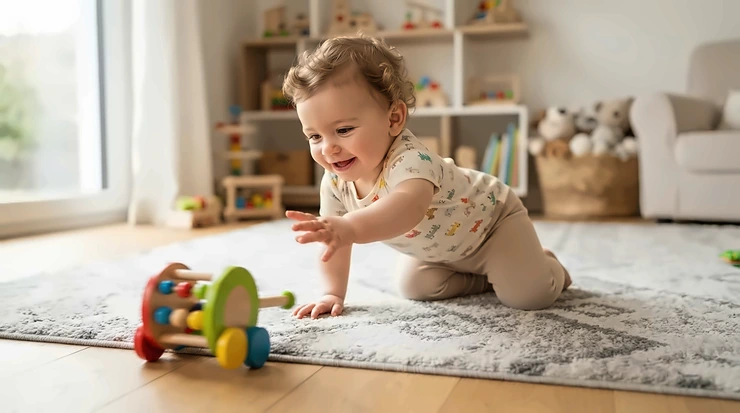
Motor skills toys for babies learning to crawl are developmentally designed playthings, such as mirrors, plush props, activity gyms, water mats, and motorized chase toys. They give infants a reason to lift their heads, push through their arms, and eventually travel across the floor. They turn strength-building into play and bridge the gap between tummy time and that first wobbly scoot.
Here’s what most parents discover around month three: crawling isn’t one skill. It’s a stack. Neck control, shoulder stability, trunk strength, weight shifting, hand-eye tracking, and the plain old desire to go somewhere. A good crawling encouragement toy for infants trains several layers of that stack at once. A bad one just rattles in the corner.
The baseline pediatric advice is refreshingly simple. The American Academy of Pediatrics recommends two to three short tummy time sessions a day, about three to five minutes each, with you or a toy within reach, then more time as your baby shows they enjoy it. Toys are how you stretch that window from “ugh” to “okay, five more minutes.”
A quick note on method. This guide rests on spec sheets, manufacturer details, and aggregated review sentiment from retail listings and editorial roundups, researched in 2026. It is not hands-on testing, so treat it as a research briefing rather than a lab report. Prices appear as ranges because they move constantly.
Quick Comparison: 7 Picks at a Glance
Every product below earns its spot at a different point on the road to crawling. Start with this snapshot, then jump to the deep dives.
| Product | Best For | Baby Stage | Price Range |
|---|---|---|---|
| Skip Hop Explore & More Follow-Bee Crawl Toy | Growing with your baby | Pre-crawler to confident crawler | Roughly $25-$35 |
| Fisher-Price Linkimals Sit-to-Crawl Sea Turtle | Chase-motivated sitters | 9 months and up (manufacturer label) | Roughly $35-$75, varies by retailer |
| Lamaze Freddie the Firefly Gym | Newborn-to-sitter floor play | Birth through sitting | Mid-range; check current price |
| Splashin’kids Inflatable Tummy Time Water Mat | Babies who protest the floor | About 3 months and up | Under $25 |
| Fisher-Price Flap & Wobble Penguin | Gentle early rewards | Newborn to early sitter | Up to around $50; compare sellers |
| Bright Starts Sit & See Safari Floor Mirror | Budget head-lifting motivation | Tummy time to sit-and-play | Budget tier; check current price |
| Nuby Animal Adventures Tummy Time Pillow with Baby Mirror | Chest support on a budget | Newborn tummy time | Budget tier; check current price |
The Skip Hop Follow-Bee is the broadest-stage pick, stretching from pre-crawling rattle play to confident chasing. The Linkimals Sea Turtle suits babies who already sit steadily and are ready to pursue a moving target. If your baby is under four months, or flat-out refuses the floor, the Splashin’kids water mat and the Lamaze Firefly Gym will do more good than any motorized toy. Budget shoppers should note that the Bright Starts Sit & See mirror and the Nuby Animal Adventures pillow deliver real head-lifting motivation for the smallest outlay, though neither will ever chase your baby across the room.
💬 Just one click — help others make better buying decisions too!😊
Top 7 Motor Skills Toys for Babies Learning to Crawl: Expert Analysis
Each pick below gets the same treatment: what the specs mean in practice, who it suits, and what aggregated reviewers say.
1. Skip Hop Explore & More Follow-Bee Crawl Toy — grows through three crawl stages
The big idea is that one toy changes jobs as your baby does, which is rare in a category full of single-trick gadgets. In stage one, the removable bee is a weighted rattle that wobbles but rights itself, ideal for a pre-crawler learning to grab and shake. In stage two, the cloud base circles close to home, so a brand-new crawler doesn’t have to chase it across the house. In stage three, it wanders randomly and forces real steering decisions. An obstacle sensor keeps it from bulldozing furniture, and lights and music reward every lunge.
Based on the spec comparison, this is the closest thing in the lineup to a pre-crawling development toy that scales. The catch is the floor. The manufacturer notes it works best on smooth, hard surfaces or a foam mat and may move slowly on low-pile carpet.
Reviewers consistently describe babies chasing the bee eagerly and staying interested across stages. Recurring complaints include uneven movement, a few reports of units that wouldn’t move at all, one parent whose baby found the music and lights startling, and one mention of small hands getting pinched underneath. Ratings hovered between roughly 4 and 4.5 out of 5 on the retail listings checked.
Pros:
- ✅ Three play stages extend its useful life
- ✅ Obstacle sensor and lights reward chasing
- ✅ Detachable bee doubles as a rattle
Cons:
- ❌ Slower and less reliable on thick carpet
- ❌ Some reports of inconsistent movement
Expect the roughly $25-$35 range at list, so check current price. Verdict: strong value on hard floors, shakier on plush carpet.
2. Fisher-Price Linkimals Sit-to-Crawl Sea Turtle — rolls ahead to spark crawl-and-chase
Where the Skip Hop Follow-Bee wanders, this turtle launches. Press the light-up button and, per one editorial review, it rolls forward roughly 3.5 feet. That is close to the “just out of reach” distance pediatric advice keeps recommending: near enough to feel winnable, far enough to demand effort. A kickstand flips it into sit-and-play mode, where it stays parked while babies explore soft flippers and a clicking head. Model GTK08 runs on three AA batteries and carries 35-plus songs, sounds, and phrases about letters, counting, and shapes. It is labeled for 9 months and up.
On paper, this is a crawling encouragement toy for infants who already sit steadily and eye the horizon, not a newborn plaything. The launch is button-driven, so you control the pace, which is predictable but less surprising than a self-steering toy. The same editorial reviewer noted the wheels spin loudly even in stationary mode, which matters if naps are fragile.
One major retailer listing showed roughly 4.4 out of 5 across about 85 ratings. Parents described it as a handy lure for both crawling and tummy time. Several of the most glowing reviews there were flagged as incentivized, so weigh them accordingly.
Pros:
- ✅ Rolls about 3.5 feet per press
- ✅ Kickstand creates two play modes
- ✅ Links with other Linkimals toys
Cons:
- ❌ Loud wheels even when parked
- ❌ Needs a button press for every chase
Listings spanned a wide range, from the mid-$30s to around $75 depending on retailer, so compare before buying. Verdict: worth it at the lower end, hard to justify at the top.
3. Lamaze Freddie the Firefly Gym — newborn-ready mirror and tummy pillow
Before a baby can chase anything, they need shoulders that lift off the floor, and this gym is built for that earlier chapter. It combines a padded mat with an arch holding three detachable hanging toys. Add a large discovery mirror, a crinkly butterfly, a soft apple teether, and a curved 2-in-1 pillow that props the chest during tummy time and supports sitting later. One listing gives the dimensions as 46 x 78 x 78 cm, or roughly 18 by 31 by 31 inches.
In practice, the dangling toys invite overhead reaching on the back, which trains shoulder and arm control. On the belly, the pillow and mirror give a reason to lift the head and press through the forearms. That makes it a textbook pre-crawling development toy and a useful tummy time toy to encourage crawling readiness months before wheels matter. The trade-off is that nothing moves on its own, so plan on adding a chase toy later.
Independent review data was thin in the sources checked. The main write-up found was a gifted-product review praising the bold colors, the mirror, and the way the gym grows from newborn lounging to sit-up play. One favorable voice isn’t a consensus, so treat the reputation as promising but unverified and read current listings.
Pros:
- ✅ Mirror and pillow motivate head lifting
- ✅ Works from newborn through sitting
- ✅ Detachable toys add reaching practice
Cons:
- ❌ Takes up considerable floor space
- ❌ No motion to chase later on
It sits in the mid-range activity-gym tier, so check current price. Verdict: excellent for the first six months, but supplement it later.
4. Splashin’kids Inflatable Tummy Time Water Mat — makes fussy floor time almost fun
Some babies treat tummy time like a personal insult. This mat negotiates a peace treaty with water. An inflatable ring forms the border, and one reviewer said no pump was needed. A water-filled center holds six floating foam sea creatures that drift when little hands slap the surface. It is labeled for roughly 3 months and up, measures about 26 by 20 inches per that reviewer, and uses heavy-duty PVC.
Floating toys keep moving, so your baby tracks, reaches, and shifts weight to chase them. Each reach loads one shoulder and the trunk, which is quiet work for core strength in infants. It won’t launch a crawl by itself. It buys you extra minutes on the belly, and minutes are the currency here. One practical note: a reviewer flagged mold risk if the mat is folded while still wet, so air-dry it fully. Never leave a baby alone on any water mat.
Baby Bargains, which says it tested 20-plus tummy time mats without taking brand money, picked it as its best water mat. One parenting roundup reported more than 26,000 five-star Amazon ratings. A parent reviewer noted no air or water leaks after a few months of rough handling.
Pros:
- ✅ Floating toys hold attention longer
- ✅ Quick, pump-free setup
- ✅ Folds up for travel
Cons:
- ❌ Needs thorough drying after every use
- ❌ Requires constant adult supervision
Expect it under about $25. Verdict: the best value for babies who resist the floor.
5. Fisher-Price Flap & Wobble Penguin — gentle first tummy-time reward
Think of this one as the opening act. The plush penguin (model HNC10) answers a baby’s touch with wing-flapping and music. It offers two music modes with up to 10 minutes of sound, and it wears high-contrast black-and-white patterns with crinkly feet. Its round, wobbly base also lets older babies sit and bat it for more action.
Touch-activated toys teach cause and effect: push, get a reward. That motivates the forearm pressing and hand reaching that underpin later crawling. High-contrast patterns suit very young eyes, so this toy pays off earliest, as a tummy time toy to encourage crawling readiness rather than crawling itself. Once your baby moves under their own steam, it becomes a floor-side companion rather than a lure.
Ratings sat around 4.6 to 4.7 out of 5 on the retailer listings checked. Review counts were small, in the dozens rather than thousands, so the sample is limited.
Pros:
- ✅ Touch rewards teach cause and effect
- ✅ High-contrast patterns suit newborn eyes
- ✅ Wobble base grows into sit-and-bat play
Cons:
- ❌ Limited appeal once crawling begins
- ❌ Pricing varies widely by seller
Listings ran up to around $50 in places, so compare sellers. Verdict: a lovely starter, but don’t pay premium prices.
6. Bright Starts Sit & See Safari Floor Mirror — foldable head-lifting motivator
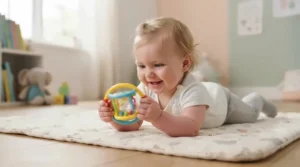
The lowest-tech toy on this list may be the most universally effective, because nothing holds a baby’s attention like a face, especially their own. This floor mirror pairs a large baby-safe reflective panel with crinkly leaves and colorful fabric details. It folds flat for storage and travel and works for tummy time or later sit-and-play. Mother & Baby’s editors named it their best baby mirror in a tummy time toy roundup.
A mirror at eye level turns “lift your head” from a chore into a reflex. Babies who stall in the fussy phase often tolerate longer sessions with a reflection to study, and the same panel later becomes a destination to crawl toward. Park it across the room while a chase toy does the luring.
Unlike the other picks, no meaningful pool of buyer reviews turned up in the sources checked. The evidence here is the editorial endorsement plus the simplicity of the design, so read current listings before buying.
Pros:
- ✅ Reflection motivates sustained head lifting
- ✅ Folds flat for storage and travel
- ✅ Simple fabric-and-mirror design, nothing overstimulating
Cons:
- ❌ No motion or sound to chase
- ❌ Appeal fades once babies are mobile
It sits in the budget tier, so check current price. Verdict: the smallest spend with the biggest first-month payoff.
7. Nuby Animal Adventures Tummy Time Pillow with Baby Mirror — budget chest support that entertains
A rolled towel under the chest is the old-school tummy time hack. This is the toy-store version. The plush pillow cradles a baby’s chest while a mirror, crinkle koala ears, a rattling parrot, and a teether ring supply reasons to stay put. It is compact enough to toss in a diaper bag.
Propping the chest reduces the effort of lifting the head, which helps newer babies who tire in seconds. The dangling gadgets give both hands something to reach for. It is a gentle on-ramp for building core strength in infants, and an easy way to stretch AAP-style three-to-five-minute sessions a little longer. Supervision remains essential, because a pillow is never a license to step away.
A UK deal tracker reported about 4.7 out of 5 across more than 2,500 reviews on the Amazon UK listing. The US listing may differ, so verify it.
Pros:
- ✅ Chest support eases early tummy time
- ✅ Mirror, rattle, and teether in one
- ✅ Small enough to travel
Cons:
- ❌ Offers no motion for crawl-chasing
- ❌ Outgrown once baby pushes up confidently
UK listings ran roughly £10-£15, so expect a budget-tier price in the US and check current price. Verdict: the cheapest way to make early tummy time less miserable.
Top 7 Specs and Review Snapshot
| Product | Power | Motion | Age Focus | Review Snapshot |
|---|---|---|---|---|
| Skip Hop Follow-Bee | Battery-powered | Self-moving base | Pre-crawler to advanced crawler | Roughly 4-4.5/5 on retail listings |
| Linkimals Sea Turtle | 3 AA batteries | Press-and-go, about 3.5 ft | 9 months and up | About 4.4/5 on one listing, around 85 ratings |
| Lamaze Firefly Gym | No motor | Static | Birth and up | Limited verified reviews |
| Splashin’kids water mat | Air and water | Floating toys | About 3 months and up | Independent-tester pick; large five-star volume reported |
| Flap & Wobble Penguin | Battery-powered plush | Flaps on touch | Birth and up | About 4.6-4.7/5, small samples |
| Bright Starts Sit & See mirror | None | Static | Tummy time to sit-and-play | Editorial “best mirror” pick |
| Nuby Animal Adventures pillow | None | Static | Birth and up | About 4.7/5 on UK Amazon, 2,500+ reviews |
Only the Skip Hop Follow-Bee and the Linkimals Sea Turtle move on their own, so they alone can truly train chasing. The other five are floor-time engines that build the strength crawling depends on. Review depth is uneven across the group, with the Nuby Animal Adventures pillow and the Splashin’kids water mat backed by the largest pools, so weigh each rating against its sample size.
Practical Usage Guide: Setting Up Crawl-Ready Play Sessions
Great toys fail in bad setups. Start with the surface. A firm floor or foam mat gives motorized toys like the Skip Hop Follow-Bee traction, and it gives your baby a stable base to push against. Clear a lane of roughly six feet, free of cords and clutter.
Next, timing. Short and frequent beats long and tearful. Try a few minutes after a diaper change or a nap, when babies tend to be alert, then extend as they show enjoyment. Get down at eye level, because your face is the best toy in the house, then introduce the product.
Placement does the real work. Pediatric advice repeated across parenting sources is to set a toy slightly out of reach, so the baby must stretch, pivot, or push to get it. Park the Bright Starts Sit & See mirror across the mat as a destination, or trigger the Linkimals Sea Turtle so it rolls to a stop just beyond fingertips.
Rotate toys every few days, because novelty is half of motivation. Limit time in swings, bouncers, and other containers, which restrict the free movement crawling depends on.
Common mistakes in the first 30 days:
- Running sessions until the meltdown
- Stacking too many lights and sounds at once
- Placing the toy so far away it feels impossible
- Forgetting that thick carpet makes movement harder for both baby and toy
Real-World Scenarios: Matching Toys to Your Baby
Specs only matter when they meet a real living room. Here are three profiles, each with a budget, a floor type, and a frequency.
The small-apartment parent with a 3-month-old who hates tummy time. Hard floors, a budget under about $50, and brief sessions several times a day. The Splashin’kids water mat earns its place here, since floating toys extend each session. Add the Bright Starts Sit & See mirror as a second, nearly free motivator. Skip motorized toys for now, because the baby can’t use them yet.
The hardwood-floor household with a 7-month-old who sits but stays put. A mid-range budget, daily play. This baby has the strength but lacks a reason to move. The Skip Hop Follow-Bee, set to its close-circling stage, offers a low-pressure lure that stays nearby. Pair it with a foam mat if the floors are slippery for hands and knees.
The carpeted home with a 9-month-old who gets frustrated being stuck. A higher budget, play several times daily. The Linkimals Sea Turtle suits a baby who sits well and wants a target. Rolling toys generally travel less on plush carpet, so foam tiles create a smoother lane. Keep the mirror or the Lamaze Firefly Gym around as a lower-stimulation option for calmer moments.
Problem → Solution Guide: Common Crawling Roadblocks
Problem: Your baby hates tummy time. Start with shorter bursts, and try lying on your back with the baby on your chest, a position the AAP suggests. Move to the Nuby Animal Adventures pillow or the Lamaze Firefly Gym pillow for chest support, then add a mirror.
Problem: Your baby ignores the toys. Distance and novelty are usually the culprits. Place the toy just out of reach and rotate it out for a few days. The Skip Hop Follow-Bee in its stage-two circling mode brings the lure to the baby.
Problem: A rolling toy stalls on carpet. Move play to a hard floor or foam mat. The manufacturer says the Skip Hop Follow-Bee may run slower on low-pile carpet.
Problem: Your baby scoots, rolls, or bottom-shuffles instead of crawling. That is common variation. Pediatric summaries note that crawling no longer appears on the CDC’s revised checklists, which were redesigned to clarify when to act early rather than wait and see, according to the American Academy of Family Physicians. If you’re concerned about overall movement, ask your pediatrician rather than relying on any toy.
How to Choose Motor Skills Toys for Babies Learning to Crawl
Choosing motor skills toys for babies learning to crawl comes down to matching the toy to your baby’s current stage, not the age printed on the box. Work through these steps:
- Name the stage. Is your baby lying down, pushing up on forearms, sitting, or already scooting? Each stage needs a different toy.
- Check your floors. Motorized toys prefer hard surfaces or foam mats, so choose static toys if you’re carpeted.
- Match motion to ability. Under about five months, mirrors, gyms, and pillows beat anything that moves. Self-moving toys suit babies who sit and track.
- Favor progression. Settings that change as skills grow, like the staged modes on the Skip Hop Follow-Bee, stretch your money.
- Mind the sensory load. Bright lights and loud music can overwhelm some babies, so prefer toys with calmer modes.
- Verify safety and cleanability. Secured battery compartments, no small detachable parts, and surfaces you can wipe or dry.
Crawling Toys vs Traditional Floor Play and Baby Containers
Crawling toys aren’t the only route to a mobile baby. Plain floor play and parent-led games have worked for generations. The real question is what each option adds.
| Option | Motivation to Move | Strength Payoff | Cost | Best For |
|---|---|---|---|---|
| Dedicated crawling toys such as the Linkimals Sea Turtle | High, because the toy moves | Strong, from chasing and steering | Moderate | Sitters who need a target |
| Gyms and mirrors such as the Lamaze Firefly Gym | Moderate | Good for neck, shoulder, and arms | Low to moderate | Newborns to early sitters |
| Household objects and parent-led play | Variable | Good, with creativity | Free | Budget-conscious families |
| Baby containers (swings, bouncers) | Low | Limited, since movement is restricted | Moderate | Short, supervised breaks |
The pattern is clear: toys that move, or that make the baby move, create the most motivation, while containers create the least. A parent crawling just ahead of the baby is free and effective, but toys keep the game going when you need a breather. Use containers sparingly, since sources note that too much time in them can limit the free movement crawling needs.
Features That Actually Matter (And Those That Don’t)
What matters:
- Predictable movement. A toy that behaves consistently teaches cause and effect. Erratic motion, which some reviewers reported with the Skip Hop Follow-Bee, frustrates both baby and parent.
- Stage flexibility. Kickstands, settings, and detachable pieces extend the useful window.
- Surface compatibility. The best features mean nothing if the toy can’t move on your floor.
- Reflective or high-contrast surfaces. They hold young attention far better than a long song list.
What doesn’t:
- Educational song libraries. A 7-month-old won’t absorb the alphabet and counting phrases on the Linkimals Sea Turtle. Enjoy them as a bonus, not a reason to buy.
- Brand ecosystems. Linking features are fun, but they won’t move your baby forward.
- Elaborate themes. A plain mirror often outperforms a fancy character.
Good marketing sells features. Good toys sell movement. When in doubt, ask: “Will this make my baby reach, push, lift, or chase?” If not, it’s decoration.
Crawling Milestones: What to Expect and When
Crawling milestones vary enormously, so treat any timeline as a range, not a deadline. MedlinePlus lists the ability to crawl among typical 9-month markers, alongside sitting for long periods and pulling to stand. WHO figures cited in a parent-health roundup put the median crawling age just over eight months.
The picture has also shifted. Pediatric summaries note that crawling no longer appears on the CDC’s 2022 revised checklists, which focus on skills 75 percent or more of children show by a given age. Some babies skip crawling entirely and go straight to scooting or pulling up.
In practice, expect an arc like this:
- Early months: forearm push-ups and head lifting during tummy time.
- Around 4-6 months: rolling, reaching, and pivoting on the belly.
- Around 6-9 months: sitting, then belly-crawling or hands-and-knees movement.
- Around 9-12 months: pulling to stand and cruising.
Toys influence the motivation, not the schedule. A pre-crawling development toy can’t speed up neurological readiness, but it can make the practice more appealing. Talk to your pediatrician if your baby seems unusually stiff, floppy, or uninterested in moving at all.
Tummy Time and Core Strength in Infants: Building Crawling Power
Tummy time is the gym membership for babies. The AAP’s guidance is to start small and build as babies show enjoyment. Pediatric sources describe the mini push-ups babies do as an early sign the muscles are working. Pathways.org’s tummy time brochure offers age-by-age activities and a milestone checklist for 3 and 6 months, which makes a useful companion.
Core strength in infants develops from the middle outward. Lifting the head strengthens the neck. Pressing up on forearms builds the shoulders. Reaching sideways recruits the trunk. Toys that cause reaching and weight-shifting, like the floating creatures on the Splashin’kids water mat, speed that process, while a crawl lure like the Skip Hop Follow-Bee later challenges coordination.
Think of tummy time toys as progress markers. Early on, a mirror or the Flap & Wobble Penguin keeps eyes up. Midway, the Lamaze Firefly Gym encourages reaching. Later, a chase toy turns strength into travel. Keep sessions supervised, and keep your baby awake and alert for all of them.
Long-Term Cost and Value Analysis
Buying everything on this list would be overkill. The smarter question is cost per useful session.
| Tier | Picks | Typical Range | Useful Window | Value Take |
|---|---|---|---|---|
| Budget accessories | Bright Starts Sit & See mirror, Nuby Animal Adventures pillow | Budget tier; check current price | Roughly the first 4-6 months | Highest payoff per dollar early on |
| Entry sensory | Splashin’kids water mat, Flap & Wobble Penguin | Under $25 to around $50 | Roughly 3-8 months | Best for fussy babies |
| Gym | Lamaze Firefly Gym | Mid-range | Birth through sitting | Solid early investment |
| Crawl-chase | Skip Hop Follow-Bee, Linkimals Sea Turtle | Roughly $25-$75 | Roughly 6-18 months | Most useful when baby is mobile-ready |
Run the math on a toy in the $30 range. Used for about five minutes, three times a day, over four months, that’s roughly 360 sessions, or around eight cents each. Even a premium toy pays back quickly if your baby actually plays with it. Batteries are a small ongoing cost for the Linkimals Sea Turtle and other powered toys. The real hidden expense is buying for the wrong stage, so match first and spend second.
The table shows that the cheapest picks deliver the biggest early return, while the pricier chase toys only pay off once your baby is ready to use them. If budget is tight, start with a mirror or pillow and buy a chase toy only when your baby sits steadily.
Safety Guide: Batteries, Surfaces, and Supervision
Safe play is non-negotiable. Always supervise tummy time, and never leave a baby alone with any toy, especially a water mat or a pillow. Remember the AAP’s safe-sleep rule: tummy is for play, back is for sleep.
Battery-powered toys such as the Linkimals Sea Turtle and the Flap & Wobble Penguin should have secure, ideally screwed-shut compartments. Check them regularly, and keep spare batteries well out of reach.
Inspect motorized toys for pinch points. One reviewer reported small hands being pinched under the Skip Hop Follow-Bee, so watch hands during early use. Check gyms like the Lamaze Firefly Gym for loose parts and wear. Dry water mats completely, since a reviewer flagged mold risk if the Splashin’kids water mat is folded wet.
Finally, give your baby a clear, soft, flat surface and remove cords, small objects, and hazards from the play area. When in doubt, ask your pediatrician.
FAQs
❓ What is the best toy to get a baby to start crawling?
❓ Are crawling toys with lights and music too stimulating?
❓ Do crawling toys work on carpet?
❓ How much should I spend on a crawling toy?
❓ Can one tummy time toy work from newborn to crawler?
Conclusion
The best motor skills toys for babies learning to crawl aren’t the flashiest. They’re the ones matched to your baby’s stage and your floors. Start early with a mirror or pillow such as the Bright Starts Sit & See mirror or the Nuby Animal Adventures pillow. Add a water mat like the Splashin’kids water mat if floor time turns tearful. Bring in the Lamaze Firefly Gym for reaching practice, then move to a chase toy when your baby sits steadily.
If I had to name a single all-rounder from the research, the Skip Hop Follow-Bee wins on stage flexibility, as long as your floors are hard. For sitters ready to chase, the Linkimals Sea Turtle is a strong second, though prices vary widely. Remember, though, that no toy replaces your attention, supervision, and patience. Crawling milestones vary, and the real goal is a strong, curious, confident baby, not a deadline.
✨ Ready to Get Your Little One Moving?
🔍 Pick the toy that fits your baby’s stage today. Click any highlighted product name to check current pricing and availability, and give your crawler-in-training the motivation they need!
Recommended for You
- Gross Motor Skills Toys For Toddlers: 7 Best Picks (2026)
- Fine Motor Skills Toys For A 1 Year Old: 7 Smart Picks 2026
- Motor Skills Tracking Device For Toddlers: 7 Best Picks 2026
Disclaimer: This article contains affiliate links. As an Amazon Associate, I earn from qualifying purchases. If you purchase products through these links, we may earn a small commission at no additional cost to you.
✨ Found this helpful? Share it with your friends! 💬🤗
