
In This Article
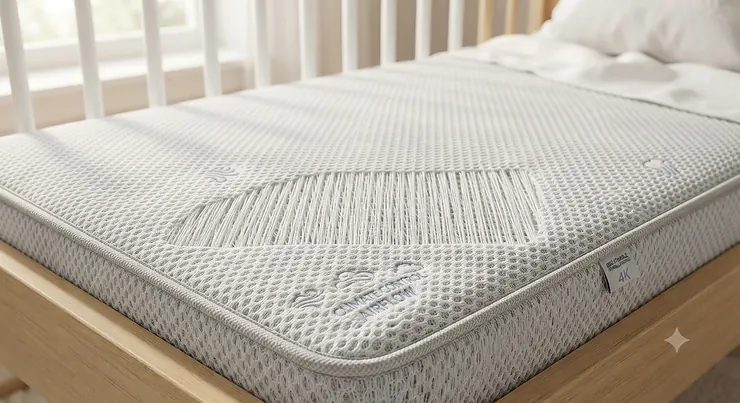
Somewhere around 2 a.m., you’ve probably done it — crept into the nursery, pressed the back of your hand against your baby’s neck, and held your breath waiting to see if it came away damp. If it did, you’re not alone, and you’re definitely not overreacting. A climate control crib mattress is a sleep surface built with materials — breathable foam channels, moisture-wicking covers, coil systems, or phase-responsive fibers — designed to move heat and humidity away from a sleeping infant instead of trapping it underneath them. That distinction matters more than most parents realize, because babies are notoriously bad at regulating their own body temperature, and an overheated sleep surface is one of the few sleep-environment risks you can actually control with a single purchase.

This guide skips the generic “cooling foam is great” filler you’ll find on most affiliate sites. Instead, we dug into real product specs, aggregated review patterns, and the safety research behind why temperature regulation matters in the first place — then lined up seven genuinely different mattresses so you can see where your money is actually going. Whether you’re chasing a heat dissipating baby mattress for a summer nursery in Phoenix or a temperature adaptive bedding setup for a drafty upstairs room in Vermont, there’s a specific engineering approach here that fits your situation, and we’ll tell you honestly which one doesn’t.
Quick Comparison Table
| Mattress | Cooling Approach | Best For | Price Range |
|---|---|---|---|
| Newton Baby Crib Mattress | Open-cell breathable core, washable | Hot sleepers & spit-up cleanup | $250-$300 range |
| Nook Sleep Pebble Air | Lightweight foam air channels + nano-wrap | Small nurseries, easy sheet changes | $200-$250 range |
| Sealy Baby Flex Cool | Hybrid coil + breathable surface | Back-and-forth sleep training | $100-$150 range |
| ORGANICDREAM Cooling Premier | Cooling gel foam topper | Budget-conscious cooling | $80-$120 range |
Looking at this snapshot, the pattern that jumps out is that cooling technology in crib mattresses splits into two camps — airflow-based (foam with open channels or coils that let heat escape downward) and surface-based (gel or wicking covers that pull heat away from the skin). Neither is objectively better; the right pick depends on whether your baby runs hot from trapped humidity or from surface contact heat, which we’ll unpack in the products below. If your household is deciding between a splurge and a starter mattress, this table alone should tell you the Newton Baby Crib Mattress anchors the premium end while the ORGANICDREAM Cooling Premier covers the budget lane without giving up the core cooling concept entirely.
💬 Already narrowing it down? Scroll to the product that matches your budget and tap through to check today’s price.
💬 Just one click — help others make better buying decisions too!😊
Top 7 Climate Control Crib Mattresses: Expert Analysis
1. Newton Baby Crib Mattress and Toddler Bed — most tested airflow on the market
The standout here isn’t marketing language — it’s a genuinely unusual construction. Newton built this mattress around a core of hundreds of thin polymer fibers stacked into an open lattice, so air (and heat) can pass straight through it instead of pooling against your baby’s back the way it does in solid foam.
That washable core is the second half of the story. The entire mattress — cover and core — can be rinsed in the shower and air-dried, which matters more at 3 a.m. after a blowout diaper than any spec sheet number does. Independent lab testing commissioned by Newton reported dramatically higher airflow than a leading organic competitor, and while every brand’s internal testing deserves a healthy dose of skepticism, the physical open-cell design is easy to verify with your own hands — it genuinely doesn’t feel like standard crib foam.
Based on the spec comparison, this is the pick for parents whose baby already runs hot, sweats through swaddles, or has shown any sensitivity to trapped humidity. Reviewers consistently mention the washability as the feature they didn’t know they needed until the first nighttime diaper leak; a smaller, recurring theme in feedback is that the firm, springy feel takes newborns a night or two to adjust to compared with plush foam.
Pros:
- ✅ Genuinely different open-core airflow design, not just marketing
- ✅ Fully washable core and cover for real-life messes
- ✅ GREENGUARD Gold certified for low chemical emissions
Cons:
- ❌ Firmer surface feel takes some newborns a night to adjust to
- ❌ Sits at the top of this list price-wise
At around the $250-$300 range, the Newton Baby Crib Mattress isn’t the cheapest way to solve overheating, but if your baby is a documented hot sleeper, the washable, breathable core earns its keep over years of spills and seasons.
2. Nook Sleep Pebble Air Ultra Lite Crib Mattress — lightest build for effortless sheet changes
The “Pebble” in the name refers to a raised, textured wrap cover engineered to keep the fabric from lying flat against the foam, creating tiny air channels across the entire sleep surface rather than just within the core.
Underneath that cover sits a CertiPUR-US foam core built with air channels of its own, and the whole mattress weighs in dramatically lighter than most crib mattresses — a detail that sounds trivial until you’re the one hoisting it up at 11 p.m. to check a diaper leak. The nano-treated cover fibers create water resistance without a plastic laminate layer, which is the mechanism behind the temperature-regulating claim: plastic-backed covers trap heat against the body, while this fabric-only approach lets moisture wick through and evaporate.
What most buyers overlook about this model is that the lightweight core, while excellent for handling, sacrifices some of the denser support that pricier innerspring options provide for older toddlers. Aggregated reviewer sentiment skews positive on the ease of changing sheets one-handed with a squirming infant, with an occasional complaint about the organic cotton cover wearing thin faster than budget shoppers expect from a premium-priced product.
Pros:
- ✅ Noticeably lighter than nearly any competing mattress
- ✅ Nano-treated cover resists moisture without a plastic barrier
- ✅ OEKO-TEX certified materials for chemical safety
Cons:
- ❌ Less dense support than coil-based options for toddler years
- ❌ Premium price for a foam-only core
Priced in the $200-$250 range, the Nook Sleep Pebble Air Ultra Lite Crib Mattress is best suited to parents who prioritize handling ease and breathability over long-haul toddler durability.
3. Sealy Baby Flex Cool 2-Stage Crib Mattress — hybrid coil breathability at a mid-range price
Sealy took its adult-mattress hybrid-coil playbook and shrank it down for the nursery. The steel coil base creates natural air gaps beneath the sleep surface, which — unlike solid foam — lets warm air sink and circulate rather than compress into a dead zone under baby’s torso.
On top of that coil base sits a breathable, waterproof cotton surface designed for the “infant” side, which flips to a firmer toddler-stage surface as your child grows. Here’s what to weigh: coil systems tend to offer more consistent long-term firmness retention than all-foam mattresses, since foam can slowly compress and lose its “no appreciable indentation” quality that safety regulators specifically test for. Reviewers frequently note this mattress feels notably firmer under a fitted sheet than foam alternatives, which some parents read as reassuring and others find takes getting used to when transferring a sleeping baby.
Pros:
- ✅ Coil-and-air-gap design promotes genuine underneath airflow
- ✅ GREENGUARD Gold certified, dual-stage for infant and toddler
- ✅ Waterproof cotton surface simplifies cleanup
Cons:
- ❌ Firmer feel than foam-based competitors
- ❌ Heavier than lightweight foam options, harder one-handed lifting
In the $100-$150 range, the Sealy Baby Flex Cool 2-Stage Crib Mattress is a smart middle-ground pick for parents who want proven coil airflow without paying premium foam-brand prices.
4. Serta Perfect Start Limited Dual Sided Crib Mattress — breathable fiber core built for longevity
Serta’s approach here leans on a fiber-based core rather than solid foam or steel coils — a construction that naturally leaves microscopic air pockets throughout the mattress, which is exactly the mechanism that lets heat dissipate downward instead of building up against the sleep surface.
The dual-sided design gives you a firmer infant side and a slightly different toddler-stage surface once your child transitions out of the crib, extending the mattress’s useful life well past year one. Based on the spec comparison against pricier premium-tier mattresses, the fiber-core approach won’t match a dedicated open-channel foam mattress for raw airflow volume, but it holds its shape better over years of nightly compression than cheaper solid-foam alternatives tend to. The seven-year warranty backing this model is a signal worth reading literally — it tells you the manufacturer expects the core to resist sagging that long, which matters for temperature regulation since a compressed, sagging mattress traps more heat against the body than a flat one.
Pros:
- ✅ Fiber core resists long-term sagging better than basic foam
- ✅ Dual-sided design supports both infant and toddler stages
- ✅ Backed by a seven-year manufacturer warranty
Cons:
- ❌ Less dramatic airflow than dedicated open-channel foam designs
- ❌ Firmness may feel plain compared with more cushioned premium picks
Sitting around $90-$130, the Serta Perfect Start Limited Dual Sided Crib Mattress is the pragmatic choice for parents who want years of consistent support without paying for boutique cooling tech they may not need.
5. Moonlight Slumber Little Dreamer Crib Mattress — dual-sided memory foam with a breathable twist
This one is aimed at parents torn between the pressure-relieving comfort of memory foam and the breathability worries that usually come with it. Moonlight Slumber’s answer is an engineered foam blend designed to be more open-cell than standard memory foam, meaning it doesn’t trap body heat the way older-generation memory foam products were notorious for.
The firm infant-support side and softer toddler-comfort side reflect the same two-stage philosophy as most of this list, but what most buyers overlook here is the waterproof layer’s placement — it’s positioned to protect against moisture without fully sealing the breathable core the way older waterproof crib mattresses did, which historically created a sweaty, plastic-adjacent sleep surface. Reviewers frequently describe the toddler side as noticeably plusher than budget competitors, with an occasional note that the mattress runs on the heavier side for parents doing frequent sheet changes.
Pros:
- ✅ Open-cell foam blend engineered to reduce heat trapping
- ✅ Dual-sided comfort tuned for infant and toddler stages
- ✅ Made in the USA with hypoallergenic materials
Cons:
- ❌ Heavier to maneuver during late-night sheet changes
- ❌ Memory foam feel isn’t for every sleep-training preference
At roughly $130-$180, the Moonlight Slumber Little Dreamer Crib Mattress suits families who want foam-level plushness without fully giving up airflow performance.
6. Delta Children Summer Breeze Crib Mattress — proof that budget doesn’t mean sweaty
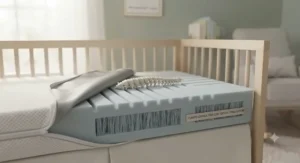
Don’t let the price fool you into assuming this is a stripped-down mattress. The “Cloud Core” construction is built specifically to be lighter and more breathable than Delta’s standard budget lineup, using a sustainably sourced core material that leaves more open space than dense polyurethane foam typically does.
Here’s the honest trade-off: this mattress won’t out-cool a dedicated premium hybrid or open-channel foam design point-for-point, but for the price, it delivers a legitimately different (and more breathable) construction than the flat, dense foam slabs that dominate the entry-level crib mattress category. The machine-washable cover and GREENGUARD Gold certification mean you’re not sacrificing chemical safety standards to hit this price point, which is the part shoppers scanning only for “cooling” specs tend to skip past. Aggregated review sentiment leans strongly toward value-for-money satisfaction, with occasional mentions that the lighter core feels less substantial underfoot than premium hybrid options.
Pros:
- ✅ Genuinely lighter, more breathable core than typical budget foam
- ✅ GREENGUARD Gold certified despite the low price point
- ✅ Machine-washable cover simplifies cleanup
Cons:
- ❌ Less airflow performance than premium hybrid or open-channel designs
- ❌ Feels less substantial than pricier alternatives
At under $80, the Delta Children Summer Breeze Crib Mattress is the clearest proof on this list that thermal comfort baby gear doesn’t have to break the nursery budget.
7. ORGANICDREAM Cooling Premier 2-Stage Crib Mattress — cooling gel where you actually need it
Instead of engineering the entire core around airflow, ORGANICDREAM concentrates its cooling strategy at the surface, where it arguably matters most — a gel-infused foam topper positioned directly under the toddler-stage sleep surface, designed to absorb and disperse contact heat right where skin meets mattress.
This is a genuinely different engineering philosophy from the coil and open-channel approaches above, and it’s worth understanding the distinction: gel foam works by conducting heat away from the body surface, while airflow-based designs work by letting heat and moisture escape downward and outward. Neither is inherently superior, but gel-topper designs tend to shine specifically for older toddlers who sleep face-down or curled against the mattress surface for extended stretches, since that’s where surface contact heat builds fastest. Reviewers commonly cite the flip-to-firm infant side as reassuring for newborn safety compliance, while a smaller subset note the toddler-side plushness runs softer than some coil-based competitors.
Pros:
- ✅ Gel foam topper targets surface contact heat directly
- ✅ CertiPUR-US certified foam, waterproof and washable cover
- ✅ Dual-sided design flips from firm infant support to plush toddler comfort
Cons:
- ❌ Softer toddler side may not suit safety-conscious back-sleep purists
- ❌ Smaller brand means a thinner track record than legacy manufacturers
In the $80-$120 range, the ORGANICDREAM Cooling Premier 2-Stage Crib Mattress is a smart pick for parents specifically chasing surface-level cooling rather than deep-core airflow.
Practical Usage Guide: Setting Up Your Climate Control Crib Mattress
Buying the right mattress solves half the overheating equation — setup solves the other half, and it’s the part most product pages skip entirely. Start by letting any compressed or rolled foam mattress fully expand for the full 24-48 hours manufacturers recommend before first use; cooling properties in open-cell foam depend on those channels re-inflating completely, and rushing a baby onto a still-compressing mattress blunts the airflow benefit you paid for.
Next, be deliberate about what goes between the mattress and your baby. A thick, heavily padded waterproof pad layered over a breathable core can undo most of its cooling benefit by sealing the surface — if you need waterproofing, look for a thin, breathable-rated pad rather than a plastic-backed one. The same logic applies to sheets: a thick flannel or heavily quilted fitted sheet insulates in ways a lightweight jersey or muslin sheet doesn’t. For maintenance, rotate and air out any removable cover every few weeks even without visible spills, since accumulated moisture from normal overnight breathing and sweat can gradually reduce a fabric’s wicking performance. A common first-30-days mistake is over-bundling on top of a cooling mattress, assuming the mattress alone offsets a heavy sleep sack — pair the mattress with lighter sleep clothing rather than treating it as a substitute for appropriate layering.
Real-World Scenarios: Matching Climate Responsive Sleep Systems to a Nursery
Picture three different households. First, a family in a converted attic nursery in Austin with no dedicated HVAC vent — for them, an airflow-first design like the coil-based Sealy Baby Flex Cool 2-Stage Crib Mattress or the open-core Newton Baby Crib Mattress makes more sense than a surface-gel approach, since ambient room heat needs somewhere to escape from underneath, not just at the contact point.
Second, a budget-conscious first-time parent furnishing an entire nursery at once, for whom the Delta Children Summer Breeze Crib Mattress delivers legitimate breathability gains without cannibalizing the stroller-and-car-seat budget. Third, a family with an active toddler who’s already outgrown the bassinet and sleeps curled on their side most nights — that’s precisely the profile that benefits most from a surface-cooling gel design like the ORGANICDREAM Cooling Premier 2-Stage Crib Mattress, since surface contact heat (not ambient room heat) is the dominant issue once a child develops a consistent sleep position. None of these scenarios has a universally “best” answer — the right climate responsive sleep system depends on which specific heat source (room temperature, trapped moisture, or skin contact) is actually driving the sweaty nights in your particular nursery.
Problem → Solution Guide for Overheated Nurseries
Problem: Baby wakes up damp at the neck and hairline. This usually points to trapped humidity rather than ambient heat, meaning an airflow-focused core like the Nook Sleep Pebble Air Ultra Lite Crib Mattress or Newton Baby Crib Mattress will likely help more than swapping room temperature alone.
Problem: Mattress feels warm to the touch even before baby lies down. That’s often a sign of a plastic-laminated waterproof layer trapping heat at the surface — solutions include switching to a mattress with a fabric-only water-resistant cover, such as the nano-treated Nook Sleep Pebble Air Ultra Lite Crib Mattress.
Problem: Budget doesn’t stretch to premium hybrid or foam-core options. The Delta Children Summer Breeze Crib Mattress proves a lighter, more open core is achievable without a premium price tag — prioritize “breathable core” language over marketing claims of “cooling gel” if your budget is the primary constraint.
Problem: Older toddler consistently sleeps in one position and wakes sweaty on that side. This is a surface contact-heat issue best solved by a gel-topper design like the ORGANICDREAM Cooling Premier 2-Stage Crib Mattress, since airflow-based cores don’t specifically address localized surface heat the way gel foam does.

How to Choose a Climate Control Crib Mattress
Choosing the right thermal regulating infant mattress comes down to matching engineering approach to your actual problem, not chasing the flashiest marketing claim. Here’s a practical framework:
- Identify your heat source first. Trapped humidity calls for airflow-based cores; localized skin contact heat calls for gel or wicking surfaces.
- Check the certification, not just the marketing. Look for GREENGUARD Gold or CertiPUR-US certification alongside any cooling claim — safety compliance should never be assumed.
- Match firmness to CPSC guidance. Regardless of cooling technology, the surface must remain firm and flat with no appreciable indentation, per federal crib mattress safety standards.
- Weigh washability against your realistic laundry tolerance. A fully washable core sounds great until you’re the one hauling a wet mattress into the shower at midnight — be honest about whether you’ll use that feature.
- Consider mattress weight for solo sheet changes. Lighter foam-core designs make one-handed changes dramatically easier than heavier coil or hybrid builds.
- Budget for the full lifespan, not just the first year. Dual-sided, two-stage mattresses extend usefulness into toddlerhood, often justifying a higher upfront price.
- Don’t treat the mattress as a substitute for room-temperature management. Even the best climate control crib mattress works alongside — not instead of — a comfortably cool nursery.
Common Mistakes When Buying a Thermal Regulating Infant Mattress
The single most common mistake is treating “cooling gel” or “breathable” as interchangeable marketing terms rather than distinct engineering approaches — as covered above, they solve different heat problems, and buying the wrong type for your situation means paying a premium for a feature that doesn’t address your actual issue. A close second is skipping firmness verification entirely because a product is marketed around temperature; cooling technology and safety-compliant firmness are separate specs, and a mattress can excel at one while falling short on the other.
Parents also frequently over-layer a cooling mattress with a thick waterproof pad “just to be safe,” which — as we covered in the usage guide — can neutralize much of the airflow benefit they just paid extra for. Finally, many buyers skip checking whether a mattress is dual-sided before committing, then find themselves shopping for a second mattress within eighteen months when their toddler outgrows the infant-firm side. Reading the two-stage construction details up front avoids that entirely avoidable repeat purchase.
Climate Control Crib Mattress vs Traditional Foam Crib Mattress
The core difference isn’t comfort — it’s what happens to heat once your baby’s body starts generating it overnight. A traditional dense polyurethane foam crib mattress has few, if any, internal air channels, so body heat and moisture accumulate at the contact surface with nowhere to escape except slowly through the fabric cover. A climate control crib mattress, by contrast, is engineered with either open-cell structures, coil-created air gaps, or heat-conducting gel specifically to give that heat somewhere to go.
In practice, this shows up most clearly during hot months or in nurseries without reliable air conditioning, where a traditional foam mattress can feel noticeably warmer to the touch after even twenty minutes of a baby lying on it. That said, traditional foam mattresses aren’t unsafe or obsolete — they simply require more diligence on the parent’s side regarding room temperature and sleep clothing to compensate for what the mattress itself isn’t doing. For families in consistently temperature-controlled homes, the gap between the two categories narrows considerably; the investment in dedicated cooling technology pays off most for hot sleepers, warm climates, and rooms without dependable HVAC.
What to Expect: Real-World Performance of a Heat Dissipating Baby Mattress
Specs on a product page describe engineering; they don’t describe what a Tuesday night actually feels like. In practice, a well-built heat dissipating baby mattress translates into your baby settling into deeper sleep stretches without the frequent, fussy half-wakings that often accompany overheating — though it’s worth being honest that no mattress eliminates every night wake-up, since hunger, teething, and developmental leaps all cause wakings that have nothing to do with temperature.
What you should reasonably expect: a mattress that stays cool to the touch when you check on baby, sheets that don’t feel damp at 2 a.m. checks, and a noticeably faster return to comfortable temperature after a diaper change disturbs the sleep surface. What you shouldn’t expect: a mattress that fully substitutes for a properly cooled nursery, since ambient room temperature remains the dominant variable in most overheating scenarios according to NICHD’s Safe to Sleep research. Treat the mattress as one lever among several, not a single fix for a warm room.
Temperature Adaptive Bedding for Every Nursery Climate and Family
A family in coastal San Diego with mild year-round temperatures has fundamentally different needs than one in humid Houston summers or a drafty older home in Minneapolis winters — and temperature adaptive bedding choices should reflect that rather than following a one-size-fits-all recommendation. In consistently mild climates, the gap between a premium airflow mattress and a solid budget option narrows considerably, since ambient conditions rarely push either surface to its performance limits.
In humid, hot climates, prioritize airflow-based cores over surface-gel toppers, since ambient humidity compounds the trapped-moisture problem that open-channel foam and coil systems are specifically built to solve. In colder climates where the real risk is overcompensating with too many blankets and sleep-clothing layers, a moderate breathable mattress paired with appropriate light sleep clothing matters more than chasing the most aggressive cooling technology on the market — remember that overheating, not the ambient cold itself, is the documented risk factor safety researchers actually track.
Long-Term Cost & Maintenance
Sticker price only tells part of the story. A budget mattress replaced twice before your child turns three can easily cost more in total than a single premium mattress with a longer usable lifespan — the real comparison is cost-per-year of use, not cost-per-purchase. Dual-sided, two-stage mattresses generally offer the best total cost of ownership, since they eliminate the mid-toddlerhood “we need a firmer/softer mattress now” repurchase that single-sided mattresses often force.
Maintenance costs matter too, though they’re rarely discussed. Fully washable cores, like the one on the Newton Baby Crib Mattress, reduce the odds you’ll need a replacement waterproof pad or emergency deep-clean service call after a significant spill, while mattresses with sealed, non-removable covers may require professional cleaning or outright replacement after serious accidents. Factor warranty length into this calculation directly — a seven-year warranty, like the one backing the Serta Perfect Start Limited Dual Sided Crib Mattress, is a manufacturer’s own bet on how long the core will resist the sagging that eventually degrades both comfort and the airflow properties you originally paid for.
Features That Actually Matter (And Those That Don’t)
Certifications like GREENGUARD Gold and CertiPUR-US actually matter — they represent independent, third-party emissions and chemical testing rather than a brand’s own marketing claims, and they show up consistently across every genuinely reputable mattress in this category. Dual-sided, two-stage construction actually matters too, extending real usable life by a year or more compared with single-firmness designs.
What doesn’t matter nearly as much as marketing suggests: exact thread counts on removable covers, elaborate nursery-matching color options, and vague “cooling technology” language that doesn’t specify whether it’s airflow-based or surface-based. Also lower on the priority list, despite prominent product-page placement, are decorative quilting patterns and “hypoallergenic” claims that aren’t backed by a specific certification — the word alone carries no regulated meaning in this category, unlike GREENGUARD or CertiPUR-US, which do.
Safety, Regulations & Thermal Comfort Compliance Guide
Every crib mattress sold in the United States, cooling technology or not, must meet the federal firmness and fit standards codified under 16 CFR Part 1241, most recently updated to incorporate the newer ASTM F2933 voluntary safety standard. That standard exists specifically to prevent overly soft mattresses from creating suffocation risk — a completely separate concern from temperature regulation, and one that should never be sacrificed for a cooling feature. A mattress marketed heavily around cooling gel or airflow still has to pass the same firm, flat, no-appreciable-indentation test as every basic mattress on the market.
On the temperature side specifically, pediatric safety researchers have consistently linked overheating to increased SIDS risk, which is why the safe sleep guidance focuses as much on room temperature and sleep clothing as it does on the mattress itself. A climate control crib mattress is a genuinely useful tool for reducing one risk factor, but it works best as part of a full safe-sleep setup — back sleeping, a firm flat surface, no loose bedding, and a room kept at a temperature comfortable for an adult in light clothing — rather than as a stand-alone solution.
Buyer’s Decision Framework
If your baby is a documented hot sleeper who wakes damp regularly, choose an airflow-first core (Newton Baby, Nook Sleep Pebble Air, or Sealy Baby Flex Cool) because trapped humidity, not surface contact, is your dominant problem. If your budget is the primary constraint and you still want a genuine breathability upgrade over standard foam, choose the Delta Children Summer Breeze Crib Mattress because it delivers a real construction difference at an accessible price. If your toddler has a consistent sleep position and wakes sweaty on one side specifically, choose a gel-topper design like the ORGANICDREAM Cooling Premier because localized surface heat is a different engineering problem than ambient trapped moisture. And if you’re furnishing for the long haul and want to avoid a second mattress purchase within two years, prioritize dual-sided, two-stage construction with a strong warranty over any single cooling claim.
✨ Ready to compare current prices side by side? Tap through to any product above before nursery-setup deals sell out.

Frequently Asked Questions
❓ Does a climate control crib mattress actually stop night sweats?
❓ Is cooling gel safe for a newborn crib mattress?
❓ How long does a climate control crib mattress last?
❓ Can I add a cooling mattress pad instead of buying a new mattress?
❓ What's the difference between breathable and cooling in crib mattresses?
Conclusion
There’s no single “best” climate control crib mattress, and honestly, any guide that tells you otherwise is skipping the part where your specific nursery, climate, and baby’s sleep habits actually determine the right pick. What the research and the spec sheets agree on is this: trapped heat and humidity are a real, addressable contributor to a fussy, frequently-waking baby, and the engineering differences between airflow-based cores, hybrid coils, and surface gel toppers aren’t just marketing dressing — they solve genuinely different versions of the overheating problem.
If you take one thing from this guide, let it be the framework rather than a single product name: figure out whether your baby’s heat problem is ambient, trapped, or surface-contact, match that to the right construction type, and treat the mattress as one part of a full safe-sleep setup rather than a magic fix on its own. Whichever of these seven you land on, you’re choosing from mattresses that back their cooling claims with actual construction differences rather than empty labels — which, in an affiliate-marketing category this crowded, is worth more than it sounds.
✨ Don’t Miss These Exclusive Deals!
🔍 Take your nursery temperature control to the next level with these carefully selected mattresses. Click on any highlighted product above to check current pricing and availability. These picks will help you create the cooler, calmer sleep environment your baby (and you) actually need.
Recommended for You
- 7 Best Breathable Foam Crib Mattress Picks for Safer Sleep (2026)
- 7 Best Cooling Crib Mattress Picks for 2026: Sleep Cooler, Safer
- Baby Sleep Insights Mattress: 7 Smart Picks for 2026
Disclaimer: This article contains affiliate links. As an Amazon Associate, I earn from qualifying purchases. If you purchase products through these links, we may earn a small commission at no additional cost to you.
✨ Found this helpful? Share it with your friends! 💬🤗
