
In This Article
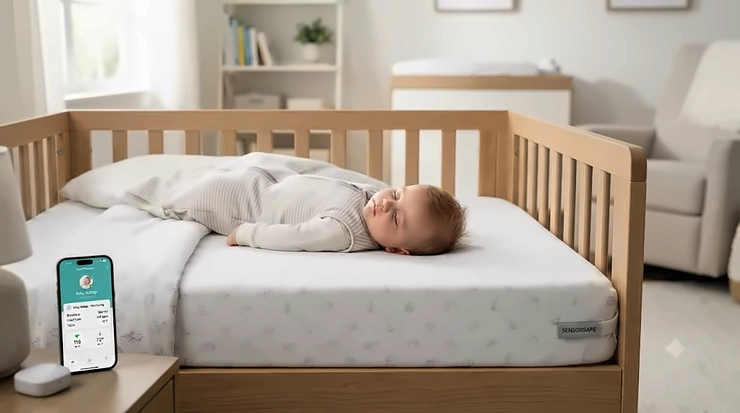
Somewhere around 2 a.m., every new parent asks the same question: is that little chest actually rising and falling, or am I just imagining it in the dark? That anxiety is exactly why the wifi enabled crib mattress category exploded from a niche gadget shelf into a full-blown nursery-tech aisle. These systems pair a crib mattress, an under-mattress pad, or a bundled monitor with a home network connection so movement, temperature, and sleep-pattern data land on your phone instead of staying locked inside the crib. A wifi enabled crib mattress, broadly defined, is any crib sleep surface or companion sensor pad that streams motion, breathing-motion, or environmental data to a smartphone app over your home network. Some are true mattresses with sensors woven in; most are sensor pads or clip-on monitors that pair with a standard crib mattress. Either way, the promise is the same: fewer 2 a.m. gut-checks, more actual sleep for you.
But here’s the honest part, the part that matters more than any spec sheet: pediatric safety groups have been explicit that no monitor, sensor pad, or “smart” mattress has been shown to prevent Sudden Infant Death Syndrome, and the safest sleep setup is still a bare, firm, flat mattress with nothing else in the crib. So this guide does two things at once. It walks you through seven real, currently sold smart sleep systems — what they track, what they cost, and who they’re genuinely worth it for — and it keeps the safety conversation front and center the whole way through, because a gadget that gives false confidence is worse than no gadget at all.
We’re focused on U.S. availability and pricing ranges (never exact figures, since prices shift constantly), and every product below is real — no invented models, no fabricated reviews. Let’s get into it.
Quick Comparison Table: Wifi Enabled Crib Mattress Options at a Glance
| Product | Type | Connectivity | Best For | Price Range |
|---|---|---|---|---|
| Cradlewise Smart Crib | Full crib + mattress system | WiFi + app | All-in-one premium nursery | $1,900-$2,150 |
| Babysense Cloud Smart Mattress | Dedicated smart mattress | WiFi + app | Dual-stage mattress upgraders | check current price |
| CuboAi Sleep Safety Bundle | Sensor pad + camera monitor | WiFi + app | AI-analyzed breathing motion | $250-$320 |
| Hubble Dream+ Comfort Cloud | Sensor mat + camera | WiFi + app | Non-wearable vitals + video | $200-$280 |
| Babysense 7 + V24R Bundle | Under-mattress pads + video monitor | Local (pads) / WiFi (video) | Budget-conscious families | $150-$230 |
| Bebcare Breathing Sensor Mat | Sensor mat, multi-monitor compatible | Model-dependent (WiFi on iQ) | Flexible monitor pairing | $150-$260 |
| smart-cot | Embedded sensor cot | WiFi + app | Early adopters, tech-forward nurseries | check current price |
Looking across the table, the split is really between two philosophies: buy a mattress or crib that’s smart from the factory floor (Cradlewise, Babysense Cloud, smart-cot), or keep a regular firm crib mattress and add a WiFi-connected sensor pad underneath it (CuboAi, Hubble, Babysense 7, Bebcare). The second approach is cheaper and lets you swap components independently, while the first bakes everything into one purchase but locks you into that ecosystem. Budget shoppers gravitate toward the Babysense 7 bundle, while families who want a single integrated nursery hub tend to land on Cradlewise despite the price jump.
💬 Just one click — help others make better buying decisions too!😊
💬 Found a combo that fits your nursery? Bookmark this table — you’ll want to cross-reference it again before checkout.
Top 7 Wifi Enabled Crib Mattress and Sleep Sensor Systems: Expert Analysis
1. Cradlewise Smart Crib — the only convertible bassinet-to-crib with a built-in monitor
The standout here isn’t the mattress itself so much as the whole ecosystem wrapped around it: a bassinet that converts to a full crib, with motion sensing and a built-in camera baked into one WiFi-connected unit. The mattress is made from coconut coir and natural rubber latex rather than polyurethane foam, and the crib bounces gently and plays white noise when its sensors pick up early stirring — the idea being to settle a baby back down before a full wake-up cry starts. Based on the spec comparison with standalone sensor pads, what you’re really paying for is integration: one app instead of three separate gadgets, one purchase instead of a mattress plus a monitor plus a sound machine bought separately.
Reviewers who’ve used it for months consistently report that the soothing and bounce-response features work reliably, while independent testers have noted the sleep-tracking accuracy itself is the weaker link — a few reviewers found it occasionally marked an awake, eyes-open baby as still asleep. That’s worth weighing carefully: soothing performance and tracking accuracy are two different jobs, and this system is stronger at the first than the second.
Pros:
- ✅ Converts from bassinet to full crib as baby grows
- ✅ Built-in camera eliminates need for a separate monitor
- ✅ Soothing bounce and sound responses are well-reviewed
Cons:
- ❌ Sleep-tracking accuracy has been questioned by independent testers
- ❌ Premium price puts it well above most nursery budgets
Pricing typically lands in the $1,900-$2,150 range depending on bundle promotions — check current pricing before buying, since Cradlewise runs periodic pre-order discounts. For families who want one integrated smart nursery purchase instead of stacking gadgets, it’s a defensible splurge; for anyone tracking every dollar of a nursery budget, it’s a tough sell against the far cheaper add-on sensor pads below.

2. Babysense Cloud Smart Mattress — dual firmness built for infant-to-toddler transition
What most buyers overlook about this one is that it’s marketed as the first mattress designed from the ground up to be a smart sleep surface, rather than a regular mattress with a sensor pad slid underneath it. It’s built with different firmness levels on each side — one tuned for infant sleep, one for toddler years — so you flip it rather than buy a second mattress later. Embedded sensing is described as sensitive enough to register micro-movements along with ambient temperature and humidity, feeding predictive insights like likely wake-windows into a companion app.
Here’s what the spec sheet won’t tell you outright: predictive “likely wake time” features are pattern-based estimates, not guarantees, and like any consumer sleep-tracking tool they’ll be noisier during growth spurts, teething, or schedule changes than during a stable stretch. Treat the predictions as a rough compass, not a schedule.
Pros:
- ✅ Dual-sided firmness extends usable lifespan into toddlerhood
- ✅ Washable, breathable cover simplifies cleanup
- ✅ Sensing is built into the mattress, not bolted on
Cons:
- ❌ U.S. retail pricing and availability are less established than competitors
- ❌ Predictive wake-time insights are estimates, not guarantees
At the time of research, fixed U.S. pricing wasn’t consistently published, so check current price and confirm domestic shipping before committing — expect it to sit above a standard organic crib mattress given the embedded electronics. If dual firmness and a single long-term mattress purchase appeal to you more than a separate sensor pad, this is worth the extra homework.
3. CuboAi Sleep Safety Bundle (Monitor 3 + Sleep Sensor Pad) — AI-flagged rollover and covered-face alerts
The standout feature is the pairing of a non-contact under-mattress pad with an AI-powered camera that specifically flags rollovers and covered-face moments, not just generic motion. The Sleep Sensor Pad uses four motion sensors slid under the mattress on the crib slats, converting surface-level micro-motion into a breathing-motion read, while the Monitor 3 camera runs facial and body-position recognition on top. Based on how the two pieces work together, the real value is redundancy — a breathing-motion signal from below, image-based detection from above — rather than either sensor working in isolation.
Reviewers consistently report that the one-time, “set it and forget it” installation under the mattress is the feature they appreciate most, since there’s no wearable to re-attach every night. A common theme in aggregated feedback is that the overnight sleep-pattern reports are genuinely useful for fine-tuning nap schedules, even among parents who bought the bundle mainly for the safety alerts.
Pros:
- ✅ Combines under-mattress motion sensing with AI camera alerts
- ✅ No wearables — nothing attached to baby’s body
- ✅ One-time setup under the mattress, minimal nightly hassle
Cons:
- ❌ Full functionality requires an ongoing app/cloud connection
- ❌ Premium features may require a paid subscription tier
Expect the bundle to run roughly $250-$320 depending on current promotions — always confirm current pricing before checkout. For parents who want camera-based reassurance plus a dedicated breathing-motion pad without buying two separate systems, this bundle earns its price tag.
4. Hubble Dream+ with Comfort Cloud™ Sensor Mat — vitals tracking without a single wearable
The short version: a soft mat slips beneath the fitted sheet and reads breathing motion, heart rate signals, and movement, while a companion WiFi camera handles video and two-way talk — and none of it touches the baby directly. What most buyers overlook is that the mat itself is washable and the sensor detaches for cleaning, which matters more than it sounds once you’ve dealt with a diaper blowout at 3 a.m.
Based on the spec comparison with camera-only monitors, the addition of a physical sensor mat gives Hubble a data layer that pure-camera systems can’t match — motion detected through direct contact with the sleep surface tends to be steadier than motion inferred purely from video, particularly in dim rooms. That said, sleep-score and heart-rate estimates from a non-medical consumer mat should be read as wellness trends, not clinical vitals.
Pros:
- ✅ No wearable devices touch the baby at any point
- ✅ Washable sensor mat simplifies hygiene upkeep
- ✅ Works right out of the box without a paid subscription
Cons:
- ❌ Two components (mat + camera) to install and pair correctly
- ❌ Heart-rate and sleep-score readings are wellness estimates, not medical data
Pricing generally sits in the $200-$280 range — check current price, since Hubble periodically bundles the mat with different camera tiers. If you want breathing-motion detection plus video without paying Cradlewise-level money, this is one of the stronger mid-range picks.
5. Babysense 7 + V24R Video Monitor Bundle — the budget-friendly under-mattress veteran
Babysense has been making non-contact, under-the-mattress movement monitors since 1992, and the 7th-generation pad bundled with the V24R video monitor is the most budget-accessible way into this category. The dual sensor-pad setup is designed to cover the full width of the crib so a baby can’t roll out of detection range, while the V24R adds split-screen support for up to four cameras if you’re monitoring twins or a shared nursery.
Here’s the nuance that matters: the under-mattress pads themselves run locally and don’t connect to WiFi by design — that’s actually a deliberate security choice by Babysense — while the WiFi-enabled piece of this bundle is the V24R video monitor, which streams to your phone. So the “wifi enabled” label in this bundle technically applies to the video half, not the movement-sensing pads themselves; know that distinction going in if a fully networked sensor pad is what you’re after.
Pros:
- ✅ Long manufacturing track record dating back decades
- ✅ Dual pads cover the full crib to prevent detection gaps
- ✅ Local-only sensor pads reduce network-security exposure
Cons:
- ❌ Movement pads themselves aren’t WiFi-connected, only the video unit is
- ❌ Video quality trails newer premium camera systems
Bundles typically land around $150-$230 — check current price for the exact bundle configuration. For budget-conscious families who want a proven, decades-old sensing approach without paying for AI extras, this remains one of the smartest value picks in the category.
6. Bebcare Breathing Sensor Mat — the flexible pick for mixing and matching monitors
What stands out about the Bebcare mat is compatibility: it pairs with the entire Bebcare monitor lineup, including the WiFi-enabled Bebcare iQ, the Bebcare Motion video monitor, and the audio-only Bebcare Hear. Its piezo-film sensing technology is built to pick up vital-sign-adjacent movement without any contact with the baby’s skin, which matters for parents wary of anything touching a newborn directly.
Based on how the ecosystem is structured, this is the pick for households that already own a Bebcare monitor and just want to add sensing, or for parents who aren’t sure yet which monitor tier they want and like the flexibility to upgrade the camera later without replacing the mat underneath.
Pros:
- ✅ Compatible across multiple Bebcare monitor models
- ✅ No direct skin contact required for sensing
- ✅ Lets you upgrade the camera/monitor independently later
Cons:
- ❌ WiFi connectivity depends on which monitor model you pair it with
- ❌ Smaller aggregated review pool than more established competitors
Expect roughly $150-$260 depending on which monitor you pair it with — check current price for the specific bundle. This is a smart choice if flexibility and future upgradability matter more to you than having one all-in-one branded system.
7. smart-cot — an ambitious, sensor-embedded cot worth watching
Rounding out the list with a lesser-known but genuinely interesting entrant: smart-cot builds image recognition, sound recognition, and motion sensors directly into the cot structure itself, rather than adding a pad or camera as an accessory. The pitch is a cot that can flag potential health-pattern changes and route parents toward relevant guidance through the connected app, alongside standard activity logging.
Because this is a newer, smaller player compared to the established brands above, independently verified customer review data is thin at the time of research — so rather than manufacture confidence that doesn’t exist yet, the honest take is this: the concept is compelling on paper, but buyers should treat it as an early-adopter purchase and verify current U.S. availability, warranty terms, and real owner feedback before committing serious money.
Pros:
- ✅ Sensors fully embedded rather than bolted onto a separate mattress
- ✅ Combines image, sound, and motion recognition in one unit
- ✅ Novel approach among the more established competitors
Cons:
- ❌ Limited independently verified review history so far
- ❌ U.S. pricing and availability need direct confirmation before buying
Pricing wasn’t consistently published for U.S. buyers at the time of research — check current price and availability directly. If you like being early to a category and are comfortable with less of a track record, it’s worth a look; if you want proven reliability, lean toward the more established names above first.
Setting Up Your Connected Nursery: A Practical Usage Guide
Getting a wifi enabled crib mattress or sensor pad running smoothly starts before the baby ever sleeps on it. First, test your WiFi signal strength in the actual nursery, not just the room where your router sits — a weak signal is the single most common reason parents report dropped alerts or laggy app notifications in the first week. Second, run the sensor calibration process (most brands ask you to place it under an empty mattress first) before baby’s first night in the crib, since a miscalibrated pad tends to throw false alarms that erode trust in the whole system fast.
During the first 30 days, the most common mistake is treating every notification as urgent. Sensor pads and cameras alike will occasionally misread rolling, grunting, or repositioning as something concerning — that’s normal, not a defect. Set a maintenance reminder to wipe down sensor pads and wash removable covers roughly every one to two weeks, and check firmware updates monthly, since manufacturers regularly patch detection algorithms based on aggregated user data.
✨ Need Help Picking the Right Setup for Your Nursery?
🔍 Compare current listings for the systems above and check availability before you build your registry — getting the right internet connected nursery setup from day one saves you a return-and-reorder headache later.
Real-World Scenarios: Matching Families to the Right Smart Sleep Setup
Consider a first-time parent in a two-bedroom apartment, anxious about every noise, working a demanding job with unpredictable hours. For that household, something like the CuboAi bundle or Hubble Dream+ makes sense — camera plus breathing-motion pad, moderate price, no wearables to fuss with during exhausted 2 a.m. changes.
Now picture a family expecting twins, on a tighter budget, who need coverage across two cribs without buying two premium systems. The Babysense 7 bundle’s multi-camera expandability and lower per-unit cost fits that scenario far better than a single-crib premium purchase like Cradlewise.
Finally, think about tech-forward parents furnishing a nursery from scratch who want one integrated purchase instead of stacking gadgets — a converting bassinet-to-crib system like Cradlewise reduces the number of separate boxes arriving on the porch, even at a steeper upfront cost.
Problem → Solution: Fixing the Most Common Sleep Sensor Mattress Headaches
Problem: constant false alerts. Solution: recalibrate the sensor with an empty crib, confirm mattress thickness falls within the manufacturer’s supported range (most pads specify roughly 2-5 inches), and reposition the pad to the center of the slats.
Problem: app disconnects overnight. Solution: move your router closer, use a WiFi extender in the nursery, and check that the device isn’t set to aggressive battery-saving mode, which can throttle background connectivity on some phones.
Problem: sleep-tracking data looks inconsistent. Solution: remember these are pattern-estimation tools, not lab-grade sensors — expect noisier data during growth spurts, teething, or travel, and judge trends over a week rather than a single night.
Problem: outgrowing the mattress or pad. Solution: check the manufacturer’s supported weight and age range before baby hits a growth spurt, and look at dual-firmness or convertible options if you want one purchase to last longer.
How to Choose a Wifi Enabled Crib Mattress
- Confirm CPSC compliance first. Whatever else it does, the mattress or crib must meet Consumer Product Safety Commission standards for firmness and fit — this is non-negotiable before any smart feature matters.
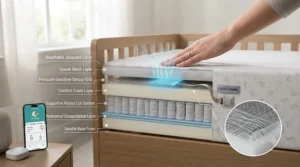
- Decide: built-in mattress or add-on pad. A dedicated smart mattress bakes sensing in permanently; an add-on pad lets you keep any CPSC-compliant mattress and add sensing separately.
- Check mattress-thickness compatibility. Sensor pads specify a supported thickness range — confirm your mattress fits before buying.
- Weigh camera versus non-contact sensing versus both. Some households want video, some want breathing-motion data only, and some want the redundancy of both.
- Look at the app’s data honestly. Ask whether “sleep insights” are described as estimates or guarantees — honest brands hedge this language themselves.
- Budget for the ecosystem, not just the sticker price. Some brands gate premium features behind subscriptions; factor that into total cost.
- Read the fine print on WiFi versus local-only operation. As the Babysense 7 example shows, “wifi enabled” sometimes applies to only part of a bundle.
Wifi Enabled Crib Mattress vs Traditional Crib Mattress: What’s Actually Different
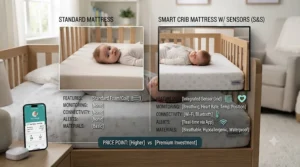
A traditional crib mattress is deliberately simple: firm, flat, tightly fitted, nothing else in the crib. A wifi enabled crib mattress or connected crib mattress setup adds a data layer on top of that same foundation — motion sensing, breathing-motion estimates, temperature readings, streamed to an app. The physical safety requirements don’t change between the two; what changes is whether you get a phone notification and an overnight report on top of that baseline.
Where the connected option genuinely helps is convenience and reassurance for anxious parents, plus useful pattern data for adjusting nap schedules over time. Where it doesn’t help is safety outcomes — no peer-reviewed evidence shows sensor-equipped mattresses reduce SIDS risk compared to a plain, CPSC-compliant mattress used correctly. Treat the smart features as a parenting-convenience layer, not a substitute for following core safe-sleep practices.
Common Mistakes When Buying a Connected Crib Mattress
The biggest mistake is buying based on marketing language like “SIDS prevention” rather than “sleep insights” or “peace of mind” — reputable brands are careful with that distinction, and you should be too. A second common mistake is skipping the mattress-thickness spec entirely, then discovering the sensor pad reads inaccurately because it’s buried under too much foam. A third: assuming pricier automatically means safer — price tracks features and brand ecosystem, not safety compliance, which should be identical across any CPSC-approved product regardless of cost.
What to Expect: Real-World Performance of Smart Sleep Sensor Mattresses
In day-to-day use, a sleep pattern tracking mattress or pad tends to be most accurate at detecting gross motion — rolling, kicking, sitting up — and least precise at fine-grained metrics like exact breathing rate, which is genuinely hard to measure non-invasively through a mattress. Expect a short settling-in period where the app’s baseline “normal” for your baby is still calibrating, typically the first one to two weeks. After that, most parents report the nightly sleep-duration and wake-window data becomes a reasonably reliable trend line, even if any single night’s numbers shouldn’t be over-interpreted.
Smart Sleep Sensor Mattresses for Different Kinds of Parents
For first-time, anxiety-prone parents, a system pairing a camera with a non-contact sensor mat (Hubble, CuboAi) tends to offer the most reassurance per dollar. For budget-focused families or those expecting multiples, the decades-proven Babysense 7 bundle scales more affordably across multiple cribs. For parents furnishing an entire nursery from scratch who value one cohesive purchase, an all-in-one system like Cradlewise reduces decision fatigue, even at a premium price. And for early-adopter households drawn to newer approaches, something like smart-cot is worth watching — with the caveat that a shorter track record means more of your own due diligence.
Long-Term Cost & Maintenance of IoT Baby Products
Beyond the upfront purchase, budget for ongoing costs: some brands gate advanced AI features or extended video history behind monthly subscriptions, while others include core functionality free forever. Replacement parts matter too — washable covers and sensor mats wear out with repeated laundering, so check whether replacement mats or covers are sold separately before you buy. Battery-powered pads (many run on AA or AAA batteries) add a small recurring cost, while WiFi camera units draw continuous power, a negligible but real addition to your utility bill. When you total the mattress or pad, any subscription, and replacement parts over two to three years of use, the true cost of IoT baby products often runs meaningfully higher than the sticker price alone suggests — worth mapping out before you commit to a premium ecosystem.
Safety, Regulations & What AAP Guidelines Actually Say About Sleep Monitors
This is the section that matters most, so let’s be direct about it. The American Academy of Pediatrics has been explicit: home cardiorespiratory monitors and other commercial products marketed around SIDS prevention have not been shown to reduce SIDS risk, and no consumer sleep monitor currently carries FDA authorization as a medical device for that purpose — they’re categorized as wellness products instead. The core safe-sleep guidance hasn’t changed because of smart tech: babies should sleep alone, on their back, on a firm and flat surface that meets Consumer Product Safety Commission standards, with nothing else in the crib — no loose bedding, no positioners, no extra padding.
That means any wifi enabled crib mattress or sensor pad you buy should sit underneath a fitted sheet on an otherwise bare, firm mattress — not add softness, incline, or bulk to the sleep surface. If a product’s marketing implies it reduces SIDS risk directly, that’s a red flag worth researching further; legitimate brands in this space generally frame their tools as sleep-pattern insight and parental reassurance, not medical prevention devices. For the full, current guidance, the Safe to Sleep campaign run through NICHD lays out every recommendation in plain language, and it’s worth a full read regardless of which gadget ends up under the mattress.
Features That Actually Matter (And Those That Don’t)
Features that matter: accurate motion/breathing-motion detection, a mattress-thickness spec that matches your actual mattress, washable components, and honest app language about what the data does and doesn’t tell you. Features that matter less than marketing suggests: elaborate “sleep score” gamification, ultra-high video resolution beyond what you’ll actually use at 2 a.m., and any feature implying medical-grade monitoring from a consumer wellness device. When comparing options, prioritize detection reliability and safety-surface compliance over flashy dashboard extras.
Frequently Asked Questions
❓ Does a wifi enabled crib mattress prevent SIDS?
❓ What mattress thickness works with sensor pads?
❓ Do these systems need a paid subscription?
❓ Can I use a sensor pad with any crib mattress?
❓ Is a built-in smart mattress better than an add-on sensor pad?
Conclusion
The wifi enabled crib mattress category has genuinely useful tools in it — breathing-motion pads that don’t touch a baby’s skin, cameras that flag rollovers, apps that turn overnight fussing into an actual pattern you can plan around. But the honest throughline across all seven products here is that none of them changes the fundamentals: a firm, flat, bare mattress that meets CPSC standards is still what keeps a baby safest, and every smart feature sits on top of that foundation rather than replacing it. Whether you land on the budget-friendly Babysense 7 bundle, the all-in-one Cradlewise system, or something in between, treat the connectivity as reassurance and convenience — real, valuable things for an exhausted parent — rather than a safety guarantee no product in this space can honestly claim.
✨ Ready to shortlist your top pick?
Revisit the comparison table above, confirm current pricing on the systems that fit your budget, and check CPSC compliance before anything goes in the registry.
Recommended for You
- 7 Best Smart Crib Mattress With Sensors Picks for 2026
- Lockable Caster Crib: 7 Secure Rolling Picks for 2026
- Rolling Crib With Locking Wheels: 7 Best Options for 2026
Disclaimer: This article contains affiliate links. As an Amazon Associate, I earn from qualifying purchases. If you purchase products through these links, we may earn a small commission at no additional cost to you.
✨ Found this helpful? Share it with your friends! 💬🤗
