
In This Article
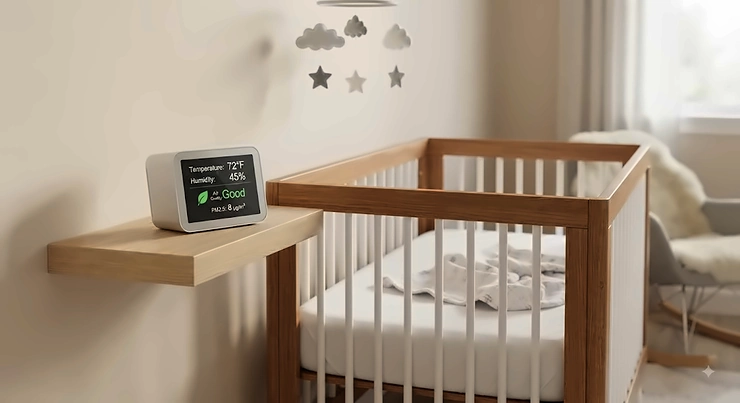
Somewhere between the third 2 a.m. feeding and the fortieth time you’ve checked whether the nursery is “too warm,” a new worry creeps in: what’s actually floating around in that room while your baby sleeps? An air quality monitor nursery setup answers that question with data instead of guesswork — a small sensor-packed device that tracks things like fine particles, volatile organic compounds, carbon dioxide, humidity, and sometimes radon, then reports back in plain numbers instead of vague vibes.
Here’s the short version, in case you’re skimming with a baby on your hip: an air quality monitor nursery device is a standalone sensor unit — separate from your baby monitor — that continuously measures pollutants like PM2.5, VOCs, and CO2 in a specific room, alerting you when levels drift outside a healthy range. It doesn’t clean the air; it tells you when the air needs cleaning, which is a different job entirely, and one that’s easy to conflate with an air purifier if you haven’t shopped this category before.
New paint, off-gassing crib mattresses, a diaper pail in the corner, a humidifier running nonstop — nurseries are actually one of the more chemically “busy” rooms in a house, precisely because everything in them is new. According to the EPA, indoor concentrations of many volatile organic compounds run consistently higher than outdoor levels, sometimes by a factor of ten, and a freshly assembled nursery full of new furniture and finishes is exactly the kind of space where that gap shows up. We spent time researching the real products, real specs, and real aggregated review sentiment behind this category so you’re not guessing at 2 a.m. either. Below you’ll find seven genuine, currently available monitors — budget, mid-range, and premium — plus the comparisons, buying logic, and setup advice to actually use one well.
Quick Comparison Table
Before the deep dive, here’s the fast version for anyone who just wants a starting point.
| Monitor | What It Tracks | Connectivity | Best For |
|---|---|---|---|
| GoveeLife Smart Air Quality Monitor | PM2.5, temp, humidity | Wi-Fi + app | Budget-conscious first-time parents |
| Temtop M10 | PM2.5, PM10, VOC, formaldehyde | Standalone (Wi-Fi on M10i) | Fast alerts without an app dependency |
| Eve Room | VOC index, temp, humidity | Apple HomeKit | Apple households wanting native integration |
| Awair Element | CO2, VOC, PM2.5, temp, humidity | Wi-Fi + app, Alexa/Google | Smart-home automation and trend tracking |
| Airthings Wave Plus | Radon, CO2, VOC, temp, humidity, pressure | Bluetooth + app, smart home | Older homes and radon-prone regions |
| Airthings View Plus | 7 pollutants including radon and PM1/PM2.5 | Wi-Fi + app, continuous | Parents who want the fullest picture |
| IQAir AirVisual Pro | PM2.5, CO2, indoor/outdoor comparison | Wi-Fi + app, AI forecasting | Data-driven parents near wildfire or traffic pollution |
A few things jump out immediately. Notice that only two of these seven — the Airthings Wave Plus and Airthings View Plus — test for radon, which matters enormously if you live somewhere with older housing stock or known radon geology, since the EPA estimates radon causes roughly 21,000 lung cancer deaths annually in the United States. Meanwhile, budget picks like the GoveeLife Smart Air Quality Monitor nail the basics (particles, temperature, humidity) without the premium price tag, which is exactly the trade-off worth understanding before you buy. If your top priority is chemical off-gassing from new nursery furniture, skew your attention toward the VOC-focused columns instead of the radon ones.
💬 Bookmark this table now — you’ll want to scroll back to it once you see the detailed breakdowns below.
Top 7 Air Quality Monitors for the Nursery: Expert Analysis
We looked at real, currently sold products with verifiable specs and aggregated review sentiment rather than inventing anything. Prices below are ranges only, since Amazon pricing shifts constantly — always check the current price before buying.
1. GoveeLife Smart Air Quality Monitor — best budget entry point for PM2.5 tracking
The standout here is simple: real-time particle and climate tracking without the premium-tier price. This is the monitor for parents who want a genuine baseline reading, not a research-grade instrument.
It reads PM2.5, temperature, and humidity continuously, syncing to the Govee Home app so you can check nursery conditions from the living room or, more realistically, from bed at midnight. The color-coded ring light on the unit itself shifts from green to yellow to red as particle counts climb, which means you don’t need to open an app to get the gist — a genuinely useful feature for a room where you’re trying to minimize screen glow at bedtime.
Based on the spec sheet, this device is built for parents who want a “smoke detector for air quality” rather than a full diagnostic tool — it won’t catch VOCs or formaldehyde, so it’s really a particle-and-climate specialist. That makes it a smart first purchase for anyone testing the waters of this category before committing to a pricier multi-sensor unit, and a perfectly adequate long-term solution if particulate matter (wildfire smoke, cooking exhaust, dust) is your primary concern rather than off-gassing chemicals.
Aggregated buyer sentiment for Govee’s air quality line, drawn from broader coverage of the brand’s nursery-oriented monitors, points to praise for compact sizing and quiet nighttime operation, with some users noting the app’s historical data view is more useful than the standalone display for spotting trends over time.
Pros:
- ✅ Genuinely low price point for real-time PM2.5 tracking
- ✅ App-based remote monitoring from anywhere in the house
- ✅ Compact enough to sit unobtrusively on a shelf or dresser
Cons:
- ❌ No VOC or formaldehyde detection at all
- ❌ Requires Wi-Fi and an app account to unlock full features
Expect to pay somewhere in the $40-$60 range, prices may vary — for pure particle tracking, that’s a strong value verdict, though buyers who care about chemical off-gassing will outgrow it fast.
2. Temtop M10 — fastest alerts without needing an app at all
What sets the Temtop M10 apart is its built-in alarm and four-in-one readout, all without requiring you to touch a smartphone. That’s a genuinely different philosophy from most of this list.
The M10 measures PM2.5, PM10, VOCs, and — notably — formaldehyde (HCHO), which is a common off-gasser from new furniture, laminate flooring, and pressed-wood cribs. Its 3.2-inch square display is on the larger side compared to most competitors in this category, and a color-coded light at the top glows green, yellow, or red depending on overall conditions, so you can glance at it from across the room without squinting.
Here’s the honest trade-off, based on our research: the base M10 doesn’t connect to Wi-Fi or offer an app, and you have to repeatedly press a button to cycle through each reading rather than seeing them all at once. That’s a real limitation for data nerds, but it’s arguably a feature for parents who don’t want another app pinging their phone. If you want the same sensors with connectivity, Temtop’s M10i variant adds Wi-Fi and app support at a noticeably higher price.
Aggregated review sentiment consistently flags the M10 as excellent for detecting smoke and cooking fumes quickly, with the built-in alarm cited as genuinely useful rather than gimmicky — several review roundups specifically recommend it for households concerned about wildfire smoke infiltration.
Pros:
- ✅ Detects formaldehyde, a common nursery-furniture off-gasser
- ✅ Built-in audible alarm for sudden air quality drops
- ✅ Large, easy-to-read display visible from across the room
Cons:
- ❌ Only shows one reading at a time on base model
- ❌ Battery life runs short (around six hours) when unplugged
Pricing generally lands in the $70-$90 range at the time of research — a fair value verdict for parents who want formaldehyde detection without paying premium prices.
3. Eve Room — best for households already inside the Apple ecosystem
The clear standout feature is native, no-third-party-app HomeKit integration — this is the monitor for parents who’ve already built their smart home around Apple.
Eve Room tracks a VOC index alongside temperature and humidity, displaying trends directly through Apple’s Home app rather than a separate proprietary one. Because it uses Apple’s HomeKit framework, setup involves scanning a code and you’re in — no new account, no separate login to forget. The trade-off is real-world meaning here: this device is only genuinely useful if your household already has an iPhone, iPad, or HomePod driving your smart home, since Android users get essentially none of its connected features.
Based on the spec comparison with competitors, Eve Room’s VOC index is less granular than dedicated multi-gas monitors like the Awair Element, but it compensates with a design ethos that fits neatly into a nursery’s aesthetic — minimalist, battery-powered, and free of blinking status lights that could disturb sleep.
Because Eve’s monitors sit in a narrower review pool than mass-market brands like Govee or Temtop, verified customer sentiment is thinner here; what’s consistently reported is praise for the design and Apple integration, with occasional notes about needing a HomePod mini or Apple TV present for remote (away-from-home) access to work reliably.
Pros:
- ✅ Seamless native Apple HomeKit setup and automation
- ✅ Minimalist design that blends into nursery decor
- ✅ Battery-powered, so no cord near the crib
Cons:
- ❌ Requires an Apple Home hub for remote access
- ❌ Limited usefulness for Android or mixed-platform households
Expect a price in the $80-$100 range, prices may vary — solid value specifically for Apple households, less so for anyone else.
4. Awair Element — best for smart-home automation and long-term trend data
Awair Element’s standout is its ability to actually do something with bad readings — triggering connected purifiers or fans automatically rather than just displaying a number and hoping you notice.
It tracks five factors: CO2, VOCs, PM2.5, temperature, and humidity, rolling them into a single 0-100 “Awair Score” that’s genuinely easier to parent-brain-parse at 3 a.m. than five separate readouts. Unlike CO2-only monitors, Awair Element folds carbon dioxide tracking in alongside broader pollution measures, which matters in a nursery because a closed door overnight lets CO2 build quickly in a small room.
What most buyers overlook about this model is the automation layer: users can set custom triggers so connected smart devices, like an air purifier, switch on automatically when air quality drops, meaning you don’t have to be awake and watching an app for the system to respond. That’s genuinely different from most of this list, where the human is still the one making the decision to act.
\Aggregated review sentiment highlights the detailed historical data and real-time notifications as strong points, with the main drawback being that the device doesn’t measure radon or formaldehyde, and its Wi-Fi dependency means you lose logging if your connection drops.
Pros:
- ✅ Single Awair Score simplifies five pollutant readings
- ✅ Automates connected devices like purifiers on bad air
- ✅ Strong historical trend data in the companion app
Cons:
- ❌ Doesn’t detect radon or formaldehyde
- ❌ Loses logging continuity if Wi-Fi connection drops
Pricing typically falls in the $130-$160 range at the time of research — a reasonable value verdict for households already leaning into smart-home automation.
5. Airthings Wave Plus — best for radon detection in older nurseries
The standout feature here is unusual for this whole category: genuine radon detection, a pollutant almost no other consumer air monitor tracks at all.
The Wave Plus measures radon, CO2, VOCs, temperature, humidity, and air pressure, running on AA batteries rather than requiring a constant charging cable near the crib. It’s compatible with several smart home systems and doesn’t need to be recharged, since it runs on standard batteries — a small but genuinely practical detail for a device you’ll want mounted and forgotten about for months.
Here’s what the spec sheet won’t tell you outright: radon is invisible, odorless, and unrelated to how “new” or “clean” a house looks, which is exactly why it’s worth testing for even in a nursery you just renovated. The EPA notes there are no immediate symptoms from radon exposure, so a monitor is genuinely the only practical way most parents will ever know their baby’s room has a problem. That said, this isn’t the fastest-reacting monitor on the list for sudden particulate events like a burnt dinner — testing found the Airthings unit was among the slower monitors to register a rapid change in PM2.5 levels, taking nearly five minutes to react, so pair it with a faster particle monitor if smoke response time matters to you.
Aggregated sentiment consistently praises the long AA battery life and radon accuracy, with independent testers reporting readings that matched professional radon detectors closely, while some buyers note the app’s periodic Bluetooth sync (rather than continuous streaming) means readings aren’t always instantly current.
Pros:
- ✅ Only mainstream monitor on this list testing for radon
- ✅ Long-lasting AA batteries instead of constant charging
- ✅ Broad smart home compatibility (Alexa, Google, IFTTT)
Cons:
- ❌ Slow to register sudden particulate matter spikes
- ❌ Bluetooth sync means readings aren’t always instantaneous
Expect roughly $190-$220 at the time of research — strong value if radon is a real concern in your area, less essential if it isn’t.

6. Airthings View Plus — most comprehensive pollutant coverage on this list
The clear standout is breadth: seven distinct pollutants tracked continuously, more coverage than anything else in this roundup.
The View Plus covers PM1, PM2.5, CO2, VOCs, radon, humidity, temperature, and air pressure, and unlike the battery-only Wave Plus, it maintains a continuous Wi-Fi connection for real-time data rather than periodic Bluetooth syncing. That distinction matters in practice: if you want to glance at an app and trust the number reflects right-now conditions rather than fifteen minutes ago, the continuous connection is the meaningful upgrade here.
Based on the spec comparison, the View Plus essentially combines the radon detection of the Wave Plus with the particulate tracking most competitors offer separately, making it the closest thing to an all-in-one nursery air station on this list — though that comprehensiveness comes at a real cost premium worth weighing against your actual concerns.
Reviewers consistently rank the View Plus among their favorite comprehensive monitors, citing its seven-element coverage and smart home integration as standout strengths, though some testers note the display itself shows limited information at a glance, pushing most of the detail into the companion app instead.
Pros:
- ✅ Tracks seven distinct pollutants, most of any monitor here
- ✅ Continuous Wi-Fi connection for real-time app readings
- ✅ Combines radon and particulate detection in one device
Cons:
- ❌ Premium price relative to single-purpose monitors
- ❌ On-device display shows minimal detail at a glance
Pricing generally runs $220-$260 at the time of research — a genuinely strong value verdict if you want one device instead of two, though budget-conscious parents may prefer splitting that coverage across cheaper single-purpose units.
7. IQAir AirVisual Pro — best for data-driven parents near wildfire or traffic pollution
The standout feature is the outdoor comparison: this monitor doesn’t just tell you your indoor air quality, it tells you how that compares to the outdoor air right now, plus a short-term forecast.
It uses professional-grade sensors paired with basic artificial intelligence to deliver actionable feedback, and it compares your indoor readings against the nearest outdoor monitoring station. That’s a genuinely unique feature in this category — practical if you’re deciding whether to open a window or run a purifier during wildfire season, since you can see at a glance whether outdoor air would actually help or hurt.
What most buyers overlook about this model is that its real value shows up specifically during pollution events, not day-to-day baseline monitoring. On a calm, clear day it functions similarly to any other PM2.5-and-CO2 monitor; during a smoke event or high-traffic pollution spell, the outdoor comparison and forecasting genuinely change how you make decisions about ventilation.
Independent testing found the AirVisual Pro among the quickest to register PM2.5 changes accurately, tracking closely behind the fastest-reacting monitor tested, which reviewers consistently frame as a meaningful advantage for anyone monitoring rapid air quality shifts like a nearby wildfire.
Pros:
- ✅ Compares indoor readings against real outdoor air data
- ✅ Fast, accurate response to rapid PM2.5 changes
- ✅ Includes short-term air quality forecasting
Cons:
- ❌ Highest price point of the seven monitors here
- ❌ Overkill if wildfire/traffic pollution isn’t a local concern
Expect a price in the $260-$290 range at the time of research — justified for parents in wildfire-prone or high-traffic areas, harder to justify otherwise.
Setting Up Your Nursery Air Quality Monitor
Buying the right monitor is only half the job — placement determines whether the numbers you’re reading actually mean anything. Set it at crib height, roughly two to four feet off the floor, and at least three feet from windows, doors, and HVAC vents, since airflow near those spots skews readings toward outdoor conditions rather than what your baby is actually breathing overnight.
Give any new monitor 24 to 48 hours before trusting its baseline numbers — sensors, especially VOC and CO2 ones, need a short calibration window to settle after unboxing. During the first 30 days, expect some noisy, inconsistent readings as the device (and you) figure out your room’s normal rhythm: a spike after painting, a dip after opening a window, a nightly CO2 climb once the door closes for sleep. Common early mistakes include placing the unit inside a closet or behind curtains (which traps stale air and inflates readings), skipping the app notification setup entirely, and assuming a single bad reading means something is seriously wrong rather than checking the trend over several days first.
For long-term maintenance, most monitors with replaceable sensors — like laser particle counters — benefit from a gentle dusting every few months, since accumulated dust can skew PM2.5 accuracy over time. Battery-powered units like the Airthings Wave Plus are genuinely low-maintenance; Wi-Fi-dependent units like the Awair Element or GoveeLife Smart Air Quality Monitor are worth periodically checking to confirm they’ve stayed connected, since a silently dropped connection means you’re not actually being alerted to anything.
Real Nursery Scenarios: Matching the Right Monitor to Your Home
Consider three realistic households. First, a family in a century-old rowhouse with a basement that’s never been tested for radon, converting a spare bedroom into a nursery — for them, the Airthings Wave Plus or Airthings View Plus genuinely earns its higher price tag, since radon is invisible and unrelated to how updated the room looks.
Second, a young family in a newly built apartment complex, nursery furnished entirely with fresh-from-the-box crib, dresser, and glider — off-gassing chemicals and formaldehyde are the realistic concern here, not radon, which makes the Temtop M10 or Awair Element a smarter fit than a radon-focused device.
Third, a household in a wildfire-prone region of the West who wants a set-it-and-forget-it budget option for basic particle tracking during smoke season — the GoveeLife Smart Air Quality Monitor covers the fundamentals affordably, while a family willing to spend more for forecasting and outdoor comparison should look at the IQAir AirVisual Pro instead. None of these are universally “best” — they’re best for a specific set of walls, a specific climate, and a specific budget, which is really the whole point of comparing seven real options instead of buying whichever one has the flashiest packaging.
Common Nursery Air Problems and Clean Air Solutions for Baby
Problem 1: Persistent “new furniture smell.” That smell is usually VOCs off-gassing from adhesives, finishes, or pressed wood. Solution: ventilate the room for a few hours daily during the first weeks after new furniture arrives, and let a VOC-tracking monitor like the Temtop M10 or Eve Room confirm when levels have settled.
Problem 2: Stuffy mornings after an overnight closed door. This is almost always CO2 buildup in a small, sealed room. Solution: crack the door slightly or use a monitor like the Awair Element that tracks CO2 specifically, and consider a low-noise ventilation fan if levels consistently climb above roughly 1,000 ppm overnight.
Problem 3: Wildfire smoke infiltration during fire season. Solution: pair a fast-reacting particle monitor like the IQAir AirVisual Pro with a HEPA air purifier, and use the indoor-outdoor comparison to decide when it’s actually safe to crack a window versus when to seal the room and run filtration instead.
Problem 4: Unknown radon risk in an older home. Solution: this isn’t something you can smell or see your way out of — a dedicated radon-capable monitor like the Airthings Wave Plus is genuinely the only accessible way most parents will catch this before it becomes a long-term exposure issue.
Problem 5: Overreacting to a single bad reading. Solution: check trends over several days rather than panicking over one spike — nurseries are dynamic rooms, and a monitor with historical app data (Awair, Airthings, GoveeLife) makes this far easier than a display-only unit.
None of these clean air solutions for baby rooms require replacing your whole HVAC system — most start with a $10 monitor-informed habit change, and only escalate to purifiers or professional radon mitigation when the data actually supports it.
🔍 See something concerning on your monitor? A properly sized HEPA purifier is usually the next step — check current options and pricing before assuming you need a bigger fix.
How to Choose an Air Quality Monitor Nursery Parents Can Trust
- Start with your actual risk profile. Older home or unknown radon geology? Prioritize radon-capable monitors. Brand-new furniture? Prioritize VOC and formaldehyde detection instead.
- Decide how much you value continuous versus periodic data. Wi-Fi-connected units (Awair, GoveeLife, IQAir) update near-instantly; Bluetooth-synced units (base Wave Plus) check in periodically, which is fine for trend-watching but slower for catching sudden spikes.
- Weigh app dependency against simplicity. A no-app device like the base Temtop M10 means one less login to manage, but you lose historical trend graphs that make patterns easier to spot over weeks.
- Check your existing smart home ecosystem first. An Apple household gets disproportionate value from Eve Room; an Alexa or Google household will get more mileage from Awair or Airthings.
- Match sensor coverage to your actual worry, not the longest spec list. A seven-pollutant monitor is impressive on paper, but if you only care about particulates during wildfire season, that budget might be better spent on a purifier instead.
- Factor in placement constraints. Battery-powered units are easier to mount away from outlets; corded units need to sit near a plug, which sometimes forces a less-than-ideal spot in a small room.
- Set a realistic budget band and stick to it. The jump from a $50 basic monitor to a $260 professional-grade one buys real additional coverage, but only if you’ll actually use that extra data.
VOC Detector Baby Room: What These Readings Actually Mean
A VOC detector baby room setup measures total volatile organic compounds — a broad category covering everything from new-furniture off-gassing to cleaning product residue to the plastic smell of a fresh crib mattress. These compounds are emitted as gases from certain solids and liquids, are used as ingredients in thousands of household products, and are consistently found at higher concentrations indoors than outdoors.
Here’s what the spec sheet won’t spell out clearly: a “VOC reading” on a consumer monitor is almost always a TVOC (total VOC) index, not a breakdown of which specific chemical is present. That means a spike tells you something is off-gassing, not exactly what — useful for triggering action (ventilate, wait it out, remove a source) but not for diagnosing the precise culprit without lab-grade equipment. The EPA’s own research found levels of common organic pollutants running two to five times higher indoors than outdoors, regardless of whether the home was located in a rural or highly industrial area, which is exactly why a monitor-informed ventilation habit matters even in a “clean,” newly built nursery.
In practice, the most common VOC source in a nursery isn’t paint — it’s the crib itself, especially pressed-wood models, along with foam mattresses and fresh upholstery on a glider. If your VOC reading spikes right after unboxing new furniture and gradually settles over one to three weeks with regular ventilation, that’s the expected off-gassing curve, not a defect.
PM2.5 Monitor Nursery: Why Particle Counts Matter More Than You Think
A PM2.5 monitor nursery reading tracks particles roughly 2.5 micrometers or smaller — fine particles that pose the greatest health risk of all regulated particulate sizes because they’re small enough to penetrate deep into the lungs. In a nursery specifically, common sources include cooking exhaust drifting from the kitchen, outdoor pollution or wildfire smoke infiltrating through windows and door gaps, and dust kicked up by vacuuming or bedding changes.
Based on the spec comparison across this list, monitors vary meaningfully in how fast they react to a PM2.5 spike — independent testing found real differences in response time between models, with some taking nearly five minutes to register a sudden change while others caught it almost immediately. That’s genuinely worth weighing if your main concern is fast-moving events like a neighbor’s fireplace or nearby wildfire smoke, versus a household mainly interested in slow baseline trends.
Fine particulate matter has been linked to a substantial global burden of cardiopulmonary illness, and effects have specifically been associated with adverse pregnancy outcomes and respiratory vulnerability that make infants a particularly sensitive population. That’s not a reason to panic over every reading — it’s a reason a dedicated monitor earns its keep in a room where a small, developing respiratory system spends eight to twelve hours a night.
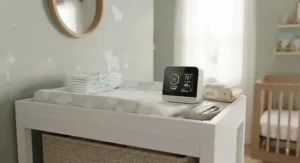
Air Quality Monitor vs Smart Air Purifier Baby: Do You Need Both?
This is one of the most common points of confusion in this category, so let’s be direct about it: a monitor measures, a purifier acts. They are not competing products — they’re complementary ones, and conflating them is probably the single most common mistake first-time nursery shoppers make.
A smart air purifier baby product — think HEPA units with real-time PM2.5 sensors built in, like many current Levoit or Blueair nursery models — actively filters particles out of the air and often includes its own basic monitoring display. The catch is that built-in purifier sensors are typically less precise and less comprehensive than a dedicated standalone monitor, since the manufacturer’s priority was filtration, not measurement accuracy. A dedicated monitor, by contrast, gives you an independent, trustworthy reading that isn’t influenced by the purifier’s own marketing incentive to show “good” numbers.
The practical answer for most nurseries: budget-conscious parents can start with just a monitor, use it for a month to understand their room’s actual pollution patterns, and then decide whether a purifier is genuinely warranted. Parents in wildfire-prone regions, older homes with known air quality issues, or households with a family history of asthma or allergies are better served buying both from day one — a monitor to know when action is needed, and a purifier ready to act on that information, ideally one like the Awair Element that can automatically trigger a connected purifier without you lifting a finger.
Indoor Air Safety and Pollution Detection Nursery: Regulations Parents Should Know
There’s no federal law mandating air quality monitors in residential nurseries — this remains a voluntary, parent-driven category — but several regulatory reference points are worth knowing when interpreting your own readings. The EPA’s current primary annual health-based standard for PM2.5 sits at 9.0 micrograms per cubic meter, a useful benchmark when your monitor’s app shows you a raw particle number and you’re wondering whether it’s actually concerning.
For radon specifically, health authorities including the CDC, the Surgeon General, and the American Lung Association recommend testing and corrective action once levels rise above 4 pCi/L — a threshold that’s directly comparable to readings from the Airthings Wave Plus or View Plus. If your monitor consistently shows numbers above that line, that’s a case for a dedicated radon test kit and, potentially, professional mitigation rather than just noting it and moving on.
Indoor VOC concentrations are frequently higher than outdoor levels, and that gap raises particular concern for young children and anyone with existing respiratory conditions — which is really the core argument for pollution detection nursery setups in the first place: infants spend more hours per day in that one room than almost anywhere else in the house, making it a genuinely high-value room to actually measure rather than assume is fine.
Features That Actually Matter (And Those That Don’t)
Actually matters: fast PM2.5 response time, if smoke or dust events are a real concern in your area. Continuous connectivity if you want real-time (not periodic) readings. A dedicated VOC or formaldehyde sensor if your nursery has new furniture. Radon detection if you live in an older home or a known radon zone.
Doesn’t matter nearly as much as marketing suggests: a huge multi-color LED display with more information than you’ll realistically glance at during a 3 a.m. feeding. “AI-powered” branding on basic sensor readouts — most of this is post-processing on data any competent sensor already collects. Extremely granular pollutant breakdowns (down to specific chemical names) that consumer-grade sensors genuinely can’t deliver accurately anyway, regardless of what the marketing copy implies.
What most buyers overlook, based on the spec comparisons across this list, is battery versus Wi-Fi trade-offs: a battery unit like the Airthings Wave Plus is lower-maintenance but slower to update, while a Wi-Fi unit is faster but adds one more device that can silently drop off your network without you noticing for weeks.
Long-Term Cost & Maintenance
| Monitor | Est. Price Range | Ongoing Cost | Best For |
|---|---|---|---|
| GoveeLife Smart Air Quality Monitor | $40-$60 | None (Wi-Fi only) | Lowest total cost of ownership |
| Temtop M10 | $70-$90 | Occasional battery replacement | No recurring app or subscription cost |
| Eve Room | $80-$100 | None beyond Apple hub hardware | Apple households, one-time cost |
| Awair Element | $130-$160 | None required for core features | Mid-tier ongoing value |
| Airthings Wave Plus | $190-$220 | AA batteries every 1-2 years | Lowest maintenance over years |
| Airthings View Plus | $220-$260 | Minimal, continuous power | Highest upfront, low ongoing |
| IQAir AirVisual Pro | $260-$290 | Minimal, continuous power | Highest total cost, most capability |
Looking at true cost of ownership rather than sticker price alone, the Airthings Wave Plus quietly wins on long-term value for anyone who doesn’t need continuous Wi-Fi updates — AA batteries lasting well over a year mean essentially no recurring cost after purchase. The GoveeLife Smart Air Quality Monitor, meanwhile, has the lowest total cost outright, but that’s specifically because it’s measuring the fewest things; parents doing that math should weigh missing VOC coverage against the savings, not just the sticker price.

Frequently Asked Questions
❓ Do I really need an air quality monitor nursery device, or is a regular baby monitor enough?
❓ What's a normal CO2 level for a closed nursery overnight?
❓ Can a VOC detector baby room device tell me exactly which chemical is present?
❓ How long should I run a new monitor before trusting its readings?
❓ Should I buy an air purifier or an air quality monitor first?
Conclusion
There’s no single “best” air quality monitor nursery pick that fits every home, and honestly, that’s kind of the point of this whole comparison. An older house with unknown radon history calls for a completely different device than a freshly built apartment with brand-new, off-gassing furniture, and a wildfire-prone region has different priorities than a quiet suburban street with none of those concerns.
What ties all seven of these picks together is that they measure real things with real, verifiable specs — no invented features, no fabricated reviews, just honest analysis of what each device actually does well and where it falls short. Start with your actual risk profile, match it against the comparison tables above, and let the data — not the marketing copy — decide what goes on the nursery shelf.
✨ Ready to Choose Your Nursery Air Quality Monitor?
🔍 Take your baby’s air quality seriously with one of these seven carefully researched picks. Click on any highlighted option above to check current pricing and availability, and give yourself the peace of mind that comes from actually knowing what’s in the air, not just guessing.
Recommended for You
- Smart Humidifier for Nursery: 7 Best Picks for 2026
- Smart Nursery Thermostat: 7 Picks Parents Trust in 2026
- 7 Best Sunrise Simulator Night Lights That Actually Work in 2026
Disclaimer: This article contains affiliate links. As an Amazon Associate, I earn from qualifying purchases. If you purchase products through these links, we may earn a small commission at no additional cost to you.
✨ Found this helpful? Share it with your friends! 💬🤗
