

In This Article
Somewhere around week eight, your baby throws a punch in their sleep, twists half a body-length sideways, and you realize: the swaddle days are numbered. That’s the moment most parents start Googling adjustable swaddle transition at 2 a.m., bleary-eyed and half-convinced they’ve broken their baby’s sleep forever. You haven’t. What you’re facing is one of the most predictable — and most solvable — hurdles in the first year.

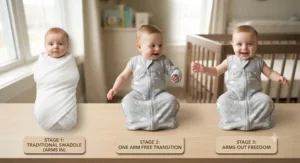
An adjustable swaddle transition simply means moving your baby from a fully arms-in swaddle to arms-free sleep using gear that lets you make the change in stages instead of all at once, usually through zip-off sleeves, snap adjustments, or convertible wings. Pediatric guidance is consistent on timing: babies should stop being swaddled the moment they show any sign of rolling, which often happens between two and four months, according to the American Academy of Pediatrics. The trouble is that “stop swaddling” and “get everyone back to sleeping through the night” are two very different goals, and the gap between them is exactly where an adjustable transition product earns its keep.
This guide breaks down seven real, currently available products that handle that gap in genuinely different ways — some through removable sleeve mechanisms, some through adaptive zippers, some through fully customizable sizing. We’ll compare them head-to-head, dig into what the specs actually mean for a squirmy 12-week-old, and walk through the transition process step by step. No fabricated five-star reviews here — just honest analysis grounded in real product design and aggregated reviewer sentiment, so you can pick the flexible sleep solution that actually fits your baby’s temperament instead of the one with the prettiest marketing photos.
Quick Comparison Table
Before we go deep on all seven, here’s the scannable version for the sleep-deprived skimmer.
| Product | Transition Method | Best For | Price Range |
|---|---|---|---|
| HALO SleepSack Swaddle 3-Way Adjustable | Fold-down wings, arms in/out | First-timers wanting one product for the whole journey | Budget, roughly $25–$35 |
| Love To Dream Swaddle Up Transition Bag | Zip-off wings, one arm at a time | Babies who fight losing both arms at once | Mid-to-premium, roughly $35–$45 |
| SwaddleDesigns Transitional Swaddle Sack | Half-length sleeves, foldover mitten cuffs | Babies who self-soothe by sucking their hands | Mid-range, roughly $28–$36 |
| SleepingBaby Zipadee-Zip Transition Swaddle | Starfish shape, single center zipper | Rolling babies who need full limb freedom fast | Mid-range, roughly $30–$40 |
| Woolino 4 Season Ultimate Sleep Sack | Adjustable underarm and shoulder snaps | Year-round use across multiple seasons | Premium, roughly $70–$90 |
| Baby Merlin’s Easy Transition Sleep Sack | Sleeveless wearable design for rolling babies | Budget-conscious parents past the arms-up phase | Budget, roughly $25–$32 |
| Kyte Baby Sleep Bag with Adjustable Sizing | Snap-adjustable shoulder sizing, bamboo rayon | Parents prioritizing fabric feel and TOG precision | Premium, roughly $48–$60 |
A quick read of the table already tells a story: this isn’t a “one winner” category. The HALO SleepSack Swaddle and Baby Merlin’s Easy Transition Sleep Sack anchor the budget end and work well as a first purchase, while the Woolino 4 Season Ultimate Sleep Sack and Kyte Baby Sleep Bag justify their higher price tags with fabric performance that pays off over months of nightly washes. The middle of the pack — Love To Dream, SwaddleDesigns, and SleepingBaby’s Zipadee-Zip — differ less on price and more on mechanism, which matters more than cost for babies who have strong opinions about how their arms get freed.
💬 Found a comparison that clicked? Save this table for your next 3 a.m. scroll — future-you will thank you.
Top 7 Adjustable Swaddle Transition Products: Expert Analysis
We researched real listings, specs, and aggregated buyer sentiment for each of these seven picks. None of the commentary below is based on hands-on testing by this writer — it’s honest analysis built from manufacturer specifications and the patterns that show up consistently across verified buyer feedback.
1. HALO SleepSack Swaddle 3-Way Adjustable — most trusted hospital-grade adjustable swaddle
The standout here is right in the name: this is the swaddle most U.S. hospitals hand new parents on day one, and that ubiquity isn’t an accident. The 3-way adjustable design lets you swaddle both arms in, do a hands-to-face partial wrap, or release one or both arms — all in the same garment, which is exactly what an adjustable swaddle transition needs to be genuinely useful. The wide, hook-and-loop wings mean you’re not buying a separate product for every stage; you’re just changing how you fold the same one.
Materially, it’s a cotton or micro-fleece sack with a two-way bottom zipper, which sounds minor until you’re doing a midnight diaper change without fully unwrapping a sleeping baby. Reviewers consistently report that the fastener holds up well through the newborn phase but note the hook-and-loop can grab onto other laundry in the wash — a small but real annoyance that shows up often enough in aggregated feedback to mention. This is the pick for parents who want to buy once and adjust as their baby’s needs shift, rather than restocking gear every few weeks. Budget-conscious households and first-time parents unsure which transition style their baby will prefer both do well starting here, since the adjustability hedges against guessing wrong. At around $25–$35 depending on size and fabric, it’s one of the more accessible entries in this roundup, and the value proposition holds up: you’re paying for one product that reasonably covers three developmental stages.
Pros:
- ✅ Covers arms-in, hands-to-face, and arms-out in one product
- ✅ Two-way zipper simplifies nighttime diaper changes
- ✅ Widely available and hip-healthy certified design
Cons:
- ❌ Hook-and-loop fasteners can be noisy at night
- ❌ Fabric can attract lint and other laundry items in the wash
At around $25–$35 (check current price for exact figures), the HALO SleepSack Swaddle earns its reputation as the safe, adjustable default — not the flashiest option, but a genuinely dependable one.
2. Love To Dream Swaddle Up Transition Bag — best zip-off wings for gradual weaning
Love To Dream’s Swaddle Up Transition Bag solves a problem the arms-in-arms-out fold-down style doesn’t: babies who wake up furious the instant both arms come free at once. The standout feature is a pair of zip-off wings you remove one at a time, so your baby experiences one loose arm for a few nights before losing the second — a gradual weaning path that mirrors what many pediatric sleep consultants recommend for reflex-sensitive babies.
The base garment keeps the brand’s signature arms-up position, which lets babies self-soothe by bringing their hands near their face even before the wings come off — a detail that matters because forcing arms-down too early can work against a baby’s natural startle-reflex pattern rather than with it. Once both wings are removed, what’s left functions as a standard sleeveless sleep sack, so there’s no need to buy a fourth product once the transition finishes. Aggregated reviewer sentiment skews positive on the zipper quality and fabric stretch, though a recurring theme in feedback is that the two-stage unzip process takes a night or two of parental fumbling before it becomes second nature. This is the pick for babies with a strong startle reflex or a track record of fighting sudden change; the incremental approach costs a bit more but can mean fewer disrupted nights during the switch. Expect to pay in the $35–$45 range, which sits comfortably mid-pack for this category.
Pros:
- ✅ One-arm-at-a-time removal eases the reflex adjustment
- ✅ Arms-up design supports self-soothing throughout the process
- ✅ Converts into a standard sleeveless sack when finished
Cons:
- ❌ Higher price point than single-stage transition sacks
- ❌ Two-way zip mechanism has a learning curve for new users
If your baby has ever seemed personally offended by a sudden change in routine, the Love To Dream Swaddle Up Transition Bag‘s staged approach is worth the extra cost.
3. SwaddleDesigns Transitional Swaddle Sack — best nurse-designed half-sleeve transition
Developed by a registered nurse specifically for the in-between stage, the SwaddleDesigns Transitional Swaddle Sack takes a different structural approach: half-length sleeves ending in foldover mitten cuffs that can be worn open or closed. That design detail is the whole point — closed cuffs offer partial suppression of the Moro reflex while still letting a baby’s arms move and reposition if they roll, and open cuffs give full hand access for self-soothing once you’re ready for that stage.
What the spec sheet won’t tell you outright, but the design implies, is that this product is trying to solve the “all or nothing” problem shared by many single-mode swaddles: most either fully restrict or fully release, with no middle setting. The half-sleeve construction gives you that middle setting without requiring a second purchase. Reviewers frequently mention that babies who were fighting a full-arm swaddle settled more easily once switched to this half-sleeve format, and the foldover mitten cuffs get consistent praise for preventing self-scratching during the newborn phase. It’s a strong match for babies who visibly calm themselves by bringing hands to their face, and for parents who want a professionally designed middle step rather than building one out of a standard swaddle. Pricing typically lands around $28–$36, putting it squarely in the mid-range tier alongside comparable convertible designs.
Pros:
- ✅ Foldover mitten cuffs allow open or closed hand access
- ✅ Partial Moro reflex suppression without restricting rolling
- ✅ Designed specifically for the transition stage, not repurposed
Cons:
- ❌ Shorter sleeve length may run snug on longer-limbed babies
- ❌ Limited color and pattern selection compared to bigger brands
For a product engineered from the ground up around the transition stage rather than adapted from a full swaddle, the SwaddleDesigns Transitional Swaddle Sack is hard to beat on purpose-built design.
4. SleepingBaby Zipadee-Zip Transition Swaddle — best starfish shape for rolling babies
The Zipadee-Zip takes a visually distinctive approach — a starfish-shaped cut with a single center zipper — that’s built around one priority: getting a rolling baby full limb freedom without the swaddle-shaped panic that can come from switching cold turkey to a plain wearable blanket. The extended sleeves give arms and legs somewhere to go, which in practice means less flailing-into-the-crib-slats than a baby transitioning straight from a snug swaddle to loose sleepwear.
The single zipper (versus the two-way designs common elsewhere on this list) is a meaningful trade-off: it’s faster for daytime changes but doesn’t offer the same bottom-access convenience for overnight diaper duty. Reviewers commonly describe the fabric as substantial without being overly warm, and several note that the extended sleeve length seems to reduce the jerky, self-startling movements some babies show right after losing a full swaddle — though that’s an observed pattern in feedback, not a clinically studied claim. This product is best suited to babies who are already rolling and need a same-day switch rather than a phased one, since there’s no partial-restriction mode; it’s a full transition tool, not an in-between step like the SwaddleDesigns option above. Expect a price range around $30–$40.
Pros:
- ✅ Starfish cut gives full arm and leg range of motion
- ✅ Substantial fabric weight without excess warmth
- ✅ Ideal for babies already actively rolling
Cons:
- ❌ Single zipper is less convenient for nighttime diaper changes
- ❌ No partial-restriction mode for a gradual switch
When your baby has already started rolling and there’s no time for a slow phase-out, the SleepingBaby Zipadee-Zip Transition Swaddle is built for exactly that moment.
5. Woolino 4 Season Ultimate Sleep Sack — best merino wool temperature regulation
Woolino takes the adjustable swaddle transition conversation in a different direction entirely: instead of offering multiple TOG-rated products for different seasons, the 4 Season Ultimate Sleep Sack uses merino wool’s natural temperature-regulating properties to work across a wider range of room temperatures in one garment. Underarm snaps adjust the fit as your baby grows, and shoulder snaps combined with a two-way zipper let the whole thing lay flat for easy on-and-off — a genuinely useful detail when you’re dressing a half-asleep infant.
The practical case for merino here is moisture-wicking: wool pulls dampness away from skin rather than trapping it the way some synthetic fleece blends do, which matters for babies prone to night sweats or overheating — a documented SIDS risk factor per pediatric guidance. This one-size-fits-most design (roughly 2 months to 2 years, per sizing) is aimed at parents who’d rather buy one higher-quality product than replace sleep sacks every few months as their baby grows. Aggregated reviews frequently mention the fabric holding its shape and softness after repeated washing, a durability signal that matters given the premium price point. It’s not the cheapest entry on this list, typically running $70–$90, but for families who care about a longer usable window and reduced seasonal buying, the total cost of ownership argument holds up reasonably well against buying three or four cheaper sacks over the same period.
Pros:
- ✅ Merino wool wicks moisture for reduced overheating risk
- ✅ Adjustable snaps extend usable fit as baby grows
- ✅ Works across multiple seasons without swapping products
Cons:
- ❌ Premium price relative to cotton or fleece alternatives
- ❌ Wool requires gentler laundering than machine-friendly cotton
If merino’s care requirements don’t scare you off, the Woolino 4 Season Ultimate Sleep Sack offers one of the more genuinely adjustable, long-horizon options in this roundup.
6. Baby Merlin’s Easy Transition Sleep Sack — best budget pick for babies past the arms-up phase
Distinct from the brand’s heavier weighted sleep suit, the Easy Transition Sleep Sack is a sleeveless wearable blanket specifically positioned for babies who are already rolling and need full arm freedom, typically in the 3–9 month range. The standout feature is simplicity: no partial-restriction mode, no zip-off wings, just a straightforward wearable blanket designed to be safe once your baby is past the point where any arm restriction makes sense.
That simplicity is deliberate rather than a missing feature. Once a baby is reliably rolling both ways, pediatric guidance is clear that arm restriction of any kind should stop, and this product is built around that exact safety line rather than trying to straddle it. Reviewers commonly describe it as an easy, low-drama “next step” purchase after a more structured transition swaddle — the product most families land on once the fussier zip-off or half-sleeve stage is behind them. It’s also one of the more budget-friendly options here, generally priced around $25–$32, which makes it a sensible pick for parents who don’t want to overspend on what is functionally the last rung of the swaddle-to-sleepwear ladder. The trade-off is that it offers nothing for babies who still want some upper-body containment; if your baby isn’t rolling yet, this isn’t the product for that stage.
Pros:
- ✅ Purpose-built for babies who are already rolling
- ✅ Budget-friendly relative to convertible or wool options
- ✅ Simple, low-fuss design with no fasteners to manage
Cons:
- ❌ No partial-restriction option for babies not yet ready
- ❌ Sizing runs narrow according to several buyer reports
For the final stretch of the journey, Baby Merlin’s Easy Transition Sleep Sack is a practical, affordable landing spot rather than a transition tool in itself.
7. Kyte Baby Sleep Bag with Adjustable Sizing — best bamboo rayon fabric with precise fit control
Rounding out the list, the Kyte Baby Sleep Bag leans into fabric feel as its differentiator: a bamboo-rayon blend that reviewers consistently describe as noticeably softer than cotton, paired with adjustable snap sizing at the shoulders that lets one sack fit a wider weight range than fixed-size alternatives. Multiple TOG options let parents match the sack to room temperature more precisely than a single-weight product allows.
The adjustable shoulder snaps are the detail worth dwelling on: instead of a hard size cutoff, the sack can be cinched smaller for a newer baby or let out as they grow, meaningfully extending the usable window compared to fixed-dimension sleep sacks. That’s a genuine customizable swaddle option, not just marketing language — the snap mechanism physically changes the garment’s proportions. Reviewer sentiment is strongly positive on fabric softness and colorfastness after washing, with a recurring note that the drape feels closer to loungewear than typical baby sleepwear stiffness. This is the pick for parents prioritizing tactile comfort and precise seasonal TOG matching over structured transition mechanics like zip-off wings, and it suits families who plan to keep the same sack in rotation for many months. It’s priced at the premium end, generally $48–$60, reflecting both the fabric cost and the multi-TOG product line.
Pros:
- ✅ Bamboo rayon fabric is notably soft and breathable
- ✅ Adjustable snap sizing extends the usable weight range
- ✅ Multiple TOG options allow precise seasonal matching
Cons:
- ❌ Among the pricier options in this comparison
- ❌ No built-in arm-restriction mode for the earliest transition stage
For parents who care as much about how the fabric feels against skin as they do about the mechanics of the transition, the Kyte Baby Sleep Bag earns its premium price tag.
Practical Usage Guide: Making the Adjustable Swaddle Transition Work
Buying the right product is half the job. How you actually use it in the first thirty days determines whether your baby settles into the change in a week or fights it for a month. Start by introducing the new gear during a daytime nap rather than at bedtime — babies are more forgiving of an unfamiliar sensation when they’re not also fighting overtiredness. If you’re using a staged product like the Love To Dream Swaddle Up Transition Bag or the fold-down wings on the HALO SleepSack Swaddle, free one arm for three to five consecutive nights before touching the second; resist the urge to rush both arms out together just because the first arm went smoothly.
Keep the room temperature consistent — around 68–72°F is the commonly cited comfort range — since a newly un-swaddled baby loses a layer of built-in warmth and may need a slightly warmer sleeper underneath during the adjustment window. Expect a rockier first three nights regardless of which product you choose; this is normal and not a sign you picked the wrong sack. A common mistake in this window is switching products mid-transition because the first few nights felt hard — give any single approach at least five to seven nights before concluding it isn’t working, since early wake-ups are frequently just the adjustment period rather than the product’s fault. Finally, wash new sleepwear before first use and inspect fasteners weekly; hook-and-loop wings and snaps both loosen with repeated laundering, and a fastener that no longer holds securely should be treated as a signal to size up, not to keep using loosely.
Real-World Scenario: Matching a Product to Your Baby
Consider three common situations. First, a first-time parent with a 7-week-old who hasn’t rolled yet but startles easily during light sleep — this is the textbook case for the HALO SleepSack Swaddle‘s hands-to-face mode or the SwaddleDesigns Transitional Swaddle Sack‘s closed mitten cuffs, since both offer partial containment without a hard commitment to full arms-out. Second, a family whose 10-week-old has just started rolling belly-down during tummy time and clearly isn’t far from doing it in the crib — safety guidance is unambiguous here, and the SleepingBaby Zipadee-Zip Transition Swaddle or Baby Merlin’s Easy Transition Sleep Sack are the appropriate next step, since any continued arm restriction becomes a genuine risk once rolling starts.
Third, a budget-conscious family in a climate with big seasonal temperature swings, trying to avoid buying four separate sleep sacks across a year — the Woolino 4 Season Ultimate Sleep Sack‘s temperature-regulating wool or the Kyte Baby Sleep Bag‘s multiple TOG options within one adjustable-sizing product line make more financial sense than repeatedly buying fixed-weight cotton sacks. None of these scenarios has a universally “best” answer; the right pick depends on rolling status first, temperament second, and budget third — in that order, because rolling status is a safety consideration, not a preference.

How to Choose an Adjustable Swaddle Transition Product
Cutting through the marketing, here’s the actual decision framework, in priority order:
- Check rolling status first. If your baby can roll either direction, any arm-restricting product is off the table regardless of how well-reviewed it is — this isn’t a style preference, it’s the core safety line pediatric guidance draws.
- Identify your baby’s soothing style. Babies who calm by bringing hands to their face generally do better with arms-up or partial-cuff designs; babies who don’t show that pattern often transition fine straight to a sleeveless sack.
- Decide gradual versus immediate. A staged product like a zip-off-wing design costs more but reduces the shock of full arm freedom arriving all at once.
- Match fabric to your climate and season. A single-TOG cotton sack works fine in a temperature-controlled nursery; multi-TOG or wool options earn their price in homes without reliable climate control.
- Confirm hip-healthy construction. Regardless of arm design, the product should leave the hips and knees free to move into a natural “M” position — a standard the International Hip Dysplasia Institute recommends for all swaddling and sleep sack products.
- Weigh fastener type against your patience for 3 a.m. changes. Two-way zippers make bottom access easier than hook-and-loop wings or single center zips.
- Set a budget band and stick close to it. Beyond a certain price point, you’re mostly paying for fabric feel and brand polish rather than meaningfully better safety outcomes.
Reference points like the Safe to Sleep campaign run through the National Institutes of Health are worth bookmarking, since sleepwear guidance occasionally gets refined as new research comes in.
✨ Ready to Simplify the Switch?
🔍 Compare the seven picks above side by side and click through to check current availability. The right adjustable swaddle transition product can turn a chaotic week into a manageable one — for your baby and for your own sleep.
Removable Sleeve Sleep Sack Designs: What Sets Them Apart
A removable sleeve sleep sack takes a mechanically different approach than a fold-down or zip-off wing swaddle: instead of tucking or unzipping fabric that stays attached, the sleeves detach entirely, converting the garment into a true sleeveless sack once removed. The practical upside is a cleaner conversion — there’s no loose wing fabric flapping once you’re done with it, which some parents find reduces the odds of a baby’s hand getting tangled during the in-between nights. The SwaddleDesigns Transitional Swaddle Sack‘s foldover cuffs sit adjacent to this category, offering a softer middle ground between fully detachable sleeves and a fixed swaddle wrap.
The trade-off worth knowing: fully removable sleeve mechanisms sometimes rely on smaller fasteners (snaps or zippers) at the shoulder, which need regular inspection since infant sleepwear standards are strict about small parts and choking hazards. If you go this route, check the product’s care instructions closely and retire any garment where the fastener no longer sits flush against the fabric. Removable sleeve construction tends to suit parents who want a visibly “finished” product after conversion rather than a modified swaddle with visible tuck points — a small aesthetic detail, but one that shows up often enough in reviews to be worth naming.
Adaptive Transition Sleep Bag vs. Traditional Swaddle Blankets
The core difference between an adaptive transition sleep bag and a traditional swaddle blanket comes down to structure versus improvisation. A traditional muslin or cotton swaddle blanket is a flat piece of fabric you fold and tuck by hand — infinitely adjustable in theory, but entirely dependent on your folding technique for safety and secureness. An adaptive transition sleep bag, by contrast, has built-in structure: pre-shaped sleeves, fasteners at fixed points, and a fit that doesn’t loosen the way a hand-tucked blanket can over the course of a wriggly night.
| Factor | Traditional Blanket | Adaptive Transition Sleep Bag |
|---|---|---|
| Setup time | Requires practiced folding technique | Zip or snap, done in seconds |
| Consistency overnight | Can loosen or come undone | Fasteners hold shape through the night |
| Transition flexibility | Manual — you decide how tight to fold | Built-in stages (e.g., Love To Dream‘s zip-off wings) |
| Hip safety | Depends entirely on folding method | Pre-shaped to allow hip movement |
| Best For | Parents confident in swaddling technique | Parents wanting a repeatable, low-error routine |
The blanket approach isn’t wrong, but it puts more responsibility on the caregiver to get the fold right every single time, including during groggy overnight changes. Adaptive sleep bags remove a lot of that variability, which is a meaningful advantage during a stage when everyone in the house is running on reduced sleep and error rates go up. For families who’ve already mastered blanket swaddling and feel confident in it, sticking with a familiar technique a little longer isn’t unreasonable — but once the transition phase starts, the built-in staging of a product like the SleepingBaby Zipadee-Zip Transition Swaddle generally produces more consistent results than hand-folding a looser and looser blanket wrap each night.
Customizable Swaddle Options for Every Growth Stage
Customizable swaddle options — adjustable snaps, multiple TOG ratings, expandable panels — exist because babies don’t grow on a predictable schedule, and a sack sized precisely for an 8-pound newborn is often uncomfortably snug by week six. The Woolino 4 Season Ultimate Sleep Sack‘s underarm snaps and the Kyte Baby Sleep Bag‘s shoulder sizing both address this directly, letting one product flex across a wider weight range instead of forcing a repurchase every couple of months.
The value case for customizable options is strongest for families expecting a long usable window — a one-size sack that fits from two months to a year effectively replaces two or three fixed-size purchases, which starts to offset the higher upfront price. It’s a weaker case for very short-term needs, like a newborn gift purchase for the earliest weeks only, where a cheaper fixed-size product does the job without paying for adjustability you won’t use for long. When comparing customizable products, check specifically what’s adjustable — snap range, fabric stretch, or interchangeable sleeve pieces — since “customizable” gets used loosely in product marketing and doesn’t always mean the same mechanism twice.
Flexible Sleep Solutions for Different Climates and Seasons
Flexible sleep solutions matter more than most first-time parents expect, because a sack that’s perfectly comfortable in a 70°F nursery in spring can run genuinely too warm — or too cool — by the time summer or winter arrives. TOG rating is the number to watch: lower TOG (roughly 0.5) suits warmer rooms above 75°F, while higher TOG (2.5 and above) is built for cooler rooms under 68°F. Products offering multiple TOG options within one adjustable-sizing line, like the Kyte Baby Sleep Bag, let you rotate fabric weight seasonally without changing the sizing you’ve already dialed in.
For households without reliable climate control — think older homes, nurseries above a garage, or apartments with inconsistent heating — natural fiber options like the Woolino 4 Season Ultimate Sleep Sack‘s merino wool offer a genuine practical advantage, since wool’s insulating properties adjust somewhat to ambient temperature rather than trapping heat uniformly the way some synthetic fleece blends can. The general safety principle to hold onto regardless of fabric choice: dress your baby in roughly one layer more than you’d wear comfortably in the same room, and watch for overheating signs like damp hair or flushed cheeks rather than relying on room thermometer readings alone.
Common Mistakes When Buying Transitional Baby Gear
The most frequent mistake with transitional baby gear is buying based on the baby you have today rather than the one you’ll have in six weeks — a snug-fitting swaddle purchased at 3 weeks is often outgrown well before the transition stage actually arrives, leaving parents needing a second purchase anyway. A related error is assuming one product will last through the entire journey from newborn to sleeveless sack; most families genuinely do need two products — an early swaddle and a later transition piece — and expecting a single garment to cover both stages usually ends in disappointment.
Another common misstep is under-researching hip safety. Some inexpensive transitional products prioritize a snug, secure-looking fit over hip and knee freedom, which runs against the hip-healthy standard endorsed by orthopedic groups. A third mistake is switching products too frequently during a rough patch — as covered in the usage guide above, a few difficult nights are often just adjustment, not evidence the product is wrong. Finally, parents sometimes skip reading the weight and age range on the packaging and end up sizing down too late, missing the point where a snug swaddle becomes an unsafe one as the baby grows into it. Reading the actual size chart, rather than trusting the age label alone, avoids most of this category of error.
Safety, Regulations, and Compliance Guide
Two safety frameworks govern this entire product category, and it’s worth understanding both. The first is general safe-sleep guidance: back-to-sleep positioning, a firm flat surface, and — specific to swaddling — discontinuing any arm restriction the moment a baby shows rolling signs, since a swaddled baby who rolls onto their stomach faces increased suffocation risk if their arms aren’t free to help them reposition. This is the single most important rule in this entire guide, and it overrides brand preference, price, or how much your baby seems to love their current swaddle.
The second framework is hip health. Improperly fitted swaddles and sleep sacks that hold the legs straight and pressed together can increase the risk of hip dysplasia, which is why orthopedic and pediatric organizations jointly promote “hip-healthy” design standards that keep the hips and knees free to move into a natural bent, spread position. Before buying any product on this list, it’s worth checking that it isn’t on a current recall — the Consumer Product Safety Commission maintains a searchable recall database for exactly this purpose, and it takes under a minute to check a model name. Weighted swaddles and weighted sleep sacks specifically fall outside current safety guidance and aren’t recommended by pediatric bodies regardless of marketing claims about calming benefits — none of the seven products featured here use weighted construction, which was a deliberate filter in the research for this guide.
Long-Term Cost and Value Analysis
Looking at total cost over a realistic six-to-nine-month transition window changes the math on some of these products. A single HALO SleepSack Swaddle or Baby Merlin’s Easy Transition Sleep Sack at the budget end costs less upfront, but many families end up buying two or three sizes as the baby grows, since fixed-dimension products don’t flex much. Adjustable options like the Woolino 4 Season Ultimate Sleep Sack or Kyte Baby Sleep Bag cost more per unit but often replace two or three separate purchases, narrowing — and sometimes closing — the total-spend gap by the end of the first year.
| Product | Upfront Price Range | Typical Replacement Need | Rough Cost-Per-Month of Use |
|---|---|---|---|
| HALO SleepSack Swaddle | $25–$35 | Often re-purchased in 1–2 larger sizes | Moderate |
| Love To Dream Swaddle Up Transition Bag | $35–$45 | Usually one size covers the transition window | Moderate |
| Woolino 4 Season Ultimate Sleep Sack | $70–$90 | Rarely — one-size design covers months | Low over a full year |
| Kyte Baby Sleep Bag | $48–$60 | Occasionally, across larger size breaks | Low-to-moderate |
The takeaway isn’t that premium options are automatically the better value — it’s that the “best value” pick depends on how long you actually plan to use it. A product bought primarily for a six-week transition window doesn’t need to be the adjustable, multi-season option; a product you’re hoping to keep in rotation for eight months or more usually earns back its higher price through fewer replacement purchases.
💬 Comparing costs like this can feel tedious at midnight — bookmark this section and come back when you’re actually ready to buy.
What to Expect: Real-World Performance During the Transition
Specs on a product page rarely tell you what the first week actually feels like. In practice, most babies show one to three nights of more frequent waking after any swaddle change, regardless of which product replaces the old one — this is a near-universal pattern across aggregated parent reports and isn’t specific to any single brand. Arm movement typically looks jerky and startled at first, even with hip-healthy, arm-friendly designs, simply because the sensation of unrestricted movement is new. By around night five to seven, most babies settle into noticeably calmer sleep with the new gear, provided the room temperature and bedtime routine otherwise stay consistent.
Daytime naps often adjust faster than overnight sleep, since shorter sleep cycles give a baby more chances to self-soothe back down without a prolonged struggle. If a baby is still waking dramatically more after ten days with no improving trend, that’s a reasonable point to reconsider fit, fabric weight, or whether the chosen transition stage (partial versus full arm freedom) matches where the baby actually is developmentally — not a sign to panic, but a sensible checkpoint.

Frequently Asked Questions
❓ When should I start the adjustable swaddle transition?
❓ Can I use a removable sleeve sleep sack from birth?
❓ How long does the full swaddle transition usually take?
❓ Are adaptive transition sleep bags safe for overnight use?
❓ Do customizable swaddle options really extend how long I can use one product?
Conclusion
There’s no single best adjustable swaddle transition product for every baby, and honestly, that’s good news — it means the range of options here exists because babies genuinely differ in how they handle losing the swaddle. A baby who self-soothes with their hands near their face will likely do best with the HALO SleepSack Swaddle‘s hands-to-face mode or the SwaddleDesigns Transitional Swaddle Sack‘s foldover cuffs. A baby who’s already rolling needs the full-freedom design of the SleepingBaby Zipadee-Zip Transition Swaddle or Baby Merlin’s Easy Transition Sleep Sack without delay. And families thinking about the next six to twelve months of nights, not just the next two weeks, may find the Woolino 4 Season Ultimate Sleep Sack or Kyte Baby Sleep Bag‘s adjustable sizing pays for itself.
Whatever you choose, the safety fundamentals don’t change: stop any arm restriction the moment rolling starts, keep hips free to move naturally, check for current recalls before buying secondhand, and give any new product a full week before deciding it isn’t working. The rest — fabric feel, fastener style, price point — is genuinely a matter of matching gear to your particular baby’s temperament, which is exactly what the comparisons above are meant to help you do.
Recommended for You
- Swaddle Transition Bag: 7 Best Picks to End 3AM Wake-Ups (2026)
- 7 Best Walking Sleep Sack Toddler Picks (2026 Guide) — Safe & Cozy
- 7 Best wifi sleep sack monitor Picks for Safer Sleep in 2026
Disclaimer: This article contains affiliate links. As an Amazon Associate, I earn from qualifying purchases. If you purchase products through these links, we may earn a small commission at no additional cost to you.
✨ Found this helpful? Share it with your friends! 💬🤗
