
In This Article
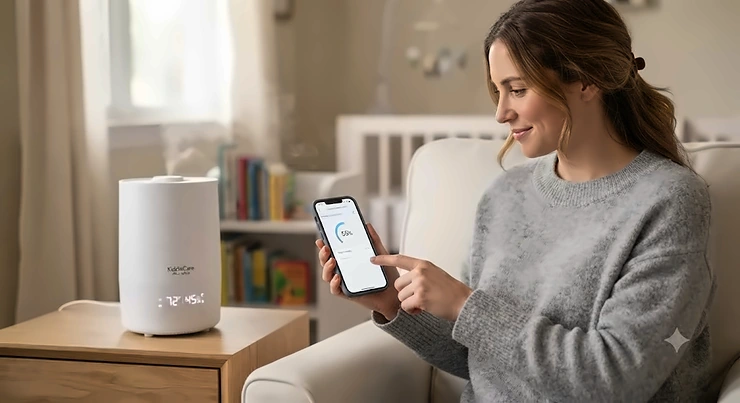
Somewhere around 2 a.m., with a fussy baby and a radiator that’s turned your nursery into the Sahara, you start Googling. A smart humidifier for nursery use isn’t just a nice-to-have gadget — it’s a small appliance that quietly does one very specific job: keep the air in your baby’s room from drying out their skin, nose, and throat, without you having to babysit a dial every few hours. In plain terms, a smart humidifier for nursery is a cool mist device with wifi or app connectivity that lets you monitor and adjust room humidity remotely, often with auto-sensing that holds a target percentage on its own.
The “smart” part matters more than marketing language would suggest. Anyone who’s tried to guess whether a nursery is too dry by licking a finger and holding it up (please don’t) knows that humidity is invisible until it’s a problem — cracked lips, a stuffy-sounding baby monitor, or condensation fogging the window. The EPA recommends keeping indoor humidity out of ranges that encourage biological growth, generally staying at or below 50 percent relative humidity, and a connected humidifier is one of the few nursery products that can actually hold you to that number instead of just hoping.
This guide walks through seven real, currently available products spanning budget ultrasonic units to premium evaporative systems, all chosen because they’re either purpose-built for nurseries or commonly recommended for one. We’ll compare specs honestly, flag where “smart” is a stretch, and cover setup, common mistakes, and long-term costs — the stuff that doesn’t show up on a product listing.
Quick Comparison Table
| Product | Type | Coverage | Runtime | Smart Control | Best For |
|---|---|---|---|---|---|
| Levoit Classic 300S | Ultrasonic cool mist | Up to 505 sq ft | Up to 60 hrs | Wi-Fi app + voice | Best overall smart pick |
| DREO HM311S | Ultrasonic cool mist | Up to 300 sq ft | Up to 36 hrs | App/touch/voice | Best budget smart pick |
| Safety 1st Connected Smart Humidifier | Ultrasonic cool mist | Up to 500 sq ft | Up to 24 hrs | Wi-Fi app + voice | Best baby-specific app |
| Levoit OasisMist 450S | Ultrasonic warm/cool | Up to 430 sq ft | Up to 45 hrs | Wi-Fi app + voice | Best dual-mist smart unit |
| Levoit Sprout | Evaporative | Single room | Up to 36 hrs | Wi-Fi app (optional) | Best nursery-specific sensor |
| Canopy Nursery Humidifier 2.0 | Evaporative + UV | Up to 500 sq ft | Up to 36 hrs | Smart sensor, no app | Best hygiene-first pick |
| Levoit Superior 6000S | Evaporative | Up to 3,000 sq ft | Up to 72 hrs | Wi-Fi app + voice | Best for large/whole-home nurseries |
Looking at the spread here, the coverage and runtime numbers vary more than most parents expect — a nursery that’s part of an open-concept loft needs something closer to the Levoit Superior 6000S than the compact DREO HM311S, even though both are labeled “smart.” Notice that only five of the seven actually connect to Wi-Fi; the Canopy Nursery Humidifier 2.0 leans on onboard smart sensors instead of an app, which is worth knowing before you assume every “smart” nursery humidifier lets you check your phone from the hallway.
💬 Just one click — help other tired parents make better buying decisions too!😊
Top 7 Smart Humidifiers for Nursery: Expert Analysis
1. Levoit Classic 300S — best all-around smart pick for most nurseries
The Levoit Classic 300S is the humidifier equivalent of a reliable minivan — nothing flashy, everything you actually need. Its 6-liter tank and ≤30dB operation make it one of the quieter ultrasonic units on this list, and at 215–505 square feet of effective range, it comfortably covers an oversized nursery or a standard one with room to spare.
The real story is in the numbers most listings gloss over: a 60-hour runtime means most parents refill twice a week instead of nightly, and the built-in humidity sensor drives an Auto Mode that holds your target percentage without you touching a dial. On paper, that’s the difference between “set it and forget it” and “wake up at 3 a.m. to check the tank.”
This is a strong fit for parents who want smart features without paying a premium-tier price, and for anyone juggling multiple kids’ rooms where remembering individual settings gets exhausting. Reviewers consistently note the top-fill design is one of the easiest to clean in its class, and testers have flagged that tap water isn’t recommended long-term — distilled water or demineralization tablets keep white dust from settling on nursery furniture.
Pros:
- ✅ App scheduling starts misting before you walk in
- ✅ 60-hour tank cuts refills to twice weekly
- ✅ Works fine with touch controls if Wi-Fi drops
Cons:
- ❌ Needs distilled or treated water to avoid white dust
- ❌ More components to clean than single-piece models
Typically priced in the $70–$100 range depending on retailer and season, the Levoit Classic 300S is hard to beat as a first smart humidifier purchase — check current price and availability before buying, since Levoit runs frequent seasonal promotions.
2. DREO HM311S — most affordable full app and voice control
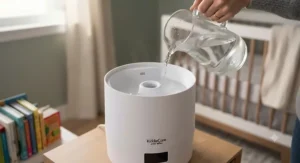
If your instinct is to question why a humidifier needs an app at all, the DREO HM311S is the one that might change your mind without draining your budget. It’s built around DREO’s dual-intake system, which the brand claims produces a notably larger mist output than typical single-intake units — useful shorthand for “reaches the far corners of the room faster.”
The 4-liter tank runs up to 36 hours, and the acoustic design keeps noise at roughly 28dB, quiet enough that most parents report not noticing it running at night. What stands out here is the completeness of the smart package at this price: touch, app, and voice control (Alexa and Google Assistant) all included, plus a 30-degree tiltable nozzle so you can direct mist away from furniture or electronics near the crib.
This is the pick for budget-conscious parents who still want the convenience of scheduling misting before bedtime through their phone, without paying for a large-capacity tank they don’t need in a standard-sized nursery. It’s also a sensible second unit for a playroom or older sibling’s bedroom.
Pros:
- ✅ Full app/voice/touch control at a budget price
- ✅ Dual-intake design pushes stronger, faster mist
- ✅ 28dB acoustic design stays nursery-quiet overnight
Cons:
- ❌ 4L tank empties faster in larger or open-plan rooms
- ❌ Demineralization cartridges are a separate purchase
At around $40–$55 in the mid-budget range, the DREO HM311S delivers more smart functionality per dollar than almost anything else on this list — check current price, as DREO frequently runs promotional codes on its own site.
3. Safety 1st Connected Smart Humidifier — best purpose-built baby app
Where most entries on this list are general-purpose smart humidifiers that happen to work in a nursery, the Safety 1st Connected Smart Humidifier was designed from the ground up for one. It’s part of the brand’s “Connected Suite,” meaning the same app that runs this humidifier can, in theory, manage other Safety 1st nursery devices — a genuinely useful detail if you’re building out a connected nursery rather than buying gadgets piecemeal.
The 1-gallon top-fill tank runs up to 24 hours, which is shorter than several ultrasonic competitors here, but the touch display compensates by showing live temperature and humidity readings so you’re not guessing between refills. Three modes — Auto-Humidity, Manual, and Hold — give more granular control than a simple on/off toggle, and the unit sends a phone notification when water runs low rather than just beeping in an empty room at 4 a.m.
What most buyers overlook about this model is the aromatherapy tray and adjustable nightlight bundled in, which quietly replace two other nursery gadgets you might have otherwise bought separately. Reviewers report the app is genuinely simple to set up compared to more general smart-home apps repurposed for humidifiers.
Pros:
- ✅ Purpose-built Connected app designed for nursery use
- ✅ Touch display shows live temperature and humidity
- ✅ Low-water phone alert before the tank runs dry
Cons:
- ❌ 24-hour runtime is shortest among the smart picks here
- ❌ Ceramic filter needs cleaning roughly every 250 gallons
Expect to pay in the $55–$75 range at the time of research — check current price, since this model frequently appears in baby-registry bundle deals that shift the effective cost.
4. Levoit OasisMist 450S — best dual warm and cool mist smart unit
The Levoit OasisMist 450S hedges its bets by offering both cool and warm mist in the same smart housing, which matters more than it sounds. Cool mist covers the pediatric safety standard for infant rooms, while warm mist mode roughly doubles output speed (up to 550 mL/h versus 300 mL/h) for adults elsewhere in the home during the depths of winter.
Specs-wise, the 4.5-liter tank runs up to 45 hours, and sleep mode keeps noise at a whisper-quiet 26dB — genuinely low enough to sit a few feet from a crib without disturbing a light sleeper. Auto Mode uses the built-in sensor to lock in whatever humidity percentage you set through the VeSync app, which is where the real value shows up: instead of manually nudging a mist-level dial every time the weather shifts, the unit self-corrects.
Based on the spec comparison with cool-mist-only competitors, this is best suited to households that want one humidifier flexible enough to run cool in the nursery and warm mist elsewhere — just not both in the same device at the same time near a mobile infant, since heating elements carry burn risk if a curious toddler can reach the unit. One reviewer on the retailer’s own site called the app setup “a bit overkill” for a seasonal-use appliance, a fair critique if you only run it three months a year.
Pros:
- ✅ Cool and warm mist modes in one connected unit
- ✅ Auto Mode holds a set humidity target automatically
- ✅ 26dB sleep mode barely registers near a crib
Cons:
- ❌ Warm mist setting isn’t appropriate once babies are mobile
- ❌ App setup felt unnecessary to some occasional-use reviewers
Priced around $75–$100 depending on retailer, the Levoit OasisMist 450S is a smart middle-ground pick — check current price, as it’s frequently bundled with filter multipacks at a discount.
5. Levoit Sprout — best nursery-specific smart sensor
The Levoit Sprout solves a problem most humidifiers ignore entirely: the sensor inside a humidifier only reads the air right next to the unit, not necessarily where your baby is actually sleeping. Levoit’s fix is a standalone humidity sensor you place near the crib itself, while the evaporative base handles the actual humidification from wherever you put it — a genuinely clever bit of engineering for nursery layouts where the crib and the outlet aren’t next to each other.
The 3.8-liter tank runs up to 36 hours, and because it’s evaporative rather than ultrasonic, tap water works fine without the white-dust risk that plagues cheaper ultrasonic units. An auto-drying function keeps the wick filter from sitting damp between uses, directly targeting the mold-growth complaint that dogs most humidifier categories. The blue-light-free nightlight is a small but thoughtful touch for 2 a.m. feedings.
Here’s what the spec sheet won’t tell you, but parent reviews on Reddit consistently do: several owners never bother activating the VeSync app at all, reporting the auto-mode-plus-standalone-sensor combination works well on its own — meaning the “smart” tier here is genuinely optional rather than required, which is unusual and, for privacy-conscious parents, arguably a feature.
Pros:
- ✅ Standalone sensor reads humidity where baby actually sleeps
- ✅ Auto-drying wick filter curbs mold between uses
- ✅ Tap-water friendly with no distilled-water runs
Cons:
- ❌ Priciest nursery-specific ultrasonic-alternative on this list
- ❌ Single-room coverage limits it to smaller nurseries
At roughly $180–$200, the Levoit Sprout sits at the top of the nursery-specific tier — check current price before buying, as this is a newer release with less markdown history than older Levoit lines.

6. Canopy Nursery Humidifier 2.0 — best hygiene-first premium pick
The Canopy Nursery Humidifier 2.0 takes a different approach to the category’s biggest complaint: dirty tanks. Instead of relying on you to remember a cleaning schedule, it runs UV light treatment on water before evaporation and uses smart airflow sensors that keep the fan running until the unit is completely dry inside, specifically to inhibit mold growth between uses.
Specs land it at a 2.5-liter tank, up to 36 hours of runtime, and coverage up to 500 square feet — modest next to the Levoit Superior 6000S, but the pitch here isn’t raw output, it’s maintenance. Every part except the electronics base is dishwasher-safe, a detail that shows up repeatedly and positively in aggregated customer reviews, with parents specifically praising how the “every-third-day EPA cleaning routine” becomes as easy as tossing pieces in with dinner dishes.
Here’s the honesty check this article promised: despite “smart” branding and onboard sensors, the Canopy Nursery Humidifier 2.0 does not connect to Wi-Fi or offer app control — its intelligence is entirely self-contained. If remote monitoring from your phone is a must-have, this isn’t your unit. If effortless cleaning and mold prevention matter more, reviewers consistently rank it among the easiest nursery humidifiers to actually keep using past February.
Pros:
- ✅ Dishwasher-safe parts eliminate scrub-brush cleaning
- ✅ UV light treatment reduces bacteria before evaporation
- ✅ Built-in sleep lights and white noise included
Cons:
- ❌ No Wi-Fi or app control despite smart-sensor branding
- ❌ Replacement filters run roughly $120 per year on subscription
Expect to pay in the $140–$170 range — check current price, since Canopy frequently bundles the aroma kit and runs seasonal sales that shift the effective cost.
7. Levoit Superior 6000S — best for large nurseries or open-concept homes
When a nursery isn’t really a separate room — think open-concept lofts, converted dens, or a nursery that shares airflow with the rest of the main floor — most humidifiers on this list simply aren’t built for the square footage. The Levoit Superior 6000S is: rated for up to 3,000 square feet, it’s a genuinely whole-home-capable evaporative unit that happens to work beautifully in a nursery corner.
The 6-gallon tank runs up to 72 hours on the low fan setting, meaning weekday refills become a non-issue, and because it’s evaporative, there’s no wet mist or white dust to worry about landing on a crib mattress or changing table. Smart control runs through the VeSync app, syncing with Alexa or Google Assistant, and the collapsible design with built-in wheels means it can migrate between rooms as your baby’s needs — or your floor plan — change.
Based on the spec comparison with smaller units, this is overkill for a single closed-door nursery, and honest aggregated feedback bears that out: several verified buyers report solid humidity output but mixed confidence in the smart-sensor accuracy specifically, with one long-term reviewer noting they hadn’t bothered testing the app at all and were still satisfied with manual control.
Pros:
- ✅ 3,000 sq ft coverage handles nursery plus adjoining rooms
- ✅ 72-hour runtime nearly eliminates weekday refills
- ✅ Evaporative tech skips wet mist and white dust entirely
Cons:
- ❌ Bulkiest footprint of any pick on this list
- ❌ Mixed customer feedback on smart-sensor precision
At around $210–$250, the Levoit Superior 6000S is the investment pick for parents humidifying more than one room — check current price, as third-party retailers have shown notable swings on this model.
Practical Usage Guide: Setting Up Your Wifi Enabled Humidifier for Baby
Unboxing a wifi enabled humidifier baby product is the easy part; getting the app, the placement, and the maintenance schedule right the first time saves you a month of second-guessing. Start with placement before you even open the app: the unit and its cord need to sit at least three feet from the crib, on a stable, elevated surface — never directly on the floor where a crawling baby could reach it, and never plugged into an outlet within arm’s reach of the crib rails.
Next, download the manufacturer’s app (VeSync for Levoit models, the DREO app, or Safety 1st Connected) before you fill the tank — most setup wizards want to confirm the device is powered on and discoverable over Wi-Fi first. A common first-30-days mistake is connecting to a 5GHz network; most humidifier Wi-Fi modules only support 2.4GHz, so if pairing fails repeatedly, that’s the first thing to check, not a defective unit.
Once connected, set your target humidity through Auto Mode rather than a fixed mist level — this is the actual advantage of an app controlled nursery humidifier over a manual dial, since the sensor will throttle output as conditions change through the day and night. Establish a maintenance rhythm immediately: empty and rinse the tank every one to two days, do a deeper vinegar-based clean weekly, and let the reservoir dry out completely between fills to discourage bacterial growth. Skipping that last step is the single most common reason parents end up with a humidifier that “smells off” within a month.

Real-World Scenarios: Which Smart Humidifier Fits Your Nursery
The first-time parent in a standard apartment nursery. A 150–250 square foot bedroom, tight budget, and zero tolerance for complicated setup describes most first-time parents. The DREO HM311S or Levoit Classic 300S both fit this profile well — enough coverage without paying for capacity you’ll never use, and app control simple enough to configure during a single naptime.
The family in an open-concept home with a nursery nook. When the crib sits in a corner of a larger living space rather than behind a closed door, square footage requirements jump fast. This is exactly the scenario the Levoit Superior 6000S was built for — its 3,000 square foot rating and 72-hour tank mean it can humidify the nursery corner and the surrounding living space simultaneously, rather than running a separate unit for each zone.
The parent prioritizing hands-off hygiene over gadgetry. Some parents have simply had enough of scrubbing narrow tank necks with a bottle brush at 11 p.m. For that household, the Canopy Nursery Humidifier 2.0 or Levoit Sprout — both evaporative, both engineered specifically to resist mold buildup — solve the actual pain point better than another app ever could, even though neither leans as hard into smart connectivity as the ultrasonic options above.
Problem → Solution Guide for Nursery Humidifiers
Even the best smart humidifier for nursery use runs into a handful of predictable problems. Here’s how to solve the most common ones without buying a second unit.
Problem: White dust settling on furniture. This happens almost exclusively with ultrasonic humidifiers run on tap water. Solution: switch to distilled water or add a demineralization filter, or move to an evaporative model like the Levoit Sprout or Levoit Superior 6000S, which don’t aerosolize minerals in the first place.
Problem: App won’t connect to Wi-Fi. Nine times out of ten this is a 2.4GHz-versus-5GHz network mismatch, not a hardware fault. Solution: temporarily create a 2.4GHz-only guest network for pairing, then reconnect to your main network if needed afterward.
Problem: Musty smell after a few weeks of use. This signals bacterial or mold growth inside the tank or wick. Solution: increase cleaning frequency to every other day, use a vinegar solution rather than harsh chemicals, and confirm the unit is drying out fully between fills — models with auto-dry functions, like the Levoit Sprout, are specifically engineered to prevent this.
Problem: Humidity reading feels inaccurate. Built-in sensors on units placed too close to a wall or vent can misread the room. Solution: reposition the humidifier at least two feet from walls, or opt for a model with a standalone sensor, such as the Levoit Sprout, that measures air near the crib directly.
How to Choose a Smart Humidifier for Nursery
Choosing the right unit comes down to seven practical decision points, each worth weighing before you check out:
- Confirm cool mist only. Warm mist and steam vaporizers carry a real burn risk if tipped, so nursery use should stick to cool mist exclusively.
- Match coverage to your actual square footage. Oversizing wastes money; undersizing leaves corners of the room too dry.
- Check the runtime against your refill tolerance. A 24-hour tank means daily refills; a 60-plus-hour tank means twice-weekly.
- Decide if you actually need Wi-Fi. App control adds convenience but also another device on your home network — some parents prefer the standalone-sensor approach instead.
- Look at maintenance requirements, not just price. A cheaper unit with a hard-to-clean tank often costs more in time and frustration than a pricier, easy-clean model.
- Factor in ongoing filter or water costs, not just the sticker price — evaporative and ultrasonic units differ meaningfully here.
- Verify auto-shutoff and low-water alerts are included — both are baseline safety and convenience features on every product covered in this guide.
Common Mistakes When Buying a Smart Humidifier for Nursery
The most frequent mistake is buying based on tank size alone, ignoring square-footage rating entirely — a 6-liter tank on a unit rated for 300 square feet won’t necessarily humidify a 500-square-foot room any better than a 4-liter tank rated for that size. Another common misstep is assuming “smart” always means Wi-Fi connected; as the Canopy Nursery Humidifier 2.0 demonstrates, some manufacturers use “smart” to describe onboard sensor logic rather than remote app control, which matters if remote monitoring was your main reason for shopping in this category.
Parents also frequently underestimate ongoing costs. Evaporative units like the Canopy Nursery Humidifier 2.0 or Levoit Superior 6000S require periodic filter or wick replacement that can add $50–$150 a year, a detail easy to miss when comparing sticker prices alone. Finally, skipping placement planning is a near-universal early mistake — many parents unbox a unit and plug it in wherever’s convenient, rather than confirming at least three feet of clearance from the crib and a stable, elevated surface first.
Smart Humidifier for Nursery vs Traditional Humidifiers
The core difference between a cool mist smart humidifier and an old-fashioned plug-and-forget model isn’t the mist itself — it’s what happens between refills. A traditional humidifier runs at a fixed output until the tank empties or you manually adjust a dial, regardless of whether the room is already at 55 percent humidity or still bone-dry. A smart model with an integrated or standalone sensor throttles output automatically, which matters in a nursery where over-humidifying invites mold and dust mites just as readily as under-humidifying invites dry, cracked skin.
| Feature | Traditional Humidifier | Smart Humidifier for Nursery |
|---|---|---|
| Humidity monitoring | Manual, guesswork | Automatic sensor, often app-visible |
| Adjustment | Physical dial | App or auto-mode |
| Remote alerts | None | Low-water and cleaning reminders |
| Overnight consistency | Fixed output | Self-correcting to target |
| Best For | Occasional, budget use | Daily nursery use with consistency needs |
Reading the table above, the gap isn’t about mist quality — both categories can humidify a room equally well on a technical level. It’s about consistency over an eight-to-twelve-hour overnight stretch, which is exactly when a nursery’s humidity swings the most as heating or cooling systems cycle. For a room a newborn spends most of their day and night in, that self-correcting behavior is the actual value proposition, not the novelty of an app icon.
Humidity Optimization for Nursery: What to Expect
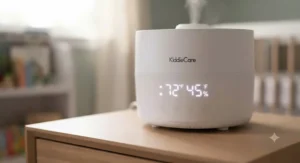
Humidity optimization in a nursery isn’t about chasing a single perfect number — it’s about staying inside a comfortable band consistently. Mayo Clinic notes it’s ideal to keep home humidity between 30% and 50%, and that guidance holds specifically true for nurseries, where both extremes cause real problems: too low, and you’ll see dry skin, nosebleeds, and static; too high, and condensation on windows becomes a mold risk.
In real-world use, a well-placed smart humidifier holds a nursery within a few percentage points of its target overnight, though placement matters more than the spec sheet suggests. A unit tucked in a corner behind furniture will read — and correct for — the humidity right next to it, not necessarily what’s happening over the crib eight feet away, which is precisely the gap products like the Levoit Sprout are designed to close with a separate sensor. Moisture control nursery setups also benefit from pairing the humidifier with a basic hygrometer as a second opinion; even the best built-in sensors can drift a few percentage points over months of use, and a five-dollar backup gauge catches that before it becomes a habit of over- or under-humidifying without realizing it.
Air Quality Improvement: Beyond Just Moisture
Air quality improvement in a nursery is a broader project than humidity alone, but humidifiers play a specific, useful role in it. Adding moisture to dry winter air helps keep mucous membranes functioning as a natural filter, thinning mucus and making it easier for a congested baby to clear their own airway — a mechanical benefit, not a cure, but a genuinely useful one during cold season. Evaporative units on this list, including the Levoit Sprout and Canopy Nursery Humidifier 2.0, add a secondary benefit here: their intake filters trap some airborne dust and particulate before the air passes through, functioning as a mild pre-filter alongside their humidifying job.
What most buyers overlook is that over-humidifying actively works against air quality goals rather than helping them — relative humidity climbing past roughly 60 percent creates conditions where dust mites and mold spores thrive, effectively trading one air quality problem for another. This is where auto-mode sensing earns its keep: rather than running full-blast around the clock, a smart humidifier that targets 40–50 percent and stops there is doing more for air quality than a traditional unit left on high all night, simply by avoiding the over-saturation that invites biological growth in the first place.
Safety, Regulations & Pediatric Guidance for Nursery Humidifiers
Every product on this list qualifies as cool mist rather than steam or warm-mist-only, which matters because the American Academy of Pediatrics recommends cool mist humidifiers specifically because warm-mist vaporizers can cause burns if a child gets too close to the steam or knocks over a unit filled with hot water. The Levoit OasisMist 450S is the one exception worth flagging again here: its warm mist setting is a legitimate feature for adult spaces, but it should be switched to cool mist only, or avoided entirely, once a baby becomes mobile enough to reach the unit.
Placement guidance is consistent across pediatric sources: keep the humidifier at least three feet from the crib, with all cords tucked well out of reach, and never run it in a fully sealed room — cracking the nursery door slightly helps prevent localized over-humidification that can encourage mold in one corner of the room. Regulatory-wise, none of the products reviewed here require a prescription or special certification; all are standard consumer appliances sold under normal CPSC consumer product guidelines, though buyers should still register products with manufacturers for recall notifications, a step frequently skipped on baby gear generally.
Cleanliness deserves equal billing with placement in any safety conversation. A humidifier that isn’t cleaned regularly can aerosolize bacteria and mold directly into a baby’s breathing space, effectively working against the reason you bought it. Sticking to a two-to-three-day cleaning cadence, using vinegar rather than harsh chemicals, and never adding essential oils to a device not explicitly rated for aromatherapy are the three habits pediatric sources return to most consistently.
Long-Term Cost & Maintenance
The sticker price on a smart humidifier for nursery use is rarely the full financial picture. Ultrasonic units like the Levoit Classic 300S or DREO HM311S have low ongoing costs if you’re diligent about distilled water — electricity use is minimal, typically under $10 a year — but skipping distilled water in favor of tap water means periodic mineral buildup that can shorten the unit’s usable life and increase cleaning frequency.
Evaporative models flip that equation: no distilled water required, but filters or wicks need periodic replacement. The Canopy Nursery Humidifier 2.0‘s filter subscription runs roughly $120 a year at a swap every five to seven weeks, while the Levoit Sprout and Levoit Superior 6000S use less frequent, lower-cost wick replacements in the $15–$30 range every few months.
| Product | Ongoing Cost Type | Approximate Annual Cost |
|---|---|---|
| Levoit Classic 300S | Distilled water / treatment tabs | Roughly $100–$120 |
| DREO HM311S | Demineralization cartridges | Roughly $30–$50 |
| Canopy Nursery Humidifier 2.0 | Subscription filter swaps | Roughly $120 |
| Levoit Superior 6000S | Wick filter replacement | Roughly $60–$90 |
Looking at the table, the cheapest unit to buy isn’t automatically the cheapest to run over a full year — the DREO HM311S wins on both counts, while the Canopy Nursery Humidifier 2.0‘s low purchase-adjacent convenience comes with the highest recurring cost of the group. For a deeper look at how independent labs weigh these tradeoffs, Consumer Reports rates humidifier output and convenience as separate criteria in its testing program, which is a useful lens for weighing sticker price against year-one and year-two total cost.
✨ Ready to Upgrade Your Nursery’s Air?
🔍 Compare current prices on any of these seven picks before checking out, and look for seasonal bundle deals that pair a humidifier with a replacement filter multipack — it’s often the easiest way to lower your true first-year cost.
Frequently Asked Questions
❓ What is the best smart humidifier for a nursery?
❓ Are wifi enabled humidifiers safe for babies?
❓ How much does a smart nursery humidifier cost?
❓ Should I choose cool mist or warm mist for a nursery?
❓ Do I need an app to use a smart humidifier in the nursery?
Conclusion
A smart humidifier for nursery use earns its keep less through app novelty and more through consistency — holding a room in that 30-to-50-percent comfort band overnight without you waking up to adjust a dial. Whether that’s the budget-friendly DREO HM311S, the nursery-purpose-built Safety 1st Connected Smart Humidifier, or the whole-home-capable Levoit Superior 6000S depends less on brand and more on your room’s actual square footage, your tolerance for filter maintenance, and whether remote app control is a genuine priority or just a nice extra.
None of these seven picks is a wrong choice on its own merits — they each solve a slightly different version of the same problem. What matters most is matching coverage and runtime honestly to your space, sticking to cool mist exclusively while your baby is mobile, and building a cleaning habit into your routine from week one rather than after the first musty smell shows up. Get those three things right, and the “smart” features become a genuine convenience rather than a gimmick you stop using by February.
✨ Don’t Miss These Exclusive Nursery Deals!
🔍 Take your nursery’s air quality to the next level with one of these seven carefully researched picks. Click through to check current pricing and availability before you buy — these humidifiers help create the comfortable, healthy sleep environment your family deserves!
Recommended for You
- Smart Nursery Thermostat: 7 Picks Parents Trust in 2026
- 7 Best Sunrise Simulator Night Lights That Actually Work in 2026
- App Controlled Baby Night Light: 7 Best Smart Picks for 2026
Disclaimer: This article contains affiliate links. As an Amazon Associate, I earn from qualifying purchases. If you purchase products through these links, we may earn a small commission at no additional cost to you.
✨ Found this helpful? Share it with your friends! 💬🤗
