
In This Article
When I first became a parent, I stood in the baby aisle completely overwhelmed by the sheer number of walker options. Should I go with a traditional seated walker or one of those trendy sit to stand walker models everyone was talking about? After countless hours of research and consultation with pediatric therapists, I learned that this decision impacts more than just convenience—it shapes your baby’s developmental journey.
The debate over sit to stand walker vs traditional walker isn’t just about preferences; it’s rooted in safety data, developmental science, and real-world outcomes. Traditional seated walkers send thousands of children to hospitals every year, with most injuries occurring from falls down stairs and head trauma. According to research published in Pediatrics, an estimated 230,676 children under 15 months were treated for infant walker-related injuries from 1990 to 2014, with 74.1% injured by falling down stairs. Meanwhile, sit-to-stand walkers encourage natural movement patterns that align with how babies naturally learn to walk.
In this comprehensive guide, you’ll discover the critical differences between walker type comparison options, understand which walker is better for baby development, and explore seven top-rated products that parents trust in 2026. Whether you’re considering a push walker vs seated walker or exploring activity walker comparison, you’ll find evidence-based insights to make an informed decision.
Quick Comparison Table
| Feature | Sit to Stand Walker | Traditional Seated Walker |
|---|---|---|
| Safety Rating | ✅ Much Safer | ⚠️ High Injury Risk |
| Development | ✅ Promotes Natural Movement | ❌ May Delay Walking |
| Age Range | 9-18 months | 6-15 months |
| Support Type | Push/Pull Support | Full Seated Support |
| Mobility | Controlled by Baby | Wheeled Movement |
| AAP Recommendation | Cautiously Approved | Not Recommended |
| Average Price | $35-$65 | $45-$90 |
💬 Just one click – help others make better buying decisions too!😊
✨ Don’t Miss These Exclusive Deals!
🔍 Take your baby’s walking journey to the next level with these carefully selected products. Click on any highlighted item to check current pricing and availability. These tools will help you create authentic developmental support your family will love!
Top 7 Sit to Stand Walker vs Traditional Walker: Expert Analysis
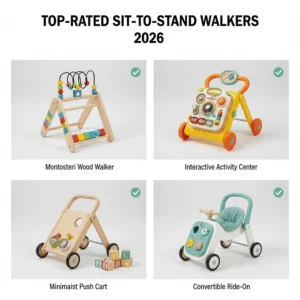
1. VTech Sit-to-Stand Learning Walker
This multifunctional walker stands as the gold standard for developmental support. The VTech Sit-to-Stand Learning Walker combines educational features with sturdy construction, making it a favorite among pediatric therapists.
Key Specifications:
- Two-speed control switch for different skill levels
- 70+ songs, sounds, and phrases
- Detachable activity panel for floor play
- Age range: 9 months to 3 years
Price Range: $35-$50
Parents rave about the adjustable speed settings that grow with their baby’s confidence. One mother shared that her son transitioned from cautious steps to confident walking within three weeks using the slower speed setting initially.
Pros:
✅ Exceptional educational value with ABC and number learning
✅ Removable panel extends product lifespan
✅ Sturdy four-wheel base prevents tipping
Cons:
❌ Volume can be quite loud (no off switch, only volume control)
❌ Works better on hard floors than carpet
2. Fisher-Price Learn with Me Zebra Walker
The Fisher-Price Learn with Me Zebra Walker brings playful design to serious developmental support. This charming zebra companion offers interactive activities that keep babies engaged while building essential motor skills.
Key Specifications:
- Sturdy 4-wheel base with easy-grasp handle
- Musical keyboard and shape sorter activities
- Teaches alphabet and numbers 1-10
- Suitable for ages 6 months+
Price Range: $40-$55
Customer feedback highlights the perfect balance between entertainment and functionality. The zebra theme captivates babies’ attention, encouraging repeated practice sessions that build walking confidence naturally.
Pros:
✅ Excellent stability even for beginners
✅ Engaging activities promote fine motor development
✅ Durable construction withstands rough handling
Cons:
❌ Some parents find music repetitive
❌ May be too lightweight for very energetic pushers
3. Fisher-Price 2-Sided Steady Speed Panda Walker
Uniqueness defines the Fisher-Price 2-Sided Steady Speed Panda Walker—babies can push from either side, making it incredibly versatile for growing walkers.
Key Specifications:
- Steady Speed wheels control pace
- Smart Stages technology with 3 learning levels
- 10+ activities including steering wheel and gear shifter
- 50+ songs, sounds, and phrases
Price Range: $45-$65
The Steady Speed technology deserves special mention—it prevents the walker from rolling too fast, giving wobbly beginners the control they need. Parents report fewer tumbles and more confident exploration.
Pros:
✅ Two-sided design accommodates different play styles
✅ Speed control prevents runaways
✅ Grows with baby through Smart Stages levels
Cons:
❌ Slightly pricier than basic models
❌ Larger footprint requires more storage space
4. SYNCFUN Baby Learning Walker 2-in-1
Budget-conscious parents love the SYNCFUN Baby Learning Walker for its impressive feature set at an accessible price point.
Key Specifications:
- Adjustable speed settings (low/standard)
- Detachable multi-scenario play panel
- Volume control with three settings
- Seven piano modes and interactive buttons
Price Range: $30-$45
This walker excels in versatility—the removable panel attaches to cribs or can be used independently, extending play value beyond the walking phase. Parents appreciate the thoughtful volume control that prevents sensory overload.
Pros:
✅ Exceptional value for money
✅ Versatile panel placement options
✅ Adjustable speed grows with baby
Cons:
❌ Assembly instructions could be clearer
❌ Plastic construction feels less premium
5. INFANS 5-in-1 Baby Walker (Traditional Seated)
For parents specifically seeking a traditional option, the INFANS 5-in-1 Baby Walker offers the most features in this category.
Key Specifications:
- Converts between 5 modes: seated walker, bouncer, rocker, push walker, feeding table
- 3 adjustable height positions
- Music playboard with lights
- Washable seat cushion
Price Range: $55-$75
While traditional walkers face safety concerns, this model includes anti-slip stair pads and speed adjustment wheels. However, parents should understand that even with safety features, seated walkers can cause injuries and developmental delays.
Pros:
✅ Multiple conversion modes
✅ Foldable for easy storage
✅ Washable materials simplify cleaning
Cons:
❌ Safety risks associated with all seated walkers
❌ Heavier and bulkier than push walkers
6. VEVOR 4-in-1 Baby Walker (Traditional Seated)
The VEVOR 4-in-1 Baby Walker combines traditional design with modern safety features, though it still carries inherent seated walker risks.
Key Specifications:
- 4 modes: learning-seated, walk-behind, rocker, bouncer
- 3 adjustable heights (14.5″-16″)
- Detachable music tray with lights
- Suitable for 6-24 months
Price Range: $50-$70
Parents choosing seated walkers often select this model for its stability features. However, remember that seated walkers don’t help babies learn to walk faster and can actually delay normal motor development.
Pros:
✅ Stable construction
✅ Engaging activity tray
✅ Multiple height adjustments
Cons:
❌ Not recommended by pediatric organizations
❌ Safety concerns with stairs and mobility
7. Dream On Me Aloha Baby Walker (Traditional Seated)
The Dream On Me Aloha Baby Walker represents a basic traditional walker option for families specifically seeking this style despite safety recommendations.
Key Specifications:
- 2-in-1 design: seated walker and activity center
- Adjustable height settings
- Musical toy tray
- Compact folding design
Price Range: $45-$60
This budget-friendly traditional walker includes standard safety features, but parents must acknowledge that approximately 21 children are hospitalized daily with baby walker-related injuries, making them more dangerous than any other nursery product.
Pros:
✅ Affordable price point
✅ Compact when folded
✅ Simple assembly
Cons:
❌ Carries all seated walker safety risks
❌ Limited activity options compared to competitors
What is Sit to Stand Walker vs Traditional Walker?
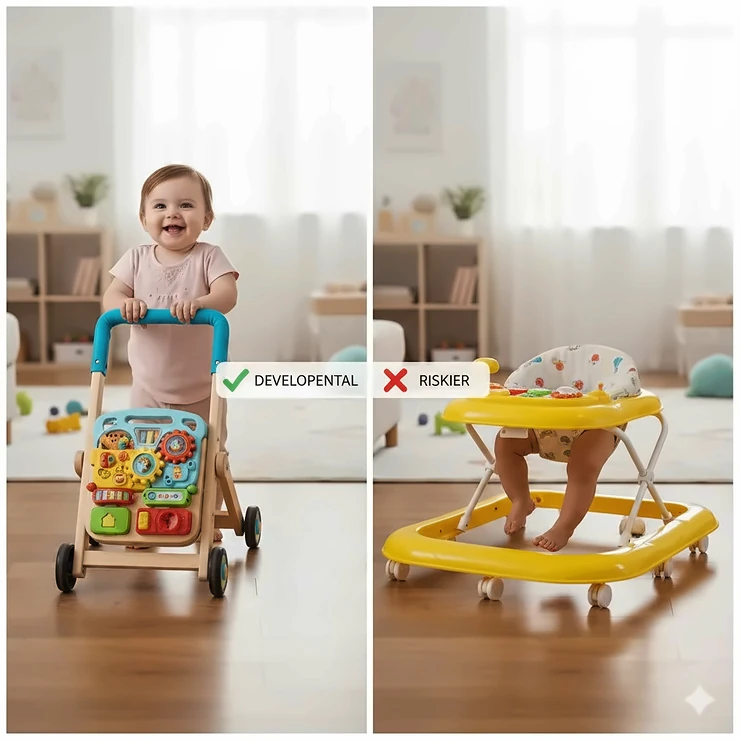
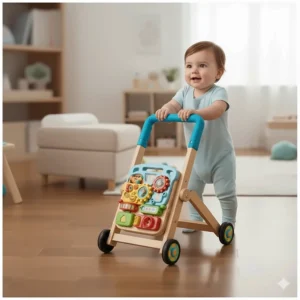
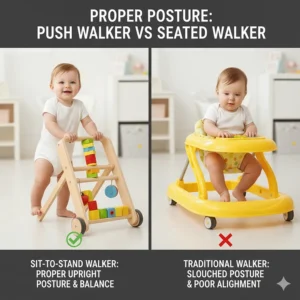
Understanding walker type comparison starts with defining each category. A sit to stand walker (also called a push walker or activity walker) supports babies who can already stand independently by providing a stable frame to push while walking. These developmental support options encourage natural movement patterns, allowing babies to control their pace and build genuine walking skills.
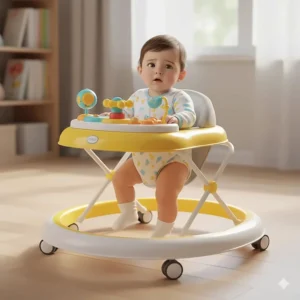
In contrast, a traditional walker features a suspended seat within a wheeled frame, allowing babies to scoot around using their feet while seated. This seated walker design gained popularity decades ago but has since fallen out of favor with medical professionals due to significant safety and developmental concerns. According to Wikipedia’s comprehensive overview, baby walkers may actually delay walking by two to three weeks for a typical child, with effects increasing based on usage time.
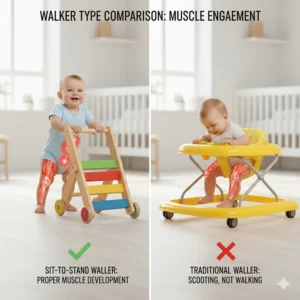
The fundamental difference lies in how each walker type comparison affects motor development. Sit-to-stand models require babies to bear their full body weight, activate core muscles, and maintain balance—exactly the skills needed for independent walking. Traditional walkers eliminate weight-bearing requirements, potentially interfering with natural developmental progression.
Research demonstrates that traditional walkers can actually delay when children begin walking independently, contrary to their original marketing promises. This occurs because seated walkers don’t activate the muscle groups and neural pathways necessary for true walking development.
Understanding Walking Aid Styles
Push Walker Development Benefits
Push walkers excel at developmental support by mimicking natural walking mechanics. When babies use a sit to stand walker, they engage their leg muscles, core stabilizers, and balance systems simultaneously—precisely the coordination needed for independent ambulation.
Push walkers can be particularly helpful for supporting balance as children progress through upright skills and building confidence in standing. The key advantage lies in baby-led exploration; children decide when to use the walker, how fast to move, and when to rest—building body awareness and motor planning skills.
These walking aid styles also offer extended value. Many sit-to-stand models work for babies as young as 6 months (for floor play with activity panels) through 18+ months as they perfect their walking skills. This extended usability makes them economically sensible compared to traditional walkers with narrower age windows.
Traditional Walker Limitations
The activity walker comparison reveals significant concerns with seated designs. Studies found statistically significant differences in motor development favoring babies who didn’t use traditional walkers, with lower scores in both motor skills and trunk control.
Why does this developmental delay occur? Traditional walkers prevent the visual experience of seeing their own legs move—a critical component in developing motor control systems. Additionally, the seated position encourages poor posture habits, toe-walking, and compensatory movement patterns that don’t translate to natural walking.
Safety statistics paint an even grimmer picture. The American Academy of Pediatrics reports that in 1999 alone, an estimated 8,800 children younger than 15 months required emergency treatment for injuries from infant walkers, with the vast majority involving falls down stairs resulting in head injuries. Modern safety standards have reduced but not eliminated these risks.
Developmental Considerations
Motor Skill Development
The push walker vs seated walker debate centers significantly on motor skill outcomes. Sit-to-stand walkers promote gross motor development by requiring full weight-bearing, balance maintenance, and coordinated leg movements. These activities strengthen the exact muscle groups babies need for independent walking.
Unlike sit-in walker toys, push walkers encourage babies to stand and bear weight on their legs, enhancing walking skills by supporting natural movement patterns. This natural progression aligns with how human motor development unfolds—from tummy time to rolling, sitting, crawling, pulling up, cruising, and finally walking.
Traditional walkers shortcut this progression, potentially creating gaps in motor skill development. When babies scoot in seated walkers, they’re not learning to stand, balance, or coordinate their movements—they’re simply pushing with their feet while fully supported. This might seem helpful but actually deprives babies of essential developmental experiences.
Cognitive and Spatial Development
Beyond physical skills, which walker is better for baby cognitive development? Sit-to-stand walkers win decisively. These models encourage problem-solving as babies figure out how to maneuver around furniture, navigate corners, and control their speed. This spatial reasoning practice builds neural pathways extending far beyond just walking.
Many modern sit-to-stand walkers incorporate educational elements—shape sorters, musical keyboards, cause-and-effect buttons—that engage cognitive development simultaneously with physical skills. This multisensory learning approach aligns with how young brains develop most effectively.
Traditional walkers, conversely, can limit exploration. Research published in the Iranian Journal of Child Neurology confirms that the use of baby walkers causes retardation in motor development, potentially due to impaired trunk control critical for improving motor development like sitting, standing, and walking. When babies can’t see their legs or control their movements properly, they miss crucial learning opportunities about body awareness and spatial relationships.
Safety Analysis
Sit to Stand Walker Safety
While no baby product is risk-free, sit-to-stand walkers present significantly fewer hazards than traditional models. The primary safety considerations include:
Supervision Requirements: Even safe walkers require adult supervision. Babies using push walkers can still encounter obstacles, stairs, or unstable surfaces.
Environmental Preparation: Clear pathways, install safety gates, and remove tripping hazards. The good news? These preparations benefit overall home safety beyond just walker use.
Appropriate Timing: Introduce sit-to-stand walkers only when babies can pull themselves to standing independently, typically 9-12 months. Earlier introduction provides no benefit and may frustrate pre-ready babies.
Quality Matters: Invest in walkers with wide, stable bases, non-slip wheels, and sturdy construction. Cheap, lightweight models tip more easily, increasing fall risks.
Traditional Walker Dangers
The American Academy of Pediatrics has called for a complete ban on the manufacture and sale of baby walkers in the United States since 2004, joining Canada where they’ve been prohibited since 1989. Why such strong opposition from medical experts?
Stair Falls: Even with safety gates, babies in wheeled walkers can reach stairs and plummet before caregivers react. According to the Children’s Hospital of Philadelphia, a child in a walker can move more than 3 feet in 1 second—faster than most parents can respond.
Extended Reach Hazards: Walkers increase babies’ reach, making it easier to pull tablecloths with hot beverages, grab pot handles from stoves, and access medications, cleaning products, or other dangerous items.
Drowning Risk: Children in walkers can fall into pools or bathtubs within seconds, as the devices provide mobility before babies develop safety awareness.
Burns: The elevated position allows contact with radiators, fireplaces, and space heaters that crawling babies couldn’t reach.
Medical professionals emphasize that most walker injuries happen while adults are watching—parents simply cannot respond quickly enough to prevent accidents.
How to Choose Between Walker Types
Age and Readiness Assessment
Determining when babies are ready for walking aid styles depends on individual development, not just chronological age. For sit-to-stand walkers, look for these readiness signs:
Physical Indicators:
- Pulls to standing using furniture
- Can stand while holding onto support for 10+ seconds
- Cruises along furniture edges
- Shows interest in walking
Developmental Milestones:
- Has mastered sitting independently
- Completed significant crawling time
- Demonstrates good head and trunk control
Resist rushing this timeline. If babies become reliant on push walkers and won’t attempt the same skills without them, it’s worth putting the walker out of sight for a few days to encourage independent practice.
Traditional walkers theoretically suit younger babies (6+ months who can sit), but given safety and developmental concerns, most experts recommend avoiding them entirely regardless of age.
Feature Prioritization
When comparing activity walker comparison options, prioritize features matching your baby’s needs and your family’s values:
For Maximum Safety:
- Wide, stable base
- Speed control mechanisms
- Non-slip wheels
- Lightweight enough to maneuver but heavy enough for stability
For Developmental Value:
- Adjustable height
- Detachable activity panels
- Age-appropriate learning features
- Encourages proper posture
For Practical Considerations:
- Easy cleaning (removable, washable parts)
- Compact folding for storage
- Durable construction
- Volume control on electronic features
For Extended Value:
- Multi-stage designs growing with baby
- Convertible features (activity center, walker, push toy)
- Engaging enough for repeated use
Budget Considerations
Quality sit-to-stand walkers range from $30-$65, representing excellent value given their safety profile and developmental benefits. Traditional walkers cost $45-$90 but carry hidden costs—potential medical bills from injuries and delayed development milestones.
Consider cost-per-use rather than just initial price. A $50 walker used daily for 6-8 months costs roughly 21-28 cents per day—less than a single cup of coffee. The developmental benefits and safety peace of mind make this an investment worth prioritizing.
Budget-friendly doesn’t mean cheap quality. Several manufacturers offer well-constructed sit-to-stand walkers under $40 that meet safety standards and provide excellent developmental support.
Alternatives to Both Walker Types
Stationary Activity Centers
Stationary activity centers or exersaucers look like walkers but don’t have wheels—instead, they feature seats with adjustable heights that rotate and bounce. These provide entertainment and leg strengthening without mobility risks.
While safer than traditional walkers, stationary centers still suspend babies in seats rather than encouraging natural movement. Use them for brief entertainment periods (15-20 minutes) rather than extended developmental sessions.
Natural Development Approach
The absolute best walker alternative? None at all. The best alternative (and the cheapest!) is letting babies learn the old-fashioned way—starting with tummy time and working through crawling, standing up, cruising and walking.
This approach costs nothing, carries zero injury risk, and supports optimal developmental progression. Create safe floor spaces with engaging toys positioned just out of reach, encouraging babies to move toward them. Furniture arranged for cruising provides natural support as babies build confidence.
Push Toys and Wagons
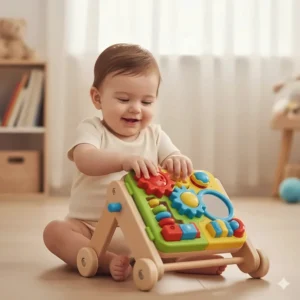
Wooden push wagons, shopping carts, and lawn mowers offer push walker benefits without the structured frame. These open-ended toys encourage creativity while building walking skills. Many work as storage containers once walking is mastered, extending their utility.
Push toys can be used earlier than the walking stage to promote floor play, helping babies build coordination, visual processing skills, upper body strength, and core stability. This makes them excellent value for families seeking one toy serving multiple developmental stages.
Expert Recommendations
Pediatrician Perspectives
The American Academy of Pediatrics clearly states that baby walkers do not promote independent walking and emphasizes they can delay normal development and motor control. Their position is unambiguous: avoid traditional walkers entirely.
Regarding push walkers, pediatric guidance is more nuanced. These devices receive cautious approval when used appropriately—meaning introduced at the right developmental stage, under supervision, for limited periods, and as supplements to (not replacements for) natural movement practice.
Dr. Sherie Weber, a pediatric trauma specialist at Tufts Medicine, notes that “The majority of professional groups recommend against using walkers—not only do they offer no developmental benefit, but they also significantly increase the risk of injury”, referring specifically to traditional seated models.
Physical Therapist Insights
Pediatric physical therapists emphasize the importance of weight-bearing and balance practice for healthy motor development. Push toys support development while sit-in walkers prioritize convenience—push toys promote walking patterns closer to natural walking, helping babies gain confidence and supporting proper muscle development.
The therapeutic community warns against over-reliance on any mobility device. Babies need varied movement experiences—tummy time, rolling, sitting, crawling, pulling up, cruising—to build the comprehensive skill set supporting lifelong movement health.
When therapists recommend walkers, they suggest models with adjustable resistance, allowing babies to build strength gradually. They also emphasize letting babies lead—allowing them to initiate walker use rather than placing them in position reinforces motor planning and body awareness.
Real Parent Experiences
Success Stories with Sit to Stand Walkers
Sarah from Oregon shares: “We introduced the VTech walker when Emma could cruise confidently. Within two weeks, she took her first independent steps! I loved that she controlled the pace and could stop whenever she felt unsteady. The educational features were a bonus—she learned her ABCs while learning to walk.”
Marcus in Texas reports: “Our son has low muscle tone, so our physical therapist recommended a sturdy push walker. The Fisher-Price Zebra model provided perfect support as he built leg strength. Six months later, he’s walking independently and actually ahead of his adjusted milestones.”
These success stories share common themes: appropriate timing, parental supervision, and walkers as supplements rather than primary teaching tools.
Lessons from Traditional Walker Use
Jennifer from Florida regrets her choice: “I didn’t research before buying a seated walker for my daughter. Within a week, she had a scary fall when the walker hit our baby gate and tipped. We immediately switched to a push walker and wished we’d started there.”
Another parent shares: “My pediatrician warned us against traditional walkers, but my mother-in-law insisted they were safe ‘back in her day.’ After reading the actual statistics on injuries and developmental delays, we politely declined her gift and explained our reasoning. She ultimately understood once she saw the research.”
These cautionary tales underscore the importance of evidence-based decision-making over tradition or convenience.
Maximizing Walker Benefits
Safe Usage Guidelines
Follow these evidence-based practices for optimal walker safety and developmental support:
Supervision Protocol:
- Never leave babies unattended with walkers
- Maintain line-of-sight supervision constantly
- Remove walkers when supervision lapses
Environmental Safety:
- Install safety gates at all stairways
- Clear floor spaces of tripping hazards
- Secure heavy furniture that babies might pull
- Use walkers only on flat, stable surfaces
Time Limits:
- Limit push walker use to 20 minutes daily as recommended by the National Health Service, as overuse can lead to dependency
- Encourage varied play activities beyond walker time
- Watch for signs of fatigue or frustration
Maintenance:
- Regularly check wheels, handles, and stability
- Clean thoroughly to prevent germ accumulation
- Retire walkers showing wear or damage
Developmental Integration
Integrate walkers into comprehensive developmental support:
Balance Activities:
- Practice standing without support
- Play games reaching for objects while standing
- Encourage cruising along furniture
Strengthening Exercises:
- Supervised climbing on age-appropriate structures
- Squatting to pick up toys
- Dancing to music
Skill Variety:
- Continue tummy time even for older babies
- Provide crawling opportunities and obstacles
- Offer toys encouraging different movements
The goal is producing confident, capable walkers with strong foundational motor skills—not just babies who can use walking devices.
Making Your Decision
Decision Framework
Use this framework for choosing between sit to stand walker vs traditional walker:
Step 1: Assess Baby’s Readiness Can your baby pull to standing and cruise independently? If yes, consider a sit-to-stand walker. If no, wait or choose stationary alternatives.
Step 2: Evaluate Home Environment Do you have safe, clear floor spaces? Multiple levels with stairs? Your physical environment impacts walker safety significantly.
Step 3: Clarify Developmental Goals Are you seeking developmental support or primarily entertainment? This distinction guides product selection and usage patterns.
Step 4: Review Safety Priorities How do you balance convenience against safety risks? Understanding your risk tolerance helps navigate product categories.
Step 5: Consider Long-Term Value Which option serves your baby longest and best supports overall development?
For most families, this framework points decisively toward sit-to-stand walkers or no walker at all—traditional seated models fail multiple crucial criteria.
Red Flags to Avoid
Product Red Flags:
- Lightweight, unstable construction
- No speed control mechanisms
- Small wheelbases that tip easily
- Poor quality customer reviews mentioning safety issues
- Recalled products or manufacturers
Usage Red Flags:
- Baby seems uncomfortable or frustrated
- Excessive tiptoeing or awkward gait patterns
- Decreased interest in natural movement
- Over-reliance on walker for mobility
- Using walker near stairs or hazards
When to Skip Walkers Entirely
Some situations warrant avoiding walkers completely:
Medical Considerations:
- Diagnosed motor delays requiring therapy
- Low muscle tone or hypotonia
- Orthopedic concerns
- Developmental conditions affecting balance
Environmental Challenges:
- Primarily carpeted homes (walkers work poorly)
- Multi-level homes without sufficient safety gates
- Limited floor space for safe maneuvering
Philosophical Preferences:
- Commitment to entirely natural development
- Minimalist parenting approach
- Following specific childcare philosophies opposing equipment
Remember: walkers are unnecessary for development and no baby truly needs one to learn walking. This is a convenience choice, not a developmental necessity.
Common Walker Myths Debunked
Myth 1: “Walkers Help Babies Walk Sooner”
Reality: Research proves walkers can actually delay when children start walking independently. Babies develop walking skills through natural progression—crawling, pulling up, cruising—not through device assistance.
Traditional walkers particularly delay development because they eliminate essential weight-bearing and balance practice. Even sit-to-stand walkers don’t accelerate walking; they simply provide safe practice opportunities for babies already near walking readiness.
Myth 2: “Modern Walkers Are Now Safe”
Reality: While post-1997 safety standards reduced some risks (wider frames, stair brakes), baby walkers are never safe to use, even with an adult close by. The fundamental design of wheeled seated walkers creates inherent hazards no safety feature fully eliminates.
Sit-to-stand walkers are relatively safer but still require vigilant supervision and proper environmental preparation. No walker guarantees safety—they all carry risks requiring parental management.
Myth 3: “Babies Need Walker Practice Before Walking”
Reality: Babies are genetically programmed to walk. No external device is required for this milestone. Natural movement progression provides optimal preparation—crawling builds core strength, pulling up develops leg muscles, cruising teaches balance.
Walkers can supplement but never replace these natural developmental experiences. Babies who never use walkers walk just as well (often better) than those who do.
Myth 4: “Seated Walkers Are Good Exercise”
Reality: Seated walker use is associated with lower motor development scores and impaired trunk control. The seated position doesn’t provide true exercise—it allows babies to scoot using improper mechanics that don’t build walking-relevant skills.
True exercise for pre-walkers includes tummy time, crawling, pulling up, and bearing weight on legs while standing—none of which seated walkers facilitate.
❓ FAQ: Sit to Stand Walker vs Traditional Walker
❓ How long should baby use a walker each day?
❓ Can walkers cause bow legs or developmental issues?
❓ What age can babies safely start using push walkers?
❓ Are baby walkers banned in the United States?
❓ Which type of walker is recommended by pediatricians?
Conclusion: Your Walker Decision
After examining safety data, developmental research, and real-world experiences comparing sit to stand walker vs traditional walker options, the evidence overwhelmingly favors push walkers—or better yet, no walker at all. Traditional seated walkers carry significant injury risks and offer no developmental benefits, justifying the American Academy of Pediatrics’ call for their prohibition.
If you choose to use a walker, opt for a high-quality sit-to-stand model introduced when your baby demonstrates clear readiness signs—pulling to stand, cruising confidently, showing walking interest. Use it as a supplemental tool for 15-20 minutes daily under constant supervision, not as a primary mobility solution or developmental crutch.
Remember that your baby will walk when developmentally ready, whether you use a walker or not. Focus on creating safe environments for natural movement exploration, providing varied play opportunities, and celebrating each small milestone along the journey. The memories of those first wobbling steps will be precious regardless of the path taken to achieve them.
Your role isn’t to accelerate development but to support it safely and lovingly. Whether you choose a push walker, stationary activity center, or simply clear floor space and patient encouragement, trust that your baby’s internal developmental programming will guide them to walking in their own perfect timing.
Recommended for You
- Walker vs Jumper vs Exersaucer: 7 Key Differences (2026 Guide)
- Best Baby Walker Under $100: 7 Expert Picks for 2026
- Best Baby Walker Under $50: 7 Budget Picks (2026 Guide)
Disclaimer: This article contains affiliate links. If you purchase products through these links, we may earn a small commission at no additional cost to you.
✨ Found this helpful? Share it with your friends! 💬🤗
