
In This Article
Choosing the right mobility aid for your little one can feel overwhelming, especially when safety concerns dominate headlines. A baby walker buying guide helps you navigate the complex landscape of design features, safety certifications, and developmental considerations that every parent should understand before making this significant purchase decision.
Baby walkers are mobile devices that allow pre-walking infants to move around while seated in a supportive frame with wheels. According to Wikipedia, these devices have existed since at least the 15th century, with modern versions incorporating sophisticated safety features mandated by federal regulations. The current baby walker buying guide landscape requires parents to balance entertainment value, developmental support, and stringent safety protocols.
The U.S. Consumer Product Safety Commission reported that between 2021 and 2023, an estimated annual average of 2,467 children under age 5 ended up in the ER after using baby walkers, jumpers or exercisers. This sobering statistic underscores why following a comprehensive baby walker buying guide matters more than ever.
Quick Comparison Table
| Walker Model | Type | Price Range | Safety Rating | Best For |
|---|---|---|---|---|
| Fisher-Price Laugh & Learn Smart Stages Puppy | Push Walker | $40-60 | ⭐⭐⭐⭐⭐ | Developmental Learning |
| Bright Starts Disney Mickey Mouse Original Bestie | Seated Walker | $60-80 | ⭐⭐⭐⭐ | Entertainment Focus |
| 5-in-1 Foldable Baby Activity Walker | Multi-Mode | $70-90 | ⭐⭐⭐⭐ | Versatility Seekers |
| Bright Starts Ford F-150 4-in-1 | Seated Walker | $80-100 | ⭐⭐⭐⭐½ | Vehicle Enthusiasts |
| Fisher-Price 2-Sided Steady Speed Panda | Push Walker | $50-70 | ⭐⭐⭐⭐⭐ | Bilateral Learning |
| Bright Starts Little Speedster 3-in-1 Car | Convertible | $75-95 | ⭐⭐⭐⭐ | Growing Families |
| Bright Starts Giggling Safari Walker | Seated Walker | $45-65 | ⭐⭐⭐⭐ | Budget-Conscious Parents |
💬 Just one click – help others make better buying decisions too!😊
Top 7 Baby Walkers: Expert Analysis
1. Fisher-Price Laugh & Learn Smart Stages Puppy Walker
This push-behind walker represents the gold standard in baby walker safety guide compliance. Unlike traditional seated walkers, this model encourages natural walking posture without compromising developmental milestones.
Key Specifications: 75+ songs, sounds and phrases; Smart Stages technology with 3 learning levels; sturdy 4-wheel base with Steady Speed wheels
Price Range: $40-60
The Fisher-Price Smart Stages Puppy Walker adapts to three learning levels as your child grows. Parents consistently praise the adjustable speed control that helps beginners maintain safe pacing while building confidence. One verified Amazon reviewer noted, “This walker has been perfect for teaching my daughter to walk without the dangers of a seated walker.”
✅ Pros:
- Encourages proper walking mechanics and core strength
- Educational content adapts to developmental stages
- Meets all ASTM F977 safety standards
❌ Cons:
- Requires baby to already pull up to standing
- Volume can’t be completely muted
2. Bright Starts Disney Baby Mickey Mouse Original Bestie 2-in-1 Walker
For families prioritizing entertainment alongside mobility, this seated walker delivers Disney magic with practical safety features. The walker selection criteria here emphasize engaging design without sacrificing structural integrity.
Key Specifications: Removable electronic toy station with lights and sounds; 3 adjustable height positions; machine-washable seat pad; easy-fold frame
Price Range: $60-80
Customer feedback highlights the Bright Starts Mickey Mouse Walker as exceptionally easy to clean. The removable toy station transforms into floor play entertainment, extending usability beyond walker mode. Amazon reviews average 4.4 stars with over 1,200+ ratings, with parents appreciating the Disney character appeal.
✅ Pros:
- Licensed Disney character increases engagement
- Toy station removes for on-the-go play
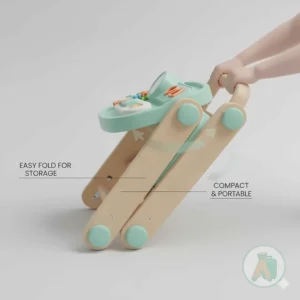
- Folds easily for storage and travel
❌ Cons:
- Wider base may not fit through narrow doorways
- Electronic toys require frequent battery replacement
3. 5-in-1 Foldable Baby Activity Walker
This multi-functional unit addresses multiple purchase decision factors by converting between walker, bouncer, rocker, feeding table, and push modes. Parents seeking maximum value gravitate toward this versatile option.
Key Specifications: 5 convertible modes; adjustable speed rear wheels; detachable trampoline mat; 3 height settings; musical toys with volume control
Price Range: $70-90
The 5-in-1 Activity Walker receives praise for its adaptability across developmental stages. The bouncer mode particularly appeals to parents of younger infants who aren’t yet ready for traditional walking. With over 900 units sold in the past month on Amazon, this model demonstrates strong market acceptance.
✅ Pros:
- Exceptional versatility across age ranges (6-18 months)
- Anti-slip silicone pads enhance safety
- Musical toys and cushions are removable
❌ Cons:
- More complex assembly than single-function models
- Heavier weight (approximately 12 lbs) reduces portability
4. Bright Starts Ford F-150 4-in-1 Baby Activity Center
Vehicle-themed walkers capture children’s imaginations while meeting rigorous safety standards for walkers. This Ford-licensed product combines authentic automotive details with developmental benefits.
Key Specifications: 4 modes of play; authentic Ford sounds and ignition; push-behind capability; removable interactive steering wheel; 3 height positions
Price Range: $80-100
Parents appreciate that the Ford F-150 Walker allows two children to play simultaneously in different modes. The detailed design elements create immersive imaginative play scenarios that extend engagement time. Amazon customers rate this model 4.5 stars, with many praising the sturdy construction.
✅ Pros:
- Two-player capability increases value
- Realistic vehicle features enhance pretend play
- High seat back provides excellent support
❌ Cons:
- Premium price point for a walker
- Large footprint requires significant storage space
5. Fisher-Price 2-Sided Steady Speed Panda Walker
This innovative push walker offers activities on both sides, allowing babies to approach from any direction. The bilateral design addresses what to look for in a baby walker from a developmental perspective.
Key Specifications: 10+ activities on two sides; Steady Speed wheels; Smart Stages learning; 3 shape blocks included; light-up panda nose
Price Range: $50-70
The 2-Sided Panda Walker stands out for its controlled-speed wheel system that prevents runaway rolling. This feature directly addresses parental safety concerns while maintaining engagement. With 2,600+ customer reviews averaging 4.8 stars, this Amazon-exclusive model enjoys strong parent approval.
✅ Pros:
- Approach from either side increases flexibility
- Speed control prevents dangerous acceleration
- Frustration-free packaging for easy setup
❌ Cons:
- Push-behind only (no seated option)
- Slightly heavier than competing models at 8 lbs
6. Bright Starts Little Speedster 3-in-1 Car Walker
Growing families value products that evolve with their children. This racing-themed walker transitions from seated walker to push-behind to portable toy station, addressing walker selection criteria for longevity.
Key Specifications: 3 grow-with-me modes; race car theme with customizable stickers; gear shifter and car key; clicking steering wheel sounds; 6-24 month age range
Price Range: $75-95
The Little Speedster includes customizable sticker decals that let parents personalize the design. Reviewers note that the clicking steering wheel sounds provide sensory feedback without overwhelming noise levels. This model has sold over 1,000 units in the past month on Amazon.
✅ Pros:
- Extended age range maximizes investment
- Customization options increase engagement
- Converts to push-walker for toddlers
❌ Cons:
- Stickers may peel over time with heavy use
- No electronic music features like competitors
7. Bright Starts Giggling Safari Walker
This budget-friendly option proves that safety and entertainment don’t require premium pricing. Perfect for cost-conscious families seeking how to choose baby walker options without breaking the bank.
Key Specifications: Safari animal theme; colorful bead chaser and toy loops; 3 adjustable seat heights; easy-fold frame for storage; durable construction
Price Range: $45-65
The Giggling Safari Walker delivers solid performance at an accessible price point. Parents report that the bright colors and animal designs captivate babies’ attention effectively. Amazon reviews highlight the value proposition, with one customer stating, “Great quality for the price—my son loves the safari animals!”
✅ Pros:
- Most affordable option in our comparison
- Bright, engaging safari theme
- Easy to fold and store
❌ Cons:
- Basic features compared to electronic models
- No music or lights included
✨ Don’t Miss These Exclusive Deals!
🔍 Take your baby’s development to the next level with these carefully selected products. Click on any highlighted item to check current pricing and availability. These tools will help you create authentic developmental progress your family will love!
Understanding Baby Walker Safety Guide Requirements
Federal safety standards for walkers exist because these products historically caused thousands of injuries annually. Research from the National Institutes of Health shows that in 1992, an estimated 25,700 children younger than 15 months were treated in hospital emergency rooms for injuries associated with baby walkers, most from stair falls. Today’s regulations have dramatically reduced these incidents.
ASTM F977 Certification Explained
The U.S. Consumer Product Safety Commission mandates compliance with 16 CFR part 1216, which incorporates ASTM F977 standards for infant walkers. This certification requires:
Structural Requirements: Walkers must not fit through standard 36-inch doorways OR include gripping mechanisms that stop at stair edges. The wider base prevents doorway passage, while brake systems detect elevation changes.
Stability Testing: Products undergo tip-over testing where weights simulate baby movements. The enlarged chassis creates a triangular structure with a low center of gravity that resists toppling.
Leg Opening Standards: Opening dimensions must prevent babies from slipping down until their head becomes entrapped. This addresses one of the most dangerous historical hazards.
What Makes a Walker Unsafe
Understanding purchase decision factors means recognizing red flags:
🚫 No ASTM certification marking – Skip any walker without visible compliance labeling
🚫 Narrow base design – Older models that fit through doorways pose fall risks
🚫 Missing brake mechanisms – Wheels should lock or grip at elevation changes
🚫 Excessively large leg openings – Baby should not slide down below chest level
🚫 Unstable when pressed sideways – Test by applying lateral pressure before purchase
Studies published in peer-reviewed journals confirm that baby walkers do not help babies learn to walk faster and may actually delay walking by two to three weeks for a typical child. For every 24 hours babies spend in walkers, they learn to walk three days later than they otherwise would have.
How to Choose Baby Walker: Step-by-Step Selection Process
Step 1: Determine Your Walker Type Preference
Three main categories dominate the market, each addressing different needs:
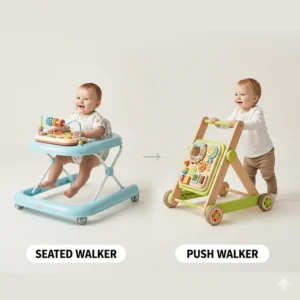
Seated Walkers feature a suspended seat within a wheeled frame. Babies propel themselves using their feet while the frame supports their weight. These traditional designs work best in single-level homes with baby gates installed.
Push Walkers require babies to stand behind and push the unit forward. These encourage proper walking posture and core strength development. Pediatricians generally prefer this category because it doesn’t interfere with natural developmental progression.
Convertible Multi-Mode Walkers transform between seated, push, bouncer, and activity center configurations. These maximize investment value by adapting to different developmental stages from 6-18 months.
Step 2: Verify Safety Certifications
Never compromise on safety standards for walkers. Look for:
- ASTM F977 compliance marking on packaging and product
- CPSC certification number indicating federal approval
- Manufacturing date within the past 2 years
- Recall database search at CPSC.gov before purchasing
Step 3: Evaluate Developmental Appropriateness
Consider where your baby falls developmentally:
6-8 Months: Stationary activity centers or convertible walkers in bouncer mode work well. Babies this age lack the coordination for mobile walkers.
8-12 Months: Traditional seated walkers or early push walkers become appropriate once babies show strong trunk control and can sit unassisted.
12-18 Months: Push walkers and convertible models in toddler mode support natural walking development without creating dependence.
Step 4: Assess Practical Features
Daily usability matters as much as safety:
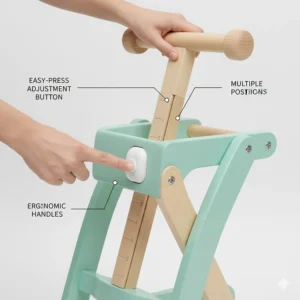
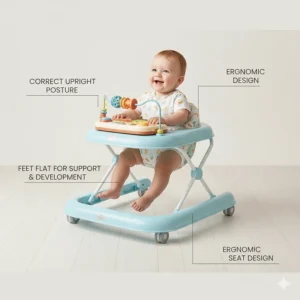
Height Adjustability: Minimum three positions ensures proper foot placement as baby grows. Feet should touch floor flat, not tiptoe.
Folding Mechanism: One-handed fold designs enable easy storage. Measure your storage space before selecting large-footprint models.
Cleaning Ease: Machine-washable seat covers and wipe-clean trays reduce maintenance burden. Babies make messes—plan accordingly.
Weight Capacity: Most walkers accommodate 20-30 pounds. Verify your baby’s current weight and projected growth.
Step 5: Consider Activity Panel Quality
Entertainment features vary dramatically:
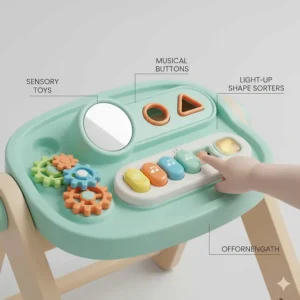
Educational Value: Look for age-appropriate learning content including letters, numbers, shapes, and colors. Fisher-Price’s Smart Stages technology adjusts complexity as babies develop.
Volume Control: Multiple volume settings (including off) preserve parental sanity. Some models offer music without option to reduce volume.
Removability: Detachable toy stations extend play value beyond walker usage. These convert to floor toys or travel entertainment.
Battery Requirements: Check battery type and quantity. Some models consume batteries rapidly.
Step 6: Evaluate Budget vs. Features
Price categories reveal distinct value propositions:
Budget Range ($40-60): Basic push walkers or simple seated models with minimal electronics. Best for families wanting short-term mobility solutions.
Mid-Range ($60-90): Licensed character themes, music features, and multiple height settings. Most popular category for balanced features.
Premium Range ($90-120+): Convertible multi-mode designs, extensive activity panels, superior build quality. Investment pieces that serve multiple developmental stages.
Step 7: Read Current User Reviews
Recent feedback reveals real-world performance. Search Amazon reviews from the past 3-6 months for most relevant experiences regarding assembly difficulty, durability concerns, safety incidents, and customer service responsiveness.
Walker Selection Criteria: Matching Products to Your Home
Space Considerations
Your home layout dramatically influences walker selection criteria. Measure doorways, hallways, and available floor space before purchasing.
Apartment Living: Compact push walkers or stationary activity centers prevent wall collisions and furniture damage. Seated walkers with wide bases may exceed available maneuvering room.
Multi-Level Homes: Push walkers pose fewer stair risks than seated versions. Install heavy-duty baby gates at ALL stairways regardless of walker type selected.
Open Concept Layouts: Larger seated walkers work well in spacious areas. Babies can explore safely without constant direction changes.
Flooring Type Impact
Surface materials affect walker performance:
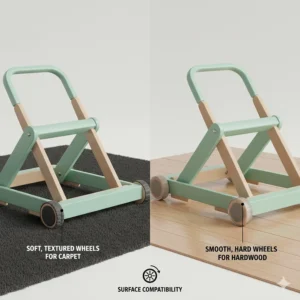
Carpet: Requires walkers with larger wheels and stronger leg strength from babies. Thick pile carpet may prevent movement entirely.
Hardwood/Tile: Walkers glide easily—sometimes too easily. Look for speed control features and rubber-coated wheels that provide friction.
Mixed Surfaces: Walkers must transition smoothly between flooring types without catching or tipping.
Supervision Reality Check
Honest assessment of your supervision capacity matters. The American Academy of Pediatrics emphasizes that babies can travel in walkers at speeds of multiple feet per second, requiring constant visual supervision.
Constant Supervision Available: Any certified walker type works if you can maintain visual contact continuously.
Intermittent Supervision: Stationary activity centers or very limited walker sessions under 15 minutes become necessary. Never leave babies unattended in mobile walkers.
Multiple Children: Push walkers allow older siblings to play alongside without collision risks.
What to Look for in a Baby Walker: Critical Feature Analysis
Frame Construction Quality
The structural foundation determines safety and longevity:
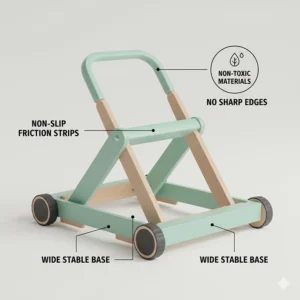
Base Width: Minimum 26-30 inches prevents doorway passage per federal standards. Test by measuring your narrowest doorway and comparing specifications.
Material Strength: High-quality polypropylene plastic resists cracking under stress. Metal frames add durability but increase weight.
Wheel Configuration: Eight wheels provide superior stability compared to four-wheel designs. Look for swivel wheels in front, fixed wheels in rear for directional control.
Weight Distribution: Bottom-heavy designs with weighted bases resist tipping when babies lunge or lean.
Seat Design Elements
Comfort and support impact usage duration:
Fabric Quality: Breathable mesh fabrics prevent overheating during extended sessions. Nylon seats wipe clean but may feel less comfortable.
Padding Thickness: Adequate cushioning prevents pressure points. Seats should support babies without excessive sinking.
Height of Seat Back: Higher backrests provide better postural support for younger babies still developing core strength.
Leg Opening Size: Should accommodate baby’s legs without gaps large enough to slip through. Openings between 5-7 inches meet safety standards.
Brake and Safety Mechanisms
Critical features that prevent accidents:
Stair Detection: Friction pads or gripping devices engage when wheels encounter elevation changes. Test this feature before first use.
Speed Governors: Wheels with built-in resistance prevent runaway acceleration. Particularly important on slick flooring.
Anti-Tip Design: Wide stance and low center of gravity stop lateral tipping. Press sides of walker to verify stability.
Locking Features: Some models include parking brakes for stationary play. Useful when using walker as feeding table.
Safety Standards for Walkers: Beyond Basic Compliance
Understanding CPSC Regulations
The Consumer Product Safety Commission requires manufacturers and importers to certify compliance by issuing a Children’s Product Certificate (CPC) for all infant walkers. This certification verifies:
Performance Requirements:
- Must either be too wide to fit through 36-inch doorway OR include gripping mechanisms
- Stair fall testing using actual walker weight for realistic scenarios
- Parking brake testing for models equipped with locking features
- Static stability testing to prevent tip-over incidents
Material Safety:
- Lead content under 100 ppm in all accessible components
- Phthalate restrictions prohibiting harmful chemicals
- Tracking label requirements for recall identification
Medical Community Perspective
Healthcare professionals maintain serious reservations about walker safety. The American Academy of Pediatrics recommends a ban on the manufacture and sale of mobile infant walkers, stating there is no clear benefit from their use. Canada implemented such a ban in 2004, becoming the first country worldwide to prohibit walker sales entirely.
Pediatric emergency medicine specialists note that risks include injuries to the head and neck, burns from accessing hot stoves, or being rolled inadvertently into pools or bodies of water.
Purchase Decision Factors: Making the Final Choice
Weighing Cost vs. Quality
Budget constraints tempt shortcuts, but safety cannot be compromised:
Budget-Friendly Options: Fisher-Price and Bright Starts offer ASTM-certified walkers starting around $40-60. These provide essential safety without premium features.
Mid-Range Sweet Spot: The $60-90 category delivers licensed characters, music, and adjustable components. Most families find optimal value here.
Premium Investments: $90-120+ walkers include convertible designs, superior materials, and extensive activities. Justified if serving multiple children.
New vs. Secondhand Considerations
Used walkers present complicated safety questions:
Risks of Used Products:
- Unknown damage history affecting structural integrity
- Older models predating current safety standards
- Missing parts compromising safety systems
- Potential recall status unknown
Never Buy Used:
- Yard sale or flea market walkers of unknown age
- Products with visible damage or repairs
- Models missing identification labels
- Anything manufactured before 2010 mandatory standards
Brand Reputation Assessment
Established manufacturers provide accountability:
Fisher-Price: Industry leader with 90+ year history. Extensive safety testing and responsive recall procedures.
Bright Starts: Popular mid-range option balancing features and affordability. Licensed designs add appeal.
Skip Hop: Premium boutique brand emphasizing design aesthetics and developmental research.
🎁 Ready to Choose Your Walker?
💡 Before you buy, double-check these critical safety elements: ASTM F977 certification, CPSC compliance number, manufacturing date within past 2 years, and verification in the recall database. Your baby’s safety depends on these simple verification steps!
Alternatives to Traditional Baby Walkers
Stationary Activity Centers
These fixed-position units provide entertainment without mobility risks:
How They Work: Babies sit in a suspended seat surrounded by toys and activities. The unit rotates but doesn’t move across floors.
Safety Advantages: Eliminates stair fall risks and reduces access to dangerous areas. Parents can supervise from nearby without constant hovering.
Developmental Benefits: Encourages standing and bouncing motions that build leg strength. Activities promote fine motor skills without compromising natural walking development.
Push Walker Toys
These encourage natural walking mechanics:
Design Philosophy: Babies stand behind wheeled units and push forward. The walker provides balance support without weight-bearing seats.
Developmental Superiority: Pediatricians prefer push walkers because they require babies to use proper walking posture and core muscles.
Skill Prerequisites: Baby must already pull up to standing independently. Typically appropriate around 9-12 months.
Floor Play as Alternative
Simple floor time provides superior developmental benefits:
Tummy Time: Builds upper body strength essential for crawling and walking. Recommended from birth onward.
Crawling Practice: Natural developmental stage that shouldn’t be rushed. Babies who crawl longer often develop better coordination.
Cruising Furniture: Babies who pull up and walk along furniture learn balance and weight shifting naturally.
Common Mistakes to Avoid When Buying Baby Walkers
Starting Too Early
Many parents introduce walkers before babies are ready. Wait until baby demonstrates consistent unsupported sitting (typically 6-8 months). Earlier use provides no benefits and may interfere with natural development.
Ignoring Height Adjustment Importance
Proper fit prevents injuries and developmental issues. Baby’s feet should rest flat on floor with slight knee bend. Tiptoe positioning or slumped posture indicates wrong height.
Exceeding Recommended Usage Time
Extended walker sessions backfire developmentally. Limit individual walker sessions to 15-20 minutes maximum. Total walker time should not exceed 45-60 minutes per day.
Inadequate Home Safety Preparation
Walkers require environmental modifications:
Essential Safety Steps:
- Install hardware-mounted gates at ALL stairways
- Remove dangling cords, tablecloths, and low-hanging hazards
- Block access to kitchens, bathrooms, and pools during walker use
- Secure heavy furniture that could tip if bumped
- Eliminate small objects that become choking hazards
❓ Frequently Asked Questions About Baby Walker Buying Guide
❓ When should I start using a baby walker for my infant?
❓ Are baby walkers actually safe despite CPSC regulations?
❓ How long should babies use walkers each day?
❓ Can baby walkers help my child learn to walk faster?
❓ What is the difference between push walkers and seated walkers?
Conclusion: Making Your Baby Walker Buying Guide Decision
Navigating the baby walker buying guide landscape requires balancing safety standards for walkers, developmental appropriateness, and practical usability within your home environment. The decision ultimately depends on your specific circumstances, supervision capacity, and comfort level with inherent risks.
Modern walkers certified to ASTM F977 standards represent dramatic safety improvements over historical designs. Yet medical experts continue expressing reservations about whether any mobile walker justifies its risks when safer alternatives exist. Stationary activity centers and push walker toys provide entertainment and developmental support without the dangers associated with seated wheeled versions.
If you proceed with a walker purchase, prioritize these non-negotiable elements: ASTM F977 certification, CPSC compliance documentation, manufacturing date within the past two years, verification against recall databases, and comprehensive home safety modifications including hardware-mounted stair gates. Never compromise on these safety standards for walkers regardless of attractive pricing or features.
Remember that walker selection criteria should emphasize your baby’s developmental stage, your home layout, and realistic supervision capabilities rather than marketing claims or character themes. The walker serves as a temporary entertainment tool, not a developmental necessity. Many babies develop perfectly without ever using walkers.
Consider your baby’s individual temperament and developmental trajectory when evaluating what to look for in a baby walker. Active babies may benefit from controlled mobility outlets, while more cautious infants might prefer stationary play. Trust your parental instincts while remaining informed about safety standards and developmental research.
Recommended for You
- 7 Best Sit to Stand Walker vs Traditional Walker (2026 Guide)
- Walker vs Jumper vs Exersaucer: 7 Key Differences (2026 Guide)
- Best Baby Walker Under $100: 7 Expert Picks for 2026
Disclaimer: This article contains affiliate links. If you purchase products through these links, we may earn a small commission at no additional cost to you.
✨ Found this helpful? Share it with your friends! 💬🤗
