
In This Article
A motor skills tracking device for toddlers is any wearable, sensor, or structured tool that records how a toddler moves: steps, active minutes, balance, climbing, and coordination. Parents can use it to compare patterns over time and spot concerns early. It supplements, but never replaces, pediatric developmental screening.
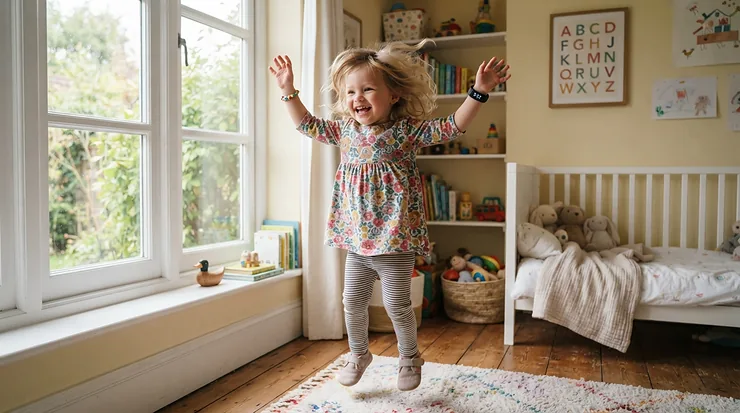
Here’s the plot twist most buying guides skip: the toddler wearable aisle is nearly empty. The kid-specific wrist trackers on shelves list minimum ages of 4 or even 6. That means a motor skills tracking device for toddlers aged one to three is rarely a single gadget. It’s a toolkit. You pair a tracker for the older end of the range with playground-style gear that turns climbing, balancing, and gliding into things you can observe, time, and compare.
That framing matters because developmental milestones are, by definition, things most children can do by a certain age. They describe typical ranges, not report cards. A good setup helps you notice patterns. Is she steadier on the stones than last month? Does he still avoid stairs? You’re watching a trend, not chasing a number.
So this guide covers seven real products: three wrist trackers and four pieces of equipment that work like occupational therapy tools at home. Every verdict comes from spec-sheet analysis and aggregated reviewer sentiment, not from claims of hands-on testing. Prices appear as ranges only, and nothing here diagnoses a delay. Ready? Let’s start with the side-by-side.
Quick Comparison: Motor Skills Tracking Device for Toddlers Options at a Glance
Before the deep dives, here’s the lineup in one scannable view. Age fits come from manufacturers or retailers and sometimes disagree, so always check the listing.
| Product | Type | Age Fit (per maker/source) | Price Range | Best For |
|---|---|---|---|---|
| Garmin vívofit jr. 3 | Wrist tracker | 4+ | $80-$100 range | Swimmers who need zero-charging simplicity |
| Fitbit Ace 3 | Wrist tracker | 6+ | $70-$90 range | Parents who want a detailed app history |
| BIGGERFIVE Vigor 2 | Wrist tracker | About 5-6+ | $25-$40 range | Tight budgets and trial runs |
| Strider 12 Sport | Balance bike | 18 months-5 years | $100-$150 range | Measuring balance through glide time |
| GONGE River Stones | Stepping stones | 2-3+ (varies) | $60-$100 range | Jump planning and balance paths |
| Wobbel Original | Balance board | Varies by version | $150-$190 range | Core control that lasts for years |
| BlueWood Pikler Triangle Set | Climbing set | 18 months-7 years | $100-$250 range | Kids who climb everything |
Looking at the table above, the three wrist trackers cost the least but sit at the oldest end of the age range. The four equipment picks are the ones that reach true toddlers. If your child is under four, the Strider 12 Sport, GONGE River Stones, Wobbel Original, and BlueWood Pikler Triangle Set are the realistic starting points. The BIGGERFIVE Vigor 2 is the cheapest way to test whether a wristband sticks at all.
💬 Just one click — help others make better buying decisions too!😊
Top 7 Picks: Motor Skills Tracking Device for Toddlers, Analyzed
Purpose-built consumer sensors for under-fours are scarce. The most detailed home-based work so far, a 2026 study in Science Translational Medicine, used research-grade sensor suits on 92 infants. You can’t buy that suit at retail. This lineup instead blends wrist trackers with equipment that makes motor progress visible.
1. Garmin vívofit jr. 3 — year-long battery, zero charging
Most kids’ trackers die by Thursday, but the Garmin vívofit jr. 3 runs on a user-replaceable CR2025 coin cell rated for up to a year. It’s built for ages 4+, with a band fitting 130-175 mm wrists. It weighs about 25 g, has a 5 ATM water rating, stores 14 days of data, and counts steps, sleep, and a 60-minute daily activity goal. In practice, it’s a pedometer with manners. It’s great at counting steps but blind to whether those steps were a confident run or a cautious shuffle.
Based on the spec comparison, this is the strongest pick for the older end of toddlerhood. A child who’s 3.5 and willing to wear a band gets continuous activity monitoring without a nightly charging fight. Treat the step trend as a baseline, not a grade.
Reviewers consistently praise the battery life, sunlight-readable display, and small-wrist fit. A common complaint is that the single-button navigation and chore setup feel clunky.
Pros:
- ✅ Year-long replaceable coin-cell battery
- ✅ Swim-friendly 5 ATM water rating
- ✅ No subscription and no location tracking
Cons:
- ❌ Listed for ages 4 and up
- ❌ Button-only interface, clunky chore setup
Price range: around $80-$100, so check current price. Verdict: the best zero-maintenance value if your child is old enough.

2. Fitbit Ace 3 — richest parent dashboard
The Fitbit Ace 3 shines in the app, with separate Parent View and Kid View. It’s recommended for ages 6+, with up to 8 days of battery, a magnetic proprietary charger, and 50-meter water resistance. It stores seven days of minute-by-minute motion data plus 30 days of daily totals. Defaults are 60 active minutes and 10,000 steps.
Minute-level data is the real prize. You can see when the afternoon slump hits, or whether a rainy week flattened movement. The 10,000-step default, however, is tuned for school-age kids. Don’t make a three-year-old chase it.
Honest take: this is a step-up device. It overshoots toddler wrists, but it’s the best fit if you want to see patterns before the preschool years. The model launched in 2021, so verify current availability.
Reviewers consistently note the accurate eight-day battery and tough strap. Critics point to the shallow feature set, the monochrome display, and the short charging cable.
Pros:
- ✅ Parent and Kid views in one app
- ✅ Minute-by-minute history for seven days
- ✅ Up to eight days per charge
Cons:
- ❌ Minimum recommended age is 6+
- ❌ Basic monochrome screen and short charger
Price range: around $70-$90, and prices may vary. Verdict: great data, wrong age, best for older siblings or the preschool years.
3. BIGGERFIVE Vigor 2 — cheapest way to test the waters
Think of the BIGGERFIVE Vigor 2 as a low-risk experiment. For a fraction of the big-brand price, you learn whether your child tolerates a wristband at all. Coverage describes an IP68 rating, roughly a week of battery, silicone straps in four colors, and tracking for steps, sleep, and heart rate. It also has sport modes, including dancing. Age guidance runs from about 5 to 6+, depending on the source and model.
IP68 handles dust and splashes, and one reviewer cautions against saltwater and hot baths. The dance mode is a small charmer for kids who spend more time spinning than sprinting.
Based on reviewer comparisons, the app can’t match Fitbit or Garmin for depth. Still, a sub-$40 gamble beats a $90 regret. Treat heart rate as bonus trivia for toddlers, not a development metric.
Reviewers describe good features for the money. They also say Fitbit and Garmin offer more, and that the battery could last longer.
Pros:
- ✅ Very low cost of entry
- ✅ IP68 rating survives splashes and dust
- ✅ Steps, sleep, and heart rate tracking
Cons:
- ❌ Less polished app than Fitbit or Garmin
- ❌ Not suited to saltwater or hot baths
Price range: around $25-$40, so check current price. Verdict: a smart trial run for the budget-conscious.
4. Strider 12 Sport — measures balance through glide
Not every motor skills tracking device for toddlers has a battery. The Strider 12 Sport is a balance bike, and it turns balance into a number you can time. The maker lists ages 18 months to 5 years. It weighs 3.0 kg (6.7 lb), has flat-free 12-inch foam tires, a seat range of roughly 11-19 inches, and a 60 lb rider limit. Retailers sometimes list narrower age ranges.
Low weight and low seat height let small riders plant both feet, which lets them self-correct instead of tipping. What you’re really measuring is feet-up glide time. A 10-second phone video every two weeks gives you a repeatable benchmark for balance, steering, and confidence.
Reviewers highlight the light weight and easy adjustment. One UK reviewer noted a three-year-old could push it around indoors. Keep a helmet handy.
Pros:
- ✅ Lightweight 6.7 lb frame toddlers can manage
- ✅ Flat-free tires and no-tool adjustment
- ✅ Fits from about 18 months per the maker
Cons:
- ❌ Needs helmet and supervision outdoors
- ❌ No brake by default (optional add-on)
Price range: roughly $100-$150, and prices vary by color and retailer. Verdict: the best “tracker” for toddlers who are already walking.
5. GONGE River Stones — turns jumping into a scoreboard
The GONGE River Stones make motor planning visible. The set has six stones: three about 15 inches wide and three about 10 inches. They stand roughly 3.35 and 1.77 inches tall, with rubber bases, stackable storage, and a 220 lb capacity. The maker lists ages 2+, while Amazon lists 36 months and up, so read your listing.
Each triangular side has a different slope, which sets progressive difficulty. Kids have to judge distance, shift weight, and plan the next hop. That’s a lot of motor planning for a plastic triangle.
The measurable benchmark is simple: how many stones can your child cross without touching the floor? Log it weekly. As an at-home entry among occupational therapy tools, it’s hard to beat.
I couldn’t verify a large body of independent reviews for this set. Sensory and therapy retailers regularly feature it, but that’s endorsement, not data.
Pros:
- ✅ Rubber bases keep stones from slipping
- ✅ Six stones allow adjustable difficulty
- ✅ Stackable for tidy storage
Cons:
- ❌ Age guidance varies by seller
- ❌ Longer paths take real floor space
Price range: roughly $60-$100, so check current price. Verdict: the best balance-per-dollar for ages two and up.

6. Wobbel Original — one board, many ages
The Wobbel Original is a curved FSC beech board measuring about 90 x 30 cm (35.4 x 11.8 inches) and weighing about 4.5 kg. The maker certifies it up to 200 kg. Age claims vary: the maker’s FAQ says the felt version suits children from 0 months with supervision, while a U.S. retailer cites 3+. Read the specific version you’re buying.
Rocking, tilting, and standing all train weight shifting and core control. Pediatric OT bloggers suggest tossing and catching a ball while standing on a board to build hand-eye coordination and balance reactions. It doubles as a tunnel, a bridge, and a very flat sled for stuffed animals.
Reviewers describe the build quality as excellent but pricey, and better for older toddlers because small fingers and toes can get pinched. Some OT bloggers argue branded boards are overpriced for how much use they get.
Pros:
- ✅ Solid FSC beech build lasts for years
- ✅ Grows from toddler play to adult use
- ✅ Open-ended: rocker, tunnel, seat
Cons:
- ❌ Premium price versus simpler wobble boards
- ❌ Fingers and toes can get pinched
Price range: roughly $150-$190, depending on finish. Verdict: a long-haul investment if you’ll use it for years.
7. BlueWood Pikler Triangle Set — climbing that builds on its own
The BlueWood Pikler Triangle Set is a foldable 7-in-1 climber with a triangle, arch ladder, and ramp. The listing cites FSC-certified solid wood, ages 18 months to 7 years, and a load capacity in the 160-180 lb range. Listing text varies, so check yours.
Climbing recruits grip, whole-body strength, and bilateral coordination. A ramp-to-triangle progression gives you built-in difficulty levels. Pikler-style play lets kids choose their own climbs rather than being lifted up, which makes progress easy to observe. Track rungs climbed unaided and whether your child descends backward or sideways.
I couldn’t verify a trustworthy aggregate of independent reviews for this exact set. The best available signal is its sales rank of #2 in Kids’ Indoor Climbers at time of research. That rank shifts daily and reflects popularity, not performance.
Pros:
- ✅ Folds for storage
- ✅ Multiple configurations as skills grow
- ✅ FSC-certified solid wood
Cons:
- ❌ Large footprint when fully open
- ❌ Needs supervision and a soft landing
Price range: roughly $100-$250 for multi-piece wooden sets in this category, so check current price. Verdict: best for kids who treat furniture as a mountain range.
| Product | Key Spec | Power / Durability | Price Range | Reviewer Sentiment | Best For |
|---|---|---|---|---|---|
| Garmin vívofit jr. 3 | Steps, sleep, 60-min goal | CR2025, up to 1 year; 5 ATM | $80-$100 range | Praised battery; clunky chores | Preschool swimmers |
| Fitbit Ace 3 | Minute-level history | Up to 8 days; 50 m | $70-$90 range | Accurate battery; shallow features | Data-minded parents |
| BIGGERFIVE Vigor 2 | Steps, sleep, heart rate | Roughly a week; IP68 | $25-$40 range | Good value; less depth | Budget trials |
| Strider 12 Sport | Glide-time benchmark | 6.7 lb; flat-free tires | $100-$150 range | Light, adjustable | Walking toddlers |
| GONGE River Stones | Stone-crossing count | 220 lb capacity | $60-$100 range | Limited verified reviews | Balance paths |
| Wobbel Original | Weight-shift control | CE-certified to 200 kg | $150-$190 range | High quality, pricey | Core strength |
| BlueWood Pikler Triangle Set | Unaided climbing rungs | Foldable; FSC wood | $100-$250 range | Popular; reviews unverified | Climbers |
The comparison shows a clear split. The BIGGERFIVE Vigor 2 wins on cost, and the Garmin vívofit jr. 3 wins on convenience. The Fitbit Ace 3 is strongest on data depth. For toddlers under four, the equipment rows matter more than the wearable rows. Among them, the GONGE River Stones are the lowest-cost way to start measuring balance.
Your First 30 Days With a Motor Skills Tracking Device for Toddlers: A Practical Setup Guide
A motor skills tracking device for toddlers only helps if you use it consistently. Here’s a four-week plan that Amazon listings won’t give you.
Week 0 — Baseline. Complete the CDC checklist for your child’s age. Pick two or three moves to watch, such as walking stairs, balancing on one foot, or hopping between stones.
Week 1 — Fit and comfort. If you’re using a wrist tracker, check that you can slide two fingers under the band and look for red marks after wear. If your child fights it, stop. Privacy matters too. Mozilla’s Privacy Not Included review found that neither the Fitbit Ace 3 nor the Garmin vívofit jr. 3 tracks location, though it suggested waiting until around age 12 for trackers in general.
Weeks 2-4 — Weekly motor probes. Once a week, run a five-minute test: a GONGE River Stones path, a Strider 12 Sport glide, or a BlueWood Pikler Triangle Set climb. Record a 10-second video each time.
Common first-month mistakes: chasing step targets, comparing your child to someone else’s, and changing several variables at once. Change one thing at a time, and let trends do the talking.

Real-World Scenarios: Three Toddler Profiles, Three Setups
Specs only matter when they meet your actual home. Here are three hypothetical situations.
If your child is 20 months old, newly walking, and you live in a small apartment on a $200 budget, the BlueWood Pikler Triangle Set folds away, while the GONGE River Stones stack. Choose one and run the weekly climb or hop probe. A wrist tracker would be wasted here.
If your child is 3.5, attends daycare, and takes swim lessons, the Garmin vívofit jr. 3 is the strongest wearable fit. Its 5 ATM rating and year-long battery suit a child who lives half their life wet. Add GONGE River Stones for weekly balance checks.
If you’re preparing for a conversation with your pediatrician or an occupational therapist, bring evidence. Pair the CDC checklist with dated videos from the Strider 12 Sport or the Wobbel Original. That kind of documentation makes coordination tracking gadget for kids data far more useful than a vague “she seems clumsy.”
✨ Ready to Build Your Toddler’s Movement Toolkit?
🔍 Take your toddler’s motor progress to the next level with these carefully selected products. Click on any highlighted item to check current pricing and availability. These tools will help you track genuine, observable progress your family will love!
Problem → Solution: Fixing Common Tracking Headaches
Problem: your toddler yanks off the wristband. Start with 20-minute sessions during favorite activities, and let your child choose the band color. If it still fails, switch to equipment-based tracking like the Strider 12 Sport.
Problem: step counts look low. Tracker step counts for small children can swing with arm movement and how much they’re carried. Compare weekly averages, never single days.
Problem: you’re comparing your child to others. Milestones describe what most children can do, not what every child does on a given day. Use your own child’s trend line.
Problem: no floor space. The BlueWood Pikler Triangle Set folds, and the GONGE River Stones stack. A two-stone path in a hallway still works as a balance probe.
How to Choose a Motor Skills Tracking Device for Toddlers
Choosing a motor skills tracking device for toddlers comes down to six steps:
- Match the age to the product. If your child is under four, skip wearables and start with equipment. Age guidance varies by seller, so double-check.
- Decide what you want to see. Steps and sleep need a wearable. Balance, climbing, and gliding need equipment.
- Check wrist fit. Garmin lists a 130-175 mm band range. If your child’s wrist is smaller, wait.
- Weigh the maintenance burden. A year-long coin cell beats weekly charging for most families.
- Check privacy and subscriptions. Prefer devices that don’t track location and don’t charge monthly fees.
- Plan how you’ll record results. Even the best product is useless without a simple log: a notes app, a spreadsheet, or dated videos.
Gross Motor Benchmarks: What Typical Development Looks Like
Gross motor benchmarks are the big-body skills pediatric guidelines look for at set ages: standing, walking, running, climbing, and jumping. They help you interpret your tracking data, so treat them as context rather than a pass/fail test.
According to CDC checklists, 12-month-olds typically pull to stand, and many walk without holding on by 18 months. By 2 years, expect running and kicking a ball. By 3 years, CDC lists physical milestones such as stringing large beads, putting on loose clothes, and using a fork.
Remember what a milestone is: something about 75% or more of children can do by that age. A quarter of typical children haven’t yet. The CDC Milestone Tracker app is free, covers ages 2 months to 5 years, and generates a summary you can share with your doctor.
Use the checklist as your anchor, then let your motor skills tracking device for toddlers add detail between visits. If you notice a skill slipping or a long plateau, talk to your pediatrician rather than waiting.

Wearable Motor Skills Monitor for Toddlers vs. Occupational Therapy Tools
A wearable motor skills monitor for toddlers excels at what it counts: steps, active minutes, and sleep. It struggles with how a child moves. Occupational therapy tools like stepping stones, balance boards, and climbers do the opposite. They reveal quality of movement but need you to do the recording.
| Approach | What It Captures | Main Strength | Main Limit | Best For |
|---|---|---|---|---|
| Wrist tracker (Garmin vívofit jr. 3) | Steps, sleep, active minutes | Objective and continuous | Can’t judge movement quality | Ages 4+ routines |
| CDC checklist and app | Milestone yes/no | Free and clinically anchored | Parent-reported snapshots | Every family |
| Home probes (GONGE River Stones, Strider 12 Sport) | Balance, jumping, glide | Shows quality; repeatable | Manual logging | Ages 18 months+ |
| Professional OT evaluation | Standardized assessment | Expert interpretation | Cost and scheduling | Persistent concerns |
The right answer for most families is to combine them. A wrist tracker gives volume, equipment gives quality, and the CDC checklist provides the reference frame. If anything worries you, only a professional evaluation can say what it means.
Activity Monitoring and the Activity Tracker for Toddler Development: Features That Actually Matter
An activity tracker for toddler development needs fewer features than marketing suggests. For activity monitoring in early childhood, focus on four things: battery, water rating, data granularity, and privacy.
Context helps. The WHO guidelines for children under 5 recommend at least 180 minutes of varied physical activity daily for ages 1-2. For ages 3-4, they recommend 180 minutes with at least 60 of those at moderate-to-vigorous intensity. That’s total movement, much of it unstructured play that no pedometer captures.
Features worth paying for: a long battery, such as the Garmin vívofit jr. 3‘s year-long coin cell. Minute-level history, like the Fitbit Ace 3 offers. Water resistance for bath and pool days.
Features to ignore: calorie counts, social leaderboards, and heart rate readings for toddlers. The metrics that matter are patterns in activity and sleep, not scoreboards.
Coordination Tracking Gadget for Kids: Safety, Privacy, and Regulations
A coordination tracking gadget for kids should be safe first and clever second.
Battery safety. The Garmin vívofit jr. 3 uses a CR2025 lithium coin cell. Pediatric safety groups flag swallowed button batteries as a serious emergency. Keep the compartment secure and store spares out of reach.
Skin and fit. Check for redness after wear, and remove the band if your child shows irritation.
Equipment safety. Use a helmet on the Strider 12 Sport, and place GONGE River Stones and the BlueWood Pikler Triangle Set on a flat, soft surface. Respect posted weight limits, and check the seller’s age guidance for Wobbel Original and stones, since it varies.
Privacy. Choose kid-specific devices that don’t track location, and avoid products requiring a monthly subscription for core features. For anything regulated, such as toy-safety certification, verify the claim on the manufacturer’s page rather than trusting a listing bullet.
Long-Term Cost & Maintenance
Cost-per-use is the honest way to compare these products. A tracker in the $80-$100 range used for two years works out to roughly $3-$4 per month. The Garmin vívofit jr. 3 adds only an occasional coin-cell replacement. The Fitbit Ace 3 needs recharging about every eight days, which is a small recurring chore.
Equipment spreads its cost across years. The Wobbel Original grows from toddler rocker to adult balance tool, and the Strider 12 Sport bridges into pedal-bike learning. Wooden items like the BlueWood Pikler Triangle Set and Wobbel Original often hold resale value, though that’s not guaranteed.
The BIGGERFIVE Vigor 2 is the cheapest to try and cheapest to lose. Maintenance across the board is light: wipe wearables, tighten screws on the climber, and check for wear every few months.
Total cost of ownership, then, favors multi-year equipment over a single wearable if your child is under four. A wearable earns its keep when your child hits four to six.

FAQ
❓ What is the youngest age for a motor skills tracking device for toddlers?
❓ How much does a motor skills tracking device for toddlers cost?
❓ Which is better for toddlers, Garmin vívofit jr. 3 or Fitbit Ace 3?
❓ Are kids' fitness trackers safe for bath time?
❓ Do these trackers need a smartphone or subscription?
Conclusion
A motor skills tracking device for toddlers isn’t one gadget. It’s a small system: a way to count (a wearable), a way to observe (equipment), and a way to interpret (milestone checklists and your pediatrician).
If your child is four or older, the Garmin vívofit jr. 3 is the standout for hands-off activity monitoring. The Fitbit Ace 3 is the pick for deeper app data, and the BIGGERFIVE Vigor 2 is the cheapest experiment. For true toddlers, start with the GONGE River Stones or the BlueWood Pikler Triangle Set, then add the Strider 12 Sport once they’re walking confidently. The Wobbel Original is the long-term investment for core control.
Whichever you choose, log one simple measure weekly, compare against the CDC checklist, and keep a pediatrician in the loop. The goal isn’t a perfect score. It’s noticing progress early and catching concerns sooner.
Recommended for You
- Cognitive Development Tablet For Toddlers: 7 Best Picks 2026
- Cognitive Development Toys For Infants: 7 Smart Picks 2026
- Baby Development Tracking Wearable: 7 Best Picks For 2026
Disclaimer: This article contains affiliate links. As an Amazon Associate, I earn from qualifying purchases. If you purchase products through these links, we may earn a small commission at no additional cost to you.
✨ Found this helpful? Share it with your friends! 💬🤗
