
In This Article
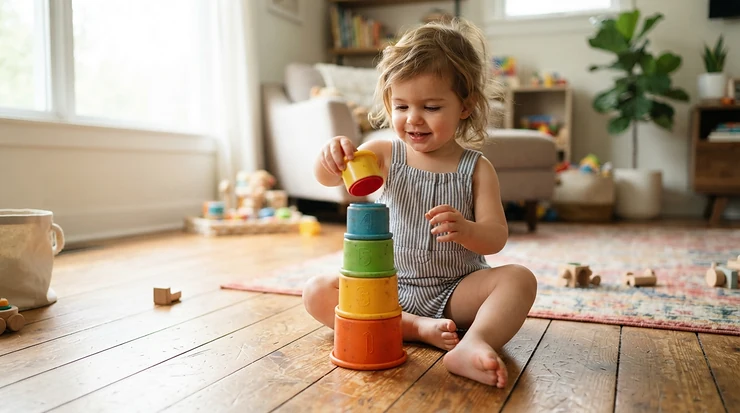
Somewhere around the first birthday, your baby’s hands get an upgrade. Fingers that once raked everything toward the palm start to pinch, poke, release, and, much to the dismay of anyone sweeping under a high chair, drop things on purpose. It’s messy. It’s also exactly what’s supposed to happen.
Choosing fine motor skills toys for a 1 year old sounds easy until you’re staring at hundreds of near-identical listings, all promising to “boost development.” Most won’t hurt. A few will genuinely help. The trick is telling them apart.
Here’s the backdrop. Most babies start using a thumb-and-finger pinch around 9 months, though Pathways.org notes it can arrive as late as 12 months. That same pinch later powers self-feeding skills, snaps, zips, and eventually handwriting. Developmental checklists for this age commonly include grasping small objects between thumb and forefinger, poking with the index finger, and putting blocks into and out of a container. That’s your target. Your toy shelf’s job is to give those tiny muscles something worth practicing on.
A quick word on method. I haven’t put these toys in a toddler’s hands, and I won’t pretend otherwise. Everything below is built from manufacturer specifications, safety information, and the patterns that show up in published parent and expert reviews. That’s analysis, not anecdote. Where the evidence is thin, I’ll say so. Prices are ranges only, so check current listings before you buy.
Quick Comparison Table: 7 Fine Motor Picks at a Glance
| Product | Min. Age (Maker) | Main Skill Target | Price Range | Best For |
|---|---|---|---|---|
| Fat Brain Toys Dimpl | 10 months+ | Finger isolation, pressing | $10-$15 | Early poking and pincer prep |
| Fisher-Price Baby’s First Blocks | 6 months+ | Grasp, carry, release | $10-$15 | Budget-friendly first sorter |
| Mushie Stacking Cups | 10 months+ | Stacking, nesting, bath play | $20-$25 | Easy-clean, multi-use play |
| The Original Toy Company Pop Up School Bus | 12 months+ | Press-and-release | $15-$20 | Cause-and-effect lovers |
| Hape Pound & Tap Bench | 12 months+ | Hammering, aim | $25-$35 | Energetic, movement-hungry toddlers |
| Fat Brain Toys SpinAgain | 12 months+ | Drop-and-release precision | High-$30s | Kids who love visual rewards |
| Lovevery The Block Set | Listed 12 months+; strongest near 18 months | Stacking, threading, sorting | $90-$100 | A long-term, grow-with-me investment |
Scan the table and a pattern jumps out. The two cheapest picks, Fat Brain Toys Dimpl and Fisher-Price Baby’s First Blocks, target the earliest skills: poking and container play. The pricier options stretch well into the toddler years. If your baby is just discovering the pinch, start with Fat Brain Toys Dimpl. If she’s more of a dump-and-fill demolition artist, Fisher-Price Baby’s First Blocks is the smarter first buy. Lovevery The Block Set is a long-term bet, not a day-one necessity.
💬 Just one click — help others make better buying decisions too!😊
Top 7 Fine Motor Skills Toys for a 1 Year Old: Expert Analysis
Each pick gets the same treatment: what the specs mean in practice, who it suits, what reviewers keep saying, and an honest price-versus-value verdict. Ages shown are manufacturer minimums, so always confirm the label on the exact version you buy.
1. Fat Brain Toys Dimpl — pocket-sized finger gym
Fat Brain Toys Dimpl is basically a tiny gym for the index finger, the digit a one-year-old needs most for pinching, pointing, and poking.
Five silicone bubbles in varying sizes and colors sit in a sturdy ABS frame of roughly 5.5 by 5 inches, weighing about 0.3 pounds. Each bubble pops through to the other side when pressed. In practice, your baby must isolate one finger and apply steady pressure instead of slapping with a flat palm, and the different bubble sizes quietly adjust the effort required. The maker lists it from 10 months, and its flat, featherweight build suits high chairs and car seats.
As a pincer grasp toy for 1 year old learners who still prefer poking to pinching, it’s strong, but it builds the finger isolation that pinching depends on rather than the pinch itself. Think of it as the warm-up act. It suits caregivers who want something quiet, portable, and inexpensive.
Reviewer sentiment is positive but not uniform. Parents on the manufacturer’s site describe babies figuring out the popping action around 9 to 10 months, and that listing averages about 4.86 stars across 873 reviews. A smaller retail listing sits at 3.4 from 61 ratings, so treat the high score as directional. A recurring complaint is that the silicone attracts lint and needs frequent rinsing.
Pros:
- ✅ Builds finger isolation and pressing strength
- ✅ Quiet, light, and easy to carry anywhere
- ✅ Food-grade silicone bubbles, BPA-free
Cons:
- ❌ Attracts lint and needs frequent rinsing
- ❌ Novelty may fade faster than other picks
Price check: usually in the $10-$15 range, which makes Fat Brain Toys Dimpl a low-risk, solid-payoff buy.
2. Fisher-Price Baby’s First Blocks — easiest first drop-and-sort game
Ten chunky shapes, one bucket, zero batteries: Fisher-Price Baby’s First Blocks is container play at its simplest.
The set includes a bucket with a slotted lid and ten blocks, measuring about 8.2 by 5.1 by 4.9 inches, with an ASTM F963-compliant, BPA-free plastic build. The maker’s age range runs from 6 to 36 months. That wide window matters. A younger baby dumps and fills, which is the “blocks in and out of a container” skill on developmental checklists, while an older toddler graduates to aligning shapes with slots. That alignment step is an early hand-eye coordination challenge, and the toy grows into it without any extra purchase.
My analytical take: this is the best entry point for a baby who loves emptying things. It rewards grasping, carrying, and releasing, which are the foundations beneath the pinch.
Retailer review summaries describe the toy as well made and easy for small hands to grip and carry, and one parent calls the size right for age one and up. A comparison guide notes the sorter lid rests on the bucket rather than locking, so it can come off during enthusiastic play.
Pros:
- ✅ Chunky blocks suit small, clumsy hands
- ✅ Bucket with handle simplifies travel and cleanup
- ✅ Wide 6-36 month range stretches its usefulness
Cons:
- ❌ Lid isn’t locked and can pop off
- ❌ All-plastic build offers little texture variety
Price check: around $10-$15, a very hard-to-beat value for a first sorter.
3. Mushie Stacking Cups — bath-friendly and dishwasher-safe
Stacking cups are a classic for good reason, and Mushie Stacking Cups is the polished, design-forward version.
The set contains eight cups of food-grade polypropylene, free of BPA, BPS, PVC, and phthalates, about 3.3 inches wide when nested and roughly 11.5 inches tall when stacked. The maker cites third-party testing to CPSIA and ASTM standards and recommends 10 months and up, though some retailers list 6 months, so check the specific listing. Holes in the cup bottoms turn them into bath and sand scoops. That’s useful because longer play time means more repetitions of grip, aim, and release.
Analytically, these are less a pincer toy than a grip-and-release trainer, and babies will likely enjoy knocking towers down as much as building them, which is also practice. To be fair, basic stacking cups cost far less, with budget sets around $7. You’re paying for design, safety documentation, and easy cleaning.
Comparison guides note the clear size differences, which suit the 9-to-12-month “putting in and taking out” stage, and they point out the cups are hard plastic rather than squishy silicone.
Pros:
- ✅ Dishwasher-safe and easy to sanitize
- ✅ Drainage holes extend play into the bath
- ✅ Third-party tested to US toy standards
Cons:
- ❌ Costs several times more than basic cups
- ❌ Retailer age labels conflict (6 versus 10 months)
Price check: roughly $20-$25. Worth it if you value cleaning convenience and a multi-year toy.
4. The Original Toy Company Pop Up School Bus — press, release, spring back
The Pop Up School Bus is a wooden bus with four peg-people who spring up when you press them down and let go.
The hardwood bus measures about 7 by 3 by 3.5 inches, and the figures sit on concealed springs. Movable wheels add a small bonus. In practice, pressing a peg down demands controlled, single-finger pressure, and letting go launches an instant, satisfying response. That’s finger isolation with built-in feedback. Tracking the popping figure adds a dash of hand-eye coordination. The maker recommends 12 months and up.
One caution from a seller listing: push a figure down far enough and it can fly out, so this belongs under adult supervision. It’s a niche toy with a clear job, ideal for cause-and-effect fans, and not an all-purpose one.
Honesty check on reviews: I couldn’t find a deep pool of independent reviews, and most listing language about “fine motor skills” is marketing, so I wouldn’t weigh it heavily.
Pros:
- ✅ Single-finger pressing builds finger isolation
- ✅ Solid hardwood construction
- ✅ Compact enough for a diaper bag
Cons:
- ❌ Pegs can fly out, so supervise
- ❌ Limited variety once mastered
Price check: around $15-$20, a fair price for a focused wooden toy, though the independent review evidence is thin.
5. Hape Pound & Tap Bench — hammering that turns into music
Hape Pound & Tap Bench (model E0305) lets toddlers hammer balls through holes onto a xylophone, then slide the xylophone out for solo play.
It measures roughly 9.45 by 5.9 by 5.3 inches and weighs about 2.6 pounds, built from solid wood with water-based, non-toxic finishes. The weight is a feature: it stays put while a determined hammerer goes to work. Aiming a mallet at a ball and landing the hit is classic hand-eye coordination toy for toddlers territory, and the maker recommends it from 12 months through age 3. It also won a 2018 Cribsie Award for favorite first musical toy.
Honestly, this is more grip-and-aim than pinch. It suits energetic toddlers who need to burn energy while learning. The xylophone has a limited single C-major range, so don’t expect symphonies.
Parent reviews describe children quickly grasping the tapping action and enjoying the removable xylophone as a separate toy. One roundup flags the limited note range. A cheaper pounding bench without a xylophone runs about $15 for budget-minded buyers.
Pros:
- ✅ Two toys in one: bench and slide-out xylophone
- ✅ Sturdy hardwood body resists years of pounding
- ✅ Usable from 12 months through age 3
Cons:
- ❌ Xylophone limited to a single scale
- ❌ Pricier than basic pounding benches
Price check: roughly $25-$35. Good value if your toddler loves banging things.
6. Fat Brain Toys SpinAgain — stacking with a twirl
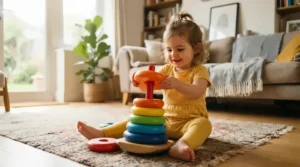
Fat Brain Toys SpinAgain adds a corkscrew twist to stacking: drop a disc on the pole and it spins all the way down.
Six dual-colored discs alternate between daisy and starburst shapes. They slide onto a corkscrew pole fixed to a reversible base, which offers a wobbly or flat seat, all in coated, BPA-free ABS plastic standing about 16 inches tall. The maker lists it from 12 months. Dropping a disc accurately onto a pole is a precision-release task, and the spin gives immediate payoff. The wobble base then raises the challenge as skills improve, so the toy has a built-in difficulty dial.
My take: you’re paying a premium for the mechanism. That’s worth it for “again, again!” kids who crave visual feedback, but less so for a baby who’d be just as happy with stacking cups.
A comparison guide names it its premium spinner pick while flagging the high price and long removable post. I found little in-depth review text elsewhere, so evidence is moderate.
Pros:
- ✅ Reversible base lets difficulty scale up
- ✅ Instant visual feedback holds attention
- ✅ Coated ABS construction, BPA-free
Cons:
- ❌ Premium price for six discs
- ❌ Narrow focus on one repeatable action
Price check: in the high-$30s. A good splurge only if your toddler is a confirmed spinner-and-dropper.
7. Lovevery The Block Set — the one that grows with them
Lovevery The Block Set is the heavyweight of this list, in both price and play value.
It includes 70 solid wood pieces in 18 shapes and colors, made from FSC-certified wood with water-based paint. There’s a storage box that converts into a pull car, a shape-sorting lid that doubles as a ramp, threading blocks with a toggle string, and an activity guide with more than 20 stage-based ideas. Full, it weighs around 8 pounds. Early on, a one-year-old will mostly stack, carry, and drop. Later, threading and sorting tackle more advanced finger skills.
Here’s the catch. Many retail pages list 12 months and up, but several parent reviewers point to around 18 months as the sweet spot. One reported minimal interest at 11 months beyond mouthing the figures, then 15-plus-minute independent play near 20 months. For a one-year-old, this is a “buy once, grow into it” choice.
An aggregator reports roughly 4.7 out of 5 stars from about 1,100 parents. Reviewers praise quality and longevity, and note the weight and the jigsaw-like repacking.
Pros:
- ✅ Twenty-plus staged activities extend its life
- ✅ Silent, open-ended play without batteries
- ✅ Replacement pieces reportedly available from Lovevery
Cons:
- ❌ Premium price and heavy when full
- ❌ Real engagement often starts near 18 months
Price check: around $90-$100. Strong long-term value, but not the cheapest way to start.
Here’s how all seven stack up on build and size:
| Product | Material | Key Mechanic | Approx. Size | Best For |
|---|---|---|---|---|
| Fat Brain Toys Dimpl | ABS plastic, silicone | Push-through bubbles | 5.5 x 5 x 1 in | Portable poking practice |
| Fisher-Price Baby’s First Blocks | BPA-free plastic | Sort-and-drop lid | 8.2 x 5.1 x 4.9 in | First container play |
| Mushie Stacking Cups | Food-grade polypropylene | Nesting and stacking | 3.3 in nested | Bath and cleanup ease |
| The Original Toy Company Pop Up School Bus | Hardwood | Spring-loaded pegs | 7 x 3 x 3.5 in | Press-and-release practice |
| Hape Pound & Tap Bench | Wood, water-based paint | Hammer and xylophone | 9.45 x 5.9 x 5.3 in | Active toddlers |
| Fat Brain Toys SpinAgain | Coated ABS | Spinning disc stack | About 16 in tall | Visual-feedback learners |
| Lovevery The Block Set | FSC-certified wood | Multi-piece building system | 16 x 6 x 5 in box | Long-term play |
The table makes one tradeoff clear: the plastic and silicone picks win on portability and cost, while the wooden picks are heavier and pricier but sturdier. If you want one toy per skill, Fat Brain Toys Dimpl (finger isolation), Fisher-Price Baby’s First Blocks (container play), and Hape Pound & Tap Bench (aim) cover a lot of ground for under $75 combined.
Practical Usage Guide: Your First 30 Days With These Toys
A toy is only as good as the way it’s introduced. A few simple habits stretch the benefit well beyond what the box promises.
Week 1: Start small and quiet
Offer one toy at a time, on the floor or at the high chair. Fewer choices mean more focus. Sit nearby and let your baby explore before demonstrating anything.
Week 2: Model, don’t push
Show the action once, slowly: press a bubble, drop a block, pound a ball. Then hand it over. If your baby is frustrated, press alongside them with your own finger. Success beats struggle at this age.
Week 3: Change the container
Therapists note that picking objects out of bowls or containers, rather than flat surfaces, encourages fingertip use over whole-hand scooping. Try placing soft finger foods in a muffin tin to practice the same motion that supports self-feeding skills.
Week 4: Rotate and refresh
Put toys away for a few days and bring them back. Familiar toys often feel brand new.
Maintenance and common mistakes
Wash silicone and plastic per the maker’s instructions (Mushie Stacking Cups are dishwasher-safe, Fat Brain Toys Dimpl is hand-washable), and wipe wooden toys with a damp cloth rather than soaking them. The classic first-month mistakes: too many toys at once, hovering and correcting, and skipping supervision on any toy with springs or strings.
Real-World Scenarios: Three Families, Three Toy Shelves
These are hypothetical profiles, built to show how the analysis plays out.
Scenario 1: The tight-budget family
You have about $30 and a baby who just turned one. Pair Fat Brain Toys Dimpl with Fisher-Price Baby’s First Blocks (roughly $20-$30 together). You’ll cover poking, grasping, and container play, with daily 10-minute sessions on the high chair and floor.
Scenario 2: The always-on-the-go household
Maybe you commute, visit grandparents, or eat out often. Keep Fat Brain Toys Dimpl and The Original Toy Company Pop Up School Bus in the diaper bag, both compact. Add Mushie Stacking Cups for bath time and travel-friendly water play.
Scenario 3: The gift-giving grandparents
You’ve got around $100 and want something that lasts. Lovevery The Block Set is the long-haul choice, though expect real engagement closer to 18 months. For immediate payoff, Hape Pound & Tap Bench delivers instant action for a one-year-old who loves noise and movement.
✨ Ready to Put Little Hands to Work?
🔍 Build a play shelf that fits your baby’s stage. Click any highlighted product to check current pricing and availability. These picks will help you support pinching, poking, and stacking skills your family will love to watch grow!
Problem → Solution Guide: When Playtime Goes Sideways
Problem 1: Everything goes straight into the mouth
Mouthing is typical at this age. Choose toys with solid, wipeable construction like Mushie Stacking Cups and keep every item age-graded for under 3. Supervise, and inspect toys regularly for cracks.
Problem 2: Interest lasts two minutes
Reduce the number of toys out, then rotate. A single Fat Brain Toys SpinAgain on an empty rug often holds attention longer than a full toy bin.
Problem 3: Frustration with stiff or tricky toys
Press alongside your baby with your own finger on Fat Brain Toys Dimpl, or start with the easy slots on Fisher-Price Baby’s First Blocks. Return to harder tasks in a few weeks.
Problem 4: Pieces everywhere
Designate one basket or bucket. Fisher-Price Baby’s First Blocks includes its own, and the box on Lovevery The Block Set is built for storage, though repacking it takes a minute or two.
What Are Fine Motor Skills Toys for a 1 Year Old?
Fine motor skills toys for a 1 year old are age-appropriate playthings that make small hand and finger muscles work through poking, pinching, stacking, dropping, threading, and pressing. They’re chunky enough to be safe for children under three yet challenging enough to build grip strength, finger isolation, and coordination.
Fine motor skills are one slice of overall early childhood development, alongside language, social, and gross motor growth, and each child moves through those stages at their own pace. Gross motor skills involve big muscles for crawling, cruising, and walking. Fine motor skills are about precision.
Why does it matter? Pathways.org links the pinch to feeding yourself, handling buttons and zips, grabbing small objects, and writing and coloring. The toys on this list don’t replace real-life practice, but they give your baby a safe, repeatable way to build those foundations.
How to Choose Fine Motor Skills Toys for a 1 Year Old
Here are seven steps to narrow the field:
- Check the age grade. Federal rules ban small parts in toys intended for children under three, so a toy’s age label matters more than its packaging photos.
- Match your baby’s current grasp. Is she raking, poking, or starting to pinch? Pick toys that fit today’s skills with a small stretch.
- Look for chunky, graspable pieces. Big pieces are easier to hold and safer for mouthing.
- Prefer one clear action. Press, drop, or stack. A toy with five functions can feel like homework.
- Seek adjustable difficulty. Reversible bases, varied sizes, and staged activities extend a toy’s life.
- Plan for cleaning. Dishwasher-safe or wipeable surfaces save time.
- Budget for longevity. Divide the price by the age span to see the real cost.
Pincer Grasp and Self-Feeding Skills: What Toys Can (and Can’t) Do
The pincer grasp develops in stages. An immature version uses the pads of the thumb and index finger around 9 to 10 months. A mature, fingertip version typically emerges closer to 12 months. Skilled fingertip grasping continues to refine through about 24 months.
Toys build the strength and finger isolation underneath that pinch. Real food builds the skill itself, which is why self-feeding skills improve fastest when toy play pairs with finger-food practice at mealtimes. A pincer grasp toy for 1 year old learners can set the stage, but nothing replaces the muffin tin and soft food pieces.
When your baby outgrows the starter picks, look at toys like Learning Resources Spike the Fine Motor Hedgehog, a peg-in-hole toy rated for 18 months and up, as a next step. One parent review notes the pegs can fall out easily.
If your child isn’t using a pinch by 12 months, Pathways.org suggests talking to a healthcare provider for tips. It’s usually a conversation, not a crisis.
Hand-Eye Coordination Toy for Toddlers: What to Expect in Real-World Performance
Specs promise “improved coordination.” Real life looks like missed shots, off-target drops, and joyful repetition. That’s normal.
Drop-and-aim toys like Fat Brain Toys SpinAgain, Hape Pound & Tap Bench, and Fisher-Price Baby’s First Blocks give a hand-eye coordination toy for toddlers its job: the child must watch a target, move a hand, and release at the right moment. Expect early attempts to miss the pole or hole entirely. Over several weeks, accuracy tends to improve as hand control and visual tracking mature. Think of it like learning to catch a bus: first you stand at the wrong stop, then the right one, then you’re running for it with a coffee.
The best predictor of progress isn’t the toy’s price tag. It’s consistent, relaxed practice with something at the right difficulty.
Features That Actually Matter (And Those That Don’t)
What genuinely helps
- Appropriate size and safety grading: the toy must pass the under-3 small parts rules.
- A single, clear mechanic: press, stack, drop.
- Adjustable challenge: variable bubble sizes, reversible bases, staged activities.
- Easy cleaning: your future self will thank you.
What’s mostly marketing
- Lights and sounds: one reviewer of Fat Brain Toys Dimpl praised its stripped-back design for helping their child focus more than louder toys did.
- “STEM” or “Montessori” badges: these are marketing labels, not safety certifications.
- Piece count: 70 pieces in Lovevery The Block Set are valuable because of how they work together, not because bigger is automatically better.
Judge every toy by its mechanic, not its adjectives.
Purpose-Built Toys vs Household Items
You don’t need to buy everything. Some of the best fine-motor workouts are already in your kitchen.
| Option | Fine-Motor Payoff | Approx. Cost | Best For |
|---|---|---|---|
| Muffin tin plus soft finger foods | Strong pincer practice | Pennies | Mealtime and self-feeding practice |
| Plastic bowls and large lids | Grasp, transfer, release | Pennies | Open-ended exploration |
| Fat Brain Toys Dimpl | Finger isolation and pressing | $10-$15 | Quiet, portable poking |
| Fisher-Price Baby’s First Blocks | Drop-and-sort | $10-$15 | Structured container play |
Looking at the table, household items win on cost and flexibility, especially for pinch practice with food. Purpose-built toys win on safety grading, durability, and focus. The smartest strategy is a mix: use the kitchen for food-based pincer work, and keep one or two purpose-built toys for structured play. Just avoid small objects, coins, or anything that fits through a cardboard tube.
Safety and Regulations Guide: Small Parts, Age Grading, and Choking Risk
In the United States, the CPSC’s small parts rule bans toys intended for children under 3 if they are, or produce, small parts. According to the CPSC’s small parts FAQ, a small part is anything that fits completely inside a test cylinder approximating the fully expanded throat of a child under three.
Practical takeaways
- Choose toys age-graded for your baby’s age or younger. A toy meant for ages 3 and up may carry a small-parts choking warning and doesn’t belong in a one-year-old’s play area.
- Inspect toys regularly for cracks, loose pieces, or peeling finishes.
- Supervise toys with springs or strings. That means the pegs on The Original Toy Company Pop Up School Bus and the toggle string in Lovevery The Block Set.
- Remember that regulation sets a floor, not a guarantee. Check the label on the exact product you buy.
Long-Term Cost and Value
Sticker price tells only part of the story. Dividing cost by the manufacturer’s stated age span gives a rough cost per year of use.
| Product | Price Range | Approx. Usable Age Span | Rough Cost per Year | Best For |
|---|---|---|---|---|
| Fisher-Price Baby’s First Blocks | $10-$15 | 12-36 months (about 2 yrs) | $5-$8 | Budget-conscious families |
| Mushie Stacking Cups | $20-$25 | 12-36 months (about 2 yrs) | $10-$13 | Multi-use bath and floor play |
| Hape Pound & Tap Bench | $25-$35 | 12-36 months (about 2 yrs) | $13-$18 | Active toddlers |
| Fat Brain Toys SpinAgain | High-$30s | 12 months to about 5 yrs | Roughly $9-$10 | Kids who love spinners |
| Lovevery The Block Set | $90-$100 | 12-48 months (about 3 yrs) | $30-$33 | Long-term, multi-child families |
Note that these are rough calculations from manufacturer age spans, not guarantees of how long your child will play. The takeaway: budget picks win on cost per year, but Lovevery The Block Set replaces many separate toys (shape sorter, pull car, threading set), which narrows the gap. It also retains resale value, with used sets reportedly selling for around half price. If you only have one child and a small space, the lower-cost trio is the smarter play.
FAQ
❓ Which pincer grasp toy for 1 year old learners is best on a tight budget?
❓ Is a hand-eye coordination toy for toddlers safe if it has balls or small pieces?
❓ Do toys actually help with self-feeding skills?
❓ When should I talk to a doctor about my baby's pincer grasp?
❓ Are wooden or plastic fine motor development toy options better?
Conclusion
Choosing fine motor skills toys for a 1 year old doesn’t require a bottomless budget or a degree in child development. It requires matching a toy to your baby’s current skills, keeping safety front and center, and letting practice happen at a relaxed pace.
To recap: Fat Brain Toys Dimpl is the cheapest finger gym, and Fisher-Price Baby’s First Blocks is the best first sorter. Mushie Stacking Cups is the easy-clean, bath-friendly pick. The Original Toy Company Pop Up School Bus is the focused press-and-release option, Hape Pound & Tap Bench is the pick for movement-hungry toddlers, and Fat Brain Toys SpinAgain rewards precision with a spin. Lovevery The Block Set is the long-haul investment, best once your child nears 18 months.
Whatever you choose, remember that milestones vary. If you’re unsure where your child stands, the CDC’s milestone checklists are a free way to track development and prepare questions for your next checkup.
✨ Ready to Build Stronger Little Hands?
🔍 Pick the toy that fits your baby’s stage today! Click any highlighted product above to check current pricing and availability, and help your little one’s pinch, poke, and stack skills take off! 🧩
Recommended for You
- Motor Skills Tracking Device For Toddlers: 7 Best Picks 2026
- Cognitive Development Tablet For Toddlers: 7 Best Picks 2026
- Cognitive Development Toys For Infants: 7 Smart Picks 2026
Disclaimer: This article contains affiliate links. As an Amazon Associate, I earn from qualifying purchases. If you purchase products through these links, we may earn a small commission at no additional cost to you.
✨ Found this helpful? Share it with your friends! 💬🤗
