
In This Article
Somewhere around 2 a.m., every new parent has the same thought: is the silence in the nursery a good silence or a bad one? That question is exactly why the baby development tracking wearable category exists, and why it has exploded from a single foot sensor into an entire ecosystem of socks, buttons, bands, and cameras that promise to translate your baby’s tiny, mysterious biology into numbers you can actually read on your phone. A baby development tracking wearable isn’t a babysitter, and it’s not a medical device in most cases — but it is a genuinely useful window into sleep patterns, movement, and (with some models) heart rate and oxygen trends that used to require a hospital monitor to see.

This guide breaks down seven real products currently sold in the U.S., spanning budget clip-ons to FDA-cleared vitals monitors, so you can figure out which one actually matches your family’s anxiety level, budget, and gear philosophy — not just which one has the flashiest marketing page. We researched specs, aggregated review sentiment, and manufacturer documentation directly rather than repeating Amazon listing copy, because “trust me” isn’t a strategy when it comes to your kid’s crib. Whether you’re comparing a full smart baby monitor with tracking against a bare-bones movement clip, or trying to decide if a camera-based nursery system beats a wearable sock, you’ll find the honest version of that comparison below.
What Is a Baby Development Tracking Wearable?
A baby development tracking wearable is a small sensor-equipped device — usually a sock, clip, button, or band — worn on or near an infant to continuously monitor metrics like heart rate, blood oxygen, movement, and sleep stages, transmitting the data to a parent’s smartphone in real time. Some pair with a nursery camera; most stand alone. None are a substitute for supervised, AAP-recommended safe sleep practices, and sudden unexpected infant deaths remain a serious public health concern, with the CDC recording roughly 3,700 sudden unexpected infant deaths in the U.S. in 2022 alone across SIDS, unknown causes, and accidental suffocation.
Quick Comparison Table
| Wearable | Tracks | Price Range | Best For |
|---|---|---|---|
| Owlet Dream Duo 3 | HR, SpO2, sleep, video | $350–$400 range | Medical-grade peace of mind |
| eufy Smart Sock S340 | HR, SpO2, sleep, 2K video | $300–$440 range | No-subscription premium tracking |
| eufy Smart Sock S320 | HR, SpO2, sleep | $140–$170 range | Vitals tracking on a mid budget |
| Sense-U Smart Sock Shoe 2 | HR, movement, sleep | $125–$150 range | Balanced mid-range accuracy |
| Snuza Hero SE | Abdominal movement | $100–$130 range | Simple, low-tech reassurance |
| MonBaby Smart Button | Movement, position, falls | Under $100 | Budget clip-on tracking |
| Nanit Pro + Breathing Band | Breathing motion, sleep, video | $280–$300 range | Camera-first nursery monitoring |
Looking at the spread above, the split really comes down to sensor type and subscription philosophy: the Owlet Dream Duo 3 and eufy Smart Sock S340 both put a camera and pulse oximetry in the same package, but the eufy Smart Sock S340 skips the recurring fee that the Owlet Dream Duo 3‘s deeper analytics require. Budget buyers gravitate toward the Snuza Hero SE or MonBaby Smart Button because both skip vitals tracking entirely in favor of dead-simple movement detection, which is honestly all some parents want. The Nanit Pro occupies its own lane — it’s the only pick here that treats the camera as the primary sensor and the wearable band as a supporting player.
💬 Found a favorite already? Bookmark this page — you’ll want to compare specs again before you check out.
Top 7 Baby Development Tracking Wearables: Expert Analysis
Real specs, honest trade-offs, and aggregated review sentiment for each pick — budget through premium.
1. Owlet Dream Duo 3 — first FDA-cleared consumer vitals sock
The headline feature here is legitimacy: the Dream Sock uses pulse-oximetry, the same approach hospitals clip to a finger, to read heart rate and blood oxygen, and it was the first FDA-cleared consumer wearable in this category. That clearance isn’t a marketing footnote — it means the underlying sensor technology went through a regulatory review most competitors never attempt. The paired Dream Sight camera adds 2K resolution, a 130-degree field of view, and automatic clip recording triggered by sound, movement, or an out-of-zone alert, so you’re getting a full nursery system rather than a bare sock.
Base vitals tracking works with no subscription, but deeper sleep analytics and historical trends sit behind the paid Owlet360 tier. On paper, that split means budget-conscious parents get the safety-relevant data for free while power users pay for the dashboard. Reviewers consistently note the pulse-ox readings are unusually stable once the sock is snugly fitted — a detail that matters because a loose sock sitting improperly across the sole is the single most common cause of false low-oxygen alerts across this whole product category, not just this one device.
Pros:
- ✅ FDA-cleared pulse oximetry, not just marketing language
- ✅ Base vitals tracking works without a subscription
- ✅ 2K camera bundle adds real nursery visibility
Cons:
- ❌ Full sleep analytics require the paid Owlet360 tier
- ❌ Sits at the top of the price range in this roundup
Given the medical-grade sensor and FDA clearance, the Owlet Dream Duo 3 justifies its price for parents of preemies or anyone whose 3 a.m. worry is specifically medical, not just “is she comfortable.”

2. eufy Smart Sock S340 — 2K camera bundle with zero monthly fees
What most buyers overlook about the eufy Smart Sock S340 is that it packages nearly everything the premium tier offers — heart rate, SpO2, sleep staging, and a pan-tilt-zoom camera — without ever asking for a subscription. The camera delivers 2K resolution with a 120-degree field of view and 4x digital zoom via the app, and all sleep tracking data, including heart rate, SpO2, movement, and sleep history, comes with full analysis and reporting built in at no recurring cost.
In practice, that means a family gets Owlet-tier data without the ongoing bill — a genuinely different value proposition, even if the up-front price sits in similar territory. The sock uses a Fresnel lens specifically to improve infrared refraction for more accurate vital-sign readings, and battery life runs a full 24 hours of continuous tracking on one charge. Privacy-focused parents should note that eufy stores footage locally on a 32GB SD card with AES 128-bit encryption rather than routing it through the cloud by default.
Pros:
- ✅ Full vitals and 2K camera with no subscription required
- ✅ 24-hour battery life on a single charge
- ✅ Local SD card storage for privacy-minded households
Cons:
- ❌ Premium price rivals subscription-based competitors
- ❌ Camera-plus-sock bundle is bulkier to set up initially
For parents who want the Owlet Dream Duo 3‘s feature set without an annual bill, this is the honest alternative worth cross-shopping.
3. eufy Smart Sock S320 — vitals tracking without the camera tax
Strip away the camera and you get the eufy Smart Sock S320, which delivers the same heart rate and oxygen tracking as its pricier sibling at a noticeably lower price point. The base glows green when baby is doing fine and triggers a sound plus red light when a check-in is warranted — a nice bit of ambient design that doesn’t require pulling out a phone every few minutes.
Based on the spec comparison with the S340, buyers here are trading the visual nursery feed for a lower entry price while keeping the vitals data intact. The sock fits babies up to 18 months or 30 pounds and comes in three sizes, and battery life stretches to 24 hours per charge with the base doubling as a charging pad. Reviewers consistently frame this as the “just the numbers” option for parents who already own a separate camera or don’t want one at all.
Pros:
- ✅ Heart rate and SpO2 tracking without camera bulk
- ✅ 24-hour battery with base-station charging
- ✅ No monthly subscription fee for core tracking
Cons:
- ❌ No built-in video — you’ll need a separate camera
- ❌ Fewer size options than some competitors
If your nursery already has a monitor and you just want a reliable vitals layer underneath it, the eufy Smart Sock S320 is the leaner, cheaper route to the same underlying sensor technology.
4. Sense-U Smart Sock Shoe 2 — the accuracy-focused mid-range pick
The Sense-U Smart Sock Shoe 2 leans hard into sensor precision rather than app polish. It uses transmissive PPG sensing technology specifically engineered for improved precision when tracking body status and sleep patterns, which on paper means fewer readings thrown off by ambient light or motion artifacts than older-generation reflective sensors.
What most buyers overlook here is the standalone functionality: the shoe-style sock delivers on-device sleep status indicators and audible notifications even without the paired app or Base Station, though it becomes smarter once you add either. That layered design lets budget-conscious parents skip the base station accessory entirely and still get real-time alerts. The Long Range configuration extends tracking to room temperature and humidity as well, from anywhere in the home, for households wanting the fuller environmental picture.
Pros:
- ✅ Transmissive PPG sensor improves reading accuracy
- ✅ Works standalone without app or base station
- ✅ Mid-range price undercuts full-vitals competitors
Cons:
- ❌ Socks are foot-side specific, limiting fit flexibility
- ❌ Smaller review base than the bigger-name brands
For parents who want measurably better sensor technology without paying premium-tier prices, this is the sleeper pick of the mid-range field.
5. Snuza Hero SE — the no-frills movement monitor
Sometimes the honest analysis is that less tech is the better fit, and the Snuza Hero SE is built entirely around that idea. There’s no app, no camera, and no vitals tracking — just a diaper clip that detects abdominal movement and alerts you the moment it stops. If breathing motion isn’t detected for 15 seconds, the device gently vibrates to rouse the baby; if there’s still no movement after another 5 seconds, it sounds a full alarm.
Reviewers consistently praise this device for having a unique vibration feature and very low levels of EMF compared to Wi-Fi-connected alternatives — a meaningful selling point for privacy-focused and radiation-cautious families. What most buyers overlook is that its simplicity is a feature, not a limitation: fewer moving parts means fewer false-alarm triggers from app connectivity hiccups, and no subscription ever enters the conversation.
Pros:
- ✅ Extremely low EMF compared to Wi-Fi-connected wearables
- ✅ Two-stage vibration-then-alarm response system
- ✅ No app, no subscription, no ongoing cost
Cons:
- ❌ No vitals, sleep staging, or camera integration
- ❌ No smartphone notifications — alerts are on-device only
Anxious parents who specifically want breathing-adjacent reassurance without a data-heavy ecosystem consistently land on this one, and the honest verdict is that it does exactly one job well.
6. MonBaby Smart Button — the cheapest entry point into wearable tracking
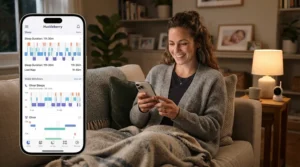
The MonBaby Smart Button clips onto clothing rather than requiring a dedicated sock, and it’s built around a straightforward premise: track movement, sleeping position, and falls, then push alerts to a phone over Bluetooth. It detects the faintest movement caused by breathing, includes a sleep position alarm, a fall detection alarm, and a proximity removal alarm, all powered by a standard coin-cell battery with no daily charging required.
Here’s what the spec sheet won’t tell you outright: Bluetooth is inherently short-range, and the manufacturer’s own site notes the device works optimally in the same room as the connected smartphone, despite marketing imagery suggesting whole-house coverage. That’s a real limitation worth weighing against the low price. On the plus side, the coin-cell battery typically lasts up to two months per charge, which is dramatically longer than the daily-charge cycle most competitors require.
Pros:
- ✅ Lowest price point in this entire roundup
- ✅ Up to two months of battery life per coin cell
- ✅ Tracks sleep position and fall detection, not just movement
Cons:
- ❌ Bluetooth range is genuinely limited to same-room use
- ❌ No heart rate or oxygen tracking of any kind
Budget-conscious first-time parents who want some wearable tracking without a three-figure investment consistently point to this as their gateway device.
7. Nanit Pro Camera + Breathing Band — the camera-first nursery system
The Nanit Pro flips the usual formula: instead of a wearable sensor with an optional camera, it’s a camera-first nursery monitoring device with an optional sensor-free wearable layered on top. The included Breathing Band lets parents track breaths per minute without any electronics, wires, or batteries touching the baby, by having the camera detect the unique pattern printed on the band’s fabric — a genuinely clever workaround for parents nervous about anything electronic touching their infant’s skin.
What stands out on the spec sheet is the computer-vision angle: this is the only device in this roundup that infers breathing motion purely from overhead video rather than a worn sensor. The Pro Camera and Wall Mount deliver 1080p HD video with two-way audio, sleep tracking, breathing motion monitoring, and automatic memory capture, with sleep trend reports generated each morning alongside a timelapse highlight reel. That highlight-reel feature is pure delight-add rather than safety-critical, but it’s a genuinely popular reason parents cite for choosing Nanit over a plain camera.
Pros:
- ✅ Sensor-free breathing tracking via printed fabric pattern
- ✅ 1080p video with automatic milestone/memory capture
- ✅ Daily sleep trend reports and timelapse highlights
Cons:
- ❌ Breathing detection relies on camera angle and band position
- ❌ Deeper Nanit Insights features require an ongoing subscription
For parents who’ve decided a nursery monitoring device matters more than a worn sensor, the Nanit Pro is the most mature computer-vision option on the market.
How to Get the Most from Your Baby Development Tracking Wearable
Buying the hardware is the easy part — dialing it in for accurate, low-drama use takes a little more care. Start by charging every device fully before the first night, since a battery that dies at 3 a.m. defeats the entire purpose of wearing the thing. Fit matters more than almost any other variable: a loose sock or clip is the leading cause of false alerts across nearly every brand in this category, so snug it against the skin the way you’d fit a shoe, not a mitten.
During the first 30 days, expect a shakeout period. Babies kick socks off, roll onto clips, and generally treat any worn device as an obstacle to be defeated. Keep a spare sock or band on hand so a missing piece doesn’t mean a sleepless night without coverage. Set your phone to the 2.4 GHz Wi-Fi band rather than 5 GHz for any device that pairs over Wi-Fi — this single step resolves a surprising share of connectivity complaints in user forums. Finally, resist the urge to check the app every ten minutes; most pediatricians will tell you that hyper-monitoring the monitor tends to create more parental anxiety than it resolves, which somewhat defeats the “peace of mind” pitch these devices are built on.

Real-World Scenarios: Which Wearable Baby Tech Fits Your Family?
Picture a first-time parent with a healthy, full-term newborn and a moderate anxiety level — this is the classic Sense-U Smart Sock Shoe 2 or eufy Smart Sock S320 buyer. They want vitals data without paying for a subscription tier they’ll never open, and the mid-range price fits a registry budget alongside a stroller and a crib.
Now picture a family whose baby arrived a few weeks early, or has a diagnosed respiratory concern flagged by their pediatrician. That’s squarely the Owlet Dream Duo 3 use case: the FDA clearance and hospital-grade pulse oximetry genuinely matter when there’s a documented medical reason to watch numbers closely, not just curiosity.
Finally, consider the budget-stretched parent furnishing a nursery on a tight timeline, maybe a grandparent buying a “just in case” gift. The MonBaby Smart Button or Snuza Hero SE deliver real functionality — movement detection and position alerts — without asking for $300-plus up front, making them the pragmatic pick when cash flow, not curiosity, drives the decision.
How to Choose a Baby Development Tracking Wearable
- Decide what you actually want tracked. Vitals (heart rate, SpO2) require pulse-oximetry hardware like Owlet or eufy’s Smart Sock line; movement-only devices like Snuza are cheaper and simpler if that’s all you need.
- Check the subscription structure before buying. Some brands lock sleep analytics behind a paid tier; others, like the eufy Smart Sock S340, bundle everything up front.
- Match battery life to your household routine. A 24-hour battery matters more if you forget to charge things than if you’re diligent about nightly routines.
- Confirm the size and age range fits your baby now and for the next several months. Most socks and bands top out around 18 months or 30 pounds.
- Weigh Wi-Fi versus Bluetooth connectivity. Bluetooth-only devices like MonBaby have shorter range but lower EMF exposure; Wi-Fi devices reach further but add a network dependency.
- Read the fine print on FDA clearance claims. Only a small handful of devices in this category have gone through that specific regulatory process — most explicitly disclaim being a medical device.
- Budget for accessories you’ll actually need. Extra sock sizes, charging cables, and mounting hardware add real cost beyond the sticker price.
Common Mistakes When Buying a Smart Baby Monitor with Tracking
The single most common misstep is assuming every “smart sock” tracks the same metrics — several budget and mid-range options track movement or sleep only, with no heart rate or oxygen data at all, despite similar-sounding marketing copy. A close second is skipping the fit instructions entirely; a sock worn loosely or on the wrong foot is the top cause of false alerts across brands, not a hardware defect. Parents also frequently underestimate subscription costs, buying a device on sale only to discover the sleep-trend dashboard they actually wanted sits behind an annual fee. Finally, many buyers treat these devices as SIDS-prevention tools rather than data-and-reassurance tools — a distinction pediatric organizations are careful to draw and one worth internalizing before you rely on any wearable as your primary safety net.
Wearable Sleep and Activity Tracker for Infants vs Traditional Baby Monitors
| Category | Wearable Sleep/Activity Tracker | Traditional Audio/Video Monitor |
|---|---|---|
| Data depth | Heart rate, SpO2, movement, sleep stages | Sound and/or video only |
| Alert type | Physiological threshold alerts | Sound/motion-triggered alerts |
| Best For | Owlet Dream Duo 3, eufy Smart Sock S320 | Basic nursery supervision |
The core trade-off here is depth versus simplicity: a wearable sleep and activity tracker for infants gives you physiological data a plain camera simply cannot capture, but it also introduces more setup, more battery management, and in some cases a subscription. Traditional monitors remain reliable, battle-tested, and dramatically simpler to operate, which is exactly why many parents run both side by side — a camera for visual reassurance and a wearable for the numbers a camera can’t show.

Baby Tracking Sock or Band: Features That Actually Matter (And Those That Don’t)
Battery life, fit accuracy, and whether vitals data requires a subscription are the features that genuinely change day-to-day experience with any baby tracking sock or band. A Fresnel lens for better infrared refraction, as used in eufy’s Smart Sock line, is a real accuracy improvement, not marketing fluff. On the other hand, flashy extras like automated highlight reels or lullaby integrations are delightful but irrelevant to the core safety-and-sleep-data pitch — nice-to-haves, not deciding factors.
It’s also worth being clear-eyed about what none of these devices claim to do. Multiple smart baby monitors that track vitals carry the caveat that, according to the Lullaby Trust, there is no evidence that baby monitors prevent sudden infant death syndrome. That’s not a knock against any specific product here — it’s an honest framing every parent deserves before treating a wearable as a safety guarantee rather than a data source.
Infant Sleep Tracking: What to Expect in Real-World Performance
Spec sheets describe infant sleep tracking in clean percentages and graphs; real nurseries are messier. Expect the first week to generate a fair number of false alerts as your baby learns to fight the sock off their foot, and expect sleep-stage classifications to smooth out only after several nights of baseline data accumulate. Heart rate and SpO2 readings on pulse-oximetry devices tend to stabilize once the sensor sits flush against skin — a snug fit genuinely changes reading quality more than brand does. Camera-based breathing detection, as used by Nanit, performs best with a clear overhead angle and minimal blanket coverage, so a swaddled baby under thick bedding will generate less reliable readings than one sleeping in a sleep sack.
Nursery Monitoring Devices: Safety, Regulations & Compliance Guide
No nursery monitoring device, wearable or otherwise, replaces supervised safe sleep practices. The American Academy of Pediatrics has led safe sleep initiatives since the 1990s, continually updating guidance as new evidence and new baby products enter the market, and current recommendations include placing babies on their backs for every sleep, using a firm and flat sleep surface, and avoiding loose bedding regardless of what monitoring hardware is running in the background. Only the Owlet Dream Sock among mainstream wearables carries FDA clearance for its specific pulse-oximetry function; most competitors, including camera-based systems, explicitly label themselves as wellness and sleep-insight tools rather than medical devices, and that distinction has real implications for how much weight to put on any single alert.
Long-Term Cost & Maintenance of Wearable Baby Tech
The sticker price is rarely the full cost of ownership for wearable baby tech. Sock-based devices need replacement sizes as babies grow — expect to buy at least one or two additional size sets over an 18-month usage window. Subscription tiers, where required, typically run under $10 a month but add up over a year of use, so factor that into any premium-tier purchase. Battery-powered clips like Snuza and MonBaby avoid daily charging but need periodic coin-cell replacement, a minor but recurring cost most buyers forget to budget for. On the reliability side, the category has matured enough that the Owlet Dream Duo 3 was named “Best for Monitoring Baby’s Health” in the PARENTS 2026 Best for Baby Awards, recognized for pairing an FDA-cleared wearable with a cybersecurity-certified video monitor — a signal that the underlying engineering has earned real third-party scrutiny, not just marketing claims.

Frequently Asked Questions
❓ Do baby development tracking wearables prevent SIDS?
❓ Is a smart baby monitor with tracking worth the subscription fee?
❓ How accurate is a baby tracking sock or band?
❓ What age range works best for infant sleep tracking devices?
❓ Can nursery monitoring devices replace supervised sleep?
Conclusion
There’s no single “best” baby development tracking wearable, because there’s no single kind of parent buying one. Some families want the medical-grade reassurance of the Owlet Dream Duo 3‘s FDA clearance; others want the eufy Smart Sock S340’s subscription-free vitals-plus-camera bundle; plenty more just want a $70 clip that tells them their baby is still moving. What matters is matching the sensor type, price, and ongoing costs to what will actually reduce your anxiety rather than add another screen to check obsessively at 2 a.m. Whichever wearable you land on, keep it in its proper lane: a helpful layer of data on top of — never a replacement for — the safe sleep basics your pediatrician already told you about at your last visit.
Recommended for You
- Milestone Tracker Journal Vs Digital Tracker: 7 Best Picks (2026)
- Baby Milestone Tracker Device Vs App: 7 Best Picks 2026
- Milestone Tracker App For First-Time Parents: 7 Picks For 2026
Disclaimer: This article contains affiliate links. As an Amazon Associate, I earn from qualifying purchases. If you purchase products through these links, we may earn a small commission at no additional cost to you.
✨ Found this helpful? Share it with a sleep-deprived friend! 💬🤗
