

Somewhere between the third 3 a.m. feeding and the sixth load of laundry, you will forget the exact day your baby rolled over for the first time. It’s not a character flaw. It’s just what sleep deprivation does to a brain. That’s the entire reason the milestone tracker journal vs digital tracker for babies debate exists in the first place — parents want proof that all those blurry, exhausting months actually happened, and they want it captured before it slips away for good.

A milestone tracker journal vs digital tracker for babies isn’t just a shopping question, though — it’s really a question about what kind of memory-keeper you are. Some parents want a physical book they can hand their kid at eighteen, ink smudges and all. Others want an app that pings them the second nap patterns shift or a growth spurt hits. Plenty of families, honestly, want both. What is a milestone tracker journal vs digital tracker? In short, it’s any tool — paper or app-based — that helps parents log developmental firsts, growth stats, and daily care so nothing gets lost to the fog of early parenthood.
This guide walks through seven real, currently available products spanning printable milestone journals, keepsake bound books, and the top digital tracker apps parents actually use. According to tracking children’s milestones provides important information about their early development and can signal when a child may need extra support, which is why health experts encourage all caregivers to keep some kind of record. Whether you land on analog, digital, or a hybrid of both, you’ll leave this article knowing exactly which option fits your family’s rhythm.
In This Article
Quick Comparison: Journal vs Digital vs Hybrid
Before diving into individual products, here’s the 30,000-foot view of how these three categories stack up.
| Format | Best For | Setup Time | Long-Term Keepsake Value | Typical Price |
|---|---|---|---|---|
| Physical Journal | Parents who want a tangible heirloom | Low | Very High | $12–$55 |
| Digital Tracker App | Parents who want data, reminders, sharing | Medium | Low–Medium (unless printed) | Free–$15/mo |
| Hybrid (App + Printed Book) | Parents who want both convenience and a keepsake | Medium | High | Free–$60 |
Looking at this table, the pattern is pretty clear: physical journals win on emotional permanence, digital trackers win on convenience and data, and hybrid tools like BabyPage try to split the difference by letting you log digitally and print later. Budget-focused parents should note that a printable milestone journal for babies can often replicate a bound book’s charm for a fraction of the cost, while families juggling multiple caregivers tend to lean digital simply because sharing a login is easier than mailing a notebook back and forth.
💬 One tap below could help another sleep-deprived parent find the right tracker — thank you for reading this far!
Top 7 Milestone Trackers for Babies: Expert Analysis
We looked at real, currently sold products across three categories — bound keepsake journals, printable/card-based keepsakes, and digital tracker apps — to cover every corner of this decision. Coverage spans budget, mid-range, and premium, plus a couple of lesser-known gems worth your attention.
1. Le Petit Baby Book — spiral-bound with pop-up surprises
The Le Petit Baby Book from Chronicle Books is the milestone journal that doesn’t take itself too seriously, and that’s exactly its charm. The spiral binding means it lies flat on a coffee table (no wrestling the spine open one-handed while holding a baby), and it packs in pockets, pop-ups, and a spinning wheel that reveals your baby’s zodiac sign — genuinely fun details you won’t find in a typical hardcover baby book.
Spanning 72 pages, it includes a pullout growth chart designed to hang in the nursery, which doubles as functional wall décor once the journaling is done. This one is for parents who find traditional baby books a little stiff and want something that feels more like a scrapbook a creative aunt would make.
Reviewers consistently describe it as a favorite baby shower gift precisely because it photographs well and feels more like a keepsake object than a chore to fill out. If you can’t verify hands-on longevity past the toddler years, that’s a fair trade for the interactive design in year one.
Pros:
- ✅ Interactive pop-ups and spinning wheel add real personality
- ✅ Pullout growth chart works as nursery décor
- ✅ Lies flat thanks to spiral binding
Cons:
- ❌ Smaller page count than premium hardcover options
- ❌ Playful design may feel less formal as an heirloom
Priced in the $30 range, the Le Petit Baby Book is a strong budget-to-mid pick if personality matters more to you than a leather-bound, generational-heirloom feel.

2. Pearhead Wooden Monthly Milestone Cards — the printable-style keepsake gift
If you want the visual punch of a milestone photo series without committing to a full journal, Pearhead Wooden Monthly Milestone Cards are the answer. This set includes seven double-sided wooden cards labeled “one month” through “twelve months,” plus “hello world” and “oh baby,” designed to be propped next to your baby for a monthly photo series.
What most buyers overlook about this format is that it functions as a printable milestone journal for babies without the printer — you get the same monthly documentation structure as an app-based photo tracker, just rendered in a tactile, gift-shelf-worthy object instead of a PDF.
Because the cards are wood rather than paper, they hold up to repeated handling by toddlers curious about the “baby me” props, which paper cards and printable inserts simply can’t survive. Aggregated reviews across retailers describe the gender-neutral engraved design as a favorite for baby registries and shower gifts specifically because it works regardless of the baby’s sex, unlike pink-or-blue themed alternatives.
Pros:
- ✅ Reusable across siblings without wearing out
- ✅ Gender-neutral engraved wood design
- ✅ Doubles as a baby shower or registry gift
Cons:
- ❌ Doesn’t record written memories, only photo moments
- ❌ Requires a separate journal or app for full milestone logging
At around $13, this is one of the more affordable keepsake gifts on this list, and it pairs beautifully with any of the written journals below.
3. Pearhead Hello Baby Keepsake Linen Baby Book — the classic all-rounder
The Pearhead Hello Baby Keepsake Linen Baby Book sits right in the middle of this list for a reason: it’s the meat-and-potatoes option that covers pregnancy through a child’s fifth birthday in one linen-covered volume. Its timeless layout means it doesn’t chase trends, which matters if you’re the type of parent who wants a book that won’t look dated when your kid is thirty.
The high page count and long timeline (five years, not just twelve months) mean this book earns its keep well past the newborn stage, something budget spiral journals typically can’t offer. Based on the spec comparison with shorter 72-page competitors, the extended timeline here is the real differentiator — you’re not buying a “first year” book, you’re buying a “childhood” book.
Reviewers frequently mention the durable linen cover holding up over years of handling, which matters more than it sounds for something that lives on a shelf getting pulled down repeatedly.
Pros:
- ✅ Covers pregnancy through age five, not just year one
- ✅ Durable linen cover built for repeated handling
- ✅ Classic design that won’t feel dated later
Cons:
- ❌ Less playful/interactive than novelty-style journals
- ❌ Written entries only — no digital backup built in
In the $30–$35 range, this is arguably the best all-around physical option if you want one book to last the whole early-childhood stretch.
4. My Baby’s Book by Anne Phyfe Palmer — guided prompts for reluctant writers
Not every parent is a natural journaler, and My Baby’s Book by Anne Phyfe Palmer (Blue Star Press) was clearly built with that person in mind. Instead of blank pages waiting to intimidate you, it uses thoughtful prompts, short-answer questions, and fill-in-the-blanks that turn memory-keeping into something closer to a guided worksheet than an essay assignment. At 144 pages, it’s noticeably more substantial than most competitors on this list, with generous space for both photos and personal reflection.
Here’s what to weigh: the charming, gender-neutral papercut artwork by Sarah Trumbauer makes this a book people actually want displayed on a shelf rather than tucked in a drawer, which is a small but real factor in whether a keepsake baby tracker actually gets used consistently.
For parents who start strong on day one and taper off by month three (which is, frankly, most of us), prompted formats like this one measurably reduce that drop-off compared to open-page journals.
Pros:
- ✅ Guided prompts remove the “blank page” barrier
- ✅ Generous 144-page length for photos and reflections
- ✅ Display-worthy papercut artwork cover
Cons:
- ❌ Premium pricing compared to basic journals
- ❌ Prompt-heavy format offers less room for free-form writing
Around $45, My Baby’s Book earns its price tag if consistency, not creativity, is your biggest obstacle to actually finishing a baby book.
5. Welcome, Little One — the premium modern heirloom
For parents who want a baby book that looks less like a craft-store purchase and more like a design object, Welcome, Little One from Zeitgeist is the premium pick. Its hardcover construction and modern, gender-neutral art update the classic baby-journal-scrapbook format for families who find vintage pastel baby books a bit too saccharine for their taste.
Easy-to-fill prompts cover everything from first bath and first smile to first holidays and birthday, spanning the full first year in a format explicitly designed to become a family heirloom rather than a disposable keepsake. What the spec sheet won’t tell you, but the design details suggest, is that this book is built to be displayed on a coffee table year-round — not shoved in a closet between milestone updates — which subtly encourages more consistent use.
At 74 pages, it’s more compact than My Baby’s Book, trading page count for a more curated, editorial feel.
Pros:
- ✅ Modern, design-forward hardcover aesthetic
- ✅ Inclusive prompts suited to varied family structures
- ✅ Coffee-table quality that encourages regular use
Cons:
- ❌ Highest price point among the physical journals here
- ❌ Fewer pages than longer-format competitors
Priced around $50–$55, this is the splurge pick for parents treating the baby book as a design piece as much as a memory tool.

6. BabyPage: Baby Book & Journal — the hybrid bridge between paper and app
BabyPage is the answer for parents who can’t decide between a milestone tracker journal vs digital tracker for babies, because it’s genuinely both. The free app prompts you to record every stage of growth — two weeks, two months, two years, and everything between — along with photos, auto-generating content for each milestone so you’re not staring at a blank text field trying to remember what to write.
Once you’ve built out enough entries, you can order a printed, physical book with a custom cover, effectively converting your phone logs into the exact kind of keepsake baby tracker a bound journal would give you. Based on the spec comparison with pure digital trackers, this print-conversion feature is the standout: it solves digital tracking’s biggest weakness, which is that data trapped on a phone doesn’t feel like a family heirloom the way a printed book does.
Reviewers rate the app highly, though with a relatively small review pool compared to larger tracker apps, so treat early adoption as a reasonable bet rather than a guaranteed one.
Pros:
- ✅ Free to use for ongoing logging and photo storage
- ✅ Auto-generated prompts reduce writing effort
- ✅ Converts digital entries into a printed keepsake book
Cons:
- ❌ Smaller user base and review pool than major competitors
- ❌ Printed book is a separate paid add-on, not included free
At $0 to start (with the printed book priced separately, typically in the same range as other custom photo books), BabyPage is the best low-risk entry point if you’re torn on format.
7. Huckleberry: Baby Tracker — the data-driven digital powerhouse
If your priority leans toward function over sentiment, Huckleberry: Baby Tracker is the most fully-featured digital option on this list. Huckleberry is described as an all-in-one parenting partner trusted by more than 5 million families worldwide, helping navigate sleep, feeding, milestones, and more through an app backed by a team of pediatric experts.
The free tier alone covers one-touch tracking for sleep, nappy changes, feedings, pumping, growth, potty training, activities, and medicine, plus reminders and multi-caregiver sync across devices, which is genuinely more logging power than most parents will ever fully use.
Reviewers consistently praise the sleep-pattern insights, though some note the deeper predictive features — like the SweetSpot sleep-timing tool — sit behind a paid Plus or Premium membership. Based on the spec comparison with basic tracker apps, Huckleberry’s edge is the multi-caregiver sync feature, which solves a real pain point for co-parents or grandparents helping with childcare who need visibility into the same data without duplicate entry.
Pros:
- ✅ Robust free tier covering sleep, feeding, and milestones
- ✅ Multi-caregiver sync across devices
- ✅ Backed by pediatric-expert-informed features
Cons:
- ❌ Advanced predictive tools locked behind subscription
- ❌ Data isn’t a physical keepsake unless manually exported
Huckleberry’s core app is free, with Plus and Premium tiers typically landing in the $10–$15 monthly range depending on the promotion at the time of research.
Top 7 at a Glance
| Product | Format | Price Range | Best For |
|---|---|---|---|
| Le Petit Baby Book | Physical journal | ~$30 | Playful, interactive keepsakes |
| Pearhead Wooden Monthly Milestone Cards | Printable-style props | ~$13 | Budget photo-series keepsake gifts |
| Pearhead Hello Baby Keepsake Linen Baby Book | Physical journal | $30–$35 | All-around, pregnancy-to-age-5 coverage |
| My Baby’s Book | Physical journal | ~$45 | Reluctant writers who need prompts |
| Welcome, Little One | Physical journal | $50–$55 | Design-forward premium heirloom |
| BabyPage | Hybrid app + print | Free–$60 | Undecided between journal and app |
| Huckleberry: Baby Tracker | Digital app | Free–$15/mo | Data-driven, multi-caregiver families |
The spread here tells its own story: Pearhead Wooden Monthly Milestone Cards wins on price, Welcome, Little One wins on design prestige, and Huckleberry wins on sheer functional depth. Notice that only BabyPage genuinely bridges format types — everything else asks you to pick a lane, which is exactly why understanding your own habits (covered below) matters more than the spec sheet.

Practical Usage Guide: Setting Up a Milestone Tracking System That Sticks
Buying the right tracker is only half the battle — plenty of beautiful baby books end up three pages deep before gathering dust. Here’s how to set yours up so it survives past month two.
First, pick one designated spot for your tool. A physical journal should live somewhere visible — the changing table, not a closet shelf — because “out of sight” genuinely means “out of mind” once sleep deprivation kicks in. A digital tracker app needs a home-screen spot on your phone, not buried three folders deep. Second, batch your entries. Instead of trying to write a beautiful paragraph after every nap, jot rough notes throughout the day (a sticky note, a phone memo) and transfer them into your journal or app once daily, ideally during a predictable lull like the evening feed. Third, set a recurring reminder for monthly photo updates if you’re using card-based props like the Pearhead Wooden Monthly Milestone Cards — a phone calendar alert on baby’s “month-iversary” prevents the classic mistake of realizing on day 35 that you missed the one-month photo entirely. Finally, back up digital entries. Apps get deleted, phones get dropped in bathwater — export or screenshot key entries quarterly so a full year of data doesn’t vanish with one software glitch.
Real-World Scenarios: Matching the Right Tracker to Your Family
Scenario one: the exhausted first-time parent with two working partners. Neither of you has bandwidth for handwriting prompts at 11 p.m. Huckleberry or BabyPage make more sense here, since logging takes seconds and syncs automatically between both caregivers’ phones.
Scenario two: the family with grandparents heavily involved in daily care. Multi-caregiver sync becomes essential, not optional — Huckleberry‘s cross-device sharing means grandma logging a nap doesn’t get lost or duplicated when mom checks in later that evening.
Scenario three: the sentimental parent who wants something to physically hand their kid on their 18th birthday. This is where Welcome, Little One or My Baby’s Book shine — a printed keepsake baby tracker simply carries more emotional weight than a login credential that might not exist on some future app platform a decade from now.
Problem → Solution: Fixing Common Milestone-Tracking Frustrations
Problem: You forgot to log anything for three straight weeks. Solution: switch to a prompted format like My Baby’s Book, where fill-in-the-blank structure lowers the effort bar enough to restart without feeling behind.
Problem: Your co-parent never updates the shared tracker. Solution: move to an app with real-time sync, like Huckleberry, so entries appear automatically instead of relying on someone remembering to hand off a physical notebook.
Problem: You love journaling but worry about losing the physical book in a move or fire. Solution: photograph each completed page and store the images in cloud backup, or pair a physical journal with a lightweight app like BabyPage as a digital insurance policy.
Problem: You want a printable milestone journal for babies but don’t own a decent printer. Solution: many local print shops and photo-book services accept PDF templates for same-day printing, making this far more accessible than it sounds.
How to Choose Between a Milestone Tracker Journal and a Digital Tracker
- Decide who else needs access. If multiple caregivers log daily care, a synced app beats a single physical notebook every time.
- Weigh how you handle writing tasks. If open pages intimidate you, choose a prompted book or an app with auto-generated milestone text.
- Think about display value. A journal you’ll display and revisit gets used more than one buried in a drawer — pick a cover you actually like looking at.
- Consider data permanence. Apps can shut down or change pricing; physical books can’t be “sunset” by a company decision.
- Factor in your budget realistically. Printable and card-based keepsakes cost a fraction of premium hardcover journals without sacrificing much sentimental value.
- Check if you want health-data features. If sleep and feeding tracking matter as much as milestones, a dedicated app like Huckleberry adds functional value a journal can’t.
- Ask if you’ll actually finish it. Be honest about your track record with journals, planners, and habit trackers before committing to a format that demands daily discipline.
Baby Memory Book vs App: The Real Differences That Matter
The baby memory book vs app debate usually gets framed as old-fashioned versus modern, but that framing misses what actually differs functionally. A physical memory book demands nothing from you technologically — no login, no app update, no dead battery — but it also can’t remind you when an entry is overdue, and it can’t be duplicated instantly if lost. An app, meanwhile, thrives on convenience: Huckleberry‘s reminder system and multi-device sync solve real logistical headaches that physical books simply weren’t built to handle. But apps carry a quieter risk — subscription models change, companies get acquired, and features once free can move behind a paywall. Reviewers of legacy tracker apps have flagged exactly this pattern, with data loss after updates cited among the more common complaints across competing baby-tracking apps. The honest takeaway: a memory book protects sentiment, an app protects logistics, and neither fully replaces the other’s strength.
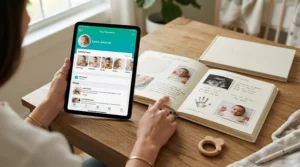
Printable Milestone Journals vs Bound Keepsake Books
A printable milestone journal for babies — whether a downloadable PDF template or card-based props like the Pearhead Wooden Monthly Milestone Cards — offers something bound books can’t: flexibility. You print exactly what you need, skip pages that don’t apply to your family structure, and spend a fraction of the cost of a hardcover option. The tradeoff is durability and cohesion; loose printed pages are easier to lose or damage than a stitched, bound book, and they lack the “finished object” feeling that makes something like Welcome, Little One feel complete on a shelf. Based on the spec comparison, printables make the most sense as a supplement — photo props for monthly updates, for instance — rather than a full replacement for a bound journal if a lasting heirloom is the actual goal.
Common Mistakes When Buying a Baby Milestone Tracker
The most common mistake is buying based on aesthetics alone, then abandoning the journal three weeks in because the prompt style doesn’t match how you naturally write. A close second is assuming a free app will stay free forever — read the fine print on subscription tiers before you get attached to a feature. Parents also frequently underestimate how much a second caregiver’s involvement matters; a beautiful solo journal is useless if your partner can’t easily add entries too. Finally, many buyers skip verifying long-term data export options on digital trackers, only to discover years of feeding logs are hard to retrieve when they eventually want to switch apps or print a physical record.
Long-Term Cost & Keepsake Value: What You’re Really Paying For
A one-time $13 purchase like the Pearhead Wooden Monthly Milestone Cards delivers value with zero ongoing cost, while a premium subscription app like Huckleberry could total $120–$180 a year at full Premium pricing — worth it if you’re genuinely using the sleep-coaching features, overkill if you just want basic logging. Physical journals, priced once between $13 and $55, essentially cost nothing over time beyond the initial purchase, making them the better long-term value if sentiment is your primary goal. Digital tools earn their keep differently — the ROI comes from time saved and stress reduced during genuinely hard early months, not from the object itself becoming a treasured heirloom.
Digital Trackers, Data & Privacy: What Parents Should Know
Handing a company years of your child’s sleep, feeding, and growth data is a bigger decision than it first appears. Before committing to any app, check what data is collected, whether it’s sold to third parties, and how easy it is to export or delete your records if you switch platforms later. Pediatric guidance around children’s digital media consistently emphasizes that parents act as their child’s “media mentor,” making conscious, informed choices about how and when technology enters the picture — the same thoughtful approach applies to choosing where your family’s private milestone data lives.
Features That Actually Matter (And Those That Don’t)
Multi-caregiver sync, data export, and prompt structure genuinely matter — they determine whether you’ll actually finish tracking your baby’s first year. Flashy AI logging features and elaborate design flourishes, meanwhile, matter far less than marketing suggests; a simple text-entry field used consistently beats a gorgeous interface abandoned after two weeks. When comparing options, prioritize whichever format removes friction from your specific daily routine over whichever one photographs best for social media.

Frequently Asked Questions
❓ Is a milestone tracker journal better than an app for babies?
❓ What is the best printable milestone journal for babies?
❓ Do baby tracker apps store data securely?
❓ Can I convert a digital baby tracker into a physical keepsake?
❓ How much should I expect to spend on a baby memory book?
Conclusion
There’s no single right answer in the milestone tracker journal vs digital tracker for babies debate, because the “right” tool is whichever one you’ll actually keep using past the newborn haze. If sentiment, display value, and a tangible heirloom matter most, a physical pick like Welcome, Little One or My Baby’s Book earns its price tag. If your household runs on shared logins and split childcare duties, Huckleberry‘s sync features solve problems paper never could. And if you genuinely can’t decide, BabyPage quietly solves the dilemma by letting you do both without picking a side today. Whichever direction you go, the goal is the same: don’t let this fleeting, exhausting, genuinely magical stretch of early parenthood slip by undocumented.
Recommended for You
- Baby Milestone Tracker Device Vs App: 7 Best Picks 2026
- Milestone Tracker App For First-Time Parents: 7 Picks For 2026
- 7 Best Budget Educational Tablets For A 2 Year Old In 2026
Disclaimer: This article contains affiliate links. As an Amazon Associate, I earn from qualifying purchases. If you purchase products through these links, we may earn a small commission at no additional cost to you.
✨ Found this helpful? Share it with a fellow sleep-deprived parent! 💬🤗
