
In This Article
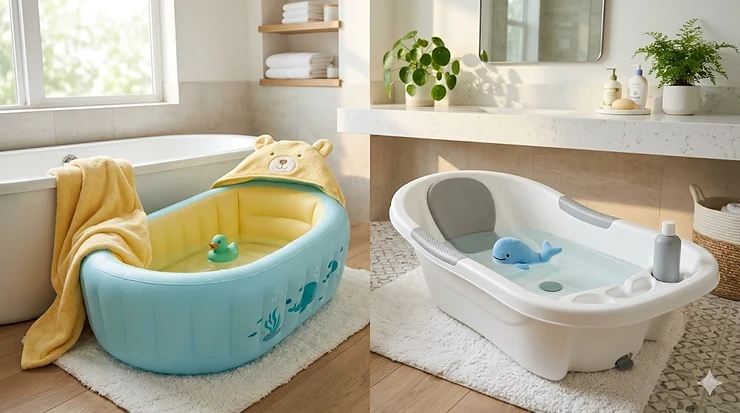
Bath time with your newborn doesn’t have to feel like you’re wrestling a slippery fish in a hurricane. The right bathtub makes all the difference between chaos and calm, but here’s the million-dollar question: should you go inflatable or stick with traditional plastic?

I’ve seen parents obsess over this decision like they’re choosing a college for their kid. Here’s what most buying guides won’t tell you: the inflatable vs plastic baby bathtub debate isn’t about which one’s “better” — it’s about which matches your lifestyle. Live in a 500-square-foot apartment? That collapsible inflatable suddenly looks genius. Got a dedicated nursery with storage galore? A sturdy plastic 4-in-1 that grows with baby might be worth the real estate.
The bathtub material comparison goes beyond just “soft vs hard.” Inflatable baby bathtub pros cons include portability and cushioned comfort, but they require inflation and can develop leaks. Plastic options offer durability and multi-stage designs, yet they hog storage space and lack the cozy padding infants love. According to the American Academy of Pediatrics, the most critical factor isn’t material — it’s safety features like non-slip surfaces and proper drainage.
In this portable vs traditional bathtub analysis, I’ll walk you through seven real products currently crushing it on Amazon, explain what those specs actually mean for your 3 AM bath sessions, and help you pick the foldable vs rigid baby bath that won’t gather dust after month three.
Quick Comparison: Inflatable vs Plastic at a Glance
| Feature | Inflatable Bathtubs | Plastic/Collapsible Bathtubs |
|---|---|---|
| Portability | Ultra-portable, deflates flat | Collapsible models fold, rigid ones bulky |
| Comfort | Cushioned, gentle on skin | Hard surface, may need inserts |
| Durability | Prone to punctures, 1-2 years | 3-5+ years with proper care |
| Storage | Minimal space when deflated | Collapsible: compact; Rigid: significant |
| Price Range | $15-$40 | $20-$60 |
| Best For | Travel, small spaces, newborns | Multi-stage use, frequent bathing |
Looking at this infant tub type analysis, the choice becomes clearer: inflatable wins for apartment dwellers and frequent travelers, while plastic dominates when you want one tub that handles newborn through toddler stages. What the chart doesn’t show is maintenance — inflatable tubs need thorough drying to prevent mold in those air pockets, while plastic models dry faster but can develop mildew in crevices. The best material for baby bathtub depends on whether you prioritize space-saving convenience or long-term investment.
💬 Just one click — help others make better buying decisions too! 😊
Top 7 Baby Bathtubs: Expert Analysis for 2026
1. PandaEar Inflatable Baby Bathtub with Air Pump
The PandaEar Inflatable Baby Bathtub hits that sweet spot between portability and functionality that makes it a standout in the baby bath construction options category. This isn’t your grandma’s blow-up pool — it’s engineered with anti-slip textured bottom and an integrated back support that actually keeps babies from doing the submarine move.
The specs tell half the story: BPA-free PVC construction, suitable for 0-36 months, includes built-in air pump (genius, by the way — no hunting for that camping pump at midnight). What the product page won’t mention is how that textured bottom performs in practice. Unlike smooth inflatable surfaces where babies slide around like they’re on ice, this grip pattern actually works. The side pocket holds shampoo and toys, which sounds trivial until you’re juggling a wet baby with one hand.
This is ideal for the parent who travels to grandma’s house every weekend or lives in a studio apartment where every square inch counts. The built-in pump inflates it in under 3 minutes — faster than your baby can go from giggling to full meltdown. Customer feedback consistently praises the sturdy construction, though several mention the pump requires some muscle if you want maximum firmness.
Pros:
✅ Deflates to envelope-thin for travel
✅ Built-in pump eliminates extra equipment
✅ Textured bottom prevents sliding
Cons:
❌ Requires thorough drying to prevent mold
❌ Air retention decreases after 6-8 months of daily use
Price-wise, you’re looking at around $25-$35, making it a budget-friendly entry into the portable bathtub vs traditional bathtub world. For occasional use or supplementary bath time at grandparents’ houses, it’s hard to beat the value proposition.

2. Munchkin Duck Inflatable Baby Bathtub
The Munchkin Duck has earned cult status among parents, and honestly, the hype is deserved. This isn’t just an inflatable tub shaped like a duck — it’s a safety innovation disguised as adorable design. The White Hot indicator dot turns white when water exceeds safe temperature (around 104°F), then blue when it cools to the ideal 98-100°F range.
Designed for 6-24 months, this tub measures roughly 23 x 18 x 15 inches when inflated. The contoured headrest and fully padded interior create a cocoon effect that newborns find comforting — several pediatric nurses I’ve spoken with recommend this specifically for anxious babies who startle during bath time. The safety dot isn’t just marketing fluff; it eliminates the guesswork that leads to scalding incidents.
For parents nervous about water temperature or dealing with finicky water heaters that fluctuate, the Munchkin Duck provides peace of mind you can’t put a price on. It’s particularly smart for households with older homes where plumbing temperature varies. One caution: the suction cup for hanging doesn’t hold reliably after a few months — consider wall hooks instead.
Pros:
✅ White Hot technology prevents burns
✅ Contoured headrest supports infant necks
✅ Cult favorite with proven safety record
Cons:
❌ Limited to 6-24 months (shorter age range)
❌ Suction cup weakens over time
Expect to pay in the $22-$30 range. The safety feature alone justifies the slight premium over generic inflatables. This is your pick if temperature anxiety keeps you up at night or if you’re gifting to a first-time parent who needs every confidence booster available.
3. Fisher-Price 4-in-1 Sling ‘n Seat Tub
Now we’re talking serious longevity. The Fisher-Price 4-in-1 Sling ‘n Seat Tub isn’t playing around — it’s the Toyota Camry of baby bathtubs: reliable, practical, and it’ll outlast your kid’s interest in rubber duckies. This plastic powerhouse adapts through four distinct stages from newborn sponge bath to toddler splash zone.
Specs that actually matter: soft mesh sling for newborns (0-3 months), baby-stopper insert to prevent sliding (3-6 months), sit-me-up support for wobbly sitters (6-9 months), and spacious toddler tub (9+ months, max 25 lbs). Dimensions are 28 x 18 x 8 inches, with drain plug and hanging hook for storage. What makes this work is the mesh sling quality — it’s machine washable and dries fast, unlike foam inserts that become mildew magnets.
This is engineered for parents who hate buying multiples. One purchase handles eighteen months of growth spurts and developmental milestones. The baby-stopper insert is brilliant — it creates a gentle barrier that keeps pre-sitting babies from doing the slow slide into the deep end while you’re reaching for soap. Customers with multiple kids report this surviving 2-3 children with minimal wear.
Pros:
✅ Four growth stages eliminate replacement purchases
✅ Mesh sling machine-washable (huge hygiene win)
✅ Proven durability across multiple children
Cons:
❌ Bulky storage footprint (28-inch length)
❌ Plastic edges can feel harsh without sling
You’re investing around $35-$50, but divide that by 18+ months of use and you’re at about $2.50 per month. For budget-conscious parents planning more than one child, this rigid vs foldable baby bath comparison tilts heavily toward Fisher-Price. It’s the workhorse choice when you need reliability over cuteness.
4. Skip Hop Moby 3-Stage Smart Sling Tub
The Skip Hop Moby wins on aesthetics while delivering substance — that whale design isn’t just Instagram bait. The Smart Sling technology locks into two ergonomic positions: elevated for full newborn support (0-3 months, up to 15 lbs) and lowered for seated support (3-6 months, up to 20 lbs). Remove the sling entirely and you’ve got a spacious tub for sitters (6+ months, up to 25 lbs).
What separates this from competitors is the dual-layer mesh construction with Comfort-Edge support. Translation: the sling doesn’t create pressure points on baby’s head and spine like single-layer alternatives. At 24 x 17 x 10 inches, it’s slightly more compact than the Fisher-Price while maintaining generous interior space. The textured non-slip bottom works without suction cups — a game-changer for textured bathtub surfaces.
This is your pick if you care about modern design and your bathroom aesthetic isn’t stuck in 1995. The whale tail provides a visual landmark that helps babies recognize bath time is starting — routine consistency that pediatric sleep consultants actually recommend. Parents report the mesh quality holds up better than Fisher-Price equivalents, with less sagging after repeated use.
Pros:
✅ Smart Sling dual-positioning for optimal support
✅ Aesthetically pleasing without sacrificing function
✅ Non-slip base works on all surface types
Cons:
❌ Mesh can retain water if not properly wrung
❌ Premium pricing for similar features
Price range sits at $40-$55, placing it in premium territory for plastic bathtub vs inflatable comparisons. The extra $10-15 over Fisher-Price buys you better materials and design, but functionally they’re neck-and-neck. Choose Skip Hop if your bathroom is your sanctuary and you want baby gear that doesn’t scream “plastic toy explosion.”
5. Frida Baby 4-in-1 Grow-with-Me Bathtub
The Frida Baby 4-in-1 is what happens when parents who actually use baby products design them. This isn’t overengineered — it’s thoughtfully engineered. The Smart Sling system features stay-put hooks (they actually stay put, unlike velcro that loses grip) and machine-washable quick-dry mesh that prevents that musty smell plaguing other slings.
Four positions handle 0-24 months: sling cradles newborns (aqua side), flip to support babies learning to sit (teal side with seat bar), remove pad for sitters, and convert to full toddler tub. At 28 x 18 x 8 inches with easy-release drain plugs and no-slip feet, it’s dimensionally similar to competitors but wins on execution details. The color-coding is genius for sleep-deprived parents — aqua means newborn side, no thinking required at 2 AM.
For the analytically-minded parent who reads reviews obsessively, Frida Baby delivers on promises. The seat bar keeps babies securely positioned without the pinching issue some Fisher-Price users report. Customer feedback highlights the exceptional sling quality — it maintains tension even after 12+ months, whereas other brands’ slings stretch and sag by month six.
Pros:
✅ Color-coded sling eliminates confusion
✅ Stay-put hooks maintain tension long-term
✅ No-slip feet work on porcelain and acrylic
Cons:
❌ Premium pricing without added features
❌ Built-in hook bends under weight over time
Expect to invest $45-$60, making this the top end of the bathtub material comparison price spectrum. You’re paying for build quality and materials that justify the cost through longevity. This is the choice when you want the iPhone of baby tubs — polished, reliable, and it won’t fail you at critical moments.

6. MoreFeel Collapsible Baby Bathtub
Here’s where the foldable vs rigid baby bath category gets interesting. The MoreFeel Collapsible Bathtub represents the hybrid approach — plastic construction with space-saving collapsibility. Made from PP+TPE materials, it folds to under 4 inches thick, combining plastic durability with inflatable portability.
The real-time thermometer built into the tub (not a separate floating toy that gets lost) displays actual water temperature, eliminating guesswork. Bonus hooded towel and soft floating cushion provide head and spinal support for newborns 0-6 months. Suitable for 0-36 months, measuring approximately 31 x 18 x 8 inches when expanded. The double-fold mechanism is legitimately clever — one fold gets you to 4 inches, fold again and it’s 2 inches for suitcase packing.
This targets the parent who wants plastic’s durability but can’t sacrifice cabinet space. The thermometer integration is practical rather than gimmicky — it’s large-display and easy to read while wrangling a squirmy baby. Several users mention it fits in standard bathtubs better than rigid options, making the transition to big-kid bath easier. The included cushion actually supports infant heads without the neck-angle issues some foam inserts create.
Pros:
✅ Folds to 2-4 inches for travel or storage
✅ Integrated thermometer (can’t lose it)
✅ Includes premium accessories (towel, cushion)
Cons:
❌ Folding mechanism can pinch if not careful
❌ Thermometer battery non-replaceable
Price range is around $35-$45, positioning it between budget inflatables and premium rigid plastics. This is your best material for baby bathtub when you need plastic’s longevity but face apartment living constraints. The value proposition is strong if you travel frequently or plan to store it between children.
7. Mink Inflatable Baby Bathtub with Built-in Air Pump
The Mink Inflatable Bathtub closes our lineup with a hybrid design that addresses inflatable’s biggest weakness: setup time. The built-in air pump inflates this in under 90 seconds — faster than finding where you put the regular pump. Suitable for 6-36 months, constructed from 0.3mm thickened PVC with anti-slip central column preventing baby from sliding.
At 80-90% inflation (the sweet spot), it measures roughly 33 x 20 x 10 inches, offering more space than typical inflatables. The ergonomic 45-degree angle meets infant reclined positioning guidelines from pediatric associations. The back support isn’t just padding — it’s strategically placed to support the natural curve of a baby’s spine during the critical first 6 months.
This solves the “I hate inflating things” problem that dooms most inflatable purchases to garage exile. The pump integration means you’ll actually use it rather than defaultating to sink baths because inflation feels like a project. Parents traveling with babies frequently cite this as their go-to because it packs flat but sets up instantly at hotels or relatives’ homes. One caveat: the pump adds a hard plastic component, so complete deflation requires removing it first.
Pros:
✅ 90-second inflation with built-in pump
✅ Thickened PVC resists punctures better
✅ 45-degree recline supports infant spine
Cons:
❌ Pump mechanism adds bulk when deflated
❌ Anti-slip column can feel intrusive for bigger babies
Pricing falls in the $28-$38 range, making it competitive with standard inflatables while adding convenience worth the modest premium. Choose this for the portable vs traditional bathtub scenario where you need inflation speed — think frequent short trips where setup time matters more than absolute minimal storage size.
How to Choose the Right Baby Bathtub Material
Stop overthinking this decision. The right baby bath construction options come down to three questions that actually matter: Where do you live? How often will you travel? And how long do you want this to last?
Space is your first filter. Studio apartment or bathroom the size of a closet? Inflatable or collapsible wins by default. You can’t negotiate with physics — a rigid Fisher-Price tub needs 28 inches of permanent real estate. Inflatable baby bathtub pros cons start with storage: deflated, they’re thinner than a yoga mat. Collapsible plastic folds to 2-4 inches. Rigid plastic sits there occupying space like an entitled house guest.
Travel frequency determines material choice. Flying to grandparents’ house every other month? Pack an inflatable in your suitcase and inflate on arrival. Car trips within driving distance? Collapsible plastic handles trunk storage better than rigid while avoiding inflation hassle. Rarely leave home? Rigid plastic’s convenience of “just fill and go” beats setup time.
Age range economics matter. Planning one child? That $25 inflatable handles 0-24 months adequately. Planning multiples? The $50 Fisher-Price 4-in-1 survives multiple children, making your per-kid cost drop to $15-20. This is basic bathtub material comparison math that buying guides skip.
Weight capacity is the hidden factor. Inflatable tubs max out around 20-25 lbs because air can only support so much. Chunky baby? You’ll outgrow it by 12 months. Plastic handles up to 30 lbs, extending use through early toddlerhood. Check your baby’s growth curve percentile — 90th percentile kids need plastic, period.
Maintenance tolerance reveals your true choice. Hate extra steps? Rigid plastic rinses and air-dries in minutes. Inflatable requires deflation, thorough interior drying (mold loves trapped moisture), then proper storage. Collapsible plastic needs careful folding to avoid mechanism damage. Match the infant tub type analysis to your actual behavior, not aspirational behavior.
According to Consumer Reports, safety trumps material preferences. Look for slip-resistant surfaces, stable bases, and drainage that prevents standing water. The best material for baby bathtub is whichever you’ll use correctly and consistently — a fancy plastic tub you avoid because it’s “too much work” loses to the inflatable you actually inflate.
Decision Framework:
- Small space + frequent travel = Inflatable
- Small space + home-based = Collapsible plastic
- Adequate space + value priority = Rigid plastic 4-in-1
- Adequate space + design priority = Premium plastic (Skip Hop, Frida Baby)
- Temporary/grandparent house = Budget inflatable
The portable bathtub vs traditional bathtub debate oversimplifies the real choice: match the tub’s strengths to your daily reality, not Pinterest fantasies.

Common Mistakes When Buying Baby Bathtubs
Mistake #1: Buying based on cute factor instead of lifecycle.
That Instagram-worthy inflatable swan looks adorable for exactly three uses before you realize it’s a pain to inflate, doesn’t support baby’s back properly, and develops a slow leak by week two. Cuteness doesn’t compensate for frustration. The foldable vs rigid baby bath decision should start with “How many times will I actually use this?” If the answer is “daily for 18 months,” cute doesn’t matter — reliable does.
Mistake #2: Ignoring your actual storage situation.
You convinced yourself you’ll definitely deflate that inflatable after each use and store it properly. You won’t. It’ll live half-deflated on your bathroom floor, collecting mildew in the folds. Be honest about your follow-through. If you know you’re the person who leaves Amazon boxes in the hallway for weeks, rigid plastic that stays ready-to-use is your friend. Storage convenience beats storage size if you never actually store it.
Mistake #3: Underestimating baby’s growth rate.
Your 10th percentile newborn might max out an inflatable by 8 months instead of the advertised 24 months. Check weight limits, not just age ranges. Babies don’t read the box guidelines. A 20-lb limit sounds generous until your chunk-a-munk hits it at 6 months and you’re buying a replacement. This bathtub material comparison factor catches first-time parents constantly.
Mistake #4: Skipping the drain plug check.
You’d think all tubs have functional drainage. You’d be wrong. Some drain plugs leak constantly. Others require removing baby, lifting the entire water-filled tub, and dumping it — try that with a screaming wet infant and report back on the experience. Read reviews specifically mentioning drainage. If multiple people say “drainage is terrible,” believe them.
Mistake #5: Trusting suction cups for stability.
Suction cups work… until they don’t. They fail on textured surfaces. They fail in humid bathrooms. They fail when you need them most. If a tub’s entire stability relies on suction cups, consider it unreliable. Look for weighted bases, non-slip textures, or mechanical stabilization instead. The portable vs traditional bathtub safety difference often comes down to how it stays put.
Mistake #6: Forgetting to factor mold potential.
Inflatable tubs with complex shapes (looking at you, character designs) have crevices perfect for mold growth. Unless you’re committed to thorough drying after every use, simpler shapes win. Collapsible plastic with fewer folds dries faster than inflatable with textured interiors. Mold isn’t just gross — it’s a respiratory risk for infants. The American Academy of Pediatrics specifically warns about mold in bath products.
Mistake #7: Buying multiples “just in case.”
One parent on a forum admitted owning four different baby bathtubs. Four. None were used consistently because the paradox of choice is real. Pick one good option based on your primary use case. Having a backup inflatable for travel when you already have a great plastic tub makes sense. Owning three similar plastic tubs “in different colors” is hoarding, not preparedness.
Mistake #8: Not testing temperature accessibility.
Some tubs position babies so low that you can’t easily check water temperature without contorting yourself. Others place baby too high, making you awkwardly reach over edges. If you have back problems, this matters enormously. The infant tub type analysis should include “Can I comfortably reach my baby without injury?”
Mistake #9: Assuming expensive means better.
The $60 designer tub isn’t automatically superior to the $30 Fisher-Price workhorse. You’re often paying for aesthetics, brand name, or marginally better materials that don’t impact actual use. Unless specific features justify the premium (like Frida Baby’s superior sling design), mid-range options deliver equal functionality.
Mistake #10: Forgetting sibling reuse plans.
If baby #2 is even a possibility, the foldable vs rigid baby bath math changes. That $25 inflatable might seem budget-friendly now, but replacing it for the next kid costs another $25. The $50 plastic tub stored properly serves multiple children, dropping per-kid cost to $15-20. Factor lifecycle economics, not just upfront price.
Most parents make 3-4 of these mistakes. You just read the cheat sheet to avoid them all.
Safety First: Essential Bathtub Features for Infants
The American Academy of Pediatrics doesn’t mince words: more than half of bathtub deaths involve children under 1 year old. The right safety features aren’t suggestions — they’re requirements.
Non-slip surfaces are non-negotiable. Textured bottoms, ribbed patterns, or silicone grip pads prevent the slide-and-panic scenario every parent fears. Smooth surfaces turn bath time into a wrestling match you’ll lose. The portable bathtub vs traditional bathtub safety comparison starts here: does the tub physically prevent sliding before you react?
Stable bases matter more than cute designs. Weighted feet, anti-tip construction, and low center of gravity keep tubs planted. According to the Consumer Product Safety Commission, tubs that tip over account for 171 injuries since 2004. If a tub wobbles when you place baby inside, it fails the safety test. Period. Suction cups don’t count as stability — they’re supplementary at best.
Proper drainage prevents drowning risk. Babies can drown in 1-2 inches of water, and it happens in seconds. Efficient drainage means you can release water without lifting baby out or tilting the tub dangerously. The drain plug should be large (1+ inch diameter), accessible while baby’s in the tub, and seal completely when closed. Any inflatable baby bathtub pros cons analysis must include drainage quality.
Temperature indicators save skin. Water over 120°F causes burns, but baby skin scalds at lower temps than adults. Built-in thermometers or color-changing indicators remove guesswork. The Munchkin Duck’s White Hot technology isn’t marketing fluff — it’s a legitimate safety buffer for exhausted parents who might misjudge temperature.
Size-appropriate support prevents submersion. Newborn slings and inserts must elevate baby’s head and chest well above water level. The best material for baby bathtub includes proper body positioning — a spacious tub without support is more dangerous than a smaller tub with good ergonomics. Look for contoured surfaces that cradle without constricting.
No sharp edges or pinch points. Run your hand over every surface. Rough seams, exposed screws, or fold mechanisms that could catch fingers fail inspection. Collapsible tubs especially need careful checking — folding joints are potential pinch hazards. The bathtub material comparison must include tactile safety beyond specs.
Water level markers guide proper filling. Many tubs include fill lines showing maximum safe depth (typically 2-3 inches for newborns, 4-5 inches for sitters). These aren’t decorative — they prevent overfilling that increases drowning risk. If a tub lacks markers, that’s a red flag about the manufacturer’s safety priorities.
Material certifications matter. BPA-free is baseline, not premium. Look for CPSC certification confirming the tub meets federal safety standards enacted October 2017 or later. Older tubs or off-brand imports might skip critical testing. The infant tub type analysis should verify third-party safety certification.
Warning labels are your checklist. If a tub states “not for sitting babies” or “requires constant supervision,” that’s information you use. Some parents think any baby tub works for any age — wrong. Seat-style tubs tip if used with non-sitting babies. Newborn slings don’t support sitting babies safely. Match tub design to developmental stage precisely.
The 10-second rule eliminates most risks: Never leave baby alone for even 10 seconds. Not to grab a towel. Not to answer the door. Not because your toddler is screaming from the other room. If you must leave, wrap baby in a towel and take them with you. Bathtub features can’t compensate for supervision gaps.
According to research from HealthyChildren.org, most bath injuries happen not from tub failures but from supervision lapses. The safest tub is the one you use correctly every single time.

Real-World Scenario: Which Bathtub for Your Situation?
Scenario 1: Urban Apartment Dweller (450 sq ft)
You’re working with a bathroom barely bigger than a closet. The sink is tiny, and “storage” means creative stacking. What works? The PandaEar Inflatable or MoreFeel Collapsible. Here’s why: both collapse to under 4 inches, storing on a shelf or behind the door. The PandaEar’s built-in pump means no extra equipment cluttering limited space. The MoreFeel offers plastic durability if you’re willing to master the folding mechanism. Budget: $30-40.
Your priority is space efficiency over aesthetics. Skip rigid plastic entirely — the 28-inch footprint doesn’t negotiate. The inflatable vs plastic baby bathtub choice tilts heavily toward anything that disappears when not in use.
Scenario 2: Suburban Home with Multiple Kids Planned
You’ve got a dedicated nursery, a proper bathroom, and baby #2 is definitely happening within 2-3 years. The smart play? Fisher-Price 4-in-1 or Frida Baby 4-in-1. These rigid plastic options survive multiple children with proper care. The mesh slings machine-wash, the plastic resists scratches, and the 4-stage design means one purchase handles birth through toddlerhood. Budget: $45-60.
Your priority is cost-per-kid economics. That $50 Frida Baby serving two children costs $25 per kid — cheaper than replacing a $30 inflatable for each child. The portable vs traditional bathtub math favors traditional when you’ve got storage space and reuse plans.
Scenario 3: Frequent Traveler (Work Trips or Family Visits)
You’re at grandparents’ house twice monthly or do regular work travel with baby in tow. The obvious choice: Mink Inflatable with Built-in Air Pump. It packs in a suitcase, inflates in 90 seconds upon arrival, and deflates fast for return trip. Hotels, Airbnbs, relatives’ homes — this handles them all. Budget: $28-35.
Your priority is setup speed and portability. The built-in pump eliminates the “I forgot the pump” disaster. Collapsible plastic works for car trips but adds more luggage than deflated inflatable. The foldable vs rigid baby bath comparison doesn’t matter here — inflatable wins on pure travel logistics.
Scenario 4: First-Time Parent on Tight Budget
You’re drowning in baby expenses and need something functional without premium pricing. PandaEar Inflatable ($25-30) or MoreFeel Collapsible ($35-40) deliver solid performance without breaking the bank. Both include essential safety features — non-slip surfaces, proper drainage, thermometers. You’ll potentially replace them sooner than premium options, but that’s acceptable when cash flow is tight.
Your priority is adequate safety features at minimal cost. Skip the $60 designer tubs — they don’t bathe baby better. The best material for baby bathtub is the one you can afford that meets basic safety standards.
Scenario 5: Nervous First-Time Parent Prioritizing Safety
You’ve read every horror story and want maximum safety features. Go with Munchkin Duck Inflatable for the White Hot temperature indicator or Skip Hop Moby for superior sling support. Both offer extra safety layers: the Munchkin prevents burns, the Skip Hop prevents slipping and improper positioning. Budget: $35-50.
Your priority is peace of mind. The inflatable baby bathtub pros cons include extra cushioning that feels safer for newborn fragility. The bathtub material comparison matters less than features actively preventing common accidents.
Scenario 6: Grandparent’s House (Occasional Use)
Grandma watches baby weekly but doesn’t need daily bath capability. A basic inflatable like the standard PandaEar (without built-in pump, around $15-20) handles occasional use without investment. It stores in a closet deflated, inflates with a bicycle pump in 5 minutes, and serves its purpose for 1-2 baths weekly.
Your priority is low-cost occasional solution. Grandma doesn’t need premium features or long-term durability. The infant tub type analysis simplifies to “adequate and cheap.”
Match your scenario to the recommendation. The common thread? Real constraints trump aspirational purchases. Buy for your actual life, not the Pinterest version of it.
Long-Term Cost & Maintenance Analysis
Let’s talk money beyond sticker price, because the cheapest tub isn’t always the most economical choice. The bathtub material comparison extends into total cost of ownership — purchase price, replacement frequency, cleaning supplies, and time investment.
Rigid Plastic (Fisher-Price, Skip Hop, Frida Baby):
Initial investment: $35-60
Lifespan: 3-5 years with one child, 5-8 years across multiple children
Maintenance: Quick rinse and air dry, monthly deep clean with mild soap
Replacement parts: Mesh slings ($10-15) available separately
Hidden costs: Storage space (has monetary value in expensive housing markets)
Real cost per year: $8-12 for single-child use, $6-8 across two children. The rigid plastic investment pays off through longevity. I’ve talked to parents who passed the same Fisher-Price tub through three kids with only sling replacement. That’s under $5 per kid per year — cheaper than coffee.
Inflatable (PandaEar, Munchkin, Mink):
Initial investment: $20-35
Lifespan: 12-24 months with regular use (punctures and air leakage)
Maintenance: Thorough drying after each use, occasional patch repairs
Replacement parts: Generally not available; full replacement needed
Hidden costs: Time investment in inflation/deflation, patch kits ($5-10)
Real cost per year: $15-25, higher if used daily. Air retention decreases around month 8-10 even without punctures. Parents report buying 2-3 inflatables over the same period one plastic tub serves. The portable bathtub vs traditional bathtub economics shift dramatically at the 18-month mark.
Collapsible Plastic (MoreFeel, TPN, BEBELEH):
Initial investment: $30-45
Lifespan: 2-4 years (folding mechanisms wear before plastic does)
Maintenance: Rinse and fold carefully to avoid mechanism strain
Replacement parts: Typically none available
Hidden costs: Learning curve on proper folding (damaged units from incorrect storage)
Real cost per year: $10-18. These split the difference between rigid durability and inflatable portability. The mechanism is the weak point — several users report folding joints cracking by year two. Still competitive with rigid plastic if you treat it gently.
Maintenance Time Investment:
- Rigid plastic: 3-5 minutes per use (rinse, wipe, air dry)
- Inflatable: 8-12 minutes per use (deflate, dry interior thoroughly, fold, store)
- Collapsible: 5-8 minutes per use (rinse, dry, carefully fold, store)
At 5 baths weekly, inflatable costs you an extra 30-40 minutes per week in maintenance versus rigid plastic. Over a year, that’s 26-35 hours of your life spent on tub maintenance. Hourly value your time at $20? The “cheaper” inflatable just cost you $520-700 in time investment.
Replacement Scenario Costs:
- Punctured inflatable at 14 months: $25 replacement
- Broken collapsible mechanism at 30 months: $35 replacement
- Worn rigid plastic sling at 18 months: $12 sling replacement
The foldable vs rigid baby bath economics favor rigid plastic when planning extended use or multiple children. Inflatable makes economic sense only for short-term or supplementary use (travel, grandparents’ house).
Environmental Cost:
Rigid plastic: Recyclable in most municipalities, lasts longest
Inflatable PVC: Difficult to recycle, typically landfill-bound
Collapsible plastic hybrid: Mixed materials complicate recycling
If environmental impact factors into your infant tub type analysis, rigid plastic wins despite larger size. Single-use economics beat multi-replacement scenarios.
The Hidden Winner: Used Market
Rigid plastic tubs resell for $15-25 on Facebook Marketplace after use. Inflatables have zero resale value — nobody wants your used blow-up tub. Factor $15-20 resale recovery into rigid plastic’s total cost and the per-kid economics become even more favorable.
Bottom line: inflatable looks cheaper until you factor time, replacement, and resale. Rigid plastic costs more upfront but wins on total lifecycle economics if used for recommended duration.
Features That Actually Matter (And Those That Don’t)
Feature That Matters: Non-Slip Texturing
This prevents the slide-and-panic scenario. Textured bottoms, ribbed patterns, or silicone grip zones keep baby stable while you reach for soap. Smooth surfaces are bathtub Russian roulette — maybe baby stays put, maybe they don’t. The best material for baby bathtub starts with slip resistance as baseline requirement.
Feature That Doesn’t: Built-In Toy Storage
Marketing teams love this feature. Parents use it exactly twice. Those mesh pockets collect mildew, the toys you actually want don’t fit, and you’ll forget to empty it until something’s growing in there. Skip tubs that charge premium for toy storage — use a separate caddy you can dry properly.
Feature That Matters: Efficient Drainage
Large drain plugs (1+ inches diameter) that release quickly without removing baby make the difference between peaceful bath endings and wrestling wet infants while water slowly drains. Test this at the store if possible — if draining requires tilting the entire tub, that’s a design failure.
Feature That Doesn’t: Character Designs/Themes
Your baby doesn’t care if the tub looks like a duck, whale, or spaceship. You’re paying extra for licensed characters that add zero function. Cute designs with complex shapes also create more crevices for mold growth. The inflatable vs plastic baby bathtub decision should ignore aesthetics — function trumps cute.
Feature That Matters: Adjustable Positioning
Slings that lock into multiple positions, reclining angles that adjust, or insert systems that adapt to growth actually extend usable life. This is how one tub handles 0-24 months instead of requiring replacement at 6 months. The Fisher-Price and Skip Hop multi-stage systems justify higher prices through this feature.
Feature That Doesn’t: Temperature Gauges (Floating Type)
Those little rubber duckies with temperature displays? They float away, get lost, and aren’t accurate anyway. Integrated thermometers built into the tub (like MoreFeel’s digital display) work. Separate floating gauges don’t. Use your elbow like generations of parents before fancy gadgets existed.
Feature That Matters: Machine-Washable Inserts
Mesh slings and fabric inserts that survive washing machine cycles prevent the mildew problem destroying so many baby products. Hand-wash-only components never get properly cleaned — be honest about your follow-through. Fisher-Price and Frida Baby’s machine-washable slings are worth the premium.
Feature That Doesn’t: Multiple Color Options
Who cares if it comes in “Ocean Blue” versus “Seafoam Green”? You’re not coordinating bathroom decor — you’re bathing a baby who will splash water everywhere. Don’t pay extra for color choices when safety features deserve that budget instead.
Feature That Matters: Hook for Hanging/Storage
Integrated hooks let tubs air-dry properly, preventing mold growth that plagues tubs stored wet in cabinets. This seems trivial until you’re dealing with a mildew-smelling tub and wondering where you went wrong. The portable vs traditional bathtub maintenance difference often comes down to proper drying.
Feature That Doesn’t: “Spa” Features
Some tubs advertise jets, bubbles, or soothing sounds. Your infant doesn’t need spa day. These features add complexity, battery requirements, more things to break, and zero functional value. They’re marketing to exhausted parents’ fantasies, not actual baby needs.
Feature That Matters: Weight Capacity
This determines actual usable lifespan regardless of age range claims. A tub rated for 20 lbs maxes out by 10-12 months for average babies, 6-8 months for larger babies. Check weight limits against your baby’s growth curve percentile. The bathtub material comparison should always verify capacity matches your baby’s expected growth.
Feature That Doesn’t: “Newborn” vs “Infant” vs “Toddler” Labels
Marketing departments love creating urgency through age-specific labels. A well-designed tub with adjustable features handles newborn through toddler. Don’t buy three different tubs because packaging says “specifically for 0-6 months.” Check actual specifications, not marketing labels.
Feature That Matters: Stable Base Design
Weighted feet, low center of gravity, anti-tip construction — these prevent the tub-tipping scenario that sends babies tumbling. Suction cups alone don’t count. The tub should remain stable when you place baby inside without relying on bathroom surface cooperation.
Feature That Doesn’t: Brand Name Premium
Paying $60 for a designer brand versus $35 for Fisher-Price doesn’t automatically mean better performance. Sometimes you’re paying for logo and packaging. Compare actual features and safety specs, not brand prestige. The infant tub type analysis should focus on engineering, not marketing.
The features that matter prevent problems. The features that don’t solve problems you won’t have. Choose accordingly.
Frequently Asked Questions
❓ Can I use dish soap to clean an inflatable baby bathtub?
❓ How often should I replace the mesh sling in plastic bathtubs?
❓ What's the safest water temperature for newborn bathing?
❓ Do collapsible bathtubs leak at the folding seams?
❓ Can I transition straight from inflatable to regular bathtub?
Conclusion: Making Your Final Choice
Here’s your decision framework stripped of marketing noise: if you live in a shoebox apartment or travel weekly, inflatable baby bathtub pros cons lean toward portability — grab the PandaEar or Mink. If you’ve got storage space and plan multiple kids, the bathtub material comparison favors rigid plastic like Fisher-Price or Frida Baby for total lifecycle value.
The inflatable vs plastic baby bathtub debate isn’t about “better” — it’s about matching strengths to your specific constraints. Small space wins with inflatable portability. Long-term use wins with plastic durability. Frequent travel wins with hybrid collapsible design.
Stop overthinking this. Pick based on your primary constraint: space, budget, travel, or longevity. A $30 inflatable used consistently beats a $60 premium tub gathering dust because it’s “too nice for daily use.” The best material for baby bathtub is the one you’ll actually use properly every single day.
Your baby doesn’t care about Instagram aesthetics or brand prestige. They care about feeling secure, staying warm, and not sliding around like they’re on a water park ride. Focus on slip resistance, stable bases, efficient drainage, and proper size for your baby’s growth curve.
The portable vs traditional bathtub choice simplifies to this: buy for your real life, not your aspirational Pinterest bathroom. Match the tub to your actual behavior patterns, living constraints, and economic reality. Bath time success isn’t about perfect gear — it’s about consistent, safe habits with equipment that doesn’t fight you at every step.
Now go forth and bathe that baby without second-guessing yourself into paralysis. You’ve got the knowledge — trust your judgment on what works for your situation.
Recommended for You
- 7 Essential Products for a Complete Baby Bath Routine in 2026
- 7 Best Detanglers for Baby Hair That Actually Work in 2026
- 7 Best Unscented Baby Wash for Sensitive Skin 2026
Disclaimer: This article contains affiliate links. As an Amazon Associate, I earn from qualifying purchases. If you purchase products through these links, we may earn a small commission at no additional cost to you.
✨ Found this helpful? Share it with your friends! 💬🤗
