
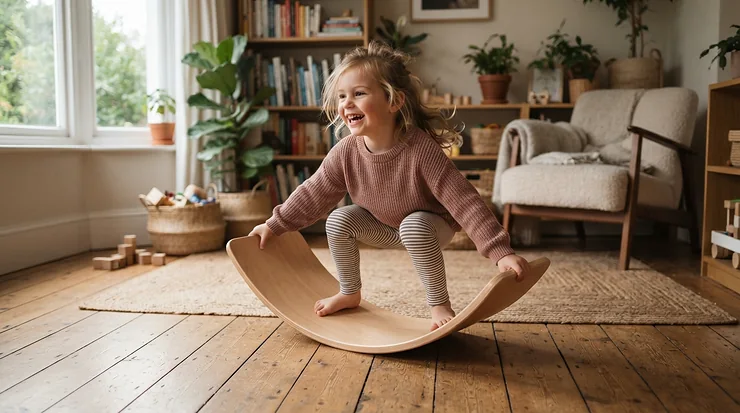
In This Article
Toddlers don’t walk anywhere. They launch, wobble, scale the couch like it owes them money, and go again. Underneath all that chaos, a brand-new nervous system is negotiating with gravity. The toys you hand over can feed that negotiation or let it quietly starve. 🚀

That’s the whole case for gross motor skills toys for toddlers. These are toys that invite big, full-body movement: pushing, stepping, balancing, climbing, bouncing, riding. Those movements build the postural strength behind everything from sitting upright at a table to feeling brave on a playground. Think of it as setting a stage rather than buying more stuff.
Here’s the catch. Searching for gross motor skills toys for toddlers drops you into a pile of near-identical climbing sets and recycled “best of” lists. This guide works differently. It compares real specs, weighs aggregated review sentiment from multiple sources, and explains what each number means on your living room floor. You’ll get seven picks across budget, mid-range, and premium tiers, plus setup guides, scenario matchups, and buying checkpoints. Where the evidence is thin, I’ll say so.
Quick Comparison: Gross Motor Skills Toys for Toddlers at a Glance
| Product | Best For | Maker’s Age Guide | Main Skill Focus | Price Range |
|---|---|---|---|---|
| edxeducation Step-a-Trail | Budget balance practice | 18 months+ | Stepping, balance | Roughly $40–$90, by set size |
| Little Tikes 3-Foot Trampoline | Burning energy indoors | 3–6 years | Jumping, leg strength | Generally under $100 |
| Radio Flyer Classic Walker Wagon | First steps | 1–4 years | Walking, pushing | Mid-range |
| Strider 12 Sport | Future bike riders | 18 months–5 years | Balance, steering | Roughly $150–$180 |
| Tiny Land 7-in-1 Pikler Triangle Set | Climbing in small spaces | 2+ years (1+ with supervision) | Climbing, crawling, rocking | Around $140–$170 |
| Foamnasium Blocksy | Cautious climbers, tumblers | 6 months+ | Climbing, crawling, jumping | Premium tier, check listing |
| Kinderfeets Kinderboard | Buy-once versatility | 18 months+ | Balance, core strength | Around $100–$125 |
The table shows a trade-off most lists skip: you’re buying either a skill specialist or a shape-shifter. The Strider 12 Sport and Radio Flyer Classic Walker Wagon each do one job extremely well. The Kinderfeets Kinderboard and Tiny Land 7-in-1 Pikler Triangle Set become something new every few weeks. If your budget is tight, start with the edxeducation Step-a-Trail, since it offers the most movement variety per dollar here.
💬 Just one click — help others make better buying decisions too!😊
What Are Gross Motor Skills Toys for Toddlers?
Gross motor skills toys for toddlers are playthings and equipment that encourage large-muscle movements like walking, balancing, climbing, jumping, pushing, and riding. They build core strength, coordination, and body awareness through active play rather than finger-level precision tasks. Ideal options match the child’s current stage while offering a slightly harder next step.
Why does stage matter so much? Because movement skills arrive in a predictable order, if not on a predictable schedule. Per the CDC’s 24-month milestone checklist, most children by age two run, kick a ball, and walk up a few stairs with or without help. By age three, the checklist adds climbing well and pedaling a tricycle.
Those milestones are your shopping map. A 14-month-old cruising along the couch needs something to push or something soft to tumble on. A three-year-old needs a challenge that rewards balance and coordination. Buy for the stage your child is approaching, not the one they’ve mastered.
Top 7 Gross Motor Skills Toys for Toddlers: Expert Analysis
Each pick below gets the same treatment: what the specs mean in practice, who it suits, and what reviewers actually say. The order runs roughly from budget-friendly to premium.
1. edxeducation Step-a-Trail — most movement variety for the money
Stepping stones sound boring until a toddler turns the living room floor into lava. This set of plastic logs and stumps, sold in 3- and 6-piece versions, is basically a portable obstacle course.
Each piece has a grippy rubber top and base, so the surfaces resist slipping, and the three-log set measures roughly 13.75 inches long and 2.5 inches tall. That low height matters. A tumble from a 2.5-inch log is a shrug, not a trip to urgent care, and the varied heights let you raise difficulty gradually.
This is the best fit for 18-month-olds to preschoolers who need balance and coordination practice but can’t justify a big wooden structure. Its hidden strength is modularity: spread pieces apart and it becomes a jumping game, line them up and it’s a balance path.
Reviewers on the 6-piece listing give it a 4.8-out-of-5 average across roughly 3,000 ratings, and shoppers describe sturdiness and enough grip that children and even adults can use them. That’s marketing-site testimony, so treat it as supportive rather than conclusive.
Pros:
- ✅ Rubber grip top and bottom reduces slipping
- ✅ Low heights suit beginners
- ✅ Nests and stacks for easy storage
Cons:
- ❌ Hard plastic is unforgiving on hard-floor falls
- ❌ Each piece challenges only one skill
Price & value: Roughly $40–$90 depending on set size and seller, which makes it the best value-per-skill pick here. Check current price.
2. Little Tikes 3-Foot Trampoline with Handle — compact indoor bouncing for older toddlers
Bouncing is the toddler version of a cardio workout, and this trampoline puts it in a 36-inch circle. The handlebar gives wobbly jumpers something to hold, which is the real innovation.
Little Tikes lists a 55-pound weight limit, indoor use only, and one child at a time. The maker’s age guide is 3–6 years, so this is the “older toddler” pick, not one for new walkers. The jumping surface sits low, so falls are short, and the bounce is gentle by design.
Who’s it for? The high-energy two-and-a-half- to four-year-old who treats the couch as a trampoline. Jumping is a legitimate milestone skill, and a handlebar trampoline channels it into something safer than furniture.
Parent reviews on retail sites lean positive, with one marketplace listing averaging roughly four stars across thousands of ratings. A recurring complaint is that the foam on the handle can tear after limited use. Expect to inspect the handle regularly and replace the padding or tape it if it frays.
Pros:
- ✅ Handlebar builds confidence for new jumpers
- ✅ Light enough to move between rooms
- ✅ Low profile limits fall height
Cons:
- ❌ Foam handle padding wears out quickly
- ❌ Maker’s age guide starts at three
Price & value: Generally under $100. Strong value for a three-year-old, questionable for a 15-month-old. Check current price.
3. Radio Flyer Classic Walker Wagon — best first-steps push toy
First steps are less about bravery than about having something sturdy to lean on. This wooden wagon doubles as a toy hauler, so the “walk” part feels like a job.
The body is solid wood, and Radio Flyer’s resist-push clickers slow the wheels so beginners stay in control. Sides are removable, there’s a furniture bumper, and the wagon carries up to 35 pounds of toys. The clicker is the clever part, because runaway rolling is what scares new walkers off push toys.
This is the pick for the 12-to-20-month stage. Loading and unloading means squatting, lifting, and pushing, all quietly useful for strength. Once walking is solid, it becomes a pull-along toy wagon.
Reviewer sentiment on retail sites is warm, and one retailer shows a 4.8-out-of-5 average. The caveats are practical. BabyGearLab found more assembly steps than competing walkers, and one shopper reported the wheels don’t allow turns. Keep that in mind if your hallway has tight corners.
Pros:
- ✅ Resist-push clickers steady early walkers
- ✅ Solid wood and removable sides
- ✅ Doubles as toy storage
Cons:
- ❌ Assembly takes longer than rivals
- ❌ Limited turning reported by some owners
Price & value: Mid-range among push walkers according to BabyGearLab. Good value if you’ll use it past the first-steps phase. Check current price.
4. Strider 12 Sport Balance Bike — lightest flat-free first bike
If you want your child to ride a pedal bike without training wheels later, start here. A balance bike teaches the hardest part of cycling, which is balance, before pedals complicate things.
The Sport weighs about 6.7 pounds, has a steel frame, and fits riders from 18 months to 5 years with a 60-pound limit. It ships with standard and extra-long seat posts. A common rule of thumb says a balance bike should weigh no more than about 30 percent of a child’s body weight, and this one clears that bar for most toddlers.
This is for the confident walker, typically 2 to 3 years old, with sidewalks or pavement nearby. Foam tires never go flat, but reviewers note limited traction off-road and no hand brake.
Testers across Mumsnet and other review sites call it light, adjustable, and low-maintenance, and Mumsnet singled out its value for money. Some reviewers also say the price feels steep for a mid-range model.
Pros:
- ✅ Very light for easy handling and carrying
- ✅ Wide fit range across several years
- ✅ Flat-free tires need no maintenance
Cons:
- ❌ Foam tires slip on loose terrain
- ❌ No hand brake for steep slopes
Price & value: At the time of research, list pricing sat roughly in the $150–$180 range. It’s an investment, but it often covers years of riding. Check current price.
5. Tiny Land 7-in-1 Pikler Triangle Set — climber, ramp, and rocker in one foldable kit
Pikler triangles built a following on a simple idea: let children choose how high to climb and learn their own limits. This set adds a reversible ramp and an anti-tip rocker so one purchase covers climbing, sliding, rocking, and crawling.
According to the maker, reinforced corners, anti-slip pads, and sturdy construction support the sets’ stability, and the frame holds up to 160 pounds. It folds for storage but weighs roughly 26–30 pounds, so you won’t be carrying it casually.
Buyer types: families with a one-to-three-year-old and limited floor space. The Good Trade lists the age range as two years and up, with one-year-olds possible under close supervision. An editor there reported gifting it for a first birthday and described it as helping with gross and fine motor skills, though that’s one person’s report.
Availability can fluctuate. One Amazon color variant appeared as unavailable at the time of research, so check current stock.
Pros:
- ✅ Seven play modes from one set
- ✅ Folds away between play sessions
- ✅ High 160-pound load capacity
Cons:
- ❌ Heavy to move and fold daily
- ❌ Needs close supervision with one-year-olds
Price & value: Around $140–$170 across retailers at the time of research. Strong value if your child will climb daily for years. Check current price and availability.

6. Foamnasium Blocksy — soft climbing for cautious climbers and tumblers
Not every toddler wants a wooden ladder. Foam blocks let babies and toddlers climb, crawl, and tumble with a lower risk when they fall.
The set includes two foldable bases and two backs, measuring about 70 by 25 by 19 inches assembled. Foamnasium states its foam is 1.5 lbs per cubic foot with a firmness of 50 IFD, free from harmful fire retardants, and the covers are wipeable. That firmness matters because foam that’s too soft collapses under climbing weight, while foam that’s too hard defeats the purpose.
Best fit: crawlers through preschoolers, and families who want an indoor climber that doubles as a couch or fort. The cover pieces can be rearranged into slides and tunnels, which keeps older siblings interested.
Customer comments on the brand’s own site are enthusiastic, but those are curated, so I’d weigh them lightly. Amazon reviews exist as well, though I couldn’t verify a stable aggregate rating during research.
Pros:
- ✅ Soft surfaces reduce fall impact
- ✅ Rearranges into slides, tunnels, forts
- ✅ Wipeable covers for easy cleanup
Cons:
- ❌ Takes up significant floor space
- ❌ Pricier than generic foam sets
Price & value: Premium tier, and I couldn’t confirm a stable current price, so check the listing. Comparable multi-piece foam sets from other brands appeared around the $100 mark. Worth it if you value US-made construction and foam specs.
7. Kinderfeets Kinderboard — one wooden board, a dozen ways to play
This is the shape-shifter of the list. Flip it, tilt it, and it becomes a seesaw, a slide, a stepping stool, a boat, a tunnel, or a rocker. Kinderfeets calls it a Waldorf-style, open-ended toy.
The listed specs are 32 by 12 by 7 inches and 8.8 pounds, with a 485-pound maximum weight. That capacity means it grows with your child (and survives the occasional adult). The board is made of German beech plywood with a water-based lacquer, and Kinderfeets recommends it from 18 months.
This is the best balance toy for toddler development when you want a single purchase to last for years. It rewards patient kids: the first week may be sitting on it, the second a wobble, the third a proper rocking balance. The weight cuts both ways, since very small toddlers may struggle to move it.
Reviewers across roundups give it about a 4.8 average, and one roundup cited more than a thousand reviews. Common complaints are the price and that the wood can show dings with rough play.
Pros:
- ✅ Extremely versatile across ages and stages
- ✅ 485-pound capacity outlasts toddlerhood
- ✅ Beech plywood with a safe finish
Cons:
- ❌ Roughly three times the cost of budget boards
- ❌ Heavy for very young toddlers to move
Price & value: Around $100–$125. Pricey up front, but the cost-per-year-of-use is low. Check current price.
How the Seven Compare: Specs That Matter
| Product | Key Size or Weight | Capacity | Best For |
|---|---|---|---|
| edxeducation Step-a-Trail | Log: ~13.75″ L x 2.5″ H | Adult-weight reported by reviewers | Balance paths on a budget |
| Little Tikes 3-Foot Trampoline | 36″ x 36″ x 33.5″ | 55 lb, one child | Indoor jumping |
| Radio Flyer Classic Walker Wagon | Solid wood body | 35 lb of toys | New walkers |
| Strider 12 Sport | 6.7 lb | 60 lb rider | Balance biking |
| Tiny Land 7-in-1 Pikler Triangle Set | ~26–30 lb, foldable | 160 lb | Climbing in small homes |
| Foamnasium Blocksy | ~70″ x 25″ x 19″ | Not verified | Soft-landing climbing |
| Kinderfeets Kinderboard | 32″ x 12″ x 7″, 8.8 lb | 485 lb | Long-term versatility |
Looking at the numbers, weight capacity is the quiet differentiator. The Kinderfeets Kinderboard and Tiny Land 7-in-1 Pikler Triangle Set will outlast a single toddler, while the Little Tikes 3-Foot Trampoline caps out at 55 pounds and ages out sooner. If you’re counting storage, the Strider 12 Sport and edxeducation Step-a-Trail are the easiest to tuck away. For a growing family planning sibling hand-me-downs, capacity is worth a second look.
Setting Up Gross Motor Skills Toys for Toddlers: A 30-Day Practical Guide
Amazon listings tell you what’s in the box. They don’t tell you how to use it so it keeps working. Here’s a simple month plan for gross motor skills toys for toddlers.
Week 1: Introduce one item. Resist the urge to unwrap everything at once. Place a single toy on a rug or carpet and let your child explore it on their own terms. Sit nearby and stay quiet.
Week 2: Add a simple challenge. Line up two edxeducation Step-a-Trail pieces, or tilt the Kinderfeets Kinderboard against a cushion. Small variations keep it fresh without raising the stakes.
Week 3: Rotate and combine. Swap one item out and combine another. A foam piece beside a stepping path creates a cushioned landing zone.
Week 4: Take it outside or upstairs. Move a toy to a new room or surface. Novelty extends interest.
Common first-30-day mistakes:
- Setting everything up at once and overwhelming the child
- Placing climbers on bare hard floors with no padding
- Skipping the manufacturer’s weight and age labels
- Forgetting to re-tighten bolts on wooden items after the first week
A five-minute weekly safety check (wobbles, loose screws, frayed foam) is the cheapest insurance you’ll ever buy.
Real-World Scenarios: Matching Gross Motor Skills Toys for Toddlers to Your Home
These are illustrative profiles, not personal case studies. Use them to match budget, space, and frequency of use to the right pick.
Scenario A: The apartment with a new walker. An 18-month-old is mid-wobble, the floor is hardwood, and the budget is about $150. The Radio Flyer Classic Walker Wagon handles first steps, and a small edxeducation Step-a-Trail set adds balance practice. Play happens daily in short bursts. Skip the climber until the walking is solid.
Scenario B: The suburban sidewalk family. A 2.5-year-old plays outside daily, and the budget stretches to around $300. The Strider 12 Sport gets used on pavement, while the Kinderfeets Kinderboard covers rainy days. This pair uses both outdoor and indoor options.
Scenario C: The two-kid playroom. A 14-month-old and a 3.5-year-old share a basement. The Foamnasium Blocksy works for the younger child’s crawl-and-climb, and the Little Tikes 3-Foot Trampoline burns off the older one’s energy. Supervise closely so the older child’s bouncing doesn’t bump the baby.
In every scenario, the winning move is matching the toy to the stage, not to the age printed on the box.
How to Choose Gross Motor Skills Toys for Toddlers
Follow these six steps before adding anything to your cart:
- Match the toy to your child’s current stage. Check where they are against the CDC milestones, then buy for the next step, not three steps ahead. Toys that are too advanced frustrate children and can pose hazards, a point echoed in the AAP’s toy-buying guidance on HealthyChildren.org.
- Check the weight limit and maker’s age guide. A 55-pound cap gets reached faster than you’d think.
- Measure your space. Foam climbers and Pikler triangles need a clear play zone, not just a spot in a closet.
- Choose surfaces and materials wisely. Hard plastic and wood need rugs underneath, while soft foam tolerates tumbles.
- Think in terms of progression. Look for gear that gives you a harder version in six months, like add-on ramps or adjustable heights.
- Plan for supervision. The safest toy still needs eyes on it, especially for climbing and bouncing.
Balance Toy for Toddler Development: Which Type Fits Which Stage?
A balance toy for toddler development isn’t a single category. It’s a ladder with several rungs, and each rung asks the body for something slightly different.
Stage one (12–18 months): Static balance, like standing and cruising. Push toys such as the Radio Flyer Classic Walker Wagon support this. The child is learning to shift weight from foot to foot.
Stage two (18–30 months): Dynamic balance, like stepping onto a raised surface. The edxeducation Step-a-Trail shines here, because the stepping stones are low, grippy, and forgiving.
Stage three (2–4 years): Moving balance, like rocking on a board or gliding on a bike. The Kinderfeets Kinderboard and Strider 12 Sport belong here.
What most buyers overlook is that balance practice works best when it’s slightly hard. If your child finds the toy effortless, raise the difficulty (a gap between stones, a tilted board). If they refuse it entirely, move one rung down. Every balance toy for toddler development needs that adjustability to stay useful.
Walking and Climbing Toy for Toddlers: A Safe Progression
A walking and climbing toy for toddlers should mirror what the body is already attempting. Most children walk independently around 12 to 15 months, begin running and exploring stairs after that, and climb furniture before they climb well.
Here’s a sensible ladder:
- Pushing and cruising (12–18 months): The Radio Flyer Classic Walker Wagon gives stability without electronics.
- Low, soft climbing (12–24 months): The Foamnasium Blocksy keeps falls gentle and the stakes low.
- Structured climbing (18 months–4 years): The Tiny Land 7-in-1 Pikler Triangle Set lets a child pick their own height.
The golden rule with any walking and climbing toy for toddlers is to never place a child at a height they couldn’t reach independently. That’s the philosophy behind Pikler-style climbing, and it keeps confidence and caution in balance. Place mats underneath, keep the area clear of toys, and stay within arm’s reach until you’ve watched them climb confidently a few times.
Gross Motor Play Equipment for Kids: Space, Budget and Safety Guide
Gross motor play equipment for kids ranges from a $40 set of stepping stones to a multi-hundred-dollar climbing structure. Here’s how to think about the three variables that decide what you can actually buy.
Space: A Tiny Land 7-in-1 Pikler Triangle Set and a Foamnasium Blocksy both claim real floor space. If your living area is small, choose equipment that folds (the Tiny Land) or stacks (the edxeducation Step-a-Trail).
Budget: Spend where growth is most likely. The Kinderfeets Kinderboard costs more but spans years, while the Little Tikes 3-Foot Trampoline is cheaper but time-limited.
Safety: Every item on this list has a weight limit or age guide, and those aren’t suggestions. Check the label, inspect hardware regularly, and use padded flooring under anything with height. Adult assembly matters too, as the Little Tikes trampoline specifically requires it.
Gross motor play equipment for kids earns its keep when it gets used daily. A cheap item that sees 30 minutes of play every day beats an expensive structure that gathers dust.
Balance and Coordination: What to Expect from Real-World Performance
Spec sheets promise “improves balance and coordination.” Real life looks messier, and that’s actually good news.
In the first week with a new balance toy, expect wobbling, bailing, and the occasional frustrated shriek. Those aren’t failures. Balance and coordination develop through small corrections, and every stumble is a data point for the child’s nervous system.
By week three or four, you’ll often see subtle shifts: a wider stance, faster recovery after a wobble, more willingness to try a harder variation. By two or three months, the child might cross a stepping-stone path without help or hold a rocking position on the Kinderfeets Kinderboard for a few seconds.
Realistic expectations matter. The Strider 12 Sport won’t turn a 20-month-old into a gliding cyclist in a weekend, and the edxeducation Step-a-Trail won’t make a toddler graceful overnight. If a child seems to be falling far more than peers, or struggles with stairs by age three, the CDC advises raising it with your pediatrician. Toys support development, but they don’t replace a check-in.
Large Muscle Development: Features That Actually Matter (And Those That Don’t)
Large muscle development responds to a few reliable features and ignores a lot of marketing. Here’s the filter.
Features that matter:
- Adjustable difficulty. Heights, angles, and spacing that can change as skills grow.
- Stable construction. Anti-slip bases and reinforced corners, like those on the Tiny Land 7-in-1 Pikler Triangle Set.
- Whole-body demands. Pushing, climbing, and balancing recruit the trunk and legs together, which is what large muscle development really needs.
- Appropriate surfaces. Grippy rubber or foam beats shiny plastic every time.
Features that don’t:
- Lights and sounds that distract from the movement itself
- Branded themes with no structural advantage
- “7-in-1” or “12-in-1” claims that don’t change how the body works
The AAP’s guidance leans the same way: look for toys that encourage active, hands-on, caregiver-involved play rather than passive entertainment. A plain wooden board often beats a flashy gadget for large muscle development, because it asks the child to do the work.
Active Play: How Much Do Toddlers Actually Need?
Active play isn’t optional décor for toddlerhood. The World Health Organization’s guidelines for children under five recommend that one- and two-year-olds get at least 180 minutes of physical activity spread across the day, at any intensity. For three- and four-year-olds, that stays at 180 minutes, with at least 60 of those minutes at moderate-to-vigorous intensity.
That sounds like a lot until you notice what counts. Walking to the mailbox counts. Hauling toys in the Radio Flyer Classic Walker Wagon counts. A ten-minute session on the Little Tikes 3-Foot Trampoline counts. It’s an accumulation, not a workout.
Practical takeaway: aim for short, frequent bursts rather than one big session. Keep a toy or two in sight and reachable, because visibility triggers movement. Toddlers rarely suggest “let’s balance.” They just see a wobbly thing and climb on it.
WHO also urges less time restrained in strollers, bouncers, and seats, so active play also means reducing the “parked” hours where possible.
✨ Don’t Miss These Exclusive Deals!
🔍 Take your toddler’s movement play to the next level with these carefully selected products. Click on any highlighted item to check current pricing and availability. These tools will help you create confident, active days your family will love!
Gross Motor Skills Toys for Toddlers vs Screens and Restraining Gear
Parents often ask whether movement toys really beat the alternatives. Here’s how they compare on what matters.
| Option | Movement Payoff | Main Downside | Best For |
|---|---|---|---|
| Movement toys (e.g., Tiny Land 7-in-1 Pikler Triangle Set) | High: climbing, balance, strength | Space, supervision | Daily active play |
| Screen-based entertainment | Very low | Sedentary by design | Short, planned downtime |
| Sit-in walkers and bouncers | Low to moderate | Restrains movement, limits free exploration | Brief supervised use only |
| Playground-only play | High but seasonal | Weather, travel time | Weekend outings |
Looking at the comparison, movement toys win on payoff but cost you space and attention. Playgrounds are great, but they don’t help on a rainy Tuesday. The practical answer isn’t either/or: use movement toys as your home base and playgrounds as the bonus. Gear that keeps a toddler seated or restrained for long stretches is the weakest link, which lines up with WHO’s push for less restrained time.
Common Mistakes When Buying Gross Motor Skills Toys for Toddlers
Even careful shoppers stumble. These are the pitfalls worth dodging, plus the long-term cost angle most people forget.
Buying for age, not stage. Age labels are a starting point. A cautious 2-year-old and a daredevil 2-year-old need different gear.
Ignoring the label. The AAP’s How to Buy Safe Toys guide emphasizes reading warning labels and age recommendations because they signal choking, strength, and ability concerns.
Overbuying. Three climbers do not equal three times the development. One well-chosen item, rotated with a second, outperforms a crowded playroom.
Forgetting total cost of ownership. A $120 item used for three years costs about $3.33 a month. A $50 item used for three months costs about $17 a month. Cheap isn’t always cheaper.
Skipping maintenance. Wooden items need hardware checks, foam needs cleaning, and padded handles on trampolines need inspection. Those 10 minutes a month protect your whole investment.

FAQ
❓ What are the best gross motor skills toys for toddlers under $100?
❓ At what age can toddlers start using a balance bike?
❓ Are Pikler triangles worth the money for a one-year-old?
❓ How much floor space do gross motor play equipment for kids typically need?
❓ Can one set of gross motor skills toys for toddlers cover a 1-year-old and a 3-year-old?
Conclusion
Choosing gross motor skills toys for toddlers doesn’t require a giant budget or a playroom the size of a gymnasium. It requires matching the toy to the stage, respecting weight limits and supervision, and leaving room for the child to do the hard part: moving.
Here’s the short version. For first steps, the Radio Flyer Classic Walker Wagon is hard to beat. For budget balance practice, the edxeducation Step-a-Trail delivers the most variety per dollar. For soft-landing climbing, look at the Foamnasium Blocksy, and for structured climbing in a compact footprint, the Tiny Land 7-in-1 Pikler Triangle Set fits. For the long haul, the Kinderfeets Kinderboard and Strider 12 Sport are investments that can span years, and the Little Tikes 3-Foot Trampoline is the energy-burner for the older toddler.
Start with one or two items, watch what your child gravitates toward, and rotate from there. Large muscle development, balance and coordination, and plenty of active play don’t come from a single perfect purchase. They come from regular, joyful repetition.
✨ Ready to get your toddler moving?
🚀 Pick the toy that matches your child’s current stage, check current pricing and availability, and give your little one a safe space to wobble, climb, and bounce. Click on any highlighted product above to see what’s available today!
Recommended for You
- Fine Motor Skills Toys For A 1 Year Old: 7 Smart Picks 2026
- Motor Skills Tracking Device For Toddlers: 7 Best Picks 2026
- Cognitive Development Tablet For Toddlers: 7 Best Picks 2026
Disclaimer: This article contains affiliate links. As an Amazon Associate, I earn from qualifying purchases. If you purchase products through these links, we may earn a small commission at no additional cost to you.
✨ Found this helpful? Share it with your friends! 💬🤗
