
In This Article
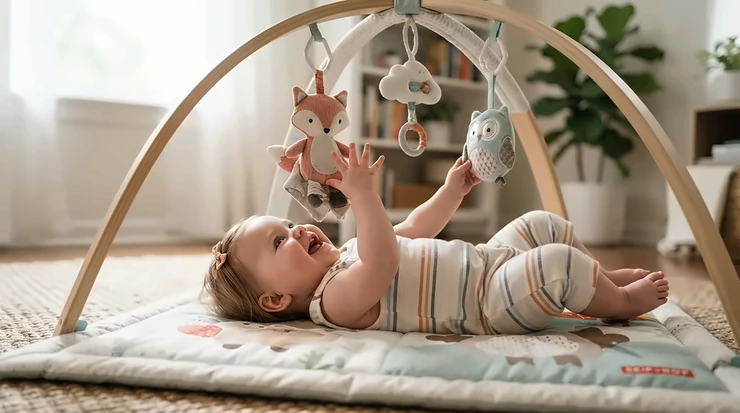
Cognitive development toys for infants are playthings built to exercise how babies notice, remember, and figure things out. They use contrast, texture, sound, cause and effect, and hide-and-find games. In the first year, the best ones invite grasping, mouthing, banging, and dropping, which quietly turns your living-room floor into a very small laboratory.
Here’s the awkward truth about the baby aisle: much of it is engineered to impress adults. Twenty-seven songs. Blinking lights. A plastic dashboard that talks back. Your six-month-old, meanwhile, is thrilled by a ring that wobbles when she swats it. Harvard’s Center on the Developing Child describes the real engine of early learning as serve and return. That’s the back-and-forth when a baby babbles, gestures, or cries and a caring adult responds, and it helps build brain architecture. A toy can’t do that job. What a good toy can do is give the two of you something to serve and return over.
That’s the lens for this guide. You’ll find seven real products, from a stacker that costs less than a sandwich to a premium play gym. For each one there’s honest analysis of what it does for infant brain development and where it falls short. Whether you’re hunting affordable brain development toys for babies, a sensory toy for infant cognitive growth, or a budget baby learning toy that outlasts the next teething phase, the picks are laid out so you can see the trade-offs fast.
One transparency note. Everything here rests on spec sheets and published customer and editorial reviews, not hands-on testing, and I flag thin review pools where they exist. Prices are ranges only, so check current price before you buy.
Quick Comparison: Cognitive Development Toys for Infants at a Glance
Before the deep dives, here’s the whole field on one screen. Ages come from manufacturer or retailer guidance, and prices are approximate ranges captured at the time of research.
| Toy | Best Age Window | Price Range | Main Cognitive Payoff | Best For |
|---|---|---|---|---|
| Fisher-Price Rock-a-Stack | 6 months+ | Under $10 | Size sequencing, cause and effect | Tightest budgets |
| Infantino Textured Multi Ball Set | 6 months+ | Roughly $10-$15 | Tactile discrimination, visual tracking | Sitters and early crawlers |
| Manhattan Toy Winkel Rattle & Sensory Teether | Newborn+ | $15-$20 | Grasping, hand-to-hand transfer, gentle sound | First-months gifts |
| Lamaze Freddie the Firefly | Newborn+ | $15-$20 | High-contrast vision, texture exploration | Car seats and strollers |
| Adena Montessori Object Permanence Box with Tray | About 6-12 months | Roughly $15-$30 | Vanish-and-reappear learning | Object permanence play |
| Tiny Love Sunny Day Gymini | Newborn+ | $55-$65 | 16 activities, peek-a-boo leaf | Mid-range all-rounder |
| Lovevery Play Gym | 0-12 months (fort to ~18) | $140-$150 | Five staged play zones | Premium, guided play |
Looking at the table, the Fisher-Price Rock-a-Stack and Infantino Textured Multi Ball Set deliver the most developmental variety per dollar for babies who can sit. Winkel and Freddie cover the earliest months, when grasping and visual contrast matter most. If you want one purchase that spans newborn to first birthday, the Tiny Love Sunny Day Gymini and Lovevery Play Gym are the contenders. The gap between them is mostly guidance, footprint, and polish. The Adena Montessori Object Permanence Box with Tray is the specialist: it does one job, cleanly.
💬 Just one click — help others make better buying decisions too!😊
Top 7 Cognitive Development Toys for Infants: Expert Analysis
The seven picks run from wonderfully simple to premium-polished. Read each as analysis rather than a verdict. The right toy depends on your baby’s age, your floor space, and how many hours a week it will actually get played with.
1. Fisher-Price Rock-a-Stack — cheapest size-sequencing lesson around
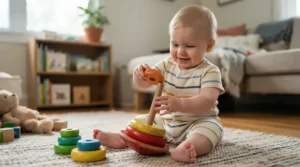
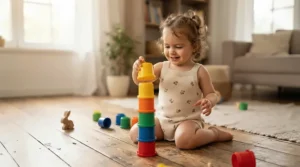
The whole personality of this classic is its wobbly base: knock the tower, watch it rock, repeat until dinner. You get five graduated rings, a bat-at rocker base, and a smallest ring with a shiny surface and swirling, rattling beads, all for ages 6 months and up.
Those five sizes are a hands-on lesson in relative size. A baby can’t say “bigger,” but the mismatch between a large ring and a small post registers in the fingers. The rocker adds honest cause and effect: swat it and it moves, every single time. That reliable feedback loop is exactly what a six-month-old brain feeds on.
Based on the spec comparison, this is the least expensive way to cover grasping, size sequencing, and cause and effect in one object. It suits the parent who wants a budget baby learning toy that stays interesting when stacking becomes a real skill around the first birthday.
On reviews, the Walmart listing I found shows roughly 4.8 stars across about 125 ratings. That’s a small sample, and I couldn’t verify a larger pooled review set, so treat it as a light signal.
Pros:
- ✅ Cheapest size-sequencing lesson in this roundup
- ✅ Rocker base delivers instant cause and effect
- ✅ Rattling top ring doubles as a grab toy
Cons:
- ❌ Limited texture variety compared with sensory sets
- ❌ Less novelty once stacking is mastered
Price range: under $10, so check current price. Value verdict: outstanding for the money.
2. Infantino Textured Multi Ball Set — six textures in one grab-and-roll set
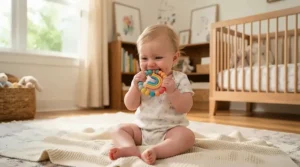
Six balls, six personalities: bumpy, ridged, squeaky-soft, and everything between. The set is six BPA-free molded plastic balls in varied sizes for babies 6 months and up, and listings describe gentle sounds when squeezed.
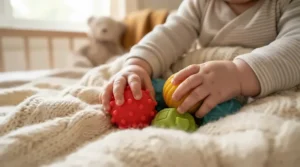
Varied surface texture means fingertips and gums are learning to discriminate smooth from nubby from ridged. That sensory data later supports sorting objects into categories. Balls also roll, so they invite eye tracking and, eventually, a crawl in pursuit.
What most buyers overlook is that a ball rolling under the couch is an unplanned object permanence lesson. Baby has to decide whether it still exists. That makes this a strong budget baby learning toy for sitters and early crawlers, provided you keep the rolling range small so the game stays fun rather than frustrating.
Reviewers I sampled praise the mix of colors and textures and the baby-friendly size. One pet owner reported that a puppy destroyed most of the set, so plan for durability around dogs. The listing data also shows a best-seller rank in the top 40 of Balls for Babies & Toddlers.
Pros:
- ✅ Six distinct textures in a single set
- ✅ Baby-friendly size for early grasping
- ✅ Rolling encourages tracking and crawling
Cons:
- ❌ Balls vanish under furniture quickly
- ❌ Pets may treat them as chew toys
Price range: roughly $10-$15, so check current price. Value verdict: high value for a tactile sampler.
3. Manhattan Toy Winkel Rattle & Sensory Teether — newborn-proof grip, chew, and rattle
Winkel is basically a tangle of soft loops that a newborn can’t fumble. It measures about 5 x 4 x 3.5 inches, weighs around 3 ounces, and is made of BPA-free polyurethane tubing. A quiet rattle sits in the center cube, and the loops can be chilled in the fridge for teething.
Continuous loops mean there is no wrong way to hold it, so grasping success starts early. Passing it from hand to hand builds the coordination that later powers stacking and drop-and-retrieve games.
My read is that Winkel earns its place in months zero to six, before object-based play really begins. Treat it as a bridge toy: it delivers sensory stimulation now and teething relief later, which stretches its useful life.
Across the listing data I saw, it holds roughly 4.8 stars over more than 40,000 ratings. Reviewers consistently mention easy grip, a rattle that isn’t grating, and durability, with one parent reporting use at 18 months. The recurring downsides are surface-wash-only care and a feeling that it’s pricey for a teether.
Pros:
- ✅ Continuous loops are easy to grip from any angle
- ✅ Quiet rattle adds sound without harshness
- ✅ Chillable for teething relief
Cons:
- ❌ Surface-wash-only care
- ❌ Some parents find it pricey for its simplicity
Price range: $15-$20, so check current price. Value verdict: good value thanks to the long lifespan.
4. Lamaze Freddie the Firefly — high-contrast back, crinkly front
Freddie is a portable sensory buffet clipped to whatever your baby is strapped into. The plush velour firefly is about 10 inches tall and weighs roughly 4.6 ounces. It has crinkle wings, a peek-a-boo mirror, a tethered ladybug teether, knotted antennae, clinking rings, and a squeaker, and the back carries high-contrast black-and-white patterns.
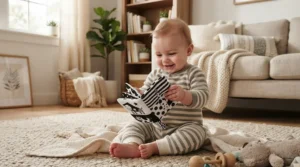
High contrast targets young eyes, which respond to bold edges more than pastels. Crinkle and squeak provide small cause-and-effect payoffs. The clip keeps the toy in reach instead of on the floor, which sounds trivial until you’ve retrieved a dropped toy eleven times.
Freddie‘s edge is location, not features. It converts dead time in a car seat or stroller into sensory practice. It fits newborns through roughly the first half-year best, then shifts to a teething and chewing role.
Retailer ratings cluster around 4.8-4.9 stars. A Babylist listing shows 4.9 across about 45 reviews, and another retailer cites 29,000+ parent ratings. Parents praise the crinkle and texture variety. The recurring complaints are weak stitching on the strap holding a clip ring, and the toy looking large next to a very small newborn.
Pros:
- ✅ High-contrast side suits newborn vision
- ✅ Crinkle, squeak, and mirror in one toy
- ✅ Clips onto strollers and car seats
Cons:
- ❌ Some reviewers report weak stitching at the clip strap
- ❌ Large for very small newborns
Price range: $15-$20, so check current price. Value verdict: strong value for travel-heavy families.
5. Adena Montessori Object Permanence Box with Tray — the purest object permanence play
This wooden box strips object permanence play to its essence: a ball goes in, vanishes, and pops out into a tray. The listing recommends it for roughly 6-12 months and includes three balls. Comparable listings describe balls around 1.77 inches across, so verify the ball size on your exact listing.
Object permanence is the understanding that something still exists when it can’t be sensed, and Piaget argued that babies build it by touching and handling objects. The drop-and-reappear loop is that idea, distilled. Baby also practices releasing on purpose, a surprisingly hard motor skill.
Based on the spec comparison, this is the most targeted purchase here. It has no lights, batteries, or noise, just a repeatable mini-experiment. It suits parents who want to lean into Montessori-style, low-stimulation play.
On reviews, I couldn’t verify a trustworthy pooled sample for this specific listing, because Amazon carries many near-identical wooden boxes from different sellers. So I won’t quote a rating. Seller descriptions across the category frame it as an entry-level exercise, with the main challenge being coordinating the drop.
Pros:
- ✅ Isolates the vanish-and-reappear concept cleanly
- ✅ Builds drop-and-release hand control
- ✅ Simple wood design, no batteries or noise
Cons:
- ❌ Loose balls need close supervision
- ❌ Many look-alike listings, so quality varies
Price range: roughly $15-$30 depending on seller, so check current price. Value verdict: good value if object permanence play is your goal.
6. Tiny Love Meadow Days Sunny Day Gymini — peek-a-boo leaf plus 16 activities
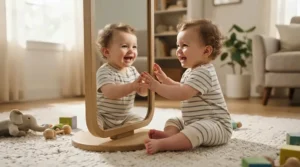
This mid-priced gym packs 16 activities under one arch, including a peek-a-boo leaf that rehearses object permanence long before crawling. It has two play modes, lying/tummy time and sit-and-play, which you switch by sliding the connector on the adjustable arches.
Highlights include easy-grasp clackers, a mirror for extended tummy time, a dragonfly jumpy toy, a crinkly mobile, and a baby-activated toy with three melodies. Adjustable arches let one product cover reach-and-bat at two months and sit-and-play at seven. The mirror can stretch tummy-time tolerance, and the melody toy gives a clean kick-and-hear cause and effect.
Here’s what to weigh: this is the compromise buy. It costs less than half the premium gym, yet still offers staged play and an object permanence element. It suits parents who want structure without the sticker shock.
Review data was thin for this exact model. A Babylist listing shows 4 out of 5 from a single review, so treat this as a spec-driven pick rather than a crowd-validated one.
Pros:
- ✅ Adjustable arches grow with your baby
- ✅ Peek-a-boo leaf introduces object permanence
- ✅ Baby-activated melodies teach cause and effect
Cons:
- ❌ Very thin verifiable review pool
- ❌ Battery-powered music adds upkeep
Price range: $55-$65, so check current price. Value verdict: solid mid-range value.
7. Lovevery Play Gym — premium gym with a hiding-and-finding zone
Lovevery Play Gym treats the play mat like a curriculum. It has five developmental zones (focus, sounds, textures, hiding and finding, colors), and you can conceal zones so baby isn’t overloaded. Wooden arches hold five detachable toys, and three card sets (black-and-white, objects, faces and mirror) slot into the focus zone. There’s also a fold-down mirror and a stage-based play guide. Open, it measures around 50 x 47 inches. It’s designed for 0-12 months, and the reversible cover converts to a fort for roughly 12-18 months.
The hiding-and-finding zone targets object permanence directly. Concealable zones give you a dial for sensory stimulation, which is rarer than it sounds.
The spec sheet won’t tell you this, but you’re buying the guide as much as the gym. One independent review site concludes that a plainer mat and an arch cover the essentials for far less, which is a fair point if you’d never open the guide.
Editorial reviewers, including Mommyhood101 and Mother & Baby, praise the newborn-friendly visuals, sensory variety, and included guidance. Recurring criticisms are the price, the large footprint, and a look that some find visually busy.
Pros:
- ✅ Five concealable zones help prevent overstimulation
- ✅ Interchangeable card system grows with baby
- ✅ Detailed stage-based guide included
Cons:
- ❌ Highest price in this roundup
- ❌ Large footprint for small apartments
Price range: $140-$150, so check current price. Value verdict: worth it only if you have the floor space and will use the guidance.
Here’s how all seven stack up side by side.
| Toy | Key Specs | Price Range | Review Signal | Best For |
|---|---|---|---|---|
| Fisher-Price Rock-a-Stack | 5 rings, rocker base, rattle top ring | Under $10 | ~4.8★, small sample | Budget stacking |
| Infantino Textured Multi Ball Set | 6 textured balls, 6 months+ | ~$10-$15 | Top-40 category rank | Tactile play |
| Manhattan Toy Winkel Rattle & Sensory Teether | ~3 oz loops, chillable | $15-$20 | ~4.8★, 40,000+ ratings | Newborns |
| Lamaze Freddie the Firefly | ~10 in plush, clip-on, mirror | $15-$20 | ~4.8-4.9★ | On-the-go |
| Adena Montessori Object Permanence Box with Tray | Wood box, tray, 3 balls | ~$15-$30 | Not verified | Object permanence |
| Tiny Love Sunny Day Gymini | 16 activities, 2 modes | $55-$65 | Thin data | Mid-range gym |
| Lovevery Play Gym | 5 zones, card system, guide | $140-$150 | Strong editorial | Guided premium play |
The pattern is clear. Every dollar above roughly $20 buys breadth (more activities, more stages) rather than a deeper lesson on any single skill. If you already own a gym, the cheap single-purpose toys are where the marginal learning value sits. If you own nothing, the mid-range Tiny Love Sunny Day Gymini covers the most ground for the least commitment.
Object Permanence Play: A Step-by-Step Guide
This is the guide the Amazon listings don’t give you. Object permanence play works best as a slow ladder, not a single trick. Britannica notes that the classic view puts the milestone around 8-9 months, while later research found hints of it in babies as young as 3.5 months. In other words, don’t wait for a birthday. Start gently and follow your baby’s lead.
Rung 1: Partial hiding. Sit at floor level with your baby and drape a light cloth over half of a favorite toy, like Winkel. Watch for the reach. If baby grabs the visible half, you’re in business.
Rung 2: Full hiding. Cover the whole toy while baby watches. Expect confusion at first. Keep it short and cheerful, and celebrate the find.
Rung 3: Container play. Introduce the Adena Montessori Object Permanence Box with Tray or the peek-a-boo leaf on the Tiny Love Sunny Day Gymini. Demonstrate slowly, wait for the ball to reappear, then hand it over.
Common mistakes in the first 30 days:
- Moving too fast to full concealment.
- Playing past fussiness. Three good minutes beat ten frustrated ones.
- Hiding items the baby doesn’t care about.
- Panicking at search errors, such as reaching where the toy used to be, which are common around 8-12 months.
Keep sessions to a few short bursts a day, and use the moment to narrate. That’s your serve and return in action.
Budget Baby Learning Toy Scenarios: Who Should Buy What
Numbers help, but stories help more. These are hypothetical profiles, not real families, matched to picks with the reasoning shown.
Scenario 1: The $30 total budget. You have a five-month-old, one small apartment, and a limit. Buy Winkel now for grasping and teething, and pick up the Fisher-Price Rock-a-Stack for the sitting stage. Together they land within a $25-$30 range. Use them daily for short stretches, and rotate one out of sight every few days so each feels new. That’s a complete budget baby learning toy kit.
Scenario 2: The commuting parent. You’re driving 40 minutes each way with a newborn. Clip Freddie to the car seat handle for the high-contrast, crinkly distraction, and keep the Infantino Textured Multi Ball Set at home for later. Usage is high, but each session is short, so durability of the strap matters. Inspect the stitching now and then.
Scenario 3: The gifting relatives. Grandparents want one meaningful present around $150. The Lovevery Play Gym fits, but only if the family has floor space. If not, the Tiny Love Sunny Day Gymini plus the Adena Montessori Object Permanence Box with Tray delivers similar breadth for roughly half.
In every case, the pattern is the same: match the toy to the developmental stage you’re in, not the one you’re anticipating.
How to Choose Cognitive Development Toys for Infants
Choosing well takes about five minutes if you know what to look for. Here’s the checklist, in order of importance.
- Match the stage, not the age on the box. A three-month-old needs grasp-friendly and high-contrast; a nine-month-old needs drop, stack, and hide. Buy for the next four to eight weeks, not the next year.
- Prioritize responsive over flashy. Toys that react predictably (wobble, crinkle, squeak) teach cause and effect better than a random light show.
- Look for texture and contrast variety. Different surfaces feed tactile discrimination, and bold patterns suit young vision.
- Check size and safety first. Confirm the toy is clearly too large for choking, and read the age label.
- Favor multi-use. A toy that works as a rattle, teether, and pass-and-grab object earns its shelf space.
- Budget by cost per month of use. A cheap toy used for twelve months beats a pricey one used for three.
Apply this and most decisions resolve themselves. For example, a newborn’s checklist points straight to Winkel or Freddie, while a sitting baby’s points to the Fisher-Price Rock-a-Stack or the Infantino Textured Multi Ball Set.
Infant Brain Development: What Toys Can (and Can’t) Do
The science of infant brain development is both reassuring and humbling. Harvard’s Center on the Developing Child explains that brain architecture is built from the bottom up, starting before birth, and that early experience has an outsized influence because the brain’s ability to adapt declines as we age. Genes provide the blueprint, but repeated use reinforces the circuits.
Notice what that doesn’t say: it doesn’t say “buy more toys.” The central ingredient is responsive relationships. A toy is a prop, not a teacher. Its job is to give your baby something worth exploring and to give you something to talk about together.
That reframes a lot of buying decisions. A toy that keeps a baby quiet in a corner is doing less for infant brain development than a plain ring you’re both giggling over. The ideal toy invites interaction: a hidden ball you find together, a crinkle you imitate, a texture you describe.
This is also good news for budgets. A Fisher-Price Rock-a-Stack used well outperforms a premium toy used passively, so let your engagement, not the price tag, set the ceiling.
Sensory Toy for Infant Cognitive Growth: Features That Actually Matter
Marketing loves to shout about features. Here’s a filter for finding the sensory toy for infant cognitive growth that’s actually worth buying.
Features that matter:
- Texture contrast. The Infantino Textured Multi Ball Set gives six different surfaces to compare.
- Visual contrast. Black-and-white patterns, like the back of Freddie, suit young eyes.
- Consistent cause and effect. A rocker that always rocks teaches more than a button that sometimes plays a song.
- Graspable shapes. Loops, rings, and rounded handles, as on Winkel, let babies succeed early.
Features that matter less:
- Dozens of songs. Novelty fades quickly, and constant sound competes with your voice.
- Screens and lights. They tend to make babies passive spectators.
- Complicated interfaces. If baby can’t discover it alone, it’s a parent toy.
The takeaway: pick sensory toys that make baby do something. The best sensory toy for infant cognitive growth is one that turns a curious hand into a tiny experiment.
Affordable Brain Development Toys for Babies: Long-Term Cost and Value
Affordable brain development toys for babies aren’t a compromise. Often they’re the smart choice. Let’s do the arithmetic on cost per month of active use.
The Fisher-Price Rock-a-Stack, under $10, might see twelve months of play, which works out to well under a dollar a month. Winkel at $15-$20 likely stretches across teething and grasping for ten to twelve months, so a couple of dollars monthly. The Lovevery Play Gym, at around $145, spread over its 12-month core window, comes to roughly $12 a month. It can drop lower if you reuse it for a second child or resell it.
That doesn’t mean premium is wrong. It means premium needs to justify itself with something cheap toys can’t provide: guidance, staged progression, or a larger sensory range. If you’ll use that, the math works. If you’ll ignore the guide, the math collapses.
Maintenance costs matter too. Wooden and molded plastic toys are usually wipe-clean, while fabric toys like Freddie are surface-clean only. Battery-powered items, like the melody toy on the Tiny Love Sunny Day Gymini, add small recurring costs.
✨ Don’t Miss These Carefully Selected Picks!
🔍 Take your baby’s early learning to the next level with these carefully selected products. Click on any highlighted item to check current pricing and availability. These toys will help you create authentic discovery moments your family will love!
Sensory Stimulation: How Much Is Enough?
More sensory stimulation isn’t automatically better. A baby’s attention is a limited budget, and a crowded play space spends it fast. A reasonable rule of thumb: offer one focus at a time, follow the baby’s cues, and end sessions when they look away or fuss.
Signs your baby has had enough include turning away, arching, fussing, or glazed staring. Signs of a good session are wide eyes, reaching, cooing, and returning to the toy after a pause.
This is where design matters. The Lovevery Play Gym lets you conceal zones, so you can reveal one at a time. Freddie packs many textures and sounds into one toy, which can be lovely for one baby and a lot for another. Reviewers have noted that some patterns feel less overwhelming than others, so watch your own baby.
A simple rotation system helps. Keep three to four toys out and store the rest, swapping every week or so. Novelty returns without buying anything new, which is the cheapest form of sensory stimulation there is.
Cognitive Development Toys for Infants vs Everyday Household Objects
Can a wooden spoon and a cardboard box do the same job? Partly. Household objects deliver texture, sound, and free novelty. What purpose-built cognitive development toys for infants add is safety testing, graded difficulty, and design around baby hands.
| Factor | Cognitive Development Toys for Infants | Household Objects |
|---|---|---|
| Safety testing | Designed to children’s product standards | Not designed for babies; needs vigilance |
| Graded challenge | Built around developmental stages | Random |
| Cost | $5-$150 range | Free |
| Longevity | Durable, reusable | Variable |
| Best For | Structured skill-building | Supplementing and variety |
The table makes the trade-off plain. Household objects are a great supplement, especially for sound and texture variety, but they shouldn’t replace tested toys during mouthing stages. The sensible approach is a small core of toys, such as Winkel and the Fisher-Price Rock-a-Stack, topped up with supervised everyday items. Use a soft cloth for hiding games, a wooden spoon for banging, and a clean plastic cup for stacking.
Common Mistakes When Buying Cognitive Development Toys for Infants
Most buying mistakes are predictable, and all of them are avoidable.
- Buying for the future baby. A toy aimed at a nine-month-old will bore a three-month-old. Buy for now.
- Chasing the biggest feature list. Sixteen activities sound impressive, but a baby explores one at a time. Depth beats breadth.
- Ignoring the review pool. A high rating from a handful of reviews isn’t the same as a high rating from thousands. This roundup flags thin data for a reason.
- Forgetting cleanability. Fabric toys like Freddie are surface-clean, so think about drool and spit-up.
- Skipping the safety label. Age grading isn’t decoration.
- Overbuying. Too many toys dilute attention. A few well-chosen items, rotated, outperform a heap.
If you dodge those six, you’re ahead of most shoppers. And if you make one anyway, the cost of a Fisher-Price Rock-a-Stack or Infantino Textured Multi Ball Set makes the mistake cheap.
Safety Guide: Small Parts, Labels, and Smart Supervision
For children under three, the U.S. Consumer Product Safety Commission enforces a small parts ban for products intended for that age group. A small part is anything that fits entirely inside a cylinder approximating the fully expanded throat of a child under three. That includes whole toys, detachable pieces, and parts that break off during use-and-abuse testing.
For you, that translates into a few habits:
- Read the age label. CPSC guidance is clear that toys designed for children three and older should be kept away from young children.
- Inspect regularly. Check seams, clips, and joins on toys like Freddie, where reviewers have reported stitching issues at the clip strap.
- Supervise loose pieces. Balls and rings, as in the Adena Montessori Object Permanence Box with Tray and the Infantino Textured Multi Ball Set, are safest with an adult nearby, and balls have their own size labeling rules.
- Watch hand-me-downs from older siblings. Toys made for older kids can carry small parts.
- Retire damaged toys. A cracked ring or loose seam isn’t worth saving.
Certification and labeling requirements exist so you don’t have to guess, but they don’t replace attention. Play is safest when you’re in the room.
Frequently Asked Questions
❓ How much should I spend on cognitive development toys for infants?
❓ Are affordable brain development toys for babies as effective as premium ones?
❓ What is the best budget baby learning toy for a six-month-old?
❓ When should I start object permanence play?
❓ Is the Lovevery Play Gym worth the price?
Conclusion
Cognitive development toys for infants don’t need to be expensive, loud, or complicated. They need to be safe, responsive, and matched to where your baby is right now. The Fisher-Price Rock-a-Stack and Infantino Textured Multi Ball Set prove that affordable brain development toys for babies can cover a lot of ground. Winkel and Freddie handle the first months beautifully. The Adena Montessori Object Permanence Box with Tray focuses squarely on object permanence play. The Tiny Love Sunny Day Gymini and Lovevery Play Gym offer structure and breadth at very different price points.
If you take only one idea from this guide, take this one: the toy is the prop, and you are the show. The back-and-forth of serve and return is what builds infant brain development, and any of these seven picks gives you something to build it around. Start small, watch your baby’s cues, rotate what’s out, and let curiosity set the pace.
Recommended for You
- Baby Development Tracking Wearable: 7 Best Picks For 2026
- Milestone Tracker Journal Vs Digital Tracker: 7 Best Picks (2026)
- Baby Milestone Tracker Device Vs App: 7 Best Picks 2026
Disclaimer: This article contains affiliate links. As an Amazon Associate, I earn from qualifying purchases. If you purchase products through these links, we may earn a small commission at no additional cost to you.
✨ Found this helpful? Share it with your friends! 💬🤗
