
In This Article
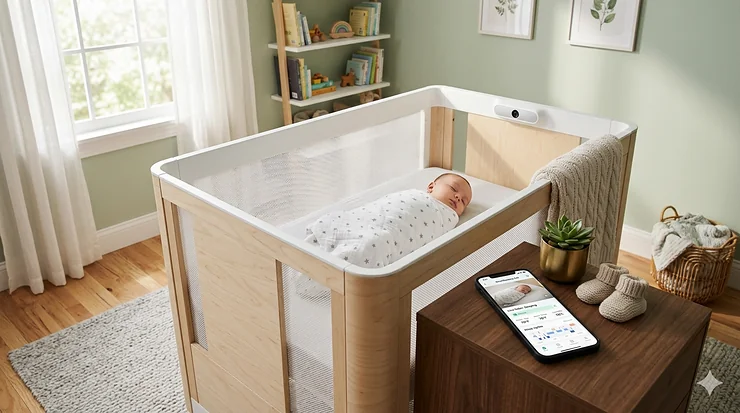
Picture this: it’s 2 a.m., you’re exhausted, and every fiber of your being wants to stay in bed — but some primal parental alarm keeps jolting you awake to check on the baby. Now imagine a smart crib with app monitoring that already knows your baby is sleeping peacefully, has been breathing steadily for the last four hours, and will quietly nudge your phone the moment anything changes. That’s not science fiction. That’s 2026.
The connected nursery has officially arrived. Whether you’re looking for a full all-in-one smart crib with app monitoring that replaces five pieces of baby gear, or a standalone crib monitoring system that bolts onto your existing setup, the options have never been more powerful — or more confusing. AI-driven bassinets, contactless breathing monitors, FDA-cleared wearable socks, and radar-based sleep trackers are all competing for a spot in your nursery. And your sleep-deprived brain has to choose between them.
That’s where this guide comes in. As a parent-tech reviewer who’s spent months buried in infant sleep data, app interfaces, and pediatric safety studies, I’ve done the research so you don’t have to stagger through it at 3 a.m. Below you’ll find seven real, currently available products — ranging from a $150 no-subscription contactless monitor to a $1,799+ AI-powered smart crib — along with honest analysis of what each one actually does for you in the real world.
What is a smart crib with app monitoring? It’s a nursery system — whether a crib, bassinet, or camera — that connects to a smartphone app and provides real-time data on your baby’s breathing, heart rate, sleep patterns, and room environment, often with AI-driven alerts before problems escalate.
The American Academy of Pediatrics (AAP) has noted that responsive parenting tools can support safe sleep practices, though it emphasizes that no monitor replaces a safe sleep environment. Keep that in mind as you shop.
Quick Comparison: Top Smart Crib & App Monitoring Systems (2026)
| Product | Monitoring Type | Breathing Tracking | Subscription Needed | Best For |
|---|---|---|---|---|
| Cradlewise Smart Crib | Full smart crib + AI | Contactless | Yes (2 yrs included) | All-in-one nursery solution |
| Owlet Dream Duo Gen 3 | Wearable sock + 2K camera | FDA-cleared SpO2 | Optional | SIDS-anxious parents |
| Nanit Pro | Overhead camera | Motion-based (band) | Optional | Sleep coaching + video |
| Miku Pro | Radar camera | Contactless SensorFusion | Optional | No-wearable breathing |
| CuboAi Smart Monitor 3 | AI camera | AI visual detection | Optional | Face-covered/rollover alerts |
| Philips Avent SCD973/37 | Camera + parent unit | SenseIQ pixel tracking | No | Parent unit + app combo |
| iBaby i20 | Contactless camera | Yobi-PPG contactless | No | Budget contactless tracking |
The table above tells a clear story: if breathing data is your top priority, you’re choosing between wearable (Owlet) and contactless (Miku Pro, CuboAi, iBaby i20) approaches — each with meaningful tradeoffs. The Cradlewise sits in its own category entirely, replacing the whole nursery stack rather than just the monitor. Parents who only need a crib monitoring system without upgrading their crib will find the best value in the $150–$400 range.
💬 Just one click — help others make better buying decisions too! 😊
Top 7 Smart Crib with App Monitoring Systems — Expert Analysis
1. Cradlewise Smart Crib — The AI-Powered All-in-One
The Cradlewise is the product that made Sam Altman tweet about it and earned TIME Magazine’s Best Inventions recognition — and once you understand what it actually does, the hype makes complete sense.
This is not a baby monitor. It’s a complete sleep ecosystem: bassinet, convertible crib, built-in baby monitor, sound machine, and sleep tracker, all in one unit that grows with your child from newborn to 24 months (up to 33 lbs). The built-in app monitoring system is genuinely predictive — trained on 50+ million hours of sleep data, the AI detects early signs of waking before your baby starts crying and triggers a gentle automatic bounce to soothe them back to sleep. That distinction matters enormously. Most parents are reactive; Cradlewise is proactive.
The Cradlewise app delivers real-time video, sleep trend data, and personalized soothing recommendations. The built-in sound machine streams white, pink, and brown noise or music. Two years of the Nurture Core subscription are included with purchase, covering access to full sleep analytics and coaching content.
Who is this for? Parents willing to make a significant investment ($1,749–$1,999+ range) who want to consolidate their nursery purchases and genuinely improve both their own sleep and their baby’s. If you’re buying a bassinet, crib, monitor, sound machine, and sleep tracker separately, you’re looking at roughly $2,150 anyway — and none of those pieces talk to each other the way Cradlewise does.
Real-world customers consistently report gaining an extra 1–2 hours of sleep per night. The 60-night trial takes real risk off the table.
✅ Replaces 5 separate nursery products
✅ AI predicts wake-ups before crying starts
✅ Forbes Vetted Best Cribs 2026, TIME Best Inventions
❌ Premium price point ($1,749–$1,999+ range)
❌ Not available in Hawaii, Alaska, or outside the contiguous US
Price range: $1,749–$1,999+ | Now available directly on Amazon.
2. Owlet Dream Duo (Gen 3) — The FDA-Cleared Safety Net
When parents talk about breathing monitors for cribs, the Owlet Dream Sock is the benchmark everything else gets measured against. The Gen 3 Dream Duo bundles the updated FDA-cleared Dream Sock with the new 2K HD Dream Sight camera in a single connected app — and the jump from 1080p to 2K is surprisingly meaningful for reading your baby’s face at night.
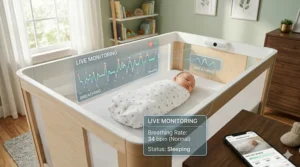
Here’s what separates Owlet from every other option on this list: the Dream Sock uses actual medical-grade pulse oximetry to measure your baby’s blood oxygen levels (SpO2) and pulse rate — the same technology used in hospital NICUs. That’s a real, quantitative health metric, not just motion detection. If readings fall outside preset ranges, you get an alert on your phone and a notification from the physical Base Station on your nightstand. You don’t have to be watching the app feed; the alert comes to you.
The Dream Sight camera handles 2K video with a 130-degree wide-angle lens and 4x zoom. Room temperature and humidity are tracked. Up to four caregivers can connect simultaneously — useful for grandparents on overnight duty.
Who should buy this? Parents with SIDS anxiety (which, honestly, is most first-time parents), families with premature babies, or anyone whose pediatrician has flagged respiratory concerns. The wearable sock requires sizing and nightly charging, which are genuine friction points — but the SpO2 data is something no contactless camera can replicate yet.
✅ FDA-cleared SpO2 + heart rate data
✅ 2K HD camera with wide-angle view
✅ Alerts even when you’re not watching the app
❌ Sock requires nightly charging and proper sizing
❌ Premium price for both hardware components
Price range: $350–$450 range | Available on Amazon (Gen 3 model B0FDT7KQTH).
3. Nanit Pro Smart Baby Monitor & Flex Stand — The Sleep Science Leader
Nanit built its reputation on sleep analytics, and the Pro model remains the gold standard for parents who want to understand their baby’s sleep patterns as much as monitor their safety. The 1080p overhead camera captures full-crib video, but the real value lives in the app: detailed breakdowns of sleep stages, time-to-sleep data, waking analysis, and long-term trend charts that actually help you optimize nap schedules.
The breathing monitoring works through Nanit’s Breathing Wear — a specially patterned swaddle or band that the overhead camera tracks for chest movement. It’s sensor-free in the sense that nothing touches your baby’s skin, though the Breathing Wear accessory is a separate purchase. Important distinction: Nanit tracks motion-based breathing, not SpO2. It will tell you if your baby has stopped moving; it won’t tell you their oxygen level. For most healthy full-term babies, that’s absolutely fine — but families with medical concerns should note the difference.
The Flex Stand is genuinely convenient, letting you move the camera between crib and pack-and-play without wall-mounting headaches. Two-way audio, night vision, temperature and humidity alerts, and sound/motion/cry notifications round out the feature set.
✅ Best-in-class sleep analytics app
✅ No wearable needed (with Breathing Wear)
✅ Easy setup with flexible stand
❌ Breathing band/swaddle sold separately for breathing monitoring
❌ Full feature access requires subscription
Price range: $250–$330 range | Available on Amazon.
4. Miku Pro Smart Baby Monitor — The Radar-Based Breathing Monitor
The Miku Pro sits in a fascinating middle ground: contactless breathing tracking that doesn’t rely on image processing. While most “contactless” monitors use AI cameras to watch for chest movement, Miku’s SensorFusion technology combines five different sensors to detect breathing through blankets, stuffed animals, and any sleep position. That means it works even when your baby has rolled over and their chest isn’t visible to the camera.
In practical terms, this is Miku’s killer feature. Parents who’ve tried camera-based breathing monitors have often hit the limitation of “baby shifted under a blanket, app lost breathing signal.” Miku doesn’t have that problem. Real-world customers report it staying accurate across the full first year and beyond — the company claims most families continue using it well past age three.
The 1080p camera, dual-band Wi-Fi (courtesy of Qualcomm wireless tech), two-way audio, and sleep analytics app are all solid. No subscription is required for core features. The wall mount is included.
Who should buy this? Parents who want contactless breathing monitoring with genuine technical robustness — especially those who tried camera-based breathing trackers and found them unreliable. At the $380–$420 range price point, it’s priced similarly to Owlet Dream Duo without the ongoing sock-charging ritual.
✅ SensorFusion works through blankets and any position
✅ No wearables, no charging, no repositioning
✅ No subscription for core monitoring
❌ No FDA clearance (contactless radar ≠ medical SpO2)
❌ Premium price without the visual sleep analytics depth of Nanit
Price range: $380–$420 range | Available on Amazon.
5. CuboAi Smart Baby Monitor 3 — The AI Safety Alert Specialist
CuboAi takes a different approach to the whole connected parenting devices category: instead of tracking vital signs, it uses computer vision to detect specific dangerous situations and alert you before they become emergencies. The “face-covered” alert is the headline feature — if a blanket or object obstructs your baby’s face, the AI flags it and sends a push notification within 10–15 seconds, even if your baby is completely still.
The New Model 3 upgrades to 2.5K QHD night vision, which is genuinely impressive in a dark nursery — the image quality improvement over 1080p is noticeable when you’re trying to read a face at 3 a.m. Rollover detection, customizable “danger zone” alerts, two-way audio, humidity sensor, and built-in lullabies are all included.
There’s an optional Premium subscription that unlocks extended video playback and additional sleep data. Without it, the core safety alerts function fine. If you skip the subscription, CuboAi actually becomes one of the better-value smart monitors in this price range.
Who should buy this? Parents whose primary anxiety is positional safety — face-covering, rollover — rather than oxygen levels. Also a strong choice for parents who already have a breathing wearable (like the Owlet Dream Sock standalone) and want to add a high-quality visual safety layer.
✅ Face-covered alert within 10–15 seconds
✅ 2.5K QHD night vision
✅ No subscription needed for core safety alerts
❌ No physiological data (heart rate, SpO2)
❌ Face-covered detection works best with overhead mounting position
Price range: $270–$310 range | Available on Amazon.
6. Philips Avent Premium Connected Baby Monitor (SCD973/37) — The Hybrid for Non-Tech Parents
The Philips Avent SCD973/37 might be the most thoughtfully designed product on this list for parents who are nervous about Wi-Fi dependency. It combines app monitoring (via the Philips Avent Baby+ app) with a physical 5″ HD parent unit that maintains a direct encrypted connection to the camera even without internet — which matters during router outages and travel.
The SenseIQ technology tracks breathing motion by analyzing millions of pixels per second to detect even the smallest chest movement — contactlessly, without wearables. Real-world reviews from early 2026 are glowing about this feature: the reassurance of watching a breathing indicator when baby is sleeping soundly is described as genuinely life-changing for anxious parents. The AI-powered cry translation feature (interpreting cries as “hungry,” “tired,” “uncomfortable”) is more hit-or-miss, per customer feedback.
No subscription is required, which makes the $330–$360 range price more palatable long-term than competitors that charge ongoing fees for the same data.
✅ Works without Wi-Fi via direct parent unit connection
✅ No subscription required
✅ SenseIQ contactless breathing tracking
❌ Cry translation feature is inconsistent per user reviews
❌ Bulkier setup than app-only monitors
Price range: $330–$360 range | Available on Amazon (model SCD973/37).
7. iBaby i20 Contactless Wellness Baby Monitor — The Smart Budget Pick
Don’t let the budget-friendly price mislead you — the iBaby i20 is doing something technically sophisticated. Using proprietary Yobi-PPG (photoplethysmography) technology combined with AI computer vision, it tracks breathing rate and heart rate completely contactlessly, without any wearable, and without a subscription fee. That combination at this price range is genuinely unusual in 2026.
The 1080p camera has 360° horizontal pan and 33° vertical tilt, AI-powered face-tracking that follows your crawling baby around the room, and over 1TB of storage capacity for video footage. Two-way audio, night vision, temperature monitoring, cry and safety alerts, and a 60-day return window are all included.
What most buyers overlook about the i20: its face-tracking isn’t just a gimmick. Once your baby becomes mobile, a fixed-position camera becomes frustrating quickly. The auto-tracking means you’re not constantly repositioning a wall-mounted device as your 7-month-old discovers the far corner of the crib.
The limitation to acknowledge honestly: Yobi-PPG contactless heart rate tracking hasn’t undergone the FDA clearance process that Owlet’s Dream Sock has. For healthy, full-term babies, this is a monitoring convenience tool, not a medical device. For families with elevated medical concerns, upgrade accordingly.
✅ Contactless breathing + heart rate with no subscription
✅ AI face-tracking follows mobile babies
✅ Excellent price-to-feature ratio
❌ No FDA clearance — contactless HR tracking not medical-grade
❌ 1080p resolution vs 2K/2.5K competitors
Price range: $150–$220 range | Available on Amazon.
How to Set Up Your Smart Crib Monitoring System the Right Way (Practical Setup Guide)
Half the frustration parents experience with these devices is avoidable with a little upfront preparation. Here’s what experience — and a lot of 2 a.m. troubleshooting calls I’ve read about — suggests you do before baby arrives.
Step 1: Install and test the camera at least two weeks early. Every single smart monitor on this list requires Wi-Fi setup, app pairing, and some form of calibration. Doing this while exhausted with a crying newborn is a special kind of nightmare. Do it at 2 p.m. on a Thursday when you have full cognitive function.
Step 2: Position the camera before deciding where it “should” go. The Nanit Pro and CuboAi are designed for overhead mounting — straight down onto the crib mattress — and their AI features only work well from that angle. Wall-mounted positions too far to the side reduce face-coverage and rollover detection accuracy by up to 30%, per CuboAi’s own documentation.
Step 3: Calibrate baseline data before you need it. The Miku Pro, iBaby i20, and Philips Avent SCD973/37 all build their alert thresholds around your baby’s specific baseline breathing rate. Let the system run for 48–72 hours before relying on the alert system — otherwise, you’ll get false alarms during the adjustment period.
Step 4: Set up caregiver sharing immediately. Every product here supports multiple users. Add your partner, your pediatrician’s recommended caregiver, and any overnight helpers on day one. Don’t wait until you desperately need backup at 4 a.m.
Step 5: Run a “night one” dry run. The night before you bring baby home, put a stuffed animal in the crib, turn on the monitor, and watch how the app responds during a normal evening. You’ll catch setup issues — camera angle, notification settings, Wi-Fi dead zones — before a real baby is involved.
Common mistake to avoid: disabling low-battery notifications on wearable devices like the Owlet Dream Sock. Parents who silence “battery alerts” as nuisances often wake up to find the sock has died and been unmonitored for two hours.
Real-World Scenarios: Which System Fits Your Family?
Every family’s anxiety profile and nursery budget is different. Here’s how I’d match parents to products.
The First-Time Parent with SIDS Anxiety (Budget: $350–$450): You want actual physiological data, not just motion detection. You’ll lie awake wondering if the camera really “saw” a breath. The Owlet Dream Duo Gen 3 is built for you. The FDA-cleared SpO2 data gives you numbers — real numbers — and the alert base station means you don’t have to watch the app feed to know your baby is okay.
The Exhausted Parent Who Wants Sleep More Than Data (Budget: $1,749+): You don’t want to check anything. You want the crib itself to handle the problem. The Cradlewise is your product. Its predictive soothing means your baby often never fully wakes — which means you never fully wake. Parents consistently report the Cradlewise returning 1–2 hours of sleep per night. At that value, the premium price becomes a straightforward math problem.
The Tech-Skeptical Parent Who Needs a Backup Connection (Budget: $330–$360): You’re worried about Wi-Fi dependency at 3 a.m. The Philips Avent SCD973/37’s parent unit maintains a direct encrypted connection without internet. You get app monitoring when it works and physical unit reliability when it doesn’t. Best of both.
The Budget-Conscious Parent With a Healthy Baby (Budget: $150–$220): The iBaby i20 delivers contactless breathing and heart rate monitoring, face-tracking, 1080p video, and no subscription. For healthy, full-term babies, it’s everything you need without the premium price tag.
The Parent Upgrading a Wearable with Visual Safety (Budget: $270–$310): You already own (or plan to own) an Owlet Dream Sock. Add the CuboAi Smart Monitor 3 as your visual layer. The face-covered and rollover alerts complement the physiological data from the sock perfectly — and together they cost less than the Owlet Dream Duo.
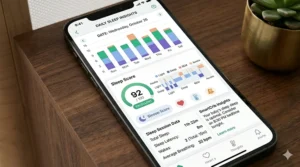
Smart Crib vs. Traditional Crib: Is the Technology Actually Worth It?
Let’s be honest about what these devices can and can’t do. According to research published via the National Institutes of Health (NIH), consumer infant monitors have not been proven to reduce SIDS rates. That’s an important distinction the marketing doesn’t always make clearly.
What smart monitoring does do well is give parents actionable information faster. A traditional baby monitor tells you your baby is crying — by definition, after the problem has already escalated. A connected parenting device like the Miku Pro or Cradlewise tells you breathing has slowed before crying starts, giving you a chance to intervene earlier.
| Factor | Traditional Crib + Basic Monitor | Smart Crib with App Monitoring |
|---|---|---|
| Real-time breathing data | ❌ None | ✅ Yes (varies by product) |
| Sleep pattern analytics | ❌ None | ✅ Comprehensive |
| Automatic soothing | ❌ Manual only | ✅ Cradlewise only |
| App remote access | ❌ None | ✅ From anywhere |
| Multiple caregiver access | ❌ None | ✅ 2–4 caregivers |
| Total setup cost | $300–$600 | $150–$1,999+ |
| Subscription required | ❌ No | Varies |
The data is clear: for parents who use the insights, smart monitoring genuinely changes behavior. A 2024 study referenced by Stanford Medicine found that parents with access to real-time sleep data adjusted bedtime routines more effectively and reported lower nighttime anxiety scores. The technology isn’t a medical device — but as a parental anxiety management and sleep optimization tool, it earns its price.
How to Choose the Best Smart Crib Monitoring System for Your Nursery
There are five factors that actually determine which product wins for your family. Everything else is marketing noise.
1. Breathing tracking method (and what you actually need from it) The single biggest decision. Wearable pulse oximetry (Owlet) gives you SpO2 — a real medical metric. Contactless radar/SensorFusion (Miku, Cradlewise) detects breathing movement without touching baby. Camera-based pixel tracking (Nanit, Philips Avent, CuboAi) watches for chest motion but can be blocked by blankets or position changes. Know which one matches your risk profile before comparing prices.
2. Subscription costs over 12–24 months The upfront price is only part of the story. Add two years of subscriptions before comparing total cost. Nanit’s basic plan runs around $10–$20/month for extended features. CuboAi’s Premium subscription adds up. The iBaby i20 and Philips Avent SCD973/37 have zero ongoing fees — which meaningfully improves their long-term value.
3. How long the product grows with your child The Cradlewise handles birth to 24 months and then requires a new crib. Most camera monitors have no age limit — the Miku Pro is commonly used past age three. If you’re planning a second child, a camera monitor shared between rooms is more economical than another smart crib.
4. Wi-Fi dependency and backup connectivity A monitor that only works on Wi-Fi is a monitor that fails during router outages at 2 a.m. The Philips Avent SCD973/37’s direct encrypted connection is the only product in this group with a genuine offline fallback. For travel or power-grid-anxious households, that matters.
5. Ease of setup for sleep-deprived parents Nanit is widely praised for its straightforward app setup. The Owlet Dream Sock has a learning curve for proper sizing. The Cradlewise requires professional delivery and installation. If you’re going solo — single parent or one partner who handles all setup — weight this factor heavily.
Common Mistakes When Buying Smart Baby Monitoring Systems
I’ve seen these patterns show up repeatedly in parent forums, Amazon review sections, and pediatric-tech communities. Don’t fall into them.
Mistake #1: Assuming all “breathing monitors” track the same thing. They don’t. SpO2 wearable, radar sensor, camera pixel tracking, and audio/movement detection are four fundamentally different technologies. Each has different accuracy profiles and different use cases. Do not compare price tags without first comparing methods.
Mistake #2: Buying for features you won’t use. A parent who wakes up every 45 minutes to check the app anyway isn’t benefiting from real-time health tracking — they need automatic soothing (Cradlewise). A parent who sleeps soundly and just wants a backup alert system doesn’t need AI sleep coaching.
Mistake #3: Skipping the subscription math. A “budget” $200 monitor with a $20/month subscription costs $680 over two years. The “expensive” $350 monitor with no subscription costs $350 over the same period. Run the numbers.
Mistake #4: Relying solely on the monitor for SIDS prevention. The CDC’s safe sleep guidelines are the primary protection — back sleeping on a firm flat surface, no loose bedding, smoke-free environment, room-sharing without bed-sharing. A monitor is a supplement to safe sleep practices, not a substitute for them.
Mistake #5: Not testing alert sensitivity before going live. Every monitor on this list has adjustable notification sensitivity. The factory defaults often generate too many false alerts (causing parents to disable notifications entirely — the worst outcome) or too few. Spend 30 minutes in the app adjusting these settings during the pre-baby setup period.
FAQ
❓ Does a smart crib with app monitoring actually prevent SIDS?
❓ What is the best smart crib with app monitoring for newborns?
❓ Do smart baby monitors with crib monitoring systems require Wi-Fi?
❓ Is contactless breathing monitoring on a vital signs tracking bassinet as accurate as a wearable?
❓ How long can I use a smart crib with app monitoring before needing to upgrade?
Conclusion: Sleep Is Worth Protecting — for Both of You
Here’s what nobody tells new parents about baby monitoring: the technology isn’t really about the baby. Healthy babies overwhelmingly sleep fine. The technology is about you — your ability to sleep, function, and parent effectively during the most cognitively demanding period of your adult life.
A smart crib with app monitoring that gives you breathing confirmation at 2 a.m. means you might actually stay in bed instead of padding down the hallway for the fourth time. The Cradlewise that senses your baby stirring and gently bounces them back to sleep means you might get a 4-hour block instead of a 2-hour block. The Owlet Dream Sock that sends an alert only when readings fall outside preset ranges means you might check your phone once instead of thirty times.
That’s the real value proposition. Not tech specs. Not subscription tiers. Sleep — yours and your baby’s — is the product these devices are all ultimately selling.
My top pick for most families is the Owlet Dream Duo Gen 3 in the $350–$450 range for its combination of FDA-cleared physiological data, strong visual monitoring, and genuine alert reliability. For families who can invest in the full nursery solution, the Cradlewise reframes the entire question. And for budget-conscious parents with healthy, full-term babies, the iBaby i20 delivers remarkably sophisticated real time baby tracking at a fraction of the premium price.
Check current pricing and availability for all seven products on Amazon — and remember: the best connected parenting device is the one you’ll actually use, trust, and sleep through.
✨ Don’t Miss These Exclusive Deals!
🔍 Take your nursery setup to the next level with these carefully selected products. Click any highlighted product name to check current pricing and availability on Amazon. These tools will help you create the peace-of-mind sleep environment your family deserves!
Recommended for You
- Best Crib With Built In Camera: 7 Top Picks for 2026
- 7 Best Heated Cooling Crib Mattress for Year-Round Comfort 2026
- 7 Best Cooling Crib for Summer 2026 – Safe Sleep Solutions
Disclaimer: This article contains affiliate links. As an Amazon Associate, I earn from qualifying purchases. If you purchase products through these links, we may earn a small commission at no additional cost to you.
✨ Found this helpful? Share it with your friends! 💬🤗
