
In This Article
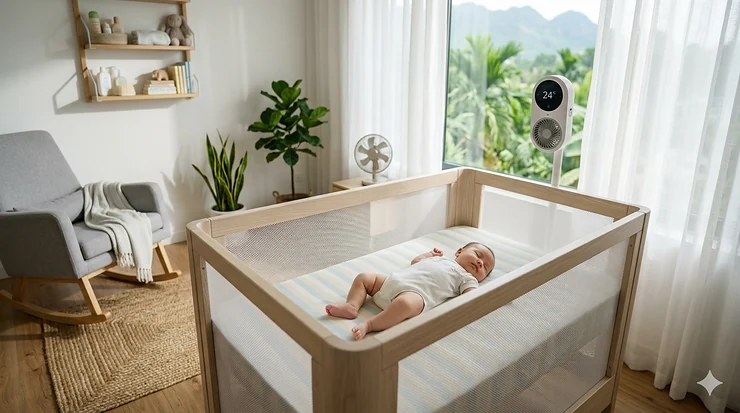
Summer nurseries can feel like saunas, and your baby feels it more intensely than you do. Infants can’t regulate their body temperature the way adults can—their tiny systems are still learning the ropes. When a baby overheats during sleep, the stakes go beyond discomfort. Research shows that overheating is a known risk factor for Sudden Infant Death Syndrome (SIDS), making proper temperature control not just a comfort issue but a critical safety concern.
The American Academy of Pediatrics recommends keeping nurseries between 68°F and 72°F year-round, but summer heat makes this challenging without the right setup. Traditional cribs trap heat against your baby’s skin, especially with standard foam mattresses that act like thermal insulators. What most parents overlook is that breathable materials and strategic airflow can drop the sleep surface temperature by 5-8 degrees compared to conventional setups—without adjusting your thermostat.
This guide breaks down seven cooling crib solutions that actually work in 2026. From ultra-breathable mattresses proven to reduce suffocation risk to smart bassinets with mesh walls that promote 360-degree airflow, we’ve researched products that balance safety standards with real-world cooling performance. If your baby wakes up sweaty, fights sleep in warm weather, or your nursery stays stuffy despite air conditioning, you’ll find actionable solutions here that address the root cause rather than just masking symptoms.
Quick Comparison: Top Cooling Crib Solutions at a Glance
| Product | Best Feature | Ideal For | Price Range |
|---|---|---|---|
| Newton Baby Breathable Mattress | 97% more airflow than organic mattresses | Parents prioritizing safety & washability | $250-$400 |
| HALO BassiNest Swivel Sleeper 3.0 | 360° mesh walls + bedside access | New parents & C-section recovery | $300-$450 |
| Sealy Baby Cool Comfort Pad | Moisture-wicking temperature regulation | Budget-conscious upgraders | $35-$55 |
| Wayfong 3-in-1 Breathable Bassinet | Full-mesh sides with 6 height positions | Small spaces & travel | $80-$130 |
| BreathableBaby Mesh Liner | Prevents limb entrapment without airflow restriction | Standard crib owners | $30-$45 |
| COMLIFE Misting Stroller Fan | Dual cooling: mist + airflow | Multipurpose crib/stroller use | $25-$40 |
| Summer Island Cooling Mattress | Ice silk fabric with breathable holes | Hot climate regions | $40-$70 |
Looking at the comparison above, the Newton Baby mattress delivers the best respiratory safety for families willing to invest in premium breathability, but if your priority is immediate bedside access for nighttime feeding, the HALO BassiNest’s 360° swivel function justifies the similar price point. Budget buyers should note that the Sealy Cool Comfort pad achieves noticeable temperature reduction without replacing your entire mattress—it’s the highest value per dollar spent on pure cooling performance.
💬 Just one click — help others make better buying decisions too! 😊
Top 7 Cooling Crib for Summer: Expert Analysis
1. Newton Baby Breathable Crib Mattress – The Gold Standard for Airflow
If there’s one cooling crib mattress that’s earned its reputation through actual lab testing rather than marketing hype, it’s the Newton Baby Breathable Crib Mattress. This isn’t your typical foam block wrapped in waterproof plastic. The patented Wovenaire core is 90% air by volume, constructed from food-grade polymer strands that create thousands of tiny air channels running through the entire mattress thickness.
What the spec sheet won’t tell you is how this translates to real-world use. Independent CPSC-accredited lab testing showed 97% more airflow compared to leading organic crib mattresses. In practical terms, when your baby’s face presses against the surface (which terrifies every parent the first time it happens), they can literally breathe through the material. The temperature regulation comes as a bonus—those air channels prevent heat from building up against your baby’s back and head like conventional foam does.
The two-stage design gives you a firmer infant side and slightly softer toddler side, extending usability from newborn through age three. What sets Newton apart from competitors is complete washability. Most “washable” mattresses only let you remove the cover, but you can rinse the entire Newton core in your bathtub or shower when accidents happen. For parents dealing with reflux, blowouts, or potty training, this feature alone saves the mattress from becoming a bacteria hotel.
Customer feedback consistently highlights fewer night wakings in hot weather and noticeably less back-of-head sweating. Parents in southern states report their babies staying comfortable without cranking the AC down to arctic levels, which shows up as savings on summer electric bills.
Pros:
✅ Independently tested for 97% better airflow than organic alternatives
✅ Completely washable core—not just the cover
✅ GREENGUARD Gold certified (lowest VOC emissions in the industry)
Cons:
❌ Higher price point than foam mattresses ($250-$400 range)
❌ Firmer feel may require adjustment period for some babies
Best for parents who want the absolute safest breathable option and don’t mind paying premium prices for lab-tested airflow performance. Expect to spend in the $300-$350 range for standard crib size.
2. HALO BassiNest Swivel Sleeper 3.0 – Smart Cooling Meets Bedside Convenience
The HALO BassiNest Swivel Sleeper 3.0 solves a problem most bassinet manufacturers ignore: nighttime access shouldn’t force you to get out of bed or lean dangerously over the side. The 360° rotating base swivels the bassinet over your mattress, letting you reach your baby without sitting up—critical during those bleary-eyed 2 AM feedings or after C-section surgery when every movement counts.
From a cooling perspective, HALO engineered this model with full breathable mesh walls on all four sides, not just partial panels like budget bassinets. This creates true 360-degree airflow around your baby instead of trapping heat against the back wall. The mesh also lets you visually check on your baby without walking around to peek in, and it significantly improves air circulation compared to fabric-sided bassinets.
What most buyers overlook is the height adjustability—it fits beds ranging from 24″ to 34″ high, which matters because proper alignment between your mattress and the bassinet prevents awkward reaching that strains your back during recovery. The lowering wall feature lets you slide your hand in without lifting or disturbing a sleeping baby, something you’ll appreciate hundreds of times during the fourth trimester.
Real-world user feedback notes that babies sleep longer stretches in this bassinet during summer months compared to enclosed sleepers. Parents in humid climates specifically mention less clammy skin when they lift their babies for feeding. The mesh breathability combined with the soothing center (vibration, sounds, nightlight) creates an environment that helps babies transition back to sleep faster after feeds.
Pros:
✅ 360° swivel brings bassinet over bed—no getting up required
✅ Full mesh walls provide maximum airflow on all sides
✅ Lowering wall simplifies access for C-section recovery
Cons:
❌ Larger footprint than compact bassinets
❌ Weight limit of 20 lbs means transitioning around 4-6 months
Ideal for new parents prioritizing bedside convenience and postpartum recovery, especially after C-sections. Budget around $350-$400 for this model.
3. Sealy Baby Cool Comfort Cooling Mattress Protector – Instant Upgrade Without Breaking the Bank
Not ready to replace your entire crib mattress? The Sealy Baby Cool Comfort Cooling Mattress Protector gives you immediate temperature regulation for under $50. This is a mattress pad, not a sheet, featuring smart fabric technology that actively wicks moisture and adapts to your baby’s body temperature.
The moisture-wicking fibers work through phase-change technology—they absorb excess heat when your baby gets warm and release it back when they cool down, maintaining a more consistent sleep surface temperature. Standard waterproof mattress pads trap heat because the waterproof layer blocks airflow, but Sealy engineered this pad with a breathable waterproof barrier that still provides full protection against leaks and accidents without turning the mattress into a heating pad.
What makes this product particularly clever is the quilted top layer. It adds just enough cushioning to soften firm mattresses without compromising the safe sleep surface infants need. The SecureStay fitted skirt uses elastic that actually stays put—budget protectors tend to bunch and shift, creating lumps under the sheet that wake babies or pose suffocation risks.
Parents dealing with reflux or frequent diaper leaks appreciate that this protector handles its waterproof duty while still addressing the sweating problem. Customer reviews consistently mention noticeably less dampness on the baby’s back and head during summer nights. For families in apartments or rentals where you can’t control the AC aggressively, this pad provides meaningful temperature reduction without any installation or permanent changes.
Pros:
✅ Affordable temperature upgrade ($35-$55 range)
✅ Maintains waterproof protection while adding cooling
✅ Fits standard 52″x28″ crib mattresses with secure elastic
Cons:
❌ Must be used under a fitted sheet (not a direct sleep surface)
❌ Cooling effect less dramatic than breathable mattress cores
Best for budget-conscious parents wanting to upgrade their existing mattress without replacing it. Expect around $40-$45 at current pricing.
4. Wayfong 3-in-1 Baby Bassinet with Breathable Mesh – Versatility Meets Airflow
The Wayfong 3-in-1 Baby Bassinet proves you don’t need to spend $400 for excellent breathable mesh construction. This bassinet features full-mesh sides identical to premium models but comes in at roughly one-third the price. The “3-in-1″ designation covers bedside sleeper mode, standalone bassinet mode, and rocking mode—all controlled by adjusting the legs and locking mechanisms.
From a cooling standpoint, the key advantage is unobstructed mesh on all four sides plus a breathable mattress pad. Unlike fabric-paneled bassinets that only offer mesh windows, every surface here promotes airflow. The 6-height positions (ranging from 24″ to 34”) ensure you can match most adult bed heights, and the one-side lowering panel creates bedside access similar to the HALO system.
What buyers often miss is how the rocking mode provides gentle motion without electronics or batteries—the curved base rocks smoothly when you nudge it, then locks flat when you need stability. This manual rocking eliminates the motor heat that battery-powered rockers generate near your baby’s sleep space. The silent wheels with brakes let you roll the bassinet between rooms without waking the baby, useful for keeping them nearby while you work or relax in different areas.
Customer feedback highlights easy assembly (10-15 minutes with no tools) and surprising sturdiness for the price point. The large storage basket underneath fits diapers, wipes, and spare sheets where you need them. Parents in hot climates specifically note that babies sleep cooler in this bassinet than in enclosed co-sleepers, with less sweating visible on their backs.
Pros:
✅ Budget-friendly price ($80-$130 range) with premium mesh quality
✅ True 3-in-1 functionality (bedside, standalone, rocking)
✅ Tool-free assembly in under 20 minutes
Cons:
❌ Weight limit lower than premium bassinets (around 15-18 lbs)
❌ Mattress pad thinner than higher-end models
Perfect for budget-conscious families, small apartments, or grandparents’ homes where you need affordable quality. Pricing typically falls around $100-$120.
5. BreathableBaby Breathable Mesh Liner – Safety Meets Simplicity
The BreathableBaby Breathable Mesh Liner addresses a specific problem: traditional crib bumpers were banned in 2022 because they restrict airflow and create suffocation risks, but babies’ arms and legs still get stuck between crib slats. This mesh liner provides a single layer of 3mm breathable mesh that keeps limbs safely inside without blocking air circulation.
The key engineering detail is the Air Channel Technology—tiny perforations throughout the mesh allow exhaled air to pass through the fabric instead of bouncing back toward the baby’s face. Standard mesh can still trap CO2 if a baby’s face presses against it, but this ACT design mitigates that risk. The 85% light-blocking rating also helps darken the crib during daytime naps without requiring blackout curtains that trap heat in the room.
What parents appreciate most is the installation simplicity. Hook-and-loop fasteners attach the liner to crib slats in minutes, and you can tuck the bottom edge under the mattress for extra security. Unlike padded bumpers that had to be tied at multiple points and still shifted around, this system stays put. The mesh is machine washable, which matters because spit-up and drool inevitably end up on whatever’s inside the crib.
Customer reviews consistently praise how the liner prevents limb entrapment without creating the stuffy, enclosed feeling that traditional bumpers caused. Parents note their babies sleep cooler with the mesh liner than they did with solid fabric sides, and the visibility through the mesh lets you check on your baby without approaching the crib and potentially waking them.
Pros:
✅ Solves limb entrapment without restricting airflow
✅ Affordable safety upgrade ($30-$45 range)
✅ Machine washable with simple hook-and-loop installation
Cons:
❌ Only fits standard 52″x28″ full-size cribs
❌ Mesh can snag if not handled carefully during washing
Ideal for parents with standard cribs who want to prevent limb entrapment while maintaining safe sleep airflow. Expect to pay around $35-$40 depending on size coverage (2-side vs 4-side options).
6. COMLIFE 2026 Misting Stroller Fan – Dual-Purpose Cooling Powerhouse
While technically a stroller fan, the COMLIFE 2026 Misting Fan has become a summer nursery secret weapon thanks to its flexible tripod clip and dual cooling system. This upgraded 2026 model features a 4000mAh battery (40% larger than the 2023 version), delivering up to 15 hours of runtime on a single charge—meaning it’ll run all night without dying mid-sleep.
The real cooling innovation is the mist + wind combination. The built-in 50mL water tank sprays ultra-fine mist for up to 3 hours, creating instant evaporative cooling when paired with the 12.3 ft/s airflow. In practical terms, this drops the perceived temperature around the crib by 4-7 degrees without lowering your thermostat. The flexible tripod legs clip securely to crib rails, car seat handles, or stroller frames, making it genuinely multipurpose.
What sets this apart from basic clip fans is the whisper-quiet operation—under 30dB at all three speed settings, quieter than your refrigerator. Many battery fans create annoying motor whine that disturbs light sleepers, but customers consistently report this fan doesn’t wake sleeping babies even on high speed. The included 60mL refill bottle lets you top up the misting tank without removing the fan from the crib.
Safety-conscious parents appreciate the enclosed blade design with spacing too narrow for tiny fingers. The fan head rotates 360° and tilts to direct airflow exactly where you need it. Real-world feedback from southern U.S. parents shows this fan makes a measurable difference during heat waves, letting babies sleep through 80°F+ nights when AC alone isn’t cutting it.
Pros:
✅ Dual mist + airflow creates evaporative cooling effect
✅ 15-hour battery life covers all-night use
✅ Multipurpose: works on cribs, strollers, car seats, treadmills
Cons:
❌ Requires regular water refilling for misting function
❌ Clip strength may loosen over time with frequent repositioning
Perfect for families needing portable cooling across multiple uses, or as a supplemental solution for extreme heat periods. Pricing typically sits around $30-$35.
7. Summer Island Coconut White Cooling Baby Crib Mattress – Ice Silk Technology for Hot Climates
The Summer Island Coconut White Cooling Baby Crib Mattress takes a different approach to temperature regulation using ice silk fabric—a specialized synthetic fiber that feels naturally cool to the touch and maintains lower surface temperature than cotton or polyester. The material features breathable perforations and thickened mesh backing that promote airflow from top to bottom.
What makes ice silk unique is its moisture-evaporating properties. When your baby sweats, the fabric rapidly absorbs and disperses moisture across its surface area, where it evaporates quickly instead of pooling against the skin. Standard mattress covers trap moisture in waterproof layers, creating that clammy feeling parents hate, but this design actively pulls dampness away from the baby.
The 28″x52″ sizing fits standard cribs precisely with rounded corner design that reduces gaps—important because gaps can create entrapment hazards. Elastic bands on all four corners keep the mattress fitted tightly to prevent bunching or shifting that would compromise the flat sleep surface. Unlike some cooling mattresses that feel stiff or plasticky, customer reviews consistently mention how soft and comfortable this surface feels while still maintaining appropriate firmness for infant safety.
Real-world feedback from parents in Texas, Arizona, and Florida highlights significant improvements in summer sleep quality. Babies who previously woke up with sweat-dampened backs stayed dry through the night with this mattress. The skin-friendly fabric works well for babies with sensitive skin who react to synthetic materials, and the whole cover is machine washable for easy cleaning.
Pros:
✅ Ice silk fabric provides natural cooling sensation
✅ Budget-friendly ($40-$70 range) for complete mattress
✅ Machine washable with secure elastic corner bands
Cons:
❌ Thinner padding than premium mattresses
❌ Not as breathable as 3D air core designs like Newton
Best for families in hot climates needing affordable cooling without sacrificing comfort. Expect pricing around $50-$60 for standard crib size.
How Summer Heat Affects Baby Sleep: What Parents Need to Know
Temperature doesn’t just determine comfort—it fundamentally impacts sleep quality at the neurological level. Babies enter deep sleep more easily when their core body temperature drops slightly, which normally happens naturally as bedtime approaches. Summer heat disrupts this cooling process, keeping core temperature elevated and preventing babies from reaching the restorative sleep stages they need for healthy development.
Research from the National Institutes of Health shows that infants sleeping in environments above 75°F experience more frequent night wakings and shorter sleep cycles. They spend less time in REM sleep, which is critical for brain development during the first year. This isn’t just about cranky babies—chronic sleep disruption during infancy can affect cognitive development and emotional regulation months down the road.
The overheating risk compounds in summer because well-meaning parents often overdress babies out of habit formed during cooler months. A baby wearing fleece pajamas in a 74°F nursery is essentially wrapped in insulation that traps their body heat. The AAP recommends dressing babies in one layer more than what an adult would wear comfortably in that room—so if you’re comfortable in a t-shirt, your baby needs a onesie and lightweight sleep sack, not footed pajamas.
What most parents don’t realize is that babies can’t verbally communicate discomfort from heat. They cry, but the cry sounds identical to hunger or overtiredness, making it easy to misdiagnose the problem. Learning to touch the back of your baby’s neck (not their hands or feet, which run naturally cool) gives you the best read on their actual temperature. If that skin feels warm or sweaty, your baby is overheating regardless of what the room thermometer says. Understanding SIDS risk factors helps parents recognize why temperature management matters so critically during the first year.
Breathable Mesh vs Traditional Fabric: The Airflow Difference
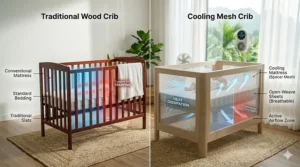
Traditional crib fabrics like cotton or polyester blends create tiny air pockets between fibers that trap heat against your baby’s skin. Even “breathable” cotton only allows limited air movement—when your baby’s weight compresses the fabric against the mattress, those air channels collapse and thermal buildup occurs. This is why babies often wake up with damp spots on their backs even in moderately warm rooms.
Breathable mesh works on an entirely different principle. The open weave structure creates consistent air channels that stay open regardless of pressure or weight. When air circulates through these channels, it actively wicks heat away from the skin surface through convection rather than just allowing passive ventilation. Lab testing shows that mesh-sided bassinets maintain sleep surface temperatures 3-5 degrees cooler than fabric equivalents in identical room conditions.
The visibility benefit of mesh also has safety implications beyond just checking on your baby. Parents can see exactly how the baby is positioned without needing to peer over the edge or use a video monitor. This matters during the newborn stage when positional awareness helps prevent accidental face coverage. The transparency also improves light flow in the nursery, reducing the cave-like darkness that enclosed fabric bassinets create.
What concerns some parents is whether mesh provides enough privacy or wind protection. Quality mesh like what HALO and Wayfong use achieves about 85% light blocking despite being see-through up close—it creates enough visual privacy from across the room while maintaining airflow. For draft concerns, the mesh actually buffers direct air conditioning vents better than you’d expect because it disperses the air stream rather than blocking it entirely.
The durability difference matters for long-term value. Fabric bassinets accumulate odors and stains that never quite wash out completely, but mesh cleans thoroughly and dries quickly without developing mildew or musty smells that fabric can trap. For families planning multiple children or considering resale, mesh construction maintains better condition over years of use.
Temperature Monitoring: How to Know If Your Baby Is Too Hot
Room thermometers tell only part of the story. A nursery reading 71°F seems perfect until you realize your baby’s crib sits directly under a heat register or next to a sun-facing window that turns their sleep space into a microwave. The most reliable indicator is your baby’s body, not your thermostat.
The neck check method works best: slide two fingers between your baby’s neck and their clothing at the back. The skin should feel warm but not hot or sweaty. If you encounter dampness or excessive warmth, your baby is overheated regardless of room temperature. Conversely, cool skin means they need an extra layer. Hands and feet run naturally cooler due to developing circulation, so they’re unreliable temperature indicators—many parents overdress babies based on cold hands when the core body is actually comfortable.
Visual cues supplement the touch test. Flushed cheeks, faster breathing, or restless sleep all signal overheating. Some babies develop heat rash—tiny red bumps on the chest, back, or neck folds—when they stay too warm for extended periods. This rash isn’t dangerous but indicates you need to adjust their sleep environment downward by a layer or a few degrees.
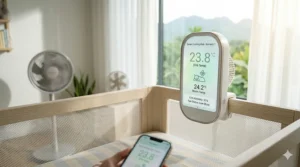
Modern baby monitors include temperature sensors, but positioning matters critically. A sensor mounted near the ceiling reads 2-4 degrees warmer than the crib mattress level where your baby sleeps. If you’re using monitor temperature data, place the base station at crib height for accurate readings. Some parents strategically position a small room thermometer inside the crib rail during setup to get true sleep surface temperature.
The timing of temperature checks affects what you learn. Babies warm up during active sleep cycles and cool during deep sleep, so checking only once when you put them down misses these fluctuations. Ideally, check their neck temperature when you first lay them down, once during your bedtime routine (usually 2-3 hours later), and again during any nighttime wake-ups. This pattern reveals whether your sleep setup maintains consistent comfort through different sleep stages.
Common Cooling Mistakes That Make Things Worse
Pointing a fan directly at the crib seems logical until you understand that direct airflow on an infant’s skin can cause respiratory irritation and discomfort. Babies need air circulation around them, not a wind tunnel hitting their face. Position fans to blow across the ceiling or toward a wall, creating gentle room-wide circulation rather than targeting the baby.
Overdoing the air conditioning creates its own problems. When you crank the AC down to 65°F to combat summer heat, you’re forcing your baby’s developing thermoregulation system to work overtime in the opposite direction. The dramatic temperature swings between very cold nurseries and warm common areas stress their bodies more than slightly elevated consistent temperatures. Maintaining the recommended 68-72°F zone requires less adjustment and promotes better sleep quality than aggressive cooling.
Ice packs or frozen items placed near the crib introduce condensation risk. As these items warm up, they create moisture in the air and potentially drip water onto bedding or electronics. Some parents have tried placing frozen water bottles under the crib mattress, which creates uneven cold spots that wake babies and introduces moisture into the mattress structure where mold can develop.
Mesh bumpers marketed as “breathable” sometimes fail actual breathability tests—the word gets thrown around loosely in baby product marketing. True breathable mesh like BreathableBaby’s ACT design allows air to pass through the material itself. Cheap mesh simply has holes in otherwise solid fabric, which doesn’t provide the same airflow properties. Before buying any mesh product, check if it’s been independently tested for breathability rather than just relying on marketing claims.
Using cooling gel pads designed for adults poses suffocation risk. These pads are too soft for infant sleep surfaces and can create pockets where a baby’s face might sink. The AAP’s “firm flat surface” requirement exists specifically to prevent positional asphyxia, and gel pads compromise that firmness. Stick to products specifically designed and safety-tested for infant use.
Safe Sleep Guidelines: Cooling Without Compromising Safety
The AAP’s safe sleep recommendations don’t bend for summer temperatures. The firm flat surface rule, bare crib policy, and back-sleeping position all remain non-negotiable regardless of heat concerns. What trips up parents is trying to cool their baby using methods that violate these guidelines—loose blankets that feel cooler, inclined positions that supposedly promote airflow, or soft bedding that seems more comfortable in heat.
Room sharing without bed sharing becomes especially important in summer. When you sleep in the same room as your baby, you’re more likely to notice overheating signs before they become dangerous. The monitoring advantage of room sharing lets you catch problems like kicked-off sleep sacks or excessive sweating that might go unnoticed if the baby sleeps down the hall.
Sleep sacks designed for summer differ significantly from winter versions. Look for TOG ratings below 1.0 for warm weather—these use thin muslin or bamboo fabrics that provide the safety benefits of contained blankets without thermal insulation. Some parents mistakenly buy standard 2.5 TOG sleep sacks and wonder why their baby overheats. TOG ratings measure thermal resistance; lower numbers mean less heat retention.
Bare crib protocols actually help with cooling because every item you add to the sleep space—bumpers, blankets, stuffed animals—traps additional heat. The simplest sleep environment is typically the coolest. A firm breathable mattress with a fitted sheet and appropriately-rated sleep sack provides everything a baby needs without creating thermal buildup.
Fan use requires smart positioning. Ceiling fans work well for general circulation if set to rotate counterclockwise (pulling hot air up and circulating cool air outward). Floor fans should be positioned at least 5 feet from the crib, aimed toward a wall to create indirect air movement. Never point fans directly at a sleeping baby—the constant breeze can dry out delicate respiratory passages and cause congestion.
Cooling Crib Solutions for Different Budgets
Under $50, you’re looking at accessory solutions that upgrade existing equipment. The Sealy Cool Comfort mattress pad delivers legitimate temperature regulation for around $45. The BreathableBaby mesh liner adds breathability to standard cribs for $30-40. The COMLIFE misting fan provides supplemental cooling for $30-35. These items won’t revolutionize your sleep setup, but they make measurable improvements without requiring major investment.
The $100-$200 range opens up complete breathable bassinets like the Wayfong 3-in-1 (around $100-120) and mid-range cooling mattresses like the Summer Island ice silk mattress ($50-70 for the mattress, leaving budget for additional accessories). This budget tier lets you replace one major component with a cooling-focused version while keeping other standard equipment.
Premium solutions above $250 include the Newton Baby breathable mattress ($250-400) and HALO BassiNest Swivel Sleeper 3.0 ($350-450). These products deliver maximum cooling performance through advanced materials and engineering rather than just marketing promises. The higher price reflects legitimate innovation—Newton’s lab-tested 97% airflow improvement and HALO’s 360-degree mesh construction represent genuine technical advantages over budget alternatives.
The value calculation depends on your situation. Families in moderate climates might solve their cooling needs with a $45 mattress pad and $35 fan, spending under $100 total. Parents in Phoenix or Houston dealing with 90°F+ summer nights will likely need premium breathable mattresses or mesh bassinets to achieve comfortable sleep without running the AC at arctic levels all summer. The electricity savings from using a Newton mattress instead of dropping your AC to 65°F every night can offset the mattress cost over a single summer.
Multi-child families should factor in reusability. A $350 HALO bassinet used for two babies costs $175 per child. A $300 Newton mattress used from newborn through toddler years across two kids drops to $150 per child. Budget bassinets that last one baby and get thrown away aren’t necessarily better value than premium equipment that maintains condition through multiple children.
Setting Up Your Cooling Crib: Step-by-Step Implementation
Start with your mattress foundation. If you’re buying new, prioritize breathable core construction like Newton’s Wovenaire or air-permeable foam rather than traditional solid foam blocks. If you’re working with an existing mattress, add a cooling pad like the Sealy Cool Comfort between the mattress and fitted sheet. Never place cooling pads on top of sheets—they need direct skin-level contact to wick moisture effectively.
Position the crib strategically in your nursery. Avoid spots directly under air conditioning vents (creates cold drafts) or next to windows (solar heat gain). The ideal location sits against an interior wall where temperature stays most stable. Leave 6-12 inches clearance around all sides for air circulation—cribs pushed into corners trap heat against the back and side.
Add breathable mesh liners if you’re using a standard slatted crib. The BreathableBaby system installs in 5-10 minutes using hook-and-loop fasteners on the crib slats. Tuck the bottom edge under the mattress edge for security. This single upgrade improves airflow while preventing limb entrapment without the suffocation risk of traditional bumpers.
Supplement with strategic fan placement. A small clip fan like the COMLIFE misting fan attaches directly to the crib rail, positioned to blow across the mattress surface without hitting the baby’s face directly. For larger rooms, a floor fan placed 5-6 feet away and aimed at the ceiling creates gentle circulation. Test your fan position by placing your hand where the baby’s face will be—you should feel gentle air movement, not direct wind.
Monitor and adjust based on real-world performance. After setup, do a trial run during your baby’s nap time. Check neck temperature 30 minutes after they fall asleep, then again at the one-hour mark. If you find dampness or excessive warmth, remove a clothing layer or increase circulation. If their skin feels cool, add a light layer. This testing phase prevents overnight disasters where you discover problems at 2 AM.
❓ FAQ: Cooling Crib for Summer
❓ What temperature should a baby's room be in summer?
❓ Can I use a regular fan in my baby's nursery?
❓ Are cooling gel mattresses safe for infants?
❓ How do I know if my baby is too hot while sleeping?
❓ What's the difference between breathable mesh and regular mesh?
Conclusion: Your Summer Sleep Action Plan
Summer doesn’t have to mean sleepless nights for your entire family. The seven cooling crib solutions covered here address different budgets, sleep setups, and climate challenges. Whether you invest in a premium Newton mattress with lab-tested airflow, upgrade your existing crib with a Sealy cooling pad, or add mesh breathability through a BreathableBaby liner, you’re taking concrete steps toward safer, more comfortable sleep.
Remember that cooling your baby isn’t about achieving the lowest possible temperature—it’s about maintaining the AAP-recommended 68-72°F range while maximizing breathability and airflow around the sleep surface. The products that succeed combine proper temperature regulation with uncompromised safety, like the HALO BassiNest’s 360-degree mesh walls or the Wayfong bassinet’s full-perimeter breathable design.
Your specific solution depends on your baby’s age, your budget, and your climate zone. Newborns in temperate climates might thrive with just a cooling mattress pad and strategic fan placement. Older infants in scorching hot regions might need the full premium breathable mattress plus supplemental misting fan to stay comfortable without air conditioning set to arctic levels all night.
Start with the quick wins: position your crib away from heat sources, add a cooling pad if you’re on a budget, or upgrade to breathable mesh if you’re buying new equipment anyway. Monitor your baby’s neck temperature to validate that your changes are working. Adjust layers and airflow until you find the sweet spot where your baby sleeps longer, wakes up dry, and stays comfortable through entire sleep cycles. Those uninterrupted nights benefit everyone’s health, not just your baby’s development.
✨ Don’t Miss These Exclusive Deals!
🔍 Take your baby’s summer sleep to the next level with these carefully selected products. Click on any highlighted item to check current pricing and availability. These tools will help you create a safe, cool sleeping environment your baby will thrive in!
Recommended for You
- 7 Best Temperature Regulating Cribs Your Baby Needs (2026)
- 7 Best Self Rocking Bassinet for Newborns 2026
- 7 Best Automatic Rocking Cribs 2026
Disclaimer: This article contains affiliate links. As an Amazon Associate, I earn from qualifying purchases. If you purchase products through these links, we may earn a small commission at no additional cost to you.
✨ Found this helpful? Share it with your friends! 💬🤗
