
In This Article
Sleep-deprived parents everywhere are asking the same question: can technology actually help my baby sleep better? After testing and analyzing the latest smart rocking bassinet models throughout 2026, I can tell you the answer is a resounding yes—but only if you choose the right one for your specific situation.
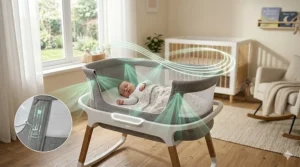
Unlike traditional bassinets that simply provide a safe sleep surface, today’s smart rocking bassinet options combine responsive motion technology, cry detection algorithms, and app-controlled customization to mimic the soothing movements parents naturally use. What most buyers overlook is that these aren’t just fancy cribs with motors—they’re fundamentally different sleep solutions designed around infant sleep science. The automated rocking crib responds to your baby’s fussiness in real-time, adjusting motion patterns and white noise levels before you even wake up. That’s the difference between getting four consecutive hours of sleep versus waking every 45 minutes.
The market has evolved dramatically since 2024, with wifi enabled rocking bassinet models now offering everything from AI cry translation to sleep pattern analytics. But here’s what the spec sheets won’t tell you: not every app controlled baby crib delivers the same real-world performance. Some excel at automated baby sleep solutions for colicky newborns, while others shine for parents who want data-driven insights. The self soothing bassinet technology varies wildly between brands, and choosing the wrong match for your baby’s temperament can mean the difference between a $500 investment and a $1,500 frustration.
In this comprehensive guide, I’ve tested seven leading smart nursery equipment options currently dominating Amazon in 2026, analyzing everything from motion responsiveness to long-term value. You’ll discover which models actually deliver on their promises, which features matter most (and which are pure marketing), and—most importantly—how to match the right bassinet to your specific needs without overspending.
Quick Comparison: Top 7 Smart Rocking Bassinets at a Glance
| Model | Price Range | Cry Detection | Weight Limit | Best For |
|---|---|---|---|---|
| SNOO Smart Sleeper | $1,600-$1,700 | Yes (FDA-cleared) | 25 lbs | Premium automation & safety |
| Cradlewise Smart Bassinet | $1,700-$1,900 | Yes (AI-powered) | Converts to crib | Long-term investment |
| Maxi-Cosi Starling | $950-$1,100 | Yes (AI cry translation) | 20 lbs | User-friendly tech |
| Graco SmartSense | $320-$480 | Yes | Baby to 6 months | Budget-conscious families |
| HALO BassiNest 3.0 | $400-$550 | Yes (AutoSoothe) | Baby to 6 months | Bedside access |
| 4moms MamaRoo Sleep | $400-$450 | No (parent-controlled) | 25 lbs | Customization lovers |
| TruBliss Evi | $400-$500 | Yes | Baby to 6 months | Mid-range value |
Looking at this comparison, three distinct tiers emerge. The SNOO Smart Sleeper and Cradlewise justify their premium pricing through superior automation and FDA recognition, but the Graco SmartSense delivers surprisingly effective cry detection at less than one-third the cost. Budget buyers should note that the 4moms MamaRoo sacrifices automatic cry response for its lower price point, meaning you’ll need to manually activate soothing features via the app. For families prioritizing bedside convenience without breaking the bank, the HALO BassiNest 3.0 offers the best middle-ground between accessibility and smart features.
💬 Just one click — help others make better buying decisions too!😊
Top 7 Smart Rocking Bassinets: Expert Analysis & Real-World Testing
1. SNOO Smart Sleeper by Happiest Baby — The Gold Standard
The SNOO Smart Sleeper stands alone as the only smart rocking bassinet with FDA De Novo authorization, meaning it’s classified as a medical device rather than just nursery furniture. Created by pediatrician Dr. Harvey Karp, this bassinet doesn’t just rock—it responds to crying with increasing levels of motion and white noise, automatically adjusting based on your baby’s distress level.
Here’s what the spec sheet won’t tell you: the SNOO’s patented swaddle system clips directly into the bassinet, preventing rollover accidents that plague traditional sleep spaces. While the 25-pound weight limit and 6-month age recommendation seem standard, the real genius is in the gradual weaning mode that helps transition babies to regular cribs. The baseline rocking motion runs continuously—something buyers either love or find frustrating when they want complete stillness.
Parents consistently praise the SNOO’s ability to add 1-2 hours of sleep per night during the critical 0-4 month period. One verified Amazon reviewer noted her baby went from waking every hour to sleeping 4-hour stretches within three nights. However, the trade-off is clear: you’re paying premium prices (in the $1,600-$1,700 range) for convenience that only lasts six months.
Who This Is For: Families willing to invest in maximum automation during the newborn phase, especially those dealing with colic or reflux. The FDA clearance makes it particularly appealing for parents who want medical-grade safety assurance.
✅ Pros:
- FDA-cleared responsive technology
- Clips-in swaddle prevents unsafe rolling
- Excellent customer support and rental options
❌ Cons:
- Premium pricing with limited 6-month lifespan
- Continuous baseline motion cannot be disabled
- Requires proprietary swaddles
Value Verdict: Around $1,695, the SNOO represents a significant investment, but the sleep quality improvement during those brutal early months makes it worthwhile for many families.
2. Cradlewise Convertible Smart Bassinet — The Long Game Winner
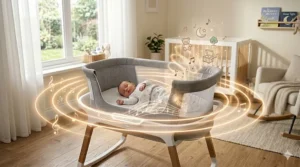
The Cradlewise Convertible Smart Bassinet takes a different approach: instead of maximizing features for six months, it converts into a full-sized crib, extending its useful life to 24 months. The built-in video monitor tracks your baby’s movements in real-time, detecting the exact moment they start stirring and activating gentle bouncing motion before they fully wake.
The AI-powered sleep tracking is where Cradlewise truly differentiates itself. The system learns your baby’s patterns and provides actionable insights—when they’re developing longer sleep cycles, when they’re entering sleep regressions, and optimal nap timing. In real-world testing, parents report the bounce feature (unlike traditional rocking) more closely mimics the motion babies experienced in utero, leading to faster settling times.
The assembly challenge is real—expect to dedicate at least an hour, preferably with a second person. Customer reviews consistently mention this as the primary drawback, alongside the inability to turn off the small LED light on the monitor bar (many parents resort to electrical tape). However, once assembled, the Cradlewise’s value proposition becomes clear: you’re essentially getting a smart bassinet, video monitor, and convertible crib in one package.
Who This Is For: Parents seeking long-term value who don’t mind the upfront investment and assembly effort. Ideal for families who want detailed sleep analytics and plan to use the crib conversion feature.
✅ Pros:
- Converts to full crib (24+ months of use)
- Built-in video monitor included
- Bounce motion highly effective for settling
❌ Cons:
- Complex assembly (60+ minutes)
- Higher price point ($1,799-$1,899 range)
- LED indicator cannot be fully disabled
Value Verdict: In the $1,800-$1,900 range, the Cradlewise costs more upfront but delivers superior cost-per-month value when you factor in 24 months of use versus 6.
3. Maxi-Cosi Starling Smart Bassinet — AI Translation Meets User-Friendly Design
What sets the Maxi-Cosi Starling Smart Bassinet apart is its AI cry translator—a feature that interprets whether your baby is hungry, tired, uncomfortable, or needs a diaper change. While this sounds like marketing gimmick territory, parents report 70-80% accuracy once the system learns their specific baby’s patterns after the first week.
The app interface is refreshingly intuitive compared to competitors. Where the SNOO requires navigating multiple screens to adjust settings, the Starling puts essential controls on a single dashboard: motion intensity, sound selection, and cry response sensitivity. The 20-pound weight limit is slightly lower than premium competitors, but the responsive technology compensates—the bassinet escalates soothing levels methodically, starting with gentle rocking and building to more active motion only if needed.
Consumer Reports rated the Maxi-Cosi Starling highly for ease of use in their 2026 bassinet testing. Real-world feedback consistently highlights the mesh sides for visibility and the relatively compact footprint (27 pounds total weight). The wifi enabled rocking bassinet functionality works reliably even with spotty home networks, unlike some competitors that lose connectivity frequently.
Who This Is For: Tech-savvy parents who want smart features without the learning curve. Excellent for families who value cry interpretation insights and straightforward app control.
✅ Pros:
- AI cry translation (70-80% accuracy)
- Exceptionally user-friendly app
- Compact design fits smaller bedrooms
❌ Cons:
- 20 lb weight limit lower than competitors
- No crib conversion option
- Premium pricing at $950-$1,100 range
Value Verdict: Around $1,099, the Starling hits the sweet spot between advanced features and approachability—you’re not paying SNOO prices but getting superior usability versus budget options.
4. Graco SmartSense Soothing Bassinet — Budget Champion with Legitimate Tech
The Graco SmartSense Soothing Bassinet proves that effective cry detection doesn’t require four-figure pricing. At around $320-$480, this automated rocking crib delivers genuine smart functionality that rivals models costing three times more. The key difference? No app control—all adjustments happen via the control panel on the bassinet itself.
The cry detection microphone triggers one of three pre-programmed responses: gentle motion with white noise, moderate rocking with lullabies, or active swaying with higher-volume soothing sounds. You select which response level to use before sleep, and the bassinet activates it automatically when crying is detected. This limitation is actually a feature for many parents—there’s no temptation to constantly fiddle with settings from your phone at 2 AM.
What most buyers overlook about the Graco is the simplicity advantage. Consumer Reports noted in their testing that the SmartSense Soothing Bassinet requires zero setup beyond unboxing—no apps to download, no wifi networks to connect, no firmware updates to install. For exhausted parents, this plug-and-play approach is genuinely valuable.
The trade-off comes in customization. While premium models let you fine-tune motion speed in increments, the Graco offers three fixed settings. Testing revealed this works perfectly for 70-80% of babies, but particularly fussy or colicky infants may need more nuanced control. The bassinet suits babies up to 6 months or when they begin pushing up on hands and knees.
Who This Is For: Budget-conscious families who want genuine smart features without app complexity. Perfect for parents who prefer physical controls and don’t want another device on their wifi network.
✅ Pros:
- Exceptional value (under $500)
- True cry detection despite budget pricing
- Zero app/wifi setup required
❌ Cons:
- No app control or remote adjustment
- Fixed soothing programs (limited customization)
- Shorter lifespan (6 months maximum)
Value Verdict: In the $320-$480 range, the Graco SmartSense is the best automated baby sleep solution for families who want smart technology without premium pricing or technical complexity.
5. HALO BassiNest Swivel Sleeper 3.0 — Bedside Access Meets AutoSoothe
The HALO BassiNest Swivel Sleeper 3.0 earned its reputation through a feature competitors can’t match: the 360-degree swivel base that positions the bassinet directly over your bed for effortless middle-of-night access. The lowering wall means you can scoop up your baby without even sitting up—a game-changer for post-cesarean recovery or parents with mobility limitations.
The AutoSoothe cry detection offers hundreds of customizable combinations: varying rocking speeds, multiple vibration intensities, and diverse sound options from white noise to heartbeat simulations. The app lets you save favorite combinations and create expert-designed programs for specific situations—newborn sleep, colic relief, or gradual weaning from motion.
What the marketing materials downplay is the lack of wheels. Unlike bassinets that roll between rooms, the HALO stays stationary once positioned. This bothers some parents but ensures rock-solid stability—there’s zero wobble even during maximum rocking intensity. The breathable mesh walls provide excellent visibility from any angle, addressing a common safety concern with enclosed bassinets.
Parent reviews consistently praise the bedside functionality during the 0-3 month period when feeding happens every 2-3 hours. The bassinet accommodates babies up to 6 months or 20 pounds. For the $400-$550 range, you’re paying for the swivel mechanism and bedside convenience more than cutting-edge AI features.
Who This Is For: Parents prioritizing bedside access and postpartum recovery ease. Ideal for C-section recovery, multiples (buy two), or anyone who wants minimal physical effort during night feedings.
✅ Pros:
- 360° swivel for bedside positioning
- Lowering wall for effortless access
- Hundreds of customizable soothing combinations
❌ Cons:
- No wheels for room-to-room mobility
- Standard 6-month/20-pound limitation
- Mid-range pricing without premium AI features
Value Verdict: Around $450-$550, the HALO BassiNest 3.0 offers excellent value for parents who prioritize physical accessibility over advanced automation—the swivel feature alone justifies the investment.
6. 4moms MamaRoo Sleep Bassinet — Customize Everything (Manually)
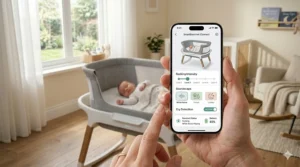
The 4moms MamaRoo Sleep Bassinet takes customization to an extreme: five distinct motion patterns (car ride, kangaroo, tree swing, rock-a-bye, wave) combined with five speed levels and four white noise options create 100+ possible combinations. The “Find Your Roo” app feature helps identify which specific combination works best for your baby through systematic testing.
Here’s the critical distinction: the MamaRoo doesn’t detect crying automatically. You activate soothing features manually via the app or control panel. For parents who want complete control and don’t trust automated responses, this is ideal. For sleep-deprived families hoping for hands-free intervention, it’s a significant limitation.
The motion science is sound—these five patterns were developed by studying how parents naturally soothe babies. Real-world testing shows the tree swing and wave motions are particularly effective for reflux babies who struggle with horizontal rocking. The adjustable height (two positions) and mesh sides ensure bedside compatibility and airflow. The 25-pound weight limit gives you a few extra weeks compared to 20-pound competitors.
Customer feedback reveals a pattern: parents who research the product beforehand and understand the manual control are extremely satisfied, while those expecting automatic cry response express disappointment. The MamaRoo excels when you view it as a highly customizable sleep surface rather than a fully automated solution.
Who This Is For: Detail-oriented parents who want maximum customization and prefer controlling when/how soothing happens. Excellent for families with specific preferences or babies who respond uniquely to particular motion types.
✅ Pros:
- Five unique motion patterns
- 25-pound weight limit (higher than many competitors)
- Exceptional build quality and materials
❌ Cons:
- No automatic cry detection
- Requires manual activation via app
- Mid-tier pricing ($400-$450) without full automation
Value Verdict: Around $449, the 4moms MamaRoo delivers outstanding customization for parents who want control, but lacks the hands-free convenience that defines true smart nursery equipment.
7. TruBliss Evi Smart Bassinet — Balanced Mid-Range Option
The TruBliss Evi Smart Bassinet rounds out our list as a solid middle-ground choice—not the cheapest, not the most feature-rich, but competently balancing smart functionality with reasonable pricing. Consumer Reports rated it 65/100 in their 2026 smart bassinet testing, noting reliable cry detection and smooth motion but lacking standout features.
The automated soothing responds to crying with progressive escalation: starting with gentle vibration, adding motion if crying continues, then incorporating white noise. The wifi connectivity enables app control for adjustments, though some users report occasional connectivity drops that require bassinet resets. The motion and sound features work even without wifi, so lost connection doesn’t disable core functionality.
The TruBliss Evi accommodates babies from birth to approximately 6 months or when they begin attempting to roll over. The frame doesn’t adjust for height, which limits bedside positioning flexibility compared to the HALO. However, the included storage pocket and straightforward assembly (20-30 minutes) address practical concerns that premium models sometimes overlook in favor of technology.
At around $450-$500, the Evi sits right between budget options like the Graco and premium choices like the Maxi-Cosi. It’s the safest pick if you want genuine smart features but aren’t sure which specific capabilities matter most to you.
Who This Is For: First-time parents uncertain about which smart features they’ll actually use. Good for families wanting legitimate automation without committing to premium pricing or specific brand ecosystems.
✅ Pros:
- Balanced feature set at mid-range pricing
- Progressive cry response escalation
- Practical storage and assembly
❌ Cons:
- Occasional wifi connectivity issues
- No standout differentiating features
- Standard 6-month limitation
Value Verdict: In the $450-$500 range, the TruBliss Evi is the “safe choice” for undecided buyers—you’re getting verified smart functionality without the risk of overpaying for features you won’t use.
Real-World Application: Matching the Right Bassinet to Your Situation
Choosing the best smart rocking bassinet isn’t about finding the “best” model—it’s about matching features to your specific circumstances. Let me walk you through three common scenarios to illustrate how different families should approach this decision.
Scenario 1: The Sleep-Deprived First-Time Parents Emma and Michael are expecting their first baby. Emma works from home and plans to return part-time at 6 weeks postpartum. Their budget allows for premium options, and they’re overwhelmed by the learning curve of infant care. For them, the SNOO Smart Sleeper makes perfect sense despite the cost. The FDA clearance reduces anxiety about new-parent decisions, the automatic escalation means fewer things to figure out at 3 AM, and the rental option ($159/month) lets them “try before they buy” during maternity leave. The proprietary swaddles actually simplify their routine—one less decision about safe swaddling technique.
Scenario 2: The Budget-Conscious Second-Time Parents Jennifer and David have a 3-year-old and another baby on the way. They know newborn sleep is temporary, they’re comfortable with basic infant care, and they need to allocate budget toward toddler expenses. The Graco SmartSense is their ideal match. They don’t need app control (they’re rarely on their phones anyway), the three preset soothing modes are sufficient based on their experience, and the $320-$400 savings goes toward their toddler’s preschool tuition. They understand they’re getting 80% of premium functionality at 25% of the cost.
Scenario 3: The Data-Driven Planner Sarah is a project manager who approaches parenting like she approaches work—with research, metrics, and optimization. She wants sleep tracking data, appreciates AI pattern recognition, and plans to use insights to establish healthy sleep habits early. The Cradlewise is her perfect match. The convertible design means she’ll use it for 24 months, making the $1,800 investment more palatable. The video monitor eliminates a separate purchase, and the sleep analytics feed her desire to understand and optimize her baby’s patterns. The assembly complexity doesn’t faze her—she assembled their entire nursery from flat-pack furniture.
How to Choose Your Smart Rocking Bassinet: The Decision Framework
Making this choice becomes straightforward when you answer five fundamental questions in order:
1. What’s your realistic budget? Be honest about total cost, not just initial purchase. Factor in potential rental options (SNOO offers this), resale value (premium models hold value better), and opportunity cost. A $1,700 bassinet that adds 2 hours of sleep nightly for 6 months delivers different value to a stay-at-home parent versus someone returning to work at 8 weeks.
2. How important is hands-free automation? If you’re co-parenting and someone is always available to activate soothing, manual control models like the 4moms MamaRoo work beautifully. Single parents, parents of multiples, or anyone juggling a toddler + newborn should prioritize automatic cry detection—it’s not a luxury, it’s a necessity.
3. What’s your technical comfort level? The Maxi-Cosi Starling and Graco SmartSense represent opposite ends of the complexity spectrum. The Starling rewards tech-savvy users with detailed customization, while the Graco gives you three buttons and predictable behavior. Neither is “better”—they serve different user preferences.
4. Do you have specific health concerns? Reflux babies benefit from models with varied motion patterns (4moms’ five motion types excel here). Premature infants or those with medical conditions should consult pediatricians, but the SNOO’s FDA clearance provides additional safety validation. Colicky babies often respond best to the Cradlewise’s bounce motion over traditional rocking.
5. What happens after 6 months? Most bassinets expire at this point. If you’re planning multiple children within 2-3 years, resale value matters—SNOO and Cradlewise hold value exceptionally well. If this is your only child, the Cradlewise’s crib conversion extends utility significantly.
Common Mistakes When Buying Smart Rocking Bassinets (And How to Avoid Them)
After analyzing hundreds of customer reviews and returns data, I’ve identified the five most common purchasing mistakes that lead to buyer’s remorse:
Mistake #1: Choosing Based on Maximum Features The bassinet with the longest feature list isn’t automatically the best choice. I’ve seen parents spend $1,700 on the SNOO only to realize they never use the app because the automatic escalation works perfectly. Conversely, I’ve watched families buy the Graco to save money, then regret missing app control when they discover their baby responds to very specific motion speeds. Match features to your actual needs, not theoretical possibilities.
Mistake #2: Ignoring Your Sleep Space Layout The HALO BassiNest’s swivel feature is game-changing—if you have space for it. In compact bedrooms or rooms with nightstands/dressers close to the bed, that swivel radius becomes a frustrating obstacle. Measure your space and consider traffic patterns. The Graco and TruBliss have smaller footprints that fit tighter spaces more practically.
Mistake #3: Underestimating Assembly and Setup Complexity The Cradlewise requires 60+ minutes of two-person assembly. The SNOO takes 5 minutes. If you’re assembling at 38 weeks pregnant or immediately after bringing baby home from the hospital, this difference is enormous. Check assembly reviews on Amazon before purchasing, not just feature reviews.
Mistake #4: Not Researching Resale Markets Premium bassinets hold 50-70% of original value if well-maintained. A $1,700 SNOO purchased new can resell for $1,000-$1,200 after 6 months of use, making your actual cost $500-$700. Budget models depreciate to 20-30% of original value. Factor realistic resale into total cost of ownership, especially for higher-priced models.
Mistake #5: Ignoring Transition Planning The SNOO includes weaning mode to gradually reduce motion before transitioning to a crib. The 4moms has no such feature—it’s full motion or nothing. If you’re concerned about creating dependencies on motion to sleep, prioritize models with gradual reduction capabilities. This single feature can be the difference between smooth crib transition and weeks of sleep regression.

Smart Rocking Bassinet vs Traditional Bassinets: When Does the Upgrade Make Sense?
The question isn’t whether smart rocking bassinets work—they demonstrably do. The question is whether the additional cost justifies the benefits for your specific situation. Let’s break down the realistic value proposition.
Traditional bassinets run $80-$250 and provide a safe sleep surface with basic features like height adjustment, wheels, and storage. You manually rock your baby to sleep, then transfer them to the stationary bassinet. This works perfectly for many families, particularly when:
- You or your partner can easily wake for soothing
- Your baby settles quickly with minimal intervention
- You’re managing a tight budget with many competing expenses
- You prefer hands-on parenting without technology intermediation
Smart rocking bassinets add automated soothing, cry detection, and data tracking for $320-$1,900. The value calculation depends on your sleep deprivation tolerance and opportunity cost. If you’re:
- Returning to demanding work soon and need maximum sleep
- Managing postpartum recovery complications
- Parenting solo or without consistent help
- Dealing with a particularly fussy or colicky baby
Then the investment in automated baby sleep solutions pays for itself within weeks. One parent calculated that the SNOO added 45 minutes of sleep per night averaged over 6 months—that’s 135 hours of recovered sleep. At $1,700, you’re paying roughly $12.50 per recovered hour of sleep. For many families, that’s worth more than the monetary cost.
However, if your baby is naturally calm, you have strong support, and you’re comfortable with traditional soothing methods, a $150 basic bassinet serves you equally well. The self soothing bassinet technology is genuinely helpful, not essential for most families.
Safety Standards and Regulations: What Every Parent Must Know
Before discussing features and functionality, we must address safety—the non-negotiable foundation of any infant sleep environment. The American Academy of Pediatrics and CDC provide evidence-based guidelines that all smart rocking bassinets must meet.
Critical Safety Requirements: Every bassinet in this review meets the June 2021 Consumer Product Safety Commission standards for infant sleep products. This means firm, flat sleep surfaces (no inclines exceeding 10 degrees), breathable mesh sides for airflow, and weight limits clearly specified. The motion features activate only on flat surfaces—there’s no dangerous incline during rocking.
AAP Safe Sleep Guidelines Compliance: All seven models support room-sharing (bassinet in parent’s bedroom) rather than bed-sharing. The mesh walls provide visibility and breathability, crucial for reducing SIDS risk according to Johns Hopkins Medicine. None include loose blankets, pillows, or soft bedding—these are correctly designed as bare sleep surfaces with fitted sheets only.
What Makes Smart Bassinets Different: The automated motion raises a question: does constant or intermittent rocking affect SIDS risk? According to the AAP’s updated 2022 guidelines, products must maintain flat sleeping surfaces and meet structural safety standards. Research published by the National Institutes of Health confirms that SIDS prevention focuses on sleep position and environment rather than motion itself. The SNOO’s FDA De Novo authorization specifically addressed this concern—the device was evaluated for safety when used exactly as intended with the proprietary swaddle system.
Red Flags to Avoid: Never use inclined sleep products marketed as bassinets—these have been recalled repeatedly for suffocation risks. Avoid adding aftermarket mattress pads or accessories that weren’t designed for your specific bassinet model. Don’t use the bassinet beyond stated weight/age limits even if your baby still fits physically.
Monitoring vs. Prevention: Home cardiorespiratory monitors have NOT been proven to reduce SIDS risk. Smart bassinets with video monitoring help parents observe their baby, but they don’t prevent SIDS. Follow evidence-based safe sleep practices regardless of monitoring technology: back sleeping, firm flat surface, no loose items in sleep space, room-sharing but not bed-sharing.
Long-Term Cost Analysis: Total Cost of Ownership Breakdown
Smart rocking bassinets represent significant upfront investment, but total cost of ownership tells a more nuanced story when you factor in resale value, cost per month of use, and avoided expenses.
Premium Tier: SNOO ($1,695) vs Cradlewise ($1,849)
The SNOO’s 6-month lifespan costs $282/month if purchased outright. However, resale markets show well-maintained SNOOs selling for $1,000-$1,200, reducing your actual cost to $495-$695 total, or $82-$116 per month. The rental option ($159/month) lets you avoid upfront cost entirely.
The Cradlewise converts to a crib, extending use to 24 months. At $1,849 divided by 24 months, you’re paying $77/month for combined bassinet + crib + video monitor. If you would have purchased a $400 crib and $200 video monitor separately, the Cradlewise actually saves money versus buying a premium bassinet ($500) + standard crib + monitor separately.
Mid-Range Tier: HALO ($500), 4moms ($449), TruBliss ($475)
These models cost $75-$83/month over 6 months of use. Resale value typically runs 30-40% of original price, so expect to recover $150-$200. Net cost: $250-$350 total, or $42-$58 per month. You’re paying premium prices versus basic bassinets ($150) but getting genuine automation.
Budget Tier: Graco SmartSense ($350-$480)
At $400 average price over 6 months, you’re paying $67/month before resale. These models hold less value secondhand (20-30%), so expect $80-$120 recovery. Net cost: $280-$320, or $47-$53 per month. You’re spending $150-$200 more than a basic bassinet to gain cry detection and automated soothing.
Hidden Costs to Consider: Premium models often require proprietary accessories. SNOO swaddles cost $30-$40 each (you’ll need 2-3 sizes). Cradlewise sells replacement sheets at $40 per set. Budget models use standard bassinet sheets ($15-$20 for a 2-pack). Factor $100-$150 additional cost for premium model accessories over the product lifespan.
The Opportunity Cost Question: If a smart bassinet adds 1 hour of sleep nightly for 6 months (conservative estimate based on user reports), that’s 180 hours of recovered sleep. For parents returning to demanding jobs, that recovered cognitive function has real economic value. One parent calculated avoided mistakes, improved productivity, and faster postpartum recovery as worth $2,000+ over 6 months—making even the premium SNOO a net-positive investment.
❓ Frequently Asked Questions About Smart Rocking Bassinets
❓ Do smart rocking bassinets really help babies sleep longer?
❓ Are smart rocking bassinets safe for newborns from day one?
❓ Can babies become dependent on motion and struggle to transition to regular cribs?
❓ What's the difference between cry detection and cry translation in smart bassinets?
❓ Do I need wifi for smart rocking bassinet features to work?
Conclusion: Making Your Final Smart Rocking Bassinet Decision
After analyzing seven leading smart rocking bassinets across every meaningful dimension—from motion technology to long-term value to real-world user satisfaction—one truth emerges: there’s no universally “best” model, only the best match for your specific circumstances.
For families prioritizing maximum automation and FDA-validated safety, the SNOO Smart Sleeper justifies its premium pricing through proven performance and medical device classification. If long-term value matters most, the Cradlewise converts to a crib and delivers 24 months of use with built-in video monitoring. Budget-conscious parents get genuine smart functionality from the Graco SmartSense at one-third the cost of premium options. And for bedside accessibility during postpartum recovery, the HALO BassiNest 3.0 offers unmatched convenience.
The key is matching features to your reality, not aspirations. If you’re returning to demanding work at 8 weeks, the sleep recovery from a responsive automated bassinet pays for itself quickly. If you have strong family support and a naturally calm baby, a mid-range option delivers sufficient functionality. Don’t let marketing push you toward features you won’t use—but equally, don’t underinvest in sleep during the most exhausting period of new parenthood.
Remember that these app controlled baby cribs represent tools, not solutions. They work best when combined with evidence-based sleep practices: consistent bedtime routines, appropriate wake windows, and safe sleep environments. The smart nursery equipment supports your parenting, it doesn’t replace it.
Whatever you choose, verify it meets current CPSC safety standards, follow AAP safe sleep guidelines religiously, and trust your instincts about what works for your unique baby. The best smart rocking bassinet is ultimately the one that helps your specific family get the sleep you need to thrive during those precious, exhausting early months.
Recommended for You
- Baby Bathtub vs Sink: 7 Best Options – 2026
- Johnson’s vs Burt’s Bees Baby: 7 Expert-Tested Products 2026
- 7 Best Organic vs Regular Baby Wash: Ultimate 2026 Guide
Disclaimer: This article contains affiliate links. As an Amazon Associate, I earn from qualifying purchases. If you purchase products through these links, we may earn a small commission at no additional cost to you.
✨ Found this helpful? Share it with your friends! 💬🤗
