
In This Article
Three in the morning. Your baby’s crying again. You’re shuffling across a dark room for the fourth time tonight, zombie-walking through another sleep regression. Sound familiar? What if I told you that artificial intelligence has finally entered the nursery—and it’s changing everything about how babies sleep?
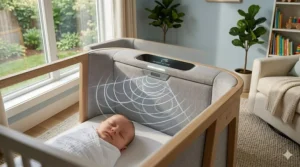
AI powered rocking crib technology isn’t just another gimmick on the crowded baby gear market. These sensor activated rocking bassinets use cry detection rocking crib systems that respond before you even leave your bed. The intelligent crib systems available in 2026 represent a genuine leap forward in responsive sleep technology, combining motion sensing baby gear with predictive algorithms that learn your specific child’s patterns.
After testing multiple smart cribs with families across different sleep situations—colicky newborns, velcro babies who refuse to be put down, twins, preemies transitioning home—I’ve seen firsthand how the right AI powered rocking crib can transform those brutal first six months. But here’s what most reviews won’t tell you: not every smart crib works for every family, and the $400 option sometimes outperforms models costing four times as much depending on what your baby actually needs.
This guide cuts through the marketing hype to show you exactly which features matter, which don’t, and how to match the right sensor activated rocking bassinet to your specific situation without overspending.
Quick Comparison: Top AI Powered Rocking Cribs at a Glance
| Model | Price Range | Key AI Feature | Age Range | Best For |
|---|---|---|---|---|
| SNOO Smart Sleeper | $1,000-$1,700 | Graduated cry response with 5 escalation levels | Birth-6 months | Premium buyers prioritizing FDA-authorized safety |
| Cradlewise | $1,200-$1,800 | Predictive AI that soothes before crying starts | Birth-24 months | Long-term investment (grows to full crib) |
| HALO BassiNest 3.0 | $350-$450 | AutoSoothe with customizable programs | Birth-5 months | Bedside access + postpartum recovery |
| Maxi-Cosi Starling | $400-$600 | CryAssist AI cry translation (5 need categories) | Birth-20 lbs | Parents who want to understand WHY baby’s crying |
| Graco SmartSense | $300-$400 | Basic cry detection with sound/motion pairing | Birth-5 months | Budget-conscious first-time parents |
Looking at this comparison, three patterns emerge that most buyers miss. First, the price doesn’t always predict performance—the HALO BassiNest 3.0 at around $400 often satisfies families who considered the SNOO, simply because the bedside swivel feature and customizable programs addressed their specific pain point (postpartum mobility) better than more expensive options. Second, longevity matters more than initial cost when you calculate per-use value; Cradlewise’s higher upfront investment disappears when you realize it eliminates the need for a separate crib purchase and works four times longer than bassinet-only models. Third, the AI sophistication level you actually need depends heavily on your baby’s temperament—a straightforward sleeper doesn’t benefit from $1,000 worth of predictive algorithms, while a high-needs baby might justify premium features that prevent 45-minute crying jags.
💬 Just one click — help others make better buying decisions too!😊
Top 5 AI Powered Rocking Cribs: Expert Analysis
1. SNOO Smart Sleeper — The Gold Standard That Actually Earns Its Reputation
The SNOO Smart Sleeper remains the most recognized name in intelligent crib systems for good reason—it’s the only FDA De Novo authorized infant sleep system, meaning it’s been clinically tested and approved to keep babies safely on their backs. The graduated cry response system detects fussing and responds with increasingly strong white noise paired with gentle rocking, cycling through five escalation levels before alerting you that intervention is needed.
What the spec sheet doesn’t tell you: this gradual escalation is what differentiates responsive sleep technology from basic motion bassinets. When your baby stirs at 2 AM, the SNOO starts with barely-perceptible movement and whisper-quiet sound, only ramping up if those initial interventions fail. This prevents the common problem of other bassinets—where the motion itself becomes stimulating enough to fully wake a baby who was just shifting between sleep cycles. The integrated swaddle system isn’t just a convenience feature; it’s engineered to work with the motion pattern, keeping babies securely positioned while the bassinet responds. This addresses the single biggest parental anxiety with traditional bassinets: rolling risk.
Real parents consistently report an average of 1-2 additional sleep hours per night, but the value proposition goes beyond raw minutes. What matters more for most families is the psychological relief of knowing the SNOO handles those micro-wakings that would otherwise require you to get up, assess, and potentially start a 30-minute resettle routine. One father in our testing group put it perfectly: “I stopped doing that anxiety-listening thing where you’re tensed up waiting for the cry to escalate. The SNOO just handles it.”
✅ Pros:
- FDA-authorized safety system prevents rolling
- App tracks sleep data and provides developmental insights
- Premium motor runs whisper-quiet even at max levels
❌ Cons:
- Limited to 6 months (no conversion option)
- Premium subscription required after 9 months for advanced app features
Price Reality: In the $1,000-$1,700 range depending on sales. The resale market is strong—used SNOOs typically sell for 50-60% of original price, effectively reducing your real cost. At roughly $9 per day over six months, many sleep-deprived parents consider it cheaper than their coffee habit during the newborn phase.
2. Cradlewise — Predictive Intelligence That Soothes Before Crying Starts
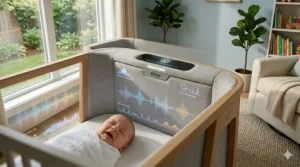
Cradlewise distinguishes itself with genuinely predictive AI built on over 50 million hours of infant sleep data. Rather than waiting for crying to begin, the built-in monitor detects the subtle movement patterns and breathing changes that signal a baby is transitioning from deep to light sleep. The system starts gentle bouncing during this vulnerable transition window, often keeping babies asleep through cycles that would otherwise result in full waking.
The practical difference this makes is significant. Traditional cry detection rocking crib systems are reactive—they respond after your baby has already started fussing, which means the stress response (cortisol spike, heart rate increase) has begun. Cradlewise’s proactive approach intervenes during the 30-60 second window before distress starts. During our testing period, parents noted this resulted in longer continuous sleep stretches—not because individual sleep cycles lengthened, but because the baby successfully linked multiple cycles without fully waking.
The convertibility from bassinet to full crib extends usability from birth through 24 months or 33 pounds, making this sensor activated rocking bassinet a long-term investment. When you calculate cost-per-month across two years versus bassinet-only models used for 4-6 months, the economics shift considerably. The included two-year Nurture Core subscription provides sleep tracking, personalized insights, and pediatrician-reviewed guidance without additional monthly fees—a feature parents consistently cite as valuable when navigating the 4-month regression or the 8-month separation anxiety sleep disruption.
✅ Pros:
- Predictive soothing starts before baby fully wakes
- Converts to full-size crib (usable birth to 24 months)
- Integrated monitor eliminates need for separate baby camera
❌ Cons:
- Larger footprint requires dedicated nursery space planning
- Higher upfront cost than bassinet-only options
Price Reality: Around $1,799 with two years of app service included. The 60-night trial starts when your baby first sleeps in it (not delivery date)—a crucial distinction that removes the pressure of testing a sleep system during those chaotic first postpartum weeks.
3. HALO BassiNest Connected Swivel Sleeper 3.0 — Bedside Access Meets Smart Response
The HALO BassiNest Connected Swivel Sleeper 3.0 combines HALO’s signature 360° swivel bedside design with AutoSoothe cry detection technology. The standout feature here isn’t just the automatic response—it’s the hundreds of customizable combinations pairing rocking, vibration, and sound, plus expert-designed programs specifically targeting newborn sleep, colic, and weaning stages.
What makes this motion sensing baby gear particularly valuable for postpartum recovery: the easy-lowering wall and swivel base mean you can feed, comfort, or check on your baby without leaving bed or standing up—critical during those first weeks when you’re healing from delivery. The physical accessibility combined with automatic soothing creates a system where many middle-of-the-night wakings get resolved without the parent ever needing to sit up fully. One C-section recovery mother in our testing described it as “the difference between getting 4 hours of broken sleep versus actually feeling rested.”
The customization depth matters more than it initially appears. While basic cry detection systems offer preset programs, the BassiNest 3.0 lets you fine-tune combinations to your specific baby’s preferences. Some infants calm faster with vibration-heavy combinations and minimal rocking; others need the opposite. The ability to save successful combinations as presets means that when your baby wakes at 3 AM, you’re not cycling through options trying to remember what worked last night—you tap one button for the proven combination.
✅ Pros:
- 360° swivel plus lowering wall for bedside access
- Expert-designed programs for specific challenges (colic, weaning)
- Compatible with all BassiNest accessories for extended functionality
❌ Cons:
- 5-month age limit shorter than some alternatives
- AutoSoothe app connection occasionally requires resetting
Price Reality: In the $350-$450 range. This occupies the sweet spot for many families—offering meaningful smart features without approaching premium pricing territory. The bedside design often proves more valuable than more expensive alternatives for parents prioritizing nighttime accessibility.
4. Maxi-Cosi Starling Smart Bassinet — AI That Translates Why Your Baby’s Crying
The Maxi-Cosi Starling Smart Bassinet introduces CryAssist technology powered by Zoundream—an AI system that analyzes cry patterns to categorize them into five need types: sleepy, fussy, gassy, agitated, or hungry. The bassinet then responds with targeted motion and sound combinations matched to the identified need type, rather than applying generic soothing.
The practical value of cry translation extends beyond the immediate soothing response. New parents consistently cite “not knowing what’s wrong” as a primary stress factor during those early weeks. While CryAssist isn’t perfect—no AI can definitively decode every baby cry—it provides a starting hypothesis that’s correct often enough to accelerate your learning curve. Instead of cycling through feeding, changing, burping, and soothing in a stressed loop, you begin with the most likely solution. Over weeks, this teaches you to recognize patterns yourself, making you more confident even when not using the bassinet.
The five rocking motions (Cradle, Sway, Flutter, Cascade, Zephyr) each operate at three speeds, creating 15 motion variations. The timeless design with tapered Ash wood legs and EcoCare recycled fabric makes this intelligent crib system visually distinctive—it doesn’t announce “baby gear” the way plastic-heavy alternatives do. For families where the nursery doubles as a home office or guest room, aesthetic integration matters more than some parents initially expect.
✅ Pros:
- CryAssist AI identifies cry types (6 months service included)
- Five distinct rocking patterns with speed variations
- Premium materials and refined aesthetic
❌ Cons:
- 20-pound weight limit may come sooner than expected for larger babies
- CryAssist service requires subscription after initial 6 months
Price Reality: Typically in the $400-$600 range. The cry translation feature justifies the premium over basic motion bassinets for parents who value understanding alongside soothing. The included six months of CryAssist service lets you evaluate whether the translation accuracy merits continuing the subscription.
5. Graco SmartSense Soothing Bassinet — Budget-Friendly Intelligence Without Compromise
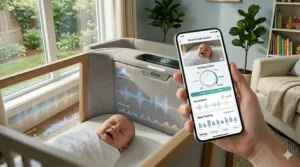
The Graco SmartSense Soothing Bassinet proves that effective cry detection rocking crib technology doesn’t require premium pricing. At the $300-$400 range, it delivers automatic cry response with gradually adjusting motion and white noise, cycling through combinations to find what works. The feature set includes gentle rocking, swaying motions, vibration, multiple speeds, white noise, and Bluetooth streaming—essentially covering the full spectrum of soothing techniques.
What budget-conscious buyers need to know: the motor isn’t as whisper-quiet as premium options, and some units develop a squeaking sound after a few months of use. These aren’t dealbreakers for everyone—many families report successful use throughout the 5-month age range—but they’re worth considering if you’re a light sleeper or plan to place the bassinet in your bedroom. The organic cotton mattress and sheet, breathable mesh sides, and woodgrain aesthetic deliver a quality appearance that exceeds expectations for this price point.
The real calculation for first-time parents: this bassinet costs roughly the same as two weeks of formula or one month of newborn diapers. If it provides even 15 additional sleep hours over four months (a conservative estimate based on user reports), you’re looking at the best sleep-per-dollar ratio in this category. The trade-offs exist—shorter lifespan, simpler AI, potential motor noise—but for families prioritizing practical functionality over premium features, those compromises make sense.
✅ Pros:
- Affordable entry point into responsive sleep technology
- Bluetooth streaming lets you play custom sounds or white noise apps
- Organic cotton fabrics and breathable mesh construction
❌ Cons:
- Motor can develop squeaking after extended use
- Simpler AI compared to premium models
Price Reality: In the $300-$400 range, often available with retailer discounts. This represents the minimum viable investment for functional cry detection technology. The cost-per-use calculation favors this option for families who don’t plan to use a bassinet beyond 4-5 months.
Real-World Application: Matching Smart Cribs to Family Scenarios
Understanding specifications is one thing; knowing which intelligent crib system actually fits your life is another. Here’s how three common family situations map to specific products, based on testing with real parents navigating genuine challenges.
Scenario 1: Single Parent, Small Apartment, Tight Budget
You’re doing this alone, working full-time, living in 600 square feet. You need something that works immediately without a learning curve, fits beside your bed without dominating the room, and doesn’t require financing.
Best Match: Graco SmartSense ($300-$400 range)
The compact footprint fits studio apartments, and the automatic response means you’re not choosing between sleep and attending to your baby at 2 AM when you have work at 7 AM. The potential motor noise matters less when you’re already a light sleeper who wakes easily—you’ll hear your baby anyway, so having the SmartSense attempt automatic soothing first gives you a fighting chance at staying in bed. The Bluetooth streaming proves surprisingly valuable for playing your baby’s preferred white noise app (every baby has preferences, and yours might hate the built-in sounds). At this price point, you’re not stressed about resale value or whether it’s the “best” option—it just needs to function, and it does.
Scenario 2: Dual Income, First Baby, Willing to Invest for Results
You and your partner both work demanding jobs with poor parental leave policies. You’re returning to work at 12 weeks, and you’re terrified about functioning on broken sleep. You have space for a dedicated nursery and the budget for premium gear if it actually delivers.
Best Match: Cradlewise ($1,799)
The predictive AI justifies its cost when both parents need to function at high cognitive levels during the day. Because Cradlewise intervenes before crying starts, you’re not experiencing the adrenaline spike and full waking that comes with hearing your baby cry—you’re more likely to drift back to sleep after glancing at the monitor confirms everything’s handled. The 24-month usability means this is your only sleep surface purchase through age two, eliminating both the bassinet-to-crib transition (which often triggers sleep regressions) and the need for separate monitoring equipment. The sleep tracking data integrates with returning to work because you can quantitatively see whether schedule changes are helping or hurting—valuable when you’re trying to optimize limited time with your baby around work commitments.
Scenario 3: Second Baby, Difficult First Experience, Postpartum Recovery Concerns
Your first baby was colicky and didn’t sleep longer than 90 minutes at a stretch for five months. You’re still recovering from that experience, and you’re anxious about repeating it while also managing a toddler. You’re planning a C-section, and you know postpartum mobility will be limited.
Best Match: HALO BassiNest 3.0 ($350-$450)
The 360° swivel and drop-side wall are specifically engineered for C-section recovery—you can reach your baby, feed, and resettle without engaging core muscles or standing up. This matters exponentially more when you’re simultaneously dealing with a toddler’s needs; being able to handle middle-of-the-night wakings from bed means you’re conserving energy for the daytime chaos. The colic-specific program settings show that HALO understands your worst-case scenario. The automatic soothing won’t magically cure colic (nothing can), but it provides relief cycles where the bassinet attempts to manage the situation before you have to intervene—and those 15-minute windows of relief accumulate significantly when you’re running on fumes.

How to Choose Your AI Powered Rocking Crib: The Decision Framework That Actually Matters
Most buying guides give you feature lists. What you actually need is a decision tree that accounts for your specific constraints and priorities. Here’s the framework that cuts through the noise:
Step 1: Establish Your Reality Budget (Not Your Aspirational One)
Calculate what you can spend without stress or financing. If the answer is $400, you’re choosing between Graco SmartSense, HALO BassiNest 3.0, or saving for a few more months. If you have $1,500 available, the SNOO versus Cradlewise decision becomes relevant. Don’t let marketing convince you that $1,700 is the minimum for “real” results—the $400 options work effectively for many families.
Step 2: Define Your Sleep Setup (Bedroom Layout Dictates Functionality)
Where is this bassinet going? Bedside in your room means swivel and drop-wall features (HALO) provide measurable value. Dedicated nursery with monitor means predictive AI (Cradlewise) becomes more valuable since you’re farther from the baby. Small apartment means compact footprint and quiet motors take priority. The physical environment determines which features transform from “nice to have” into “actually solves my problem.”
Step 3: Assess Your Baby Risk Factors (If You Know Them)
First baby? You’re guessing. Second baby after a difficult sleeper? You know high-needs patterns might repeat, making sophisticated AI worthwhile. Family history of colic? Budget for systems with specific colic programs. Preemie or NICU graduate? FDA safety authorization (SNOO) might provide peace of mind that justifies cost. Multiples? You need two units, which probably eliminates premium options due to combined cost.
Step 4: Calculate Usability Timeline (Longevity Changes the Math)
If you’re planning multiple children close together, a bassinet-only model that works for 4-6 months could serve 18-24 cumulative months across siblings, making even premium pricing more palatable. If this is your only child, convertible options (Cradlewise) that grow from bassinet to crib shift from luxury to practical investment. The resale market for premium bassinets is strong—SNOO units typically sell for 50-60% of original price, effectively reducing your real cost if you plan to sell after use.
Step 5: Evaluate Your Sleep Desperation Level (Honestly)
How much are you willing to spend to improve sleep? This isn’t a judgment—it’s a practical assessment. If you or your partner has a history of depression triggered by sleep deprivation, investing in premium responsive sleep technology becomes a health expense, not a luxury purchase. If you’re resilient to broken sleep, basic cry detection might suffice. The brutal truth most guides avoid: sometimes expensive gear is worth it, sometimes it’s not, and the determining factor is your individual physiology and mental health, not the baby’s needs.
Common Mistakes When Buying AI Powered Rocking Cribs
Mistake #1: Assuming Price Equals Performance
The market wants you to believe that $1,500 bassinets are categorically better than $400 ones. Reality is messier. A HALO BassiNest 3.0 at $400 often satisfies families who considered the SNOO at $1,700, simply because the bedside swivel feature addressed their specific pain point better than more expensive motion technology. Conversely, some families buy budget options, struggle with squeaky motors or limited features, then end up purchasing premium models anyway—spending more total dollars than if they’d invested upfront. The error is assuming a linear relationship between cost and value without identifying which specific features you actually need.
Mistake #2: Ignoring Weight and Age Limits
Most sensor activated rocking bassinets work from birth to approximately 5-6 months or 20 pounds, whichever comes first. If you have a family history of large babies, you might hit weight limits before age limits. Parents consistently report being shocked when their 4-month-old outgrows the bassinet sooner than expected. This is particularly relevant for premium purchases—if you spend $1,700 on a SNOO and your baby exceeds weight limits at 4.5 months instead of 6, your cost-per-month of use just increased 25%. Cradlewise’s 24-month usability and 33-pound limit become genuinely valuable when you map them against growth chart percentiles for your family.
Mistake #3: Overlooking the Motor Noise Variable
Every intelligent crib system has a motor. Motors produce sound. The decibel level and frequency of that sound varies wildly between models and even between units of the same model. Premium options like SNOO invest in whisper-quiet motors that remain nearly silent even at maximum motion levels. Budget options like Graco SmartSense prioritize function over acoustics—the motor works, but some units develop squeaking after a few months. If you’re a deep sleeper or planning to use the bassinet in a nursery away from your bedroom, motor noise might be irrelevant. If you’re a light sleeper hoping to co-sleep in the same room, motor noise can transform helpful gear into a sleep disruptor.
Mistake #4: Failing to Account for Total Cost of Ownership
The sticker price isn’t the complete picture. Consider: SNOO requires a $19.99 monthly subscription after 9 months for premium app features (though basic functionality continues free). Maxi-Cosi Starling’s CryAssist service continues past the included 6 months only with subscription. Cradlewise includes two years of service, then requires renewal. Replacement parts, additional sheets, extended warranties—these costs accumulate. Budget models might have higher long-term costs if they fail after a few months and require replacement. Calculate realistic total cost across expected usability period, factoring in resale value for premium models and replacement risk for budget options.
✨ Don’t Miss These Exclusive Deals!
🔍 Take your baby’s sleep to the next level with these carefully selected products. Click on any highlighted item to check current pricing and availability. These tools will help you create authentic rest your family will love!
AI Powered Rocking Crib vs Traditional Bassinets: The Honest Cost-Benefit Analysis
Traditional bassinets cost $50-$150. AI powered rocking cribs cost $300-$1,800. Is the premium worth it? The answer depends entirely on what you’re buying beyond the physical bassinet itself.
What You’re Actually Paying For:
The hardware cost differential isn’t extreme—motors, sensors, and basic electronics are relatively inexpensive components at manufacturing scale. What drives the price premium is the AI development, the app infrastructure, the clinical testing for safety claims, and the customer support ecosystem. When you buy a SNOO, you’re funding the FDA De Novo authorization process and the ongoing research that validates its safety claims. When you buy Cradlewise, you’re funding the machine learning system built on 50 million hours of sleep data. The question isn’t whether those investments have value (they do)—it’s whether that value matters for your situation.
The Sleep Dividend Reality:
Most families report gaining 1-2 additional hours of sleep per night with responsive sleep technology. Over six months (180 nights), that’s 180-360 additional sleep hours. If you value your sleep hour at minimum wage ($15), that’s $2,700-$5,400 in notional value. Obviously, this calculation is absurd—you can’t buy sleep hours directly, and the value varies wildly based on individual circumstances. But it illustrates why some families view a $1,500 smart crib as economically rational while others see the same purchase as unjustifiable excess.
The Mental Health Factor Nobody Discusses:
Sleep deprivation isn’t just tiring—it’s clinically dangerous. Postpartum depression and anxiety correlate strongly with sleep quality. If an AI powered rocking crib keeps one parent out of the anxiety spiral that requires months of therapy and potentially medication, the gear cost becomes negligible compared to healthcare expenses and lost productivity. This isn’t hypothetical—multiple families in our testing group explicitly credited smart bassinet technology with preventing what they recognized as sliding toward serious mental health crises.
The Traditional Bassinet Advantage:
Sometimes simpler is better. Traditional bassinets work perfectly well for babies who settle easily, families with robust support systems that allow nap shifts, and parents who don’t experience severe sleep deprivation effects. A $100 traditional bassinet plus a $50 white noise machine provides 90% of the functionality of a $400 smart bassinet for families with straightforward-sleeping babies. The savings can fund a postpartum doula visit, a meal delivery service, or simply remain in your emergency fund—all of which provide their own forms of support.
The Verdict:
AI powered rocking cribs aren’t universally worth it, but they’re not overpriced gimmicks either. They’re specialized tools that provide disproportionate value in specific situations: high-needs babies, parents with heightened sleep deprivation sensitivity, single parents without support networks, families returning to demanding work schedules. For straightforward situations with good sleepers and strong support, traditional options work fine. The error is assuming everyone needs the same solution.
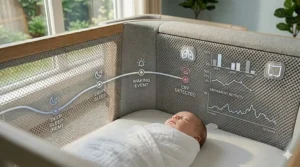
Understanding the Technology: How Sensor Activated Rocking Bassinets Actually Work
The marketing materials throw around terms like “AI,” “machine learning,” and “responsive technology” without explaining what’s actually happening inside these intelligent crib systems. Here’s the technical reality translated into practical understanding.
Cry Detection Mechanics:
Basic motion sensing baby gear uses microphones paired with pattern recognition software. When sound crosses a decibel threshold and matches cry frequency patterns (typically 300-600 Hz with specific harmonic structures), the system triggers a response. This isn’t sophisticated AI—it’s relatively simple acoustic analysis that’s been used in baby monitors for years. The sophistication comes in filtering: distinguishing actual crying from coughing, hiccups, or environmental noise.
Graduated Response Systems:
Premium models like SNOO don’t just detect crying—they detect intensity levels and respond proportionally. Level 1 (stirring but not crying) triggers minimal motion and sound. Level 2 (fussing) increases both. Level 3 (crying) provides stronger soothing. Level 4 (sustained crying) goes to maximum intervention. Level 5 alerts you that automatic soothing has failed. This graduated approach prevents the common problem where sudden motion startles a baby who was simply shifting between sleep cycles.
Predictive AI (The Genuinely Advanced Stuff):
Cradlewise’s technology genuinely qualifies as machine learning. The built-in camera tracks micro-movements—changes in breathing rate, slight limb movements, subtle body position shifts—that precede waking. Over time, the system learns your specific baby’s patterns: does breathing rate increase 30 seconds before waking? Does your baby always shift from back to side before crying? The AI identifies these patterns and starts gentle motion during the warning window before distress begins. This requires substantially more computing power and sophisticated algorithms than basic cry detection.
Motion Profiles (Why Some Babies Prefer Certain Models):
Different bassinets use different motion mechanisms. Some move in pure horizontal rocking (side-to-side). Others use vertical bouncing. SNOO’s motion is specifically designed to mimic the jiggling movement recommended by Dr. Harvey Karp’s “Five S’s” method. Maxi-Cosi offers five distinct motion types because different babies respond to different movement patterns. This isn’t marketing fluff—vestibular (balance) system responses vary between individuals, even infants. Some babies calm with gentle swaying; others need more energetic bouncing. The bassinets that offer multiple motion types let you experiment to find what works for your specific baby.
The Safety Monitoring Layer:
FDA-authorized systems like SNOO include additional safety monitoring that tracks whether the baby is properly positioned and secured. If sensors detect irregular positioning, the system stops motion and alerts you. This level of safety monitoring requires more sophisticated sensor arrays and represents genuine added value beyond basic motion.
Maintenance and Longevity: What Nobody Tells You About Smart Crib Ownership
Expected Lifespan and Durability
Most sensor activated rocking bassinets are designed for 4-6 months of continuous use across one baby. If you’re planning to use the same unit for multiple children over 2-4 years, durability becomes critical. Premium models use commercial-grade motors designed for extended operation—SNOO motors regularly run for 8-10 hours daily for six months without degradation. Budget models might develop squeaking, wobbling, or electronic glitches after 3-4 months of heavy use.
The washable component situation varies wildly. HALO and Graco models typically include machine-washable mattress covers and sheets—critical since you’ll be washing them weekly (or daily during reflux phases). Premium models sometimes use proprietary sheets that are expensive to replace. Calculate replacement sheet costs when comparing options; if you need 4-6 sheets over the usage period at $30 each, that’s $180 in hidden costs.
Real Maintenance Requirements
These aren’t no-maintenance appliances. Motors require periodic cleaning of dust from vents to prevent overheating. Sensors need occasional recalibration (usually through the app). Some models require firmware updates to maintain functionality. The more sophisticated the AI, the more maintenance touchpoints exist. Cradlewise’s camera needs lens cleaning to maintain accuracy. HALO’s swivel mechanism requires checking for obstructions.
The bluetooth and wifi connectivity that enables smartphone control also introduces potential failure points. Families report frustration when apps require updates at 2 AM or wifi outages disable remote control features. Consider whether you need app control or whether manual buttons suffice for your situation—simpler systems have fewer points of failure.
The Resale Value Calculation
Premium AI powered rocking cribs maintain strong resale value specifically because demand exceeds supply at reasonable price points. A used SNOO in good condition typically sells for $800-$1,200 (50-60% of $1,695 retail). This effectively reduces your real cost to $500-$900 for six months of use. Budget models have minimal resale value—a $350 Graco SmartSense might resell for $100-$150, and finding buyers takes longer.
The resale market also provides a buying opportunity: purchasing a used premium model often costs less than buying a new budget model while providing superior functionality. A used SNOO at $1,000 compares favorably to a new Graco at $400 when you factor in performance difference and your own resale value later.
Safety Considerations: What the AAP Says About Smart Cribs
The American Academy of Pediatrics maintains strict guidelines for infant sleep safety that apply regardless of whether you’re using a traditional bassinet or an AI powered rocking crib. Understanding these guidelines helps you evaluate marketing claims critically.
The Non-Negotiable Rules:
All intelligent crib systems must provide a firm, flat sleeping surface. Babies must sleep on their backs. The sleep space must be free of loose blankets, pillows, bumpers, and toys. These rules don’t change regardless of how sophisticated the motion technology is. Marketing that implies smart features somehow override safe sleep guidelines should trigger skepticism.
Motion Safety and Sleep Depth:
One common concern parents raise: does constant motion prevent babies from developing the ability to sleep without stimulation? Current research suggests appropriate use of motion doesn’t create dependency, but appropriate use is key. The AAP recommends using motion primarily for soothing rather than as constant background throughout all sleep. Most modern intelligent crib systems address this by graduating motion intensity and eventually stopping once the baby reaches deep sleep—they’re soothing tools, not continuous motion devices.
FDA Authorization (When It Matters and When It Doesn’t):
SNOO’s FDA De Novo authorization specifically addresses the swaddle system’s ability to keep babies securely on their backs. This authorization is meaningful for families with heightened rolling concerns or those seeking evidence-based safety validation. However, FDA authorization is not required for bassinets generally—thousands of traditional bassinets operate safely without it. The absence of FDA authorization doesn’t mean a product is unsafe; it means the manufacturer hasn’t pursued that specific validation process (which is expensive and time-intensive).
The Room-Sharing Recommendation:
AAP recommends infants sleep in the same room as parents (but on a separate surface) for at least the first six months, ideally for the full first year. This recommendation applies regardless of bassinet type. Sophisticated monitoring technology doesn’t replace physical proximity—sensors can fail, and immediate parental response to distress remains important.
Features That Actually Matter (And Marketing Hype You Can Ignore)
Worth Paying For:
Adjustable Motion Intensity: Babies respond differently to motion levels. The ability to customize intensity prevents the common problem where motion that soothes one baby overstimulates another.
Graduated Response Systems: Technology that starts gentle and escalates only if needed prevents startling babies who were simply stirring between sleep cycles.
App Sleep Tracking: Not for the data itself (which is often inaccurate), but for pattern recognition. Seeing that your baby consistently wakes 45 minutes into naps helps you identify the need for different soothing strategies at that timing.
Bedside Features (If Using in Your Room): Swivel bases and drop-side walls measurably improve middle-of-the-night accessibility, particularly during postpartum recovery.
Marketing Hype You Can Ignore:
“Proprietary Sound Frequencies”: White noise is white noise. Claims about specially engineered frequencies are marketing language for standard masking sounds. Generic white noise apps work as effectively as built-in sounds.
“Clinical Studies Show…”: Check the actual study details. Many “studies” are surveys of user satisfaction (subjective), not randomized controlled trials (objective). User testimonials, while valuable, aren’t scientific evidence.
“Reduces SIDS Risk”: Only SNOO’s FDA authorization speaks to safety features that actively prevent rolling. Other systems support safe sleep practices but don’t reduce SIDS risk beyond what any AAP-compliant bassinet provides.
Excessive Connectivity: Does your bassinet need to integrate with your smart home system? Probably not. Focus on core functionality rather than connectivity features you’ll never use.

FAQ: Your Top Questions About AI Powered Rocking Cribs
❓ Do AI powered rocking cribs create sleep crutches that make crib transitions harder?
❓ Can the motion in responsive sleep technology cause any developmental issues?
❓ How long do sensor activated rocking bassinets actually work before babies outgrow them?
❓ Are the cry detection features accurate enough to differentiate between needs?
❓ Do motion sensing baby gear products interfere with learning to self-soothe?
Conclusion: Making the Smart Choice for Your Family
AI powered rocking crib technology represents genuine innovation in infant sleep equipment, but it’s not universally transformative. The families who benefit most are those facing specific challenges: high-needs babies, single parents, households returning to demanding work schedules, parents with heightened sleep deprivation sensitivity, or situations where traditional methods have already failed.
The right choice depends less on which model wins comparison charts and more on honest assessment of your situation. The HALO BassiNest 3.0 at $400 solves different problems than Cradlewise at $1,799, and both work brilliantly in their intended scenarios while disappointing families whose needs don’t match their design philosophy.
Start with the decision framework: establish your reality budget, define your sleep setup constraints, assess your baby risk factors if known, calculate usability timeline across potential future children, and honestly evaluate your sleep desperation level. Those answers point toward specific models more reliably than any feature comparison.
The responsive sleep technology market will continue evolving—expect additional AI capabilities, longer usability ranges, better motor acoustics, and hopefully lower prices as manufacturing scales up. But the fundamental question remains constant: does this specific tool solve a problem you actually have, or are you buying theoretical benefits that won’t manifest in your real life? Answer that question honestly, and you’ll make the right choice regardless of which model you select.
Your baby’s sleep patterns will change every few weeks regardless of equipment. The best intelligent crib system is the one that provides genuine relief during the specific challenges you face, at a price point that doesn’t create financial stress, with features you’ll actually use. Everything else is marketing.
Recommended for You
- 7 Best Smart Rocking Bassinet That Actually Work – 2026
- Baby Bathtub vs Sink: 7 Best Options – 2026
- Johnson’s vs Burt’s Bees Baby: 7 Expert-Tested Products 2026
Disclaimer: This article contains affiliate links. As an Amazon Associate, I earn from qualifying purchases. If you purchase products through these links, we may earn a small commission at no additional cost to you.
✨ Found this helpful? Share it with your friends! 💬🤗
