
In This Article
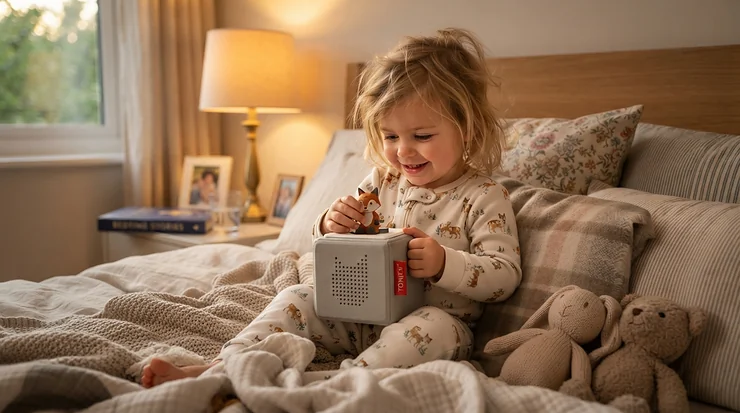
Somewhere between a first birthday cake and a second one, a small miracle happens in your living room: babble turns into words. One day it’s “ba.” The next it’s “ball,” and suddenly you’re being narrated by a person who weighs twenty-four pounds. The toy aisle knows this, which is why talking toys for 1-2 year olds are everywhere, each promising to nudge the miracle along. Some genuinely help. Others are just noisy plastic with a cheerful voice.
Here’s the yardstick worth keeping in your pocket. Per the CDC’s 2-year milestone checklist, most children combine at least two words by age 2 and can point to things in a book when asked. Around 18 months, most are trying three or more words beyond “mama” and “dada.” Those word acquisition milestones are the benchmark for everything below: does a toy help your child hear, try, and repeat words, or does it just make noise?
A transparency note: this roundup is built from published specs and aggregated retail review patterns, not hands-on testing. Treat star ratings as directional, and check current prices before you buy.
What are talking toys for 1-2 year olds?
Talking toys for 1-2 year olds are battery-powered or card-driven toys that say words, phrases, songs, or sounds when a child touches or triggers them. The best ones label real objects, repeat clearly, and respond to the child’s touch or voice, giving toddlers a repeatable model of speech while caregivers join in.
Quick Comparison: Talking Toys for 1-2 Year Olds at a Glance
Short on time? This table puts all seven picks side by side. Each one is unpacked in the full reviews below.
| Toy | Best For | Standout Feature | Price Range |
|---|---|---|---|
| LeapFrog Learning Friends 100 Words Book | First-word labeling, bilingual homes | 100+ words in 12 categories | $20-$30 |
| Fisher-Price Laugh & Learn Smart Stages Puppy | Cuddly play that grows with your child | Three Smart Stages levels | $15-$35 |
| VTech Sit-to-Stand Learning Walker | Cruisers who need to move | Converts from sit-and-play to push walker | $40-$55 |
| Airbition Talking Flash Cards | Budget word repetition | 224 words on 112 cards | $14-$20 |
| Spark Create Imagine Talking Plush Sunflower | Toddlers who love to mimic | Repeats what your child says | $15-$20 |
| Fisher-Price Linkimals Happy Shapes Hedgehog | Active toddlers, shapes and colors | Links with other Linkimals | $25-$36 |
| VTech Touch and Learn Activity Desk Deluxe | Long-term play from age 2 | Desk, easel, 100+ vocabulary words | $40-$70 |
Looking at the table, the LeapFrog Learning Friends 100 Words Book is the clearest vocabulary building toy for early talkers, and the Airbition Talking Flash Cards deliver the most words per dollar. If your toddler is mostly on the move, the VTech Sit-to-Stand Learning Walker is the better interactive talking toy for toddlers who won’t sit still. Budget buyers should note that the Spark Create Imagine Talking Plush Sunflower trades fixed vocabulary for something different: it responds to your child’s own voice.
💬 Just one click — help others make better buying decisions too!😊
Top 7 Talking Toys for 1-2 Year Olds: Expert Analysis
Every pick below is a real product with real specs. Price ranges reflect what retailers listed at the time of research, so check current price before you buy. Ratings come from aggregated retail listings, and I’ve flagged where they were thin or inconsistent.
1. LeapFrog Learning Friends 100 Words Book — best first-word labeling from 18 months
This is the closest thing on the list to a talking picture dictionary, and that’s the point. Touch a picture and the book says the word, adds a sound effect, and offers a quick fun fact. One press delivers the label, the context, and a sound your toddler can try to copy.
It covers 100-plus words across 12 categories, including pets, food, mealtime, vehicles, clothes, and body parts, with English and Spanish play built in. Those are the nouns toddlers learn first, so the book mirrors what’s already on your kitchen table and your child’s body. It runs on two AA batteries, and at least one retail summary says they aren’t supplied.
Based on the spec comparison, this is my top pick for a child who’s pointing but not yet naming, and a natural vocabulary building toy for early talkers. It works best when you sit beside your toddler and say each word together, which turns a button press into a conversation.
Aggregated listings put it around 4.8 stars across well over 100,000 reviews. Reviewers consistently describe it as simple to operate and word-focused. A recurring complaint is that touch-sensitive pages can trigger neighboring words, and one retail summary flags uneven page quality.
Pros:
- ✅ 100+ words in 12 everyday categories
- ✅ English and Spanish play built in
- ✅ Simple touch pages toddlers can run alone
Cons:
- ❌ Sensitive pages trigger nearby words
- ❌ Batteries may not be included
Expect roughly $20-$30. For a toy that earns daily use, that’s strong value.
2. Fisher-Price Laugh & Learn Smart Stages Puppy — grows with your child across three levels
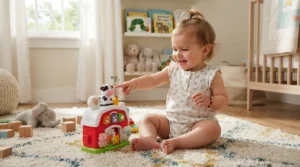
The puppy’s party trick is Smart Stages, three levels that change what it says as your child develops. Level one introduces first words and body parts. Level two encourages counting and finding colors. Level three shifts into pretend-play songs and phrases.
Listings cite 100-plus first words and 75-plus songs, sounds, and phrases, triggered through five touch points: hands, a foot, an ear, and a light-up heart. In practice, that means the toy escalates from labeling to prompting, which suits a child moving from 12 to 24 months. It’s rated for 6 to 36 months, so the first level may feel too basic for an older toddler.
What the spec sheet won’t tell you, but reviewers hint at, is that a plush toy alone won’t teach much. One skeptical reviewer says as much. Used as a prop while you narrate (“Where’s puppy’s foot?”), it becomes a gentle speech development toy for toddlers. Used as a babysitter, it won’t carry early speech development on its own.
Aggregated listings show roughly 4.8 stars across more than 20,000 reviews, with parents praising softness, price, and singing. Critics mostly argue for modest expectations.
Pros:
- ✅ Three levels grow with your child
- ✅ Soft plush toddlers actually cuddle
- ✅ Low price for the amount of content
Cons:
- ❌ Won’t teach much without a talking caregiver
- ❌ Level one content is too basic past 18 months
Expect around $15-$35 depending on version and retailer. It’s a good-value starter for the younger end of the age range.
3. VTech Sit-to-Stand Learning Walker — talking activity center and push walker in one
Most talking toys sit on a shelf. This one moves with your child. It starts as a floor activity panel for sitters, then converts into a push walker for cruisers.
Listings highlight light-up buttons, spinning gears, a shape sorter, a detachable activity panel, and multi-language learning content, for ages 9 months to 3 years. For a one-year-old more interested in standing than speaking, that’s the clever bit: language prompts arrive while the body does its work, so the toy holds attention longer.
Let me be blunt: this is a motor-skills toy with talking features, not a dedicated vocabulary builder. Its language contribution is songs and phrases. It suits families who want one product bridging the walking and talking phases, rather than a pure word-teacher.
It’s the most-reviewed item here, at roughly 4.8 stars across about 98,000 listing reviews. Parents consistently praise sturdiness and the way it grows with the child. Recurring complaints include reduced grip on carpet and a toy phone that can work loose, so check the attachment after unboxing.
Pros:
- ✅ Converts from sit-and-play to push walker
- ✅ Huge, consistent review base
- ✅ Sturdy build for rough toddler handling
Cons:
- ❌ Language content is secondary to motor play
- ❌ Reduced traction on some floor types
Roughly $40-$55. It’s good value if you need a walker anyway, and poor value if vocabulary is your only goal.
4. Airbition Talking Flash Cards — most words per dollar
This pocket-sized reader is simple: slide a card in, hear the word and a matching real-world sound. The set (model KPJ01) includes 112 double-sided cards carrying 224 words across animals, vehicles, foods, fruits, vegetables, and more.
The insert-and-listen routine is a built-in turn-taking game. Your child chooses, the machine answers, you repeat. The listing’s 12-month minimum age is generous, though card handling takes fine motor control, so it’s more realistic for 18 to 24 months. It’s also screen-free, which many parents prefer.
That 224 number looks heroic, but toddlers learn through repetition and context, not volume. The best use is pulling out five or six cards at a time and tying each to a real object in your home. As a vocabulary building toy for early talkers, it’s cheap enough to rotate in and out.
Ratings are inconsistent. One listing shows about 4.9 stars, a comparable Walmart listing sits near 4.1 across 123 ratings, and at least one buyer returned it. Fans call the cards sturdy and easy to slot. Loose cards and a small reader mean supervision, and you should confirm the battery compartment is secured.
Pros:
- ✅ 224 words on 112 double-sided cards
- ✅ Screen-free, simple operation
- ✅ Cheap enough to rotate in and out
Cons:
- ❌ Loose cards get lost or chewed
- ❌ Ratings vary widely between listings
Around $14-$20. It’s excellent value when paired with real objects.
5. Spark Create Imagine Learning Bilingual Talking and Dancing Plush Sunflower — repeats what your toddler says
Where most toys talk at your child, this one talks back, literally. It repeats what it hears, then dances and lights up, which turns every mumble into a call-and-response game.
It’s a 14-inch plush with English and Spanish features, rated for ages 2 and up. For a child experimenting with sounds, that echo is a powerful hook, because a toy that answers makes vocalizing feel worth the effort.
This is the only toy here that responds to a child’s own voice, which is why I’d call it the most genuinely interactive talking toy for toddlers on the list. Its weakness is content: it teaches no fixed vocabulary and simply reflects whatever you give it. Feed it your own word list, such as “banana, ball, boots,” and it becomes a playful speech development toy for toddlers at the older end of the range.
Retail listings put the average in the mid-4-star range across hundreds to thousands of reviews, depending on the listing. I couldn’t verify detailed written reviews, so treat the number as directional. Novelty talkers also tend to lose their shine, so expect the repeat feature to charm in bursts.
Pros:
- ✅ Responds to your child’s own voice
- ✅ English and Spanish play
- ✅ Low price point
Cons:
- ❌ Teaches no fixed vocabulary
- ❌ Rated for 2+, the edge of this age range
Around $15-$20. It’s a fun, low-risk add-on rather than a core purchase.
6. Fisher-Price Linkimals Happy Shapes Hedgehog — best for toddlers who never stop moving
A pull toy that sings, lights up, and syncs with other Linkimals. It’s built for the cruising-and-chasing stage, rated for 9 months and up.
Five light-up buttons teach shapes, colors, and numbers through songs and phrases, and a bat-at roller adds sound. The practical value is concept words (round, red, three) that sit alongside the noun labels your child is already collecting. When it detects other Linkimals nearby, it triggers a synchronized music and light show, which is charming but locks you into one product family.
Treat it as an interactive talking toy for toddlers who need a reason to stay engaged, not a primary word-teacher. The collect-them-all linking encourages extra spending, so skip it if you’re shopping for a single toy.
A major retail listing shows about 4.6 stars across more than 1,000 ratings. Shoppers like the linking, while one buyer found the hedgehog noticeably quieter than other Linkimals. Availability fluctuates, and one large listing showed it out of stock at the time of research.
Pros:
- ✅ Teaches shapes, colors, and numbers through songs
- ✅ Pull-along movement encourages cruising
- ✅ Links with other Linkimals toys
Cons:
- ❌ Only links with other Linkimals toys
- ❌ Fewer true first words than a word book
Around $25-$36. Fair value if you’ll collect more than one.
7. VTech Touch and Learn Activity Desk Deluxe — best grow-into pick for 2-year-olds
Part desk, part easel, part chalkboard, this is the biggest toy here and the one most likely still in use at age four.
Listings cite 100-plus vocabulary words, 20-plus activities, and 20-plus songs across five activity pages, with an LED display showing letter and number strokes. It’s labeled for ages 2 and up. For a two-year-old, the vocabulary prompts are the doorway, and the writing features are for later. One reviewer noted a one-year-old could swap the cards, which suggests the core interaction is forgiving.
I’d frame this as the long-game purchase. Much of its content targets ages 3 to 6, so a 13-month-old will only scratch the surface. A 22-month-old who loves pressing, pointing, and naming will get real mileage, and the vocabulary building continues as they grow.
Aggregated listings show about 4.7 stars across more than 27,000 reviews. Parents find the cards easy to swap and the build forgiving. Recurring complaints include overly sensitive buttons and the need for matching chip cards with expansion packs.
Pros:
- ✅ 100+ vocabulary words plus activities
- ✅ Easel and chalkboard extend its useful life
- ✅ Easy card swapping for small hands
Cons:
- ❌ Much content is aimed at older kids
- ❌ Expansion packs add cost and compatibility headaches
Around $40-$70 depending on retailer and version. It’s the priciest pick, but its lifespan justifies the spend.
Top 7 Specs Side by Side
| Toy | Maker Age Range | Language Content | Listing Rating* | Price Range | Best For |
|---|---|---|---|---|---|
| LeapFrog Learning Friends 100 Words Book | 18 months+ | 100+ words, 12 categories, English/Spanish | ~4.8 | $20-$30 | Naming first objects |
| Fisher-Price Laugh & Learn Smart Stages Puppy | 6-36 months | 100+ first words, 75+ songs/phrases | ~4.8 | $15-$35 | Younger toddlers |
| VTech Sit-to-Stand Learning Walker | 9 months-3 years | Songs, phrases, multi-language content | ~4.8 | $40-$55 | Cruising and walking |
| Airbition Talking Flash Cards | 12 months+ | 224 words on 112 cards | ~4.1-4.9 | $14-$20 | Budget repetition |
| Spark Create Imagine Talking Plush Sunflower | 2 years+ | Repeats child’s speech, bilingual | Mid-4s | $15-$20 | Mimicking and play |
| Fisher-Price Linkimals Happy Shapes Hedgehog | 9 months+ | Shapes, colors, numbers via songs | ~4.6 | $25-$36 | Active toddlers |
| VTech Touch and Learn Activity Desk Deluxe | 2 years+ | 100+ vocabulary words, 20+ activities | ~4.7 | $40-$70 | Long-term use |
*Ratings are approximate averages from retail listings at the time of research and vary by listing.
The table makes the trade-offs obvious. The LeapFrog Learning Friends 100 Words Book and Airbition Talking Flash Cards are the most vocabulary-focused, while the VTech Sit-to-Stand Learning Walker and Fisher-Price Linkimals Happy Shapes Hedgehog prioritize movement. If your budget is tight, pair the Airbition Talking Flash Cards with a library board book and you’ll cover more ground than a single $60 gadget would.
Word Acquisition Milestones: What to Expect Between 12 and 24 Months
Before you spend a dime, it helps to know what “normal” looks like. These word acquisition milestones come from CDC and pediatric sources, and they describe what at least 75% of children do by a given age, not a deadline.
Around 12 months, babble starts carrying meaning, and first words appear. By 15 months, most children try one or two words beyond “mama” and “dada,” like “ba” for ball. At 18 months, the target is three or more additional words, and pediatric sources note that most toddlers say around ten words while understanding roughly 100 to 200. By 24 months, most combine two words, like “more milk.” By 30 months, many use around 50 words.
Notice the gap between understanding and speaking. Receptive language runs well ahead, so a child who “isn’t talking” may still be absorbing plenty. That’s why early speech development rewards patient, repetitive exposure more than flashy gadgets.
Every child moves at their own pace, and premature babies may reach milestones later. But if your toddler has lost skills they once had, or seems far behind these word acquisition milestones, talk to your pediatrician rather than shopping for a fix.
How to Choose Talking Toys for 1-2 Year Olds
Use these seven steps to filter hype from help.
- Match the age rating to your child’s actual stage. A toy rated 2+ may frustrate a 13-month-old, while a 6-month-plus toy may bore a 23-month-old.
- Prefer clear single words over sound effects and songs. Toddlers need clean, repeatable models of speech.
- Check whether it responds to touch or voice. A toy that answers your child’s own sounds rewards attempts at communication.
- Look for a volume control or quiet mode. You’ll be hearing this toy hundreds of times.
- Check battery security. A screwed-shut compartment is non-negotiable for under-3s.
- Choose words that match your home. Nouns for food, pets, and body parts get used daily, which is exactly where vocabulary building sticks.
- Pick something you’ll want to play with. A good vocabulary building toy for early talkers works when an adult joins in, so choose a toy you won’t dread.
Choosing a Speech Development Toy for Toddlers: Features That Matter (And Those That Don’t)
Marketing copy loves big numbers. Here’s what actually counts when you’re evaluating a speech development toy for toddlers.
Features that matter: a clear, slow voice; the ability to repeat a word when asked; labels for real, recognizable objects; and a way to turn the volume down. A toy that makes your child do something (press, point, insert a card) beats one that performs at them.
Features that don’t: a count of how many songs it plays, flashing light shows, and “teaches 1,000 words” claims. A toddler can’t absorb a thousand words from a single toy in a single year, and the number says nothing about quality. Zero to Three, the early-childhood nonprofit, notes that lights, buttons, and music can overwhelm a child still learning cause and effect.
A useful test: if the toy were silent, would your child still be able to play with it in a way that invites you to talk? If yes, the electronics are a bonus. If no, you’re buying a speaker with a face. The best speech development toy for toddlers is one that gives you something to say.
Early Speech Development: Do Talking Toys Help or Hinder?
This is the honest part of the conversation. Research suggests electronic toys can quiet the adult half of the dialogue, and adult talk is the fuel for early speech development.
In a widely covered study led by Anna Sosa, parents played with babies aged 10 to 16 months using electronic toys, traditional toys, and board books. Parents spoke about 40 words per minute with the electronic toys, compared with roughly 56 with traditional toys and about 67 with books. Conversation quality, including turn-taking and responsiveness, also dipped with the electronic toys. The study was small, at 26 families, mostly white and educated, so it’s a signal rather than a verdict.
The takeaway isn’t “ban the talking toys.” It’s “don’t let the toy do the talking.” Treat each toy as a conversation prop. Sit beside your toddler, repeat what the toy says, and add your own words.
| Factor | Interactive Talking Toy | Traditional Alternative (board books, blocks, shape sorters) |
|---|---|---|
| Parent talk | Can drop if the toy “takes over” | Typically higher, especially with books |
| Word modeling | Consistent, clear pronunciation | Depends entirely on the caregiver |
| Replay value | Novelty can fade quickly | Open-ended, long-lasting |
| Safety | Batteries and small parts need checking | Fewer electronics concerns |
| Cost | $14-$70 for picks like LeapFrog 100 Words Book or VTech Activity Desk Deluxe | Often under $15 |
| Best For | Repetition, bilingual exposure, independent moments | Rich back-and-forth conversation |
Traditional toys win on parent conversation, while talking toys like the Airbition Talking Flash Cards and LeapFrog 100 Words Book win on consistent, repeatable word models. The strongest setup is both: a stack of board books and one or two talking toys you actively use together.
Vocabulary Building at Home: A 4-Week Practical Plan
A toy is only as good as the routine around it. Here’s a simple vocabulary building plan you can run with any pick above.
Week 1: Choose five target words. Pick nouns tied to daily life: ball, milk, shoe, dog, banana. Use the LeapFrog 100 Words Book or Airbition Flash Cards to find the matching picture, then say the word naturally throughout the day.
Week 2: Pair the toy with the real thing. Hear “banana” from the toy, then hold a real banana and say it again. This bridge from screen-free picture to real object is what Amazon listings never explain.
Week 3: Pause and wait. After saying a word, wait five to seven seconds with an expectant look. Silence is a prompt.
Week 4: Expand. When your toddler says “ball,” respond with “big ball” or “red ball.” This is the move from word to word combination.
Common mistakes in the first 30 days: leaving the toy on constantly, correcting instead of repeating, and offering more than two or three toys at once. Rotate toys weekly, wipe them down, and replace batteries before the voice slows or distorts.
ASHA’s roundup of speech-language pathologist toy recommendations leans on simple, low-cost play items like pop-up toys, a reminder that the interaction matters more than the electronics.
Vocabulary Building Toy for Early Talkers: Real-World Scenarios
Here are three hypothetical family profiles to show how the right pick changes with the situation.
Scenario 1: The pointer. A 13-month-old points at everything but hasn’t said a word. The family is bilingual, the budget is under $30, and they can set aside 15 minutes a day. The LeapFrog 100 Words Book is the match, because it labels everyday nouns in English and Spanish, and 15 daily minutes of shared pointing is exactly the right dose.
Scenario 2: The mimic. A 22-month-old in daycare copies every sound, with about $20 to spend. The Spark Create Imagine Sunflower feeds that imitation instinct, and the Airbition Talking Flash Cards add actual word content. Together they run under $40, and both are easy to pack along.
Scenario 3: The cruiser. A 16-month-old pulls up on furniture, and grandparents with hardwood floors want one gift. The VTech Sit-to-Stand Learning Walker keeps him moving while songs and phrases play in the background. It won’t replace books, but it fits a busy household.
For a child who loves pressing and naming at 2 and beyond, the VTech Activity Desk Deluxe is the long-term pick. In every scenario, the toy is the starting point. The lasting vocabulary building toy for early talkers is you, narrating the day.
Interactive Talking Toy for Toddlers: Safety, Batteries, and Noise
Any interactive talking toy for toddlers brings electronics, and electronics bring risk.
The U.S. Consumer Product Safety Commission bans small parts in toys intended for children under 3, defining a small part as anything that fits entirely inside a cylinder approximating a young child’s fully expanded throat. Stick to age-appropriate labels, and be especially careful about toys intended for older siblings.
Batteries deserve extra attention. Button and coin cell batteries can cause serious internal injuries if swallowed, so confirm that any battery compartment is secured, ideally with a screw. Zero to Three also flags small batteries as a hazard in electronic toys.
For noise, the Fisher-Price Linkimals Happy Shapes Hedgehog and Fisher-Price Puppy play songs at volumes that can wear on adults quickly. If a toy lacks a volume control, put tape over the speaker or remove the batteries between sessions. Finally, check the CPSC site for recalls before buying secondhand.
Long-Term Cost: Are Talking Toys Worth It?
Let’s do some cost-per-use math. Imagine a toy in the $20-$30 range used for 15 minutes a day over six months. That’s about 45 hours of play, which works out to well under a dollar per hour. Even a $40-$70 pick like the VTech Touch and Learn Activity Desk Deluxe, used for two or three years, comes out cheaper per hour than most entertainment.
Hidden costs matter too. Batteries add up, so keep a stash of fresh ones. Expansion packs for the VTech Activity Desk Deluxe can double your outlay, and Linkimals collecting can quietly inflate your budget.
The best value strategy is to pick two toys with different jobs, one word-focused like the LeapFrog 100 Words Book and one movement-focused like the VTech Sit-to-Stand Learning Walker, and add free tools: library books, kitchen objects, and your own voice. A great speech development toy for toddlers should reduce your shopping, not multiply it.
FAQ
❓ Which talking toys for 1-2 year olds are best for a tight budget?
❓ What age is right for an interactive talking toy for toddlers?
❓ Do talking toys actually support early speech development?
❓ Is a vocabulary building toy for early talkers worth it for a late talker?
❓ How many talking toys does a toddler need?
Conclusion
Talking toys for 1-2 year olds can be genuinely helpful, but only when they’re part of a conversation. The standouts here earn their place for different reasons: the LeapFrog Learning Friends 100 Words Book for first-word labeling, the Airbition Talking Flash Cards for budget repetition, the Fisher-Price Laugh & Learn Smart Stages Puppy for gentle growth across stages, and the VTech Touch and Learn Activity Desk Deluxe for staying power. The Spark Create Imagine Sunflower, Fisher-Price Linkimals Happy Shapes Hedgehog, and VTech Sit-to-Stand Learning Walker round things out for mimics and movers.
Remember the big picture. Early speech development is built on back-and-forth talk, and the best speech development toy for toddlers is the one that makes you say more, not less. Use the milestones as a compass, keep an eye on safety, and pick the interactive talking toy for toddlers that fits your child’s stage, your budget, and your routine. Vocabulary building starts with a single repeated word and a parent who’s paying attention.
Recommended for You
- Screen-Free Tech Toys For Toddlers Under 2: 7 Brilliant Picks 2026
- Learning Tablet For A 1 Year Old: 7 Best Safe Picks 2026
- Sensory Toys With Tech For A 6 Month Old: 7 Best Picks (2026 Guide)
Disclaimer: This article contains affiliate links. As an Amazon Associate, I earn from qualifying purchases. If you purchase products through these links, we may earn a small commission at no additional cost to you.
✨ Found this helpful? Share it with your friends! 💬🤗
