
In This Article
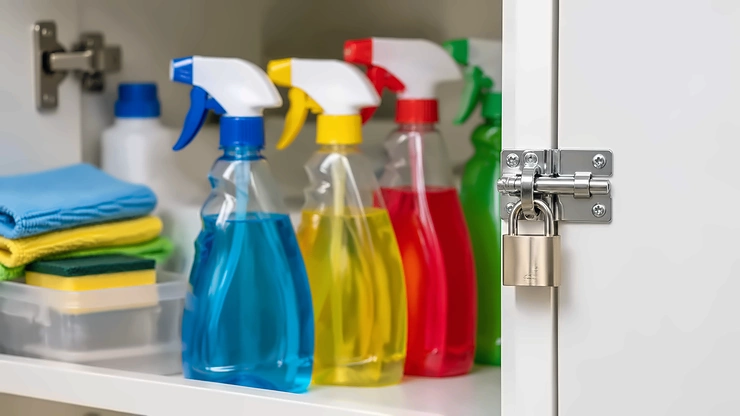
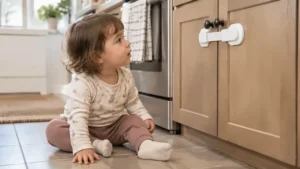
The cabinet under your kitchen sink sits at the exact height of a crawling baby’s curiosity. It is also usually stuffed with the most dangerous stuff in the house: bleach, drain opener, oven cleaner, and dishwasher pods that look like candy. Choosing a cabinet latch for under sink with cleaning chemicals isn’t a cute nursery-planning chore. It’s one of the few purchases where a small piece of plastic and a 30-second install can change a family’s risk profile.
Poison-safety groups say it plainly. Poison Control’s prevention guidance tells families to install child safety latches on every cabinet that holds harmful products. It also says to pull items like detergents and drain cleaners out from under the sink entirely. So the latch is the safety net, not the first move. We’ll dig into that in the poison prevention section.
The market, meanwhile, is a jungle. There are magnetic locks, strap locks, squeeze-and-lift designs, and double-door arms. Half the listings look identical. This guide cuts through the noise. I compared seven real products on what matters for chemical storage: how the mechanism resists a determined toddler, how it survives daily use, and whether it fits your cabinet. That last point includes double door cabinet spacing, which quietly ruins more purchases than any manufacturing defect.
Prices below are ranges, not live numbers, so check current price on each listing before you buy. And one honest caveat up front: no latch is childproof. The good ones are child-resistant, which buys you time.
Quick Comparison: 7 Under-Sink Latches at a Glance
Here’s the lineup before we get into the weeds. Skim the “Best For” column first. It’s the fastest way to find your match.
| Product | Type | Install | Best For |
|---|---|---|---|
| Safety 1st Magnetic Locking System (8 Locks, 1 Key) | Hidden magnetic | Screws | Heavy daily-use doors that need maximum holding power |
| Safety 1st Adhesive Magnetic Lock System (4 Locks, 1 Key) | Hidden magnetic | Adhesive | Renters and first-time installers |
| Vmaisi 20 Pack Magnetic Cabinet Locks | Hidden magnetic | Adhesive | Whole-house coverage on a budget |
| Dreambaby Adhesive Mag Lock (4 Locks + 1 Key) | Hidden magnetic with status indicator | Adhesive plus template | Parents who forget to re-engage locks |
| Skyla Homes Cabinet Strap Locks (8-Pack) | Adjustable strap | Adhesive | Fast, flexible, low-cost coverage |
| Munchkin Xtraguard Dual Action Multi-Use Latches | Dual-button strap | Adhesive | Anyone who wants a dual action latch on knobs or handles |
| Qdos Adhesive Double Door Lock by Cardinal Gates | Dual-release arm | Adhesive | Framed double door cabinets |
Looking at the table, the Safety 1st Magnetic Locking System (8 Locks, 1 Key) is the only screw-mounted option here, and that matters in a damp, greasy sink cabinet. If your doors meet in the middle, the Qdos Adhesive Double Door Lock by Cardinal Gates was built for exactly that layout. The strap options trade stealth for flexibility. Budget buyers should note that the Skyla Homes Cabinet Strap Locks (8-Pack) and Vmaisi 20 Pack Magnetic Cabinet Locks deliver the lowest cost per lock.
💬 Just one click — help others make better buying decisions too!😊
Top 7 Cabinet Latch Options for Under Sink With Cleaning Chemicals: Expert Analysis
Every pick below is a real, currently listed product. I leaned on manufacturer specs and aggregated buyer-review sentiment rather than claiming hands-on testing. That means you get honest analysis, not invented war stories. The table gives the numbers; the sections give the meaning.
| Product | Mounting | Price Range | Aggregated Rating* |
|---|---|---|---|
| Safety 1st Magnetic Locking System (8 Locks, 1 Key) | Screws | $25–$40 | ~4.5 (3,500+ ratings) |
| Safety 1st Adhesive Magnetic Lock System (4 Locks, 1 Key) | 3M adhesive | $15–$25 | ~4.6 (1,200+ ratings) |
| Vmaisi 20 Pack Magnetic Cabinet Locks | 3M adhesive | $35–$45 | ~4.6 |
| Dreambaby Adhesive Mag Lock (4 Locks + 1 Key) | Adhesive | $20–$30 | ~4.3 (Babylist, ~58 reviews) |
| Skyla Homes Cabinet Strap Locks (8-Pack) | Adhesive strap | $12–$20 | ~4.6 (37,000+ ratings) |
| Munchkin Xtraguard Dual Action Multi-Use Latches | Adhesive strap | Budget tier; check current price | Verify on listing |
| Qdos Adhesive Double Door Lock by Cardinal Gates | Adhesive arm | Around $9–$12 per lock | Verify on listing |
*Ratings come from retail listings at the time of research and change constantly.
Notice the pattern: the magnetic systems cost more per lock but disappear from view. The strap and arm styles cost less but announce themselves. For a cabinet holding bleach, that tradeoff is the whole decision. The two rows marked “verify” are products where I couldn’t confirm a stable aggregate rating, so I’d rather tell you than guess.
1. Safety 1st Magnetic Locking System (8 Locks, 1 Key) — screw-mounted security that outlasts adhesive
This is the belt-and-suspenders pick. The lock body screws into the inside of the door, so nothing depends on glue surviving humid, greasy sink-cabinet life.
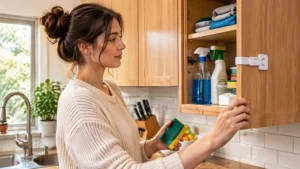
Eight locks and one magnetic key means a double-door sink cabinet takes two locks. The other six cover the pantry, a drawer, or the bathroom vanity. Because the lock lives inside the cabinet, a toddler has no button to study and no strap to tug. The system also disengages for periods of non-use, which is handy during a deep clean but risky if you forget to flip it back.
Based on the spec comparison, this suits families who want the chemicals genuinely secured and don’t mind a drill. Screws beat adhesive wherever doors are slammed, steamed, or splashed daily. Listings show roughly 4.5 stars across thousands of ratings, with reviewers describing it as one of the few systems a child can’t beat without the key. A recurring complaint is that small plastic parts can snap and replacements are hard to source, so buy a spare pack if you can.
Pros:
- ✅ Screw-mount holds on greasy, humid doors
- ✅ Fully hidden inside the cabinet
- ✅ Magnetic key stays up and out of reach
Cons:
- ❌ Needs a drill and careful alignment
- ❌ Small plastic parts can break; spares are scarce
Expect roughly a $25–$40 range. It’s the priciest per lock, but the best per-cabinet value if secure matters more than stealthy-and-cheap.
2. Safety 1st Adhesive Magnetic Lock System (4 Locks, 1 Key) — the no-drill magnetic lock for renters
Same invisible-magnet idea, minus the power tools. The adhesive-backed lock sticks inside the door, and the key releases it from outside.
The manufacturer’s Q&A says these were tested on cabinet doors from about 1/2 inch to 1 1/2 inches thick. That range is the spec to check first, because a magnet has to reach through the door. Thick or double-skinned doors may leave the key too weak to release it. Some retail listings mention optional screws and others don’t, so confirm what’s in your pack.
My analytical take: this is the easiest on-ramp for renters who can’t drill. For an under-sink cabinet that gets opened daily, I’d treat adhesive as a commitment. Degrease the surface, wait the full cure time, and consider screws if your pack includes them. Aggregated ratings sit near 4.6 across roughly 1,200 listings. Reviewers love the simplicity and the on/off switch. The recurring critique across adhesive locks, this one included, is “works great until it fails” under heavy use. Also note that a newer Safety 1st “Secure-to-Explore” line has drawn comments that it’s harder to install, so check which version you’re buying.
Pros:
- ✅ Tool-free install, renter-friendly
- ✅ Hidden magnetic release
- ✅ Can be disengaged when not needed
Cons:
- ❌ Adhesive may loosen under daily heavy use
- ❌ Door-thickness limits can rule it out
Plan on around $15–$25. Fair value if your doors fit the thickness spec.
3. Vmaisi 20 Pack Magnetic Cabinet Locks — the most locks per dollar
Twenty locks and two keys is a whole-house kit disguised as a single purchase.
The 3M adhesive mount and the stated compatibility with doors up to about 2 inches thick are the headline specs. That extra thickness tolerance means solid-wood and thicker doors that defeat other magnetic systems may still work. Invisible from the outside, the lock gives a curious toddler nothing to investigate.
Here’s what I’d weigh: this is the volume play. If you’re also securing the pantry, fridge, bathroom, and a second-floor dresser, per-lock cost drops fast. For the chemicals cabinet itself, treat installation like a science experiment. Clean thoroughly, align precisely, and wait out the cure before loading the shelf. Listings show roughly 4.6 stars. Buyer reviews and roundups describe the adhesive staying bonded on wood and MDF interiors, while the standard category caveat applies: surface prep decides everything. Two keys help, but magnetic keys love to disappear, so give yours a permanent home on top of the fridge.
Pros:
- ✅ Twenty locks cover an entire home
- ✅ Handles doors up to about 2 inches thick
- ✅ Completely hidden once installed
Cons:
- ❌ Overkill if you only need a few locks
- ❌ Adhesive-only mounting
Expect a $35–$45 range. It’s excellent value if you’ll use most of the pack.
4. Dreambaby Adhesive Mag Lock (4 Locks + 1 Key) — the red/green lock-status indicator
The headline feature is the EZY-Check indicator: a red/green window that shows whether the lock is engaged.
That sounds like a gimmick until you remember that the biggest hole in any disengageable lock is a tired parent forgetting it’s switched off. The indicator turns a silent failure into a glance-and-fix. Each pack includes a placement template, and the lock hides inside the cabinet like other magnetic systems.
From the spec sheet, this is best for households where more than one adult handles the cabinets. Grandparents, babysitters, and partners all benefit from a visible status check. Aggregated sentiment is solid but based on a smaller pool, roughly 4.3 stars from about 58 reviews on one retailer. One reviewer reported the template wouldn’t transfer cleanly even on a clean, dry door, which is a reminder to dry-fit before peeling any backing. Check the pack for optional screws, since some retail listings mention them.
Pros:
- ✅ Red/green indicator confirms lock status
- ✅ Hidden magnetic design
- ✅ Template included for placement
Cons:
- ❌ Smaller review base than competitors
- ❌ Template can be fiddly to use
Roughly $20–$30. It’s a worthwhile premium if forgetfulness is your family’s weak spot.
5. Skyla Homes Cabinet Strap Locks (8-Pack) — the most-reviewed everyday workhorse
If a latch can have a “default” status, this is it. The adjustable nylon strap bends around uneven gaps and awkward angles.
The strap adjusts across roughly 3 to 7 inches, so it can span two knobs on a double-door cabinet or wrap a fridge handle. A press-and-slide release works one-handed, which matters when you’re holding a toddler and a pot. Listings show about 4.6 stars across tens of thousands of ratings, and the product has sat at or near the top of the category’s best-seller ranking. That volume is a real signal of broad compatibility.
Now the analysis. A strap lock is visible, so a child can watch you operate it and learn to copy you. That’s the main weakness against hidden magnets. Under a sink that gets opened constantly, repeated use can also wear on any strap-style lock. My read: this is a strong choice for cabinets holding non-toxic items, or as a second layer on a double-door cabinet. For the actual chemicals, pair it with moving the worst offenders to a high shelf. The most common complaint is the 24-hour adhesive cure time, which is manageable if you plan for it.
Pros:
- ✅ Adjustable strap fits many door layouts
- ✅ One-handed press-and-slide release
- ✅ Very large review base and low cost per lock
Cons:
- ❌ Visible, so toddlers can learn the mechanism
- ❌ Needs a full day to cure before use
Around a $12–$20 range, often under about $2.50 per lock. Excellent value, with the caveat above.
6. Munchkin Xtraguard Dual Action Multi-Use Latches — a two-button dual action latch for knobs and handles
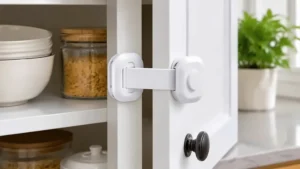
This is the dual action latch of the group. It needs two separate button presses to open, which is the whole point.
A single-motion toddler fumble can defeat a basic latch. A dual action latch asks for two coordinated actions, a task that’s genuinely hard for small hands. Product descriptions list a dual-button release, a flexible strap, and adhesive mounting. Roundups typically position it as the “double-lock security” choice among strap styles. I couldn’t verify a stable aggregate rating, so check the live reviews before you commit.
Here’s what to weigh: it’s visible, like other straps, but the two-step release raises the effort bar. That makes it a sensible pick for a sink cabinet where hidden magnets won’t fit your door style. Expect a slightly slower release for you too, which is the nature of dual action latches. Measure first, because strap length limits apply, and a poor fit leaves a gap.
Pros:
- ✅ Two-button release raises the difficulty for kids
- ✅ Flexible strap suits knobs and handles
- ✅ No drilling required
Cons:
- ❌ Visible hardware on the cabinet face
- ❌ Aggregate ratings need checking on the live listing
I couldn’t confirm a live price. Sets in this category generally land in the $8–$15 neighborhood, so check current price. Worth it if the two-step release appeals.
7. Qdos Adhesive Double Door Lock by Cardinal Gates — built for framed double doors
Most latches treat double doors as an afterthought. This one starts there.
The manufacturer’s FAQ explains that standard sliding locks leave doors able to pull open slightly, creating a finger-pinch gap. This lock holds the doors completely closed. It fits framed double-door cabinets with or without a center post, and it ships with four arm lengths plus a mounting plate for that center piece. The arm is slightly over 1/8 inch thick, and the maker notes that most cabinet hinges can be adjusted sideways to widen a too-tight gap. Critically, it does not work on frameless (Euro or IKEA-style) cabinets.
My analysis: double door cabinet spacing is the make-or-break variable, and this product confronts it directly. Dual release buttons are hard for a child to press simultaneously, and adults operate it one-handed. The brand is refreshingly honest that you should stop using it once your child can defeat it. Check the live listing for current ratings, since I couldn’t verify a stable aggregate.
Pros:
- ✅ Eliminates the finger-pinch gap
- ✅ Includes arms for center-post cabinets
- ✅ One-handed adult release
Cons:
- ❌ Won’t fit frameless cabinets
- ❌ Needs adequate gap between doors
Around $9–$12 per lock. Cheap insurance if your cabinet matches the design.
Practical Installation Guide: Mount a Child Safety Latch for Chemical Cabinet Use in 30 Minutes
Adhesive failure is the most common reason an under-sink latch disappoints, and most of it is preventable. Here’s the order that gives you the best shot.
- Empty and clean the cabinet. Clear the cleaners, then wipe the mounting area with isopropyl alcohol to cut grease and soap film.
- Dry-fit first. Hold the lock and the template in place and check alignment before you peel anything. For magnets, confirm the key releases it at your door’s thickness.
- Press hard, then wait. Apply firm pressure for about a minute. Buyers repeatedly note that adhesive mounts need roughly 24 hours to cure, so don’t load the cabinet early.
- Add screws where offered. Under a sink, screws beat glue. If your pack includes them, use them.
- Run the tug test. Pull the door hard, the way a determined toddler would. If anything shifts, stop and re-seat it.
- Give the key a permanent home. Somewhere high, visible to adults, invisible to kids.
Maintenance schedule: check the lock monthly with another tug test. Re-check after any deep clean, and replace adhesive pads at the first sign of lifting. In the first 30 days, the common mistakes are skipping the cure time and leaving a disengageable lock switched off.
✨ Don’t Miss These Top-Rated Picks!
🔍 Take your under-sink safety to the next level with the latches above. Click on any highlighted product to check current pricing and availability. A few minutes of installing now means a lot more peace of mind later!
Real-World Scenarios: Which Latch Fits Your Home?
Specs are abstract. Households aren’t. Here are three profiles, with a budget, a setting, and how often the cabinet gets opened.
Scenario 1: The renter with a crawling baby. You’re in a rental kitchen, can’t drill, and open the sink cabinet maybe a dozen times a day. Budget is tight. The Safety 1st Adhesive Magnetic Lock System (4 Locks, 1 Key) gives you a hidden lock without tools, and it fits a small budget. If your doors are within the thickness spec, it’s the logical fit. Use the optional screws only if your landlord allows them.
Scenario 2: The family with a clever 3-year-old and framed double doors. Your toddler watches everything and copies it. A visible strap is a tutorial. Here the Qdos Adhesive Double Door Lock by Cardinal Gates solves the pinch gap and the spacing, while the Safety 1st Magnetic Locking System (8 Locks, 1 Key) is the stealth upgrade if you’ll drill. Opening frequency is high, so durability matters most.
Scenario 3: Grandparents hosting a few weekends a month. Nobody’s there daily, and multiple adults forget the routine. The Dreambaby Adhesive Mag Lock (4 Locks + 1 Key) earns its place because the indicator shows status at a glance. The Skyla Homes Cabinet Strap Locks (8-Pack) also works for secondary cabinets in a pinch.
The pattern: pick for your child’s temperament, your cabinet’s design, and how forgetful the adults are. Price comes last.
Problem → Solution Guide: When Under-Sink Latches Fail
Even good hardware fails when the setup is off. These are the four problems you’re most likely to meet.
Problem 1: The adhesive lets go. This is the biggest complaint across adhesive locks. Solution: re-clean with alcohol, press firmly, wait a full day, and use screws where possible. The Safety 1st Magnetic Locking System (8 Locks, 1 Key) is the fix if adhesive keeps failing on your doors.
Problem 2: Your toddler learns the mechanism. Kids who watch you unlock a strap will mimic it. Solution: switch to a hidden magnetic lock like the Vmaisi 20 Pack Magnetic Cabinet Locks, and never open any latch in front of a child.
Problem 3: The doors still gap. Sliding or loop locks can leave a slit. Solution: use the Qdos Adhesive Double Door Lock by Cardinal Gates, or adjust hinges to improve alignment before mounting.
Problem 4: Everyone forgets to re-engage. Solution: choose a lock with a visible indicator, like the Dreambaby Adhesive Mag Lock (4 Locks + 1 Key), or one that re-locks automatically each time the door closes.
What Is a Cabinet Latch for Under Sink With Cleaning Chemicals?
A cabinet latch for under sink with cleaning chemicals is a child-resistant locking device that keeps toddlers from opening a cabinet that stores hazardous household products. It works by requiring a magnetic key, a two-step squeeze, or a hidden release that small children can’t easily figure out.
That definition matters because “child-resistant” is an engineering term, not a marketing one. Under the U.S. Poison Prevention Packaging Act, the Consumer Product Safety Commission requires special child-resistant packaging for certain household substances, and you can read the rules on the CPSC’s PPPA page. A latch plays a similar role one layer up: it’s the lock on the container that holds the containers.
There are four broad families: hidden magnetic locks, adjustable strap locks, dual action latch designs, and double-door arms. Each makes a different tradeoff between stealth, strength, and ease of use. The rest of this guide helps you match one to your cabinet.
How to Choose a Cabinet Latch for Under Sink With Cleaning Chemicals
Skip the feature-list scrolling. Work through these steps in order.
- Check your cabinet type. Framed or frameless? Single or double door? This decides which products can physically work.
- Measure the gap and spacing. For handles or knobs, measure the distance between them. Strap locks typically span about 3–7 inches, so know your number.
- Check door thickness for magnets. A magnetic lock needs the key to reach through the door, and thick doors can defeat weaker magnets.
- Match mount to your situation. Renters should lean adhesive, while owners with heavy-use doors should lean screws.
- Pick stealth over convenience. A hidden lock teaches a child nothing, and a visible one invites study.
- Plan for adults. One-handed release matters when you’re carrying a baby. Indicators help families with several adult users.
- Budget for backups. Spare adhesive, extra screws, and a second key save a bad afternoon.
Double Door Cabinet Spacing and the Dual Action Latch Question
Most under-sink cabinets have two doors meeting in the middle. That layout creates the single most common shopping mistake: buying a latch that doesn’t fit the spacing.
Start with the numbers. Measure center-to-center between knobs or handles. A KidCo sliding lock, for instance, lists a fit range of about 2–7 inches apart, while a Safety 1st adjustable design lists roughly 3–8 inches. Beyond that, check whether your doors are framed or frameless. The Qdos Adhesive Double Door Lock by Cardinal Gates works on framed double-door cabinets but not on frameless (Euro or IKEA-style) ones. It also needs a small gap between doors, and the arm is just over 1/8 inch thick.
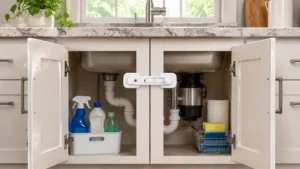
Now the dual action latch question. A dual action latch requires two actions to release, such as pressing two buttons or squeezing and lifting. That doubles the difficulty for a small hand while staying manageable for an adult. The Munchkin Xtraguard Dual Action Multi-Use Latches and the Qdos arm both use this idea. If your double door cabinet spacing is awkward, the arm design is the cleanest solution. If your spacing is standard and doors line up, hidden magnets sidestep the issue entirely, since each door gets its own lock.
Latch Types Compared: Benefits vs Traditional Alternatives
Here’s how the four latch families stack up against two common “do nothing” alternatives.
| Option | Visibility | Strength | Convenience | Best For |
|---|---|---|---|---|
| Hidden magnetic | Invisible | High | Needs a key | Safety 1st Magnetic Locking System (8 Locks, 1 Key), Vmaisi 20 Pack Magnetic Cabinet Locks |
| Adjustable strap | Visible | Medium | One-handed | Skyla Homes Cabinet Strap Locks (8-Pack) |
| Dual action latch | Visible | Medium–High | Two-step | Munchkin Xtraguard Dual Action Multi-Use Latches |
| Double-door arm | Visible | Medium–High | One-handed | Qdos Adhesive Double Door Lock by Cardinal Gates |
| Rubber band or hair tie | Visible | Very low | Easy | Nothing; skip it |
| No lock, chemicals moved up | N/A | High (if truly out of reach) | Changes habits | Households that can relocate everything |
The takeaway: hidden magnets win on strength and stealth, while straps and arms win on flexibility and price. The improvised options lose on safety. Relocating chemicals beats every lock, which is exactly what poison-safety guidance says. Treat the latch as the backup, not the plan.
Poison Prevention: What a Latch Can and Can’t Do
Poison prevention works in layers, and a latch is one of them. The data explain why. Household cleaners account for roughly one in ten pediatric exposures reported to poison control centers, according to the National Capital Poison Center. Safe Kids Worldwide notes that young kids are often eye-level with items under the kitchen and bathroom sinks. That’s why bleach, detergent, and dishwasher liquid should find a new home.
So what should your layers look like?
- Move the worst offenders up high. Drain cleaners and oven cleaners belong on a high shelf, not under the sink.
- Lock what must stay. Use a child safety latch for chemical cabinet storage on everything left behind.
- Keep original containers. Never decant chemicals into drink bottles.
- Remember “child-resistant” isn’t “childproof.” CPSC’s own brochure says the special packaging is child-resistant, not childproof.
- Read the label on the latch itself. At least one brand, Prince Lionheart, says on its product page not to use its latch to secure dangerous or harmful items.
- Save the number. Program Poison Help, 1-800-222-1222, into your phone and post it near the sink.
If a child may have swallowed something harmful, call that number right away. If they’ve collapsed or aren’t breathing, call 911.
Under Sink Cabinet Lock for Toddlers: A Child Safety Latch for Chemical Cabinet Done Right
Toddlers aren’t just curious; they’re observational. An under sink cabinet lock for toddlers has to beat a small person who watches your hands like a hawk.
A guiding principle from the childproofing world: the best safety devices are the ones a child doesn’t know are there. That’s the case for hidden magnetic locks. A visible strap or arm shows a child exactly where to push. A magnet gives them nothing to study.
Match your approach to the stage. For crawlers, a basic child safety latch for chemical cabinet storage plus relocation does the job. For walkers, step up to a hidden or dual action design, because they can pull, push, and mimic. For climbers around three, add screws, since a strong adhesive mount can still be defeated by body weight. Also keep in mind that any latch loses effectiveness when adults leave it off “just for a second.” One insurer’s safety guidance warns that frequently opened under-sink cabinets are exactly where that habit sets in. If your cabinet is a daily-use zone, consider making it a true no-chemicals zone and locking the rest elsewhere.
Long-Term Cost & Maintenance
Sticker price misleads. Cost per lock, plus upkeep, tells the real story.
| Product | Approx. Cost per Lock | Upkeep | Best For |
|---|---|---|---|
| Skyla Homes Cabinet Strap Locks (8-Pack) | About $1.50–$2.50 | Replace worn straps; re-seat adhesive | Budget-conscious buyers |
| Vmaisi 20 Pack Magnetic Cabinet Locks | About $1.75–$2.25 | Re-check adhesive; keep spare keys | Whole-home coverage |
| Safety 1st Magnetic Locking System (8 Locks, 1 Key) | About $3–$5 | Tighten screws; keep spares | Long-term durability |
| Safety 1st Adhesive Magnetic Lock System (4 Locks, 1 Key) | About $4–$6 | Re-check adhesive monthly | Renters |
| Dreambaby Adhesive Mag Lock (4 Locks + 1 Key) | About $5–$7.50 | Re-check adhesive; verify indicator | Multi-adult households |
| Qdos Adhesive Double Door Lock by Cardinal Gates | Around $9–$12 | Re-check arm and hinge gap | Framed double doors |
The analysis: the cheapest lock per unit is the Skyla Homes Cabinet Strap Locks (8-Pack), but screws on the Safety 1st Magnetic Locking System (8 Locks, 1 Key) may save money over time if adhesive keeps failing. Total cost of ownership also includes your time. A lock you re-glue every few months isn’t really cheap. Budget a quick monthly tug test and a small stash of spare adhesive and screws.
Frequently Asked Questions
❓ Are magnetic locks strong enough for an under-sink cabinet with bleach?
❓ Will adhesive cabinet latches damage my doors?
❓ How many latches do I need for a double-door sink cabinet?
❓ Can a two-year-old open a dual action latch?
❓ Is it better to move cleaning chemicals than to lock the cabinet?
Conclusion
The right cabinet latch for under sink with cleaning chemicals comes down to three questions: does it fit your doors, will it survive daily life, and can your child learn to beat it? For maximum holding power, the Safety 1st Magnetic Locking System (8 Locks, 1 Key) is the strongest option here. For renters, the Safety 1st Adhesive Magnetic Lock System (4 Locks, 1 Key) is the easiest. The Vmaisi 20 Pack Magnetic Cabinet Locks is the best value for a whole home, and the Dreambaby Adhesive Mag Lock (4 Locks + 1 Key) helps forgetful households. Strap fans should look at the Skyla Homes Cabinet Strap Locks (8-Pack), dual action latch fans at the Munchkin Xtraguard Dual Action Multi-Use Latches, and framed double doors belong to the Qdos Adhesive Double Door Lock by Cardinal Gates.
Whichever you choose, remember the bigger picture. Latches slow a child down. Distance and supervision do the rest. For more on safer storage habits, the CPSC’s poison prevention brochure is a handy reference to keep on hand.
Recommended for You
- Baby Gate With Cat Door For Pet Owners: 7 Best Picks 2026
- Retractable Baby Gate For Wide Doorways: 7 Best Picks For 2026
- Pressure Mounted Baby Gate For Stairs With Banister: 7 Top Picks 2026
Disclaimer: This article contains affiliate links. As an Amazon Associate, I earn from qualifying purchases. If you purchase products through these links, we may earn a small commission at no additional cost to you.
✨ Found this helpful? Share it with your friends! 💬🤗
