
In This Article
Picture this. Your toddler has just worked out that the glowing rectangle in your hand makes the whole room go quiet. You’d love a few minutes of peace, but you’d also like to keep that rectangle away from a brain that is still under construction. That tension is exactly why screen-free tech toys for toddlers under 2 have gone from a niche idea to a full shopping category.
The gap between advice and reality is wide. Common Sense Media data summarized by The 74 Million found that children under 2 averaged roughly an hour of daily screen time in 2024. Any amount of that deviates from long-standing pediatric guidance. Nobody needs a lecture about it. Most parents need a better option.
Better options now exist. Think talking plush animals, audio players that run on figurines or cards, and sound-making benches that reward every whack. Each gives a toddler instant cause and effect without a video loop or an algorithm.
I’ve researched seven real products across budget, mid-range and premium tiers. I compared their specs against what reviewers consistently report. I also added practical guides you won’t find on a product listing. This is analysis, not hands-on testing. I haven’t tested these toys myself, so everything here rests on specs and published reviews. Let’s get into it.
What Are Screen-Free Tech Toys for Toddlers Under 2?
Screen-free tech toys for toddlers under 2 are electronic or sound-producing toys that respond to a child’s touch, movement or placement without a video screen. They use buttons, lights, sensors or audio to deliver songs, words and sounds. They support early language, fine motor skills and cause-and-effect learning without screen exposure.
That definition covers a surprisingly wide range. A non-screen electronic toy for toddlers might be a plush puppy that sings the alphabet when you press its paw. It might also be a soft figurine that starts a story when it lands on a speaker. What unites them is simple: the toddler interacts with a physical object, and the object answers back.
Two caveats are worth stating plainly. First, “screen-free” and “display-free” aren’t always identical. Some devices include a tiny pixel-icon indicator, which I’ll flag where it applies. Second, “tech” shouldn’t mean “better.” Reviewers of educational toys in 2026 have pointed out that for babies and toddlers, simple tools such as a shape sorter often deliver more repeat learning than an electronic toy with a handful of canned phrases. So the goal isn’t to buy the most circuitry. It’s to buy the right amount, matched to your child’s stage.
Quick Comparison: Screen-Free Tech Toys for Toddlers Under 2 at a Glance
| Product | Type | Manufacturer Age Range | Price Range | Best For |
|---|---|---|---|---|
| Toniebox 2 | Figurine-based audio player | 1+ (with My First Tonies) | Around $130-$150 for bundles | Families wanting a system that grows to age 9+ |
| Yoto Mini | Card-based audio player | Toddlers and up (parent-operated under 2) | Around $70-$80 | Portable audio for travel and quiet time |
| VTech Baby Lil’ Critters Moosical Beads | Musical plush | 0-24 months | Around $25-$30 | Budget-friendly first sound toy |
| Fisher-Price Laugh & Learn Smart Stages Puppy | Learning plush | 6 months-3 years | Around $30-$40 | Toys that adapt as language grows |
| LeapFrog Learn & Groove Musical Table | Convertible activity table | 6-36 months | Around $55-$70 | Crawlers turning into cruisers |
| Fisher-Price Laugh & Learn Busy Learning Tool Bench | Pretend-play bench | 6-36 months | Around $40-$45 | Pretend play and fine motor practice |
| Hape Pound & Tap Bench | Battery-free wooden sound toy | 12-36 months | Around $35-$45 | Parents wanting sound without batteries |
Prices vary by retailer and change often, so check current pricing before you buy. Looking at the table, the Toniebox 2 is the only option that is explicitly designed to grow past toddlerhood. That’s why it carries a premium. The VTech Baby Lil’ Critters Moosical Beads and Hape Pound & Tap Bench are the safest low-cost entries if you want to test the waters. The Yoto Mini sits in between, though under 2 it works best as a parent-led device.
💬 Just one click — help others make better buying decisions too!😊
Top 7 Screen-Free Tech Toys for Toddlers Under 2: Expert Analysis
1. Toniebox 2 — the audio system that grows with your child
The Toniebox 2 works like a soft cube with a speaker. You set a character figurine on top, and the story or song starts. There are no menus and no buttons to hunt for.
It’s certified for children from 12 months. Reviewers also note that a toddler can learn to swap figurines independently, which builds a real sense of autonomy. The dynamic light ring glows while audio plays. Battery life in one published review was about seven hours, enough for a full day of intermittent play. The new My First Tonies line is softer, larger and designed for ages 1+, while standard Tonies are labeled 3+ because they aren’t built to be chewed.
On paper, this means the box is toddler-proof but the content library needs age checking. The spec sheet won’t tell you that. Reviewers repeatedly flag it.
Reviewers consistently praise how placing a figurine is easier for small hands than inserting a card. Common complaints include the steep cost of individual Tonies, a short USB-C cable, and clumsy track skipping.
Pros:
- ✅ Figurine placement is easy for tiny hands
- ✅ Backward-compatible with older Tonies
- ✅ Light ring adds visual reward without a screen
Cons:
- ❌ Individual Tonies add up fast
- ❌ Some Tonies are only suitable for ages 3+
Expect around $130-$150 for common bundles, with extra Tonies in the high-teens to $20 range each. Verdict: premium upfront, but the strongest long-term ecosystem on this list.
2. Yoto Mini — pocket-sized audio for car rides and quiet time
The Yoto Mini is the compact sibling of the Yoto Player. You slide in a credit-card-sized card, and a story or album plays. Wi-Fi is used to download content, and playback afterward can run offline.
Here’s the honesty check you need for this keyword. The device has a small pixel-icon indicator. One reviewer described it as colorful and cheerful but “not really a screen.” There’s no video, no browsing and no apps, so it still fits a tech toy without a display for toddlers in spirit. Storage is 16 GB, and unlike the full-size player it has no night light, per one published review.
The analytical take: cards are fiddlier than figurines for very young toddlers. A review comparing the two ecosystems noted this directly. Under 2, treat the Yoto Mini as a parent-operated device. It shines for road trips and calm-down routines.
Reviewers consistently describe it as distraction-free, since it does nothing except play audio cards. Some note ongoing costs for cards or a subscription club.
Pros:
- ✅ Truly distraction-free audio device
- ✅ Light, portable and travel-friendly
- ✅ Ad-free, curated content library
Cons:
- ❌ Cards are fiddly for under-2 hands
- ❌ Content costs add up over time
Around $70-$80 at the time of research. Verdict: great value as a portable pick, better from the toddler years onward.
3. VTech Baby Lil’ Critters Moosical Beads — the cuddly budget starter
The VTech Baby Lil’ Critters Moosical Beads is a plush cow with a bead ring attached. Press the light-up buttons or spin the square bead, and it plays songs, sounds and phrases teaching shapes, colors, numbers and letters.
That’s 30+ songs, melodies and phrases, aimed at birth to 24 months. In practice, the bead ring is the star. It’s easy to grasp, which supports early hand coordination, while multiple fabric textures give tactile variety. The compact size makes it a decent crib or diaper-bag companion.
Based on the spec comparison, this is a sound and light toy at its gentlest: modest in features, but nothing overwhelming. It suits the youngest end of this age bracket best.
Reviewers consistently describe babies being drawn to the textures and buttons, and several call it a good gift pick. Detailed critical reviews were harder to verify, so I’d treat sentiment here as positive but thin.
Pros:
- ✅ Soft plush with several fabric textures
- ✅ Light-up buttons encourage cause and effect
- ✅ Compact enough for travel
Cons:
- ❌ Limited depth once your child outgrows it
- ❌ Fewer songs than larger activity toys
Around $25-$30. Verdict: an easy, low-risk first purchase.
4. Fisher-Price Laugh & Learn Smart Stages Puppy — grows through three learning levels
The Fisher-Price Laugh & Learn Smart Stages Puppy is a plush dog whose hands, foot, ear and light-up heart respond to touch. It plays 75+ songs, sounds, tunes and phrases and introduces over 100 first words.
The Smart Stages system is the clever bit. Level 1 offers simple first words and colors, level 2 encourages counting and body-part identification, and level 3 shifts to pretend play. That means one toy covers the six-month-to-three-year window rather than being abandoned at 14 months.
What most buyers overlook is that the heart button replays all songs. That gives toddlers a “greatest hits” shortcut without a parent in the loop, which supports independent play.
A published reviewer average was 4.4 stars from 22 reviews on one UK parenting site. Parents consistently praise the staged learning and durability. One aggregated review summary noted price as the main drawback, though pricing varies widely by retailer.
Pros:
- ✅ Three learning levels extend usefulness
- ✅ Light-up heart twinkles to the music
- ✅ Teaches first words and body parts
Cons:
- ❌ Price swings between retailers
- ❌ Plush may need spot-cleaning
Around $30-$40 at the time of research. Verdict: strong value if you want one toy to last through the second year.
5. LeapFrog Learn & Groove Musical Table — floor mat today, standing table tomorrow
The LeapFrog Learn & Groove Musical Table is a convertible activity table. Remove the legs and it’s a floor mat. Attach them and it becomes a standing station.
It offers 70+ songs and sounds, bilingual English-Spanish modes, and real instrument sounds, with a ages 6-36 months range. In practice, that convertible design matters. A child who’s still crawling plays on the floor, while a cruiser can grip the edge and walk around it.
There’s a safety flag worth knowing. Several reviewers report the table can slide when a child leans or pulls up on it. One suggested skid tape under the legs. Treat the floor-mat mode as the safer default for new pullers-up, and supervise.
Listing data showed about 4.8 stars across several thousand ratings. Reviewers consistently highlight sturdiness and variety. A common complaint is the touchy ABC bowling-pin sensor and the table’s tendency to slip.
Pros:
- ✅ Converts from floor mat to table
- ✅ Real instrument sounds and bilingual mode
- ✅ Sturdy build, per most reviewers
Cons:
- ❌ Can slide when children lean on it
- ❌ Some sensors react too easily
Around $55-$70, with marketplace prices varying. Verdict: a high-value centerpiece for the crawling-to-cruising stage.
6. Fisher-Price Laugh & Learn Busy Learning Tool Bench — pretend play with real feedback
The Fisher-Price Laugh & Learn Busy Learning Tool Bench turns a toddler’s urge to imitate grown-ups into a learning moment. Press the drill, flip the light switch, hammer the nail and watch the pop-up surprise.
It carries 70+ songs, sounds and phrases across three Smart Stages, teaching shapes, colors, opposites, numbers, counting and Spanish words, for ages 6-36 months. The hammer-and-nail action and sorting of the three “wood chip” shapes give small hands real fine motor practice, which is the meaningful part under all the lights.
Here’s what to weigh. Pretend-play toys tend to have a longer shelf life than pure song toys because children can reinvent the game. That’s an inference from the feature set, not a lab result.
A retailer listing showed about 4.5 stars across 44 ratings, with shoppers praising quality and value. The sample is small, so treat it as a directional signal rather than a verdict.
Pros:
- ✅ Hammering and sorting build fine motor skills
- ✅ Pretend play extends its lifespan
- ✅ Three levels grow with your child
Cons:
- ❌ Stock can be inconsistent
- ❌ Bulkier than a plush toy
Around $40-$45 at the time of research. Verdict: good value for kids who love to copy what adults do.
7. Hape Pound & Tap Bench — battery-free sound toy
Full disclosure: the Hape Pound & Tap Bench isn’t electronic. I included it deliberately as the analog benchmark. It’s a wooden bench with pounding balls that roll down a slide-out xylophone, so every whack produces a melody.
It’s built for 12-36 months, made of solid wood with water-based paint and metal keys. No batteries means no battery compartment to worry about, and no volume dial to fight over. The xylophone also pulls out for solo play, which extends the toy’s use.
The analysis: it delivers the same cause-and-effect payoff as electronic toys, and no screen is involved at all. Based on the spec comparison, it’s the best answer to parents who want sound without circuitry.
Listing data showed roughly 4.7 stars across 17,000+ ratings at the time of research. Reviewers consistently describe it as sturdy and not too loud. A common minor complaint is that balls can go missing, and one reviewer reported a chewed ball and said a replacement set was available.
Pros:
- ✅ No batteries, no screens, no fuss
- ✅ Xylophone slides out for solo play
- ✅ Very sturdy, per most reviewers
Cons:
- ❌ Small balls can go missing
- ❌ Sound options are limited to one instrument
Around $35-$45. Verdict: a classic worth owning alongside any electronic pick.
How to Choose Screen-Free Tech Toys for Toddlers Under 2
Choosing well starts with a few honest questions. Follow these six steps in order.
- Check the manufacturer age label first. For Toniebox 2 content, this matters twice, because the box suits ages 1+ but some figurines are 3+.
- Match the toy to your child’s motor stage. A crawler needs floor-level play, as with the LeapFrog Learn & Groove Musical Table. A cruiser needs something stable to grip.
- Decide between content systems and standalone toys. Systems like the Toniebox 2 and Yoto Mini add ongoing content costs. Standalone toys like the VTech Baby Lil’ Critters Moosical Beads don’t.
- Look for adjustable levels. Smart Stages on the Fisher-Price Laugh & Learn Smart Stages Puppy extends useful life.
- Test volume expectations. Toddlers can’t self-regulate, so choose toys with volume control or gentle tones.
- Think about cleaning and durability. Anything that will be chewed, dropped or carried needs a wipeable surface and solid construction.
If you’d like a deeper look at that last point, PBS NewsHour’s coverage of the pediatric guideline shift is a useful companion. It explains why context and consistency matter more than a single number.
AAP Screen Time Guidelines: What They Mean for Toy Shopping
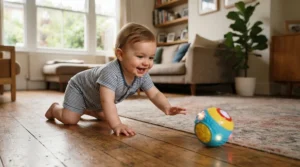
The AAP screen time guidelines have shifted in tone, and parents are understandably confused. Earlier advice was blunt: no screens for children under 2. The AAP’s recent approach, discussed by the pediatricians involved, moves toward flexibility. It urges families to focus on how media is used instead of treating every minute as equal.
Several points carry over regardless of which headline you read. AAP guidance summaries still say children under 2 should generally avoid screens, aside from video calls with family. Updated guidance also cautions against using media to soothe upset children, because that can undercut emotional coping over time. It encourages media-free zones such as the dinner table and bedrooms. And it frames screen time by what it crowds out, including sleep, movement and face-to-face time.
Here’s why that matters for toy shopping. A screen-free tech toy isn’t a loophole. It’s a tool that supports the same goals: protecting play, talking time and sleep. If you use the Toniebox 2 or Yoto Mini to calm a tantrum every time, you may be repeating the habit the guidelines caution against. Use them for routines, such as a story before nap, and not as a rescue button.
This is general information, not medical advice. For specifics, ask your child’s pediatrician or consult the AAP’s screen time toolkit.
Sound and Light Toys: Helpful Cause-and-Effect or Overstimulation?
Sound and light toys divide opinion for good reason. At their best, they teach one of the first lessons in cognition: “When I do this, that happens.” A press, a pop of light, a note, and a baby learns they can change the world.
The trouble starts when everything lights up and sings at once. Toys with many triggers can overwhelm, especially for toddlers who are sensitive to noise. The practical approach is to match the toy’s intensity to your child’s temperament, and to put a toy away if play turns frantic.
The seven picks here differ in intensity. The VTech Baby Lil’ Critters Moosical Beads uses gentle light-up buttons and a plush body. The Fisher-Price Laugh & Learn Smart Stages Puppy adds a twinkling heart that syncs with the music. The Hape Pound & Tap Bench produces sound without any light or electronics, which is the calmest option. The Toniebox 2 adds a light ring that glows in rainbow colors during playback, and its main output is audio.
A useful rule: rotate. Offer one sound-making toy at a time, and let quiet play breathe between sessions. Toddlers learn more from repeated, focused exploration than from a pile of competing noises.
Non-Screen Electronic Toy for Toddlers vs Traditional Toys
Should you buy electronic at all? A non-screen electronic toy for toddlers offers things a wooden block set can’t: recorded songs, language prompts and adaptive levels. Traditional toys offer things electronics can’t: open-ended use, durability and silence.
| Factor | Non-Screen Electronic Toys | Traditional Toys (Blocks, Stackers) | Best For |
|---|---|---|---|
| Language exposure | Built-in words and songs | Depends on caregiver talk | Fisher-Price Laugh & Learn Smart Stages Puppy for first words |
| Open-ended play | Moderate | High | Hape Pound & Tap Bench as a middle ground |
| Ongoing cost | Batteries or content | Usually none | VTech Baby Lil’ Critters Moosical Beads for low upkeep |
| Independence | High (button presses) | High | Toniebox 2 for self-start audio |
| Durability | Varies | Often excellent | LeapFrog Learn & Groove Musical Table for sturdiness |
Reading across the rows, electronics win on built-in language and independent triggers, while traditional toys win on longevity and cost. The healthiest toy shelf mixes both. If your budget allows only one electronic item, pick the one that adapts, like the Fisher-Price Laugh & Learn Smart Stages Puppy, and fill the rest with simple, open-ended toys.
✨ Don’t Miss These Exclusive Deals!
🔍 Take your screen-free play to the next level with these carefully selected products. Click on any highlighted item to check current pricing and availability. These picks will help you create calm, curious playtime your family will love!
Tech Toy Without a Display for Toddlers: Features That Actually Matter (And Those That Don’t)
When you’re hunting for a tech toy without a display for toddlers, marketing copy can blur what counts. Here’s the filter.
Features that matter:
- Tactile controls. Big buttons, spinning beads and pressable limbs suit small hands better than touch panels.
- Adjustable difficulty. Smart Stages on the Fisher-Price Laugh & Learn Busy Learning Tool Bench means the toy doesn’t expire at 15 months.
- Parent control over content. Systems like the Yoto Mini and Toniebox 2 let you curate what your child hears, which is a real advantage.
- Honest age labels. The 12-month certification on the Toniebox 2 versus 3+ on standard Tonies shows why labels deserve scrutiny.
Features that matter less:
- Huge song counts. Seventy songs sounds impressive, but toddlers repeat favorites. Quality of interaction beats quantity.
- Bilingual modes, unless you’ll use them. They’re a nice bonus on the LeapFrog Learn & Groove Musical Table, but not a deciding factor if you don’t.
- Gadget-style extras. Fancy lights matter less than a stable, wipeable body.
A quick safety note: check battery compartments for secure screws, and keep small parts, like the Hape Pound & Tap Bench balls, away from children who still mouth everything. Follow each manufacturer’s age labeling, and supervise play.
Screen-Free Play Setup Guide: Your First 30 Days
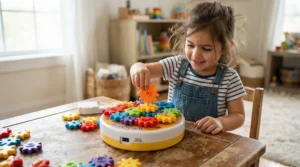
Screen-free play works best when you set it up deliberately. Here’s a practical plan to get the most from whatever you buy.
Week 1: Introduce one toy. Let your toddler explore with you beside them. Name what happens: “You pressed it, and it sang!” Narration turns a toy into a conversation.
Week 2: Build a routine. Anchor audio to a predictable moment, such as a story before nap. This is where the Toniebox 2 and Yoto Mini shine, since a consistent cue helps toddlers settle.
Week 3: Rotate. Put the first toy away and bring out another, like the VTech Baby Lil’ Critters Moosical Beads. A toy that returns after a break feels new again.
Week 4: Add a movement toy. Use something like the LeapFrog Learn & Groove Musical Table to encourage standing, cruising and reaching.
Common mistakes in the first 30 days:
- Buying several toys at once and overwhelming the child
- Using audio devices as a tantrum fix instead of a routine
- Leaving volume too high
- Forgetting to check battery doors
Maintenance is simple. Wipe plush with a damp cloth, check screws monthly, and replace batteries before they fade, because dimming lights and distorted sound can frustrate a child. Keep content libraries lean, too. Three well-loved stories beat thirty unplayed ones.
Real-World Scenarios: Matching Toys to Your Household
Specs only matter when they fit a life. Here are three profiles with reasoning, framed as illustrative examples, not real customers.
Scenario 1: The commuting family on a tight budget. You have a 10-month-old, a 25-minute drive each way, and about $40 to spend. The VTech Baby Lil’ Critters Moosical Beads is the obvious pick. It’s compact, soft and won’t hurt if dropped in the car seat. Pair it with the battery-free Hape Pound & Tap Bench at home once your baby reaches 12 months.
Scenario 2: The apartment dweller with a crawler. Space is limited, noise travels, and your 9-month-old is on the move. The LeapFrog Learn & Groove Musical Table works as a floor mat now and a standing station later. Use skid tape to stop sliding, per reviewer advice, and set the volume low for neighbors.
Scenario 3: The grandparents’ house. You want something that works the same wherever your 18-month-old goes. The Yoto Mini is portable, while the Toniebox 2 builds independence through figurines. If grandparents want to give gifts, individual Tonies are easy to buy and meaningful to receive.
For a broader view of how pediatricians frame these choices, Consultant360’s summary of AAP media guidance is a helpful read. Use these scenarios as a decision shortcut, not a rule. Your child’s temperament matters more than any category.
Common Problems and Solutions
Even good toys come with friction. Here are the usual pain points, with fixes.
Problem: My toddler throws everything, and electronics break.
Choose sturdy builds. Reviewers describe the Toniebox 2 as built to take a beating and the Hape Pound & Tap Bench as solid enough to double as a step.
Problem: The toy is too loud.
Look for adjustable volume, as on the LeapFrog Learn & Groove Musical Table. If a toy lacks it, you can often limit play to supervised sessions. The battery-free Hape Pound & Tap Bench is reviewed as surprisingly quiet.
Problem: The table slides when my child pulls up.
Add skid tape under the legs, as one reviewer did, and keep the toy in floor mode until your child is steady.
Problem: Content costs are creeping up.
With the Toniebox 2 and Yoto Mini, set a budget per quarter. Free tracks and gifted Tonies stretch the library further.
Problem: My child ignores the toy after a week.
This is normal. Rotate it out for two weeks and bring it back. Toddlers’ interests move fast.
Screen-Free Learning Gadget for Toddlers: Long-Term Cost & Value
A screen-free learning gadget for toddlers should earn its place over months, not days. Total cost of ownership matters as much as sticker price.
| Product | Upfront Cost | Ongoing Costs | Useful Life | Best For |
|---|---|---|---|---|
| Toniebox 2 | Higher ($130-$150 range) | Individual Tonies add up | Ages 1 to 9+ | Long-term families |
| Yoto Mini | Moderate ($70-$80 range) | Cards or club membership | Toddler years onward | Portable listeners |
| VTech Baby Lil’ Critters Moosical Beads | Low ($25-$30 range) | Batteries | Birth to 24 months | Newborn gifting |
| Fisher-Price Laugh & Learn Smart Stages Puppy | Low-mid ($30-$40 range) | Batteries | 6 months to 3 years | Adaptive learning |
| LeapFrog Learn & Groove Musical Table | Mid ($55-$70 range) | Batteries | 6 to 36 months | Floor-to-standing play |
| Fisher-Price Laugh & Learn Busy Learning Tool Bench | Mid ($40-$45 range) | Batteries | 6 to 36 months | Pretend play |
| Hape Pound & Tap Bench | Low-mid ($35-$45 range) | None | 12 to 36 months | Battery-free fans |
Cost-per-month tells the real story. A $30 toy used for 24 months is far cheaper than a $140 system used for six. But the Toniebox 2 may last for years across siblings, which changes the math. Based on the comparison, the Fisher-Price Laugh & Learn Smart Stages Puppy and Hape Pound & Tap Bench offer the best value per month for families who want durability without a content subscription. Prices shift, so check current listings before buying.
FAQ
❓ What are the best screen-free tech toys for toddlers under 2 for travel?
❓ Are sound and light toys safe for babies?
❓ Can a toddler use the Toniebox 2 before turning one?
❓ Do AAP screen time guidelines say toddlers can have electronic toys?
❓ Is a non-screen electronic toy for toddlers worth it over blocks?
Conclusion
The best screen-free tech toys for toddlers under 2 aren’t the flashiest. They’re the ones that fit your child’s stage, your budget and your household’s rhythm. Here’s the short version of what the research suggests.
For long-term value and independence, the Toniebox 2 leads, with the caveat that content costs add up. For portable audio, the Yoto Mini is a smart pick, though under 2 it works best with a parent running the controls. For the lowest risk, start with the VTech Baby Lil’ Critters Moosical Beads. For language growth, the Fisher-Price Laugh & Learn Smart Stages Puppy adapts across three levels. For crawlers heading toward cruising, the LeapFrog Learn & Groove Musical Table earns its space, with supervision. For pretend play, the Fisher-Price Laugh & Learn Busy Learning Tool Bench stretches further. And for a calm, battery-free option, the Hape Pound & Tap Bench remains a favorite.
Keep one principle in mind: screen-free play is about what the toy invites you to do together. Narrate, sing along, and let your toddler lead.
✨ Ready to build a calmer, more curious playroom?
🔍 Pick the toy that fits your child’s stage, click through to check current pricing and availability, and start with just one. Your toddler’s next favorite moment might be one button press away!
Recommended for You
- Learning Tablet For A 1 Year Old: 7 Best Safe Picks 2026
- Sensory Toys With Tech For A 6 Month Old: 7 Best Picks (2026 Guide)
- Educational Tech Gifts For A 6-12 Month Old: 7 Best Picks For 2026
Disclaimer: This article contains affiliate links. As an Amazon Associate, I earn from qualifying purchases. If you purchase products through these links, we may earn a small commission at no additional cost to you.
✨ Found this helpful? Share it with your friends! 💬🤗
