
In This Article
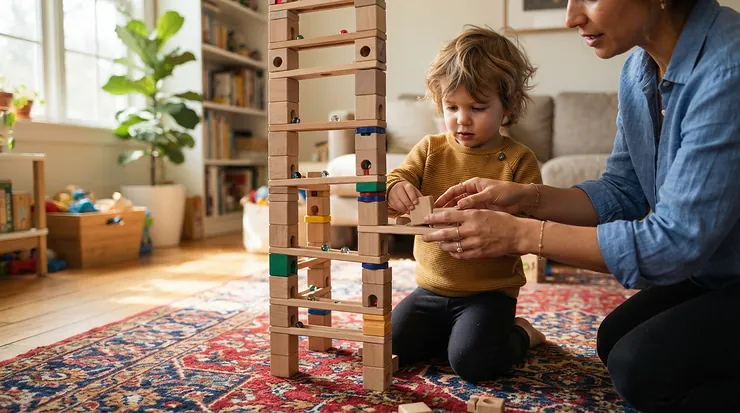
Stand in the toy aisle for five minutes and you’ll feel it: the tug-of-war between the block set that glows and chirps and the plain wooden one your own parents probably stacked with you on a shag carpet in 1988. That tension is exactly why so many parents end up typing smart building blocks vs traditional blocks for toddlers into a search bar at 11 p.m., cart already half-full, second-guessing everything. Good news — you don’t need a child-development degree to sort this out, just some real specs and a little honesty about what each option actually delivers.
What Is the Difference Between Smart and Traditional Building Blocks?
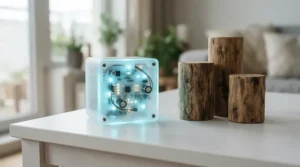
Smart building blocks vs traditional blocks for toddlers comes down to feedback versus imagination. Smart blocks use batteries, apps, or sensors to react with light, sound, or motion when connected. Traditional blocks — usually wood or simple plastic — offer no built-in response at all, relying entirely on the child’s hands and mind to create meaning.
Here’s the thing nobody tells you upfront: this isn’t really an either-or decision, and the “winner” changes depending on your kid, your household rules around screens, and honestly, your tolerance for AA batteries rolling under the couch. There’s also real developmental research behind block play worth knowing before you buy, which we’ll dig into below. Below, we’ve dug into seven real products spanning both categories — budget, mid-range, and genuinely premium — with honest analysis of specs, aggregated review themes, and where each one actually earns its keep in a toddler’s playroom.
Quick Comparison Table
| Feature | Smart Blocks | Traditional Blocks |
|---|---|---|
| Power source | Batteries or USB, app-optional | None required |
| Sensory feedback | Built-in lights, sounds, motion | Feedback comes from the child’s own play |
| Typical price range | $20-$120 range depending on tech | $15-$200 range depending on materials |
| Screen involvement | Sometimes (app-connected models) | Never |
| Longevity | Limited by battery life and app support | Often decades, heirloom-grade |
| Best for | Sensory-seeking toddlers, novelty-driven play | Open-ended, imagination-first play |
Looking at this table, the pattern that jumps out is durability versus stimulation. Traditional sets like solid wood blocks tend to outlast smart sets by years because there’s no circuitry to fail and no app that might get discontinued. On the flip side, smart blocks with light and sound can be genuinely useful for toddlers who need an extra sensory hook to stay engaged with open-ended play in the first place — it’s not cheating, it’s scaffolding.
💬 Bookmark this guide now — you’ll want to compare products again before you check out.
Top 7 Smart and Traditional Building Blocks: Expert Analysis
We pulled these seven picks from real Amazon listings, brand product pages, and independent toy-testing roundups, then sorted them across budget, mid-range, and premium tiers so there’s something here regardless of what your holiday budget looks like.
1. Mega Bloks Fisher-Price Rise & Snooze — budget sensory blocks with built-in routines
The standout here isn’t the blocks themselves — it’s the light-up base station that turns stacking into a bedtime and morning ritual. Each of the 30 oversized blocks is chunky enough for a one-year-old’s fist, and the base cycles through three lullabies, two soft sounds, and five light effects (including a star projector) for wind-down time, then flips to upbeat songs and sunny light effects in the morning. In practice, that means the toy is doing double duty as a routine cue, not just a pile of plastic — something worth noting if bedtime battles are a daily event at your house.
Based on the spec comparison with other sensory sets in this price bracket, the Mega Bloks Fisher-Price Rise & Snooze set punches above its price tag because it’s solving an actual parenting problem (transitions) rather than just adding noise for noise’s sake. It’s best suited to toddlers ages 1-3 who respond well to routine and repetition, and less ideal for kids who get overstimulated by lights right before sleep.
Reviewers consistently mention that the blocks are compatible with other Mega Bloks sets, which extends the toy’s life well past the “phase” stage, and that the base’s auto-off timer is appreciated by parents who don’t want a lullaby loop running all night.
Pros:
- ✅ Doubles as a bedtime and wake-up routine tool
- ✅ Oversized blocks are easy for small hands to grip
- ✅ Compatible with the wider Mega Bloks ecosystem
Cons:
- ❌ Requires batteries and periodic replacement
- ❌ Lights may overstimulate sensitive sleepers
At around $15-$25, this is one of the more affordable entry points into smart blocks with light and sound, and the value verdict is straightforward: for the price of a couple of takeout dinners, you get a toy that pulls double duty as a sleep-routine aid.

2. LEGO DUPLO Cargo Train (10875) with Connected Train App — most app-connected play value for toddlers 18 months+
What makes this set stand out is that the physical train works completely fine without the app, but the optional Connected Train app adds a genuinely thoughtful layer on top rather than gating core play behind a screen. The push-and-go motorized train lets toddlers place “action bricks” on the track to trigger horn sounds, headlights, and speed changes, while the companion app — when parents choose to use it — lets kids remote-control the train, record their own voice for sound effects, and collect digital stickers.
What most buyers overlook about this set is that the coding-adjacent mechanic (predicting what an action brick will do before the train reaches it) is quietly teaching sequential thinking, which is one of the building blocks — no pun intended — of actual computer science later on. It’s built for toddlers 18 months to 3 years and holds up well for on-track imaginative play even after the novelty of the lights wears off.
Aggregated review sentiment around LEGO DUPLO’s app-connected sets tends to praise the no-in-app-purchase, no-third-party-advertising policy, which matters a lot to parents wary of handing a toddler a tablet loaded with dark patterns.
Pros:
- ✅ Works fully offline; app is optional, not required
- ✅ Action bricks introduce early sequencing and prediction skills
- ✅ No in-app purchases or third-party ads in the companion app
Cons:
- ❌ Full experience does involve screen time if the app is used
- ❌ Motorized train parts add more to break than plain bricks
Priced in the $45-$65 range, the LEGO DUPLO Cargo Train set sits at a reasonable mid-tier for app-connected building blocks for toddlers, and it’s the pick we’d point to for families who want the option of tech without making it mandatory.
3. LEGO SMART Play Star Wars Starter Set — most advanced sensor tech for reactive builds
This is the newest and most technically ambitious entry on this list. LEGO’s SMART Play system, which debuted in March 2026, is built around a sensor-packed 2×4 SMART Brick that measures motion and acceleration, recognizes color, and includes a tiny built-in sound synthesizer — all without requiring a screen at any point. The Star Wars starter set pairs the SMART Brick with SMART Minifigures and SMART Tags so builds respond to how a child moves, holds, and reassembles them, with LEGO describing it as one of its biggest play innovations in years.
Here’s what the spec sheet won’t tell you outright: because the reactive tech lives inside a standard-sized brick rather than a separate accessory, it should, in theory, integrate into a child’s existing LEGO collection rather than becoming an isolated novelty bin. That said, this is genuinely new-to-market technology in 2026, so long-term durability data and independent teardown reviews are still catching up — we’d flag this honestly rather than promise something we can’t verify yet.
Given how recently SMART Play launched, aggregated customer review sentiment specific to this exact starter set is still thin; early hands-on coverage has focused more on the concept and CES unveiling than on months of real toddler wear-and-tear, so treat early ratings with appropriate caution.
Pros:
- ✅ No screen required — feedback happens through the brick itself
- ✅ Standard brick size integrates with existing LEGO collections
- ✅ Combines motion, color, and sound sensing in one system
Cons:
- ❌ Premium price for a genuinely new, unproven technology
- ❌ Long-term durability reviews aren’t available yet
Expect this set to sit in the $70-$100 range at launch, which puts it firmly in premium territory — a reasonable ask if you want to be an early adopter, but worth waiting on if you’d rather let the reviews catch up first.
4. Melissa & Doug 100-Piece Wooden Building Blocks Set — best budget entry into traditional wooden blocks for toddler development
If there’s a “default answer” in this entire article, this is it. The set includes 100 unfinished hardwood blocks across nine architectural shapes — cubes, arches, columns, triangles, cylinders — in four painted colors, all stored in a wooden crate with a lid that doubles as a building base. There’s no plastic filler here; the wood is solid rather than laminated, which is part of why the pieces actually stack square instead of wobbling.
Based on the spec comparison with cheaper block sets, the real differentiator is shape variety — nine distinct shapes force a toddler to think about balance and fit in a way that identical cube sets simply don’t. It’s a strong fit for ages 2 and up, and it scales beautifully: a two-year-old stacks towers, while a four-year-old starts building arches and bridges with the same pieces.
Reviewers testing this set over extended periods report that the paint holds up remarkably well — one independent toy-testing team noted that after weeks of heavy play, and even after a set was accidentally left outside during rain, the blocks came back looking essentially new once dried.
Pros:
- ✅ Nine architectural shapes encourage real structural thinking
- ✅ Solid hardwood construction, not laminate
- ✅ Storage crate doubles as a building base
Cons:
- ❌ Painted finish can chip after years of hard use
- ❌ No sensory feedback for toddlers who crave stimulation
At around $15-$25, the Melissa & Doug 100-Piece Wooden Building Blocks Set is close to the platonic ideal of value in this category — cheap enough to feel low-risk, sturdy enough to become a genuine heirloom.
5. Uncle Goose Classic ABC Blocks — best hand-finished traditional blocks for early literacy
What sets this one apart immediately is the manufacturing story: these blocks are hand-printed and made in the USA, which is increasingly rare in a toy aisle dominated by overseas mass production. Each block combines letters, numbers, and pictures, hand-finished with a smooth, splinter-free edge that’s noticeably different to the touch than mass-market alternatives.
On paper, this means you’re paying a premium for craftsmanship rather than features, and that’s a legitimate trade-off — not every family needs “Made in America, hand-printed” on a toy, but for households prioritizing sourcing transparency and non-toxic finishes, it’s a meaningful differentiator. It’s best suited to toddlers around 18 months to 4 years who are starting to show interest in letters and early literacy concepts, layered onto standard stacking play.
Aggregated feedback across toy-safety and parenting review roundups consistently flags Uncle Goose alongside Melissa & Doug, HABA, and PlanToys as a reliable, eco-conscious brand — but also notes the price sits noticeably higher than mass-market wooden sets, which is the honest trade-off for domestic hand-production.
Pros:
- ✅ Hand-printed and manufactured in the USA
- ✅ Smooth, splinter-free edges on every block
- ✅ Combines letter recognition with classic stacking play
Cons:
- ❌ Higher price point than comparable imported sets
- ❌ Smaller piece count than bulk wooden sets at this price
Priced in the $35-$55 range depending on set size, this is the pick for parents who want traditional wooden blocks for toddler development with an added literacy angle and don’t mind paying for domestic craftsmanship.
6. Melissa & Doug Deluxe Wooden ABC/123 50-Piece Set — best variant for letter and number sorting
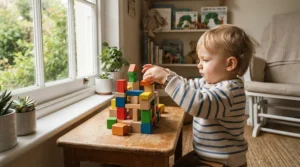
This is the sorting-focused sibling to the brand’s classic block set, built around 50 pieces sized at 1 inch by 1 inch, each stamped with letters, numbers, or simple images, and packaged with a fabric storage pouch rather than a crate. The smaller, uniform size makes this set noticeably more travel-friendly than bulkier architectural block sets — genuinely useful for restaurant waits or car trips.
What most buyers overlook about smaller uniform blocks like these is that the size consistency actually supports fine motor development more directly than oddly-shaped architectural pieces, because toddlers repeat the same grip and release motion across every single block rather than adapting their grip shape by shape. It’s a strong complementary set for toddlers 18 months and up who already own a shape-based block set and are ready for letter and number exposure.
Review themes across parenting sites highlight the drawstring pouch as a practical touch for reducing loose-block clutter, alongside consistent praise for the brand’s non-toxic paint and FSC-certified sourcing.
Pros:
- ✅ Compact, travel-friendly storage pouch
- ✅ Uniform size supports repetitive grip practice
- ✅ FSC-certified, non-toxic painted finish
Cons:
- ❌ Less structurally interesting than architectural shape sets
- ❌ Small pieces need supervision with younger toddlers
Expect to pay somewhere in the $20-$30 range, making the Melissa & Doug Deluxe Wooden ABC/123 50-Piece Set an easy add-on purchase rather than a standalone centerpiece toy.
7. Brilliant Wagon Wood Blocks (200+ Piece Set) — best premium heirloom set for big builds
The headline feature is scale: with over 200 pieces and a wagon-style storage cart included, this is built for toddlers who will eventually outgrow toddlerhood and keep building anyway. The sheer piece count means multiple kids can build simultaneously without fighting over the last arch piece, and the wagon doubles as both storage and a pull-toy in its own right.
Here’s what the price tag is really buying you: longevity measured in years, not toddler phases. Based on the spec comparison with 100-piece starter sets, the extra pieces unlock genuinely more complex builds — bridges spanning multiple supports, multi-story towers, elaborate castle walls — which keeps the set relevant well past age 5, unlike smaller sets that get “solved” and abandoned within a year or two.
Toy-testing roundups covering large wooden sets in this category consistently describe this style of set as lasting five-plus years of regular use, with the wagon storage cited as a meaningful upgrade over loose bins or bags that inevitably get lost.
Pros:
- ✅ Massive piece count supports complex, multi-child builds
- ✅ Wagon doubles as storage and a pull-along toy
- ✅ Designed to remain relevant well past toddlerhood
Cons:
- ❌ Highest price point of any set on this list
- ❌ Takes up significantly more storage space
At roughly $130-$180 range, this is a genuine investment purchase — the kind of gift grandparents ask about, not an impulse cart-add.
Setting Up and Maintaining Your Toddler’s Blocks: A Practical Usage Guide
Getting either category of blocks right in the first 30 days comes down to a few unglamorous habits. For smart blocks, charge or install batteries before gift-wrap ever comes off, and test every light and sound mode yourself first — nothing kills momentum like a “dead on arrival” toy on a birthday morning. If the set includes an app, like the LEGO DUPLO Cargo Train, set up parental controls before your toddler ever sees the tablet, and consider introducing the physical toy alone for the first week before layering in the app at all.
For traditional sets like the Melissa & Doug 100-Piece Wooden Building Blocks Set, the main setup task is simply sorting: dump the whole set out once, let your toddler explore freely without instructions, and resist the urge to demonstrate “correct” building right away. Common first-30-day mistakes include over-narrating play (“look, a tower!”) instead of letting a toddler discover shape relationships on their own, and storing blocks somewhere inconvenient enough that nobody bothers pulling them out. Wipe wooden blocks with a barely-damp cloth rather than soaking them, since wood swells and warps with excess moisture — a mistake that ends more heirloom sets early than actual toddler destruction does.
Real-World Scenarios: Matching Blocks to Your Toddler’s Play Style
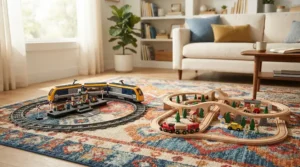
Consider three toddlers with three very different temperaments. First, there’s the sensory-seeker: the seventeen-month-old who bangs, shakes, and mouths everything, and genuinely lights up (literally) at feedback. For that kid, something like the Mega Bloks Fisher-Price Rise & Snooze set earns its keep, since the built-in response rewards exactly the kind of exploratory bashing this age group does anyway.
Then there’s the methodical builder — the two-and-a-half-year-old who’ll sit for twenty quiet minutes lining up blocks by color before knocking them down exactly once. That kid tends to thrive with a large, varied traditional set like the Brilliant Wagon Wood Blocks, where piece variety rewards patient sorting rather than instant gratification.
Finally, there’s the social builder, often a three-year-old with an older sibling, who wants collaborative, story-driven play. The LEGO DUPLO Cargo Train fits here nicely — the train narrative gives siblings a shared script to build around, whether or not the app ever gets switched on. None of these profiles are fixed; most toddlers drift between all three moods across a single week, which is honestly the best argument for owning at least one set from each category.
Common Block-Time Problems (And How to Solve Them)
Problem: Batteries die at the worst possible moment. Keep a spare set taped to the underside of the base station, and toddlers barely notice the thirty-second swap.
Problem: Wooden blocks develop splinters over time. Sand any rough edge lightly with fine-grit sandpaper and reseal with a food-safe wood finish; this is far cheaper than replacing an otherwise good set.
Problem: Smart blocks become “just noise” and stop holding interest. Rotate the auto-off timer settings or introduce the app layer (if available, as with the DUPLO train) only after novelty wears off the physical toy alone — introducing complexity gradually extends engagement.
Problem: Small pieces go missing constantly. Set-specific storage — the wagon that ships with the Brilliant Wagon Wood Blocks, or the drawstring pouch with the Melissa & Doug Deluxe Wooden ABC/123 50-Piece Set — dramatically cuts losses compared to a generic toy bin.
Problem: Siblings fight over the same pieces. Sets with high piece counts, like the 200-plus-piece Brilliant Wagon Wood Blocks, largely sidestep this by simply providing enough volume for parallel building.
Smart Building Blocks vs Traditional Blocks for Toddlers: The Full Comparison
| Category | Smart Building Blocks | Traditional Blocks |
|---|---|---|
| Feedback style | Built-in lights, sounds, sometimes app control | Feedback generated entirely by the child |
| Power dependency | Requires batteries or charging | None |
| Skill emphasis | Cause-and-effect, early sequencing | Spatial reasoning, open-ended imagination |
| Best example | LEGO SMART Play Star Wars Starter Set | Brilliant Wagon Wood Blocks |
| Weak spot | Battery reliance, unproven longevity on new tech | No built-in sensory hook for stimulation-seekers |
The direct answer to smart building blocks vs traditional blocks for toddlers is that neither category “wins” outright — they optimize for different things. Smart blocks with light and sound genuinely help sensory-seeking toddlers stay engaged during independent play, while traditional wooden blocks for toddler development lean harder into unstructured, imagination-first building that doesn’t run out of battery. Reviewers and researchers alike tend to agree that the ideal toddler toy shelf includes both, used at different times of day and for different moods.
App-connected building blocks for toddlers occupy a useful middle ground here, since sets like the LEGO DUPLO Cargo Train let a family dial screen involvement up or down without buying an entirely separate toy. That flexibility is arguably more valuable long-term than committing fully to either extreme.
How to Choose Between Smart and Traditional Building Blocks
- Start with your toddler’s sensory profile. Kids who seek out noise and movement generally respond better to smart blocks; quieter, methodical kids often prefer traditional sets.
- Decide your screen-time stance before you shop. If you want zero screen exposure, skip app-connected sets like the DUPLO train entirely rather than fighting the urge later.
- Check battery and charging logistics honestly. A set that needs constant battery swaps will frustrate you faster than it frustrates your toddler.
- Weigh piece count against storage space. Large traditional sets like the Brilliant Wagon Wood Blocks need real shelf real estate.
- Consider how many kids will use the set. Larger households benefit from higher piece counts to reduce sibling conflict.
- Look at long-term relevance, not just toddler-year appeal. Traditional wooden sets tend to scale further into preschool and early elementary years.
- Budget for the full experience, not just the toy. Smart sets may need ongoing batteries; app-connected sets need a compatible tablet or phone on hand.
Common Mistakes When Buying Blocks for Toddlers
The single biggest mistake we see is buying based on packaging excitement rather than piece count and material quality — a beautifully boxed 20-piece smart set often gets “solved” and abandoned within weeks, while a plain 100-piece wooden set keeps earning its shelf space for years. A close second is ignoring age-grading on small parts; sets rated for 3-plus can pose real choking risks for a still-mouthing 18-month-old, regardless of how educational the marketing sounds.
Parents also frequently overlook compatibility. If your toddler already owns DUPLO or Mega Bloks, buying an incompatible competing system effectively starts a second, separate toy collection instead of expanding the one you have. Finally, don’t assume “smart” automatically means “educational” — a light-up block that reacts randomly teaches less than a wooden arch that requires actual balance and planning to place correctly.

Traditional Wooden Blocks for Toddler Development: What the Research Shows
This isn’t just nostalgia talking. A large, nationally representative study found that children who play frequently with puzzles, blocks, and board games tend to show stronger spatial reasoning ability than peers who don’t. That matters because spatial reasoning in early childhood correlates with later math performance — the skill of mentally rotating and fitting shapes together isn’t just play, it’s early cognitive scaffolding.
Separate research from the University of Delaware and Temple University found that preschoolers who were better at copying block structures also performed better on early math assessments, with the effect appearing meaningful even among three-year-olds from a range of socioeconomic backgrounds. Traditional wooden blocks for toddler development earn their reputation specifically because they force a child to solve balance and fit problems with zero built-in shortcuts — there’s no light telling you the block goes here; you have to figure it out yourself, fail, and try again.
Spatial Reasoning Skills: Why Blocks Beat Screens
Spatial reasoning skills — the ability to visualize how objects relate to each other in space — show up everywhere from geometry class to parallel parking, and block play is one of the more reliably studied ways to build them early. Unlike passive screen time, physically stacking, rotating, and fitting real objects together requires a toddler’s hands and brain to coordinate in three dimensions simultaneously, which is a fundamentally different cognitive task than tapping a flat screen.
This is part of why pediatric guidance leans cautious on screen exposure for the youngest kids in the first place. The American Academy of Pediatrics frames screen boundaries around ensuring kids still get adequate sleep, play, and family time, with specific daily targets varying by family circumstance — which is a reasonable argument for leaning on physical block play, smart or traditional, over app-only alternatives whenever the option exists.
Fine Motor Development and Block Play
Fine motor development — the small muscle control in fingers and wrists — gets a genuine workout from block play regardless of which category you choose, but the mechanics differ. Traditional sets with varied shapes, like the Melissa & Doug 100-Piece Wooden Building Blocks Set, challenge a toddler to adjust grip and pressure differently for a cylinder versus a flat rectangle. Uniform-sized sets, like the Melissa & Doug Deluxe Wooden ABC/123 50-Piece Set, instead reinforce the same precise pincer grip repeatedly, which some occupational therapists favor for building consistency before introducing variety.
Smart blocks contribute here too, particularly ones requiring precise alignment to trigger their sensor response — a toddler quickly learns that a sloppy connection on the LEGO SMART Play Star Wars Starter Set won’t register, which is its own subtle fine motor lesson wrapped in a more immediate reward than a plain block ever offers.
Open-Ended Play: The Feature No Spec Sheet Lists
Open-ended play — activity without a single “correct” outcome — is arguably the most undersold benefit in this entire category, because it doesn’t fit neatly on a box. A pile of plain wooden blocks can become a castle, a spaceship, or a pretend birthday cake depending entirely on what a toddler imagines that day; a set with pre-programmed light responses inevitably nudges play toward whatever behavior triggers the “reward.”
That’s not a knock against smart blocks broadly — reactive feedback has its place, especially for building early cause-and-effect understanding — but it does mean open-ended play tends to flourish more reliably with traditional sets. If open-ended, imagination-first play is your priority, sets like the Brilliant Wagon Wood Blocks or the Uncle Goose Classic ABC Blocks are the stronger long-term bet precisely because they impose the fewest built-in “right answers.”
Safety, Screen Time, and Long-Term Value
All seven products on this list fall under mandatory U.S. toy safety oversight. Toys intended for children 12 and under must be third-party tested and certified compliant with the applicable federal children’s product safety regulations, and the current mandatory toy safety standard is incorporated by reference into federal regulation. Always check the age grading printed on the box — sets rated for ages 3-plus should never go into the hands of a still-mouthing toddler, regardless of educational marketing.
On the screen-time side, families choosing app-connected building blocks for toddlers should weigh those minutes against broader daily screen guidance rather than treating “educational app” as an automatic exemption. On pure cost-per-year math, traditional wooden sets tend to win the long game: a $20 wooden set that lasts eight years works out to roughly $2.50 per year, while a smart set needing periodic battery replacement or eventual app discontinuation may cost more over the same span, even with a lower sticker price today.
🔋 Don’t let battery frustration ruin playtime — stock up on spares before the big unboxing!

Frequently Asked Questions
❓ Are smart building blocks bad for toddler development?
❓ What age should toddlers start with building blocks?
❓ Are wooden blocks better than plastic blocks for toddlers?
❓ Do app-connected building blocks count as screen time?
❓ How many building blocks does a toddler actually need?
Conclusion
If you take one thing away from this comparison, let it be this: smart building blocks vs traditional blocks for toddlers isn’t a battle with a single winner, it’s a matchup between two tools that solve different problems. Smart blocks with light and sound reward exploration with instant feedback, which works wonders for sensory-driven toddlers and for building early cause-and-effect understanding. Traditional wooden blocks for toddler development quietly build spatial reasoning skills, fine motor development, and genuinely open-ended play precisely because they refuse to tell your toddler what to do with them.
Our honest recommendation, after digging through the specs, the safety standards, and the aggregated review patterns on all seven sets: start with one traditional set as your foundation — the Melissa & Doug 100-Piece Wooden Building Blocks Set is the easiest low-risk entry point — and layer in a smart set like the LEGO DUPLO Cargo Train for variety once your toddler’s shown interest in sequencing and cause-and-effect play. Neither category needs to “win” your toy shelf; they just need to earn their place on it.
Recommended for You
- 7 Best Coding Toy for Kids Ages 4-6 Picks in 2026
- Parental Control Tablet vs Regular Tablet for Toddlers: 7 Picks 2026
- Educational Tablet for Preschoolers: 7 Best Picks for 2026
Disclaimer: This article contains affiliate links. As an Amazon Associate, I earn from qualifying purchases. If you purchase products through these links, we may earn a small commission at no additional cost to you.
✨ Found this helpful? Share it with your friends! 💬🤗
