
In This Article
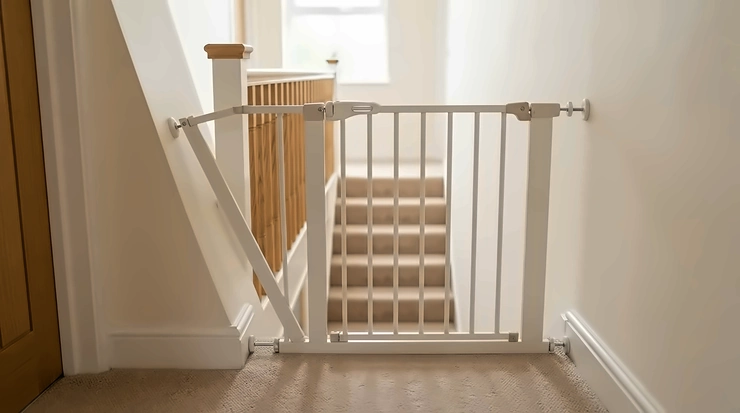
A baby gate for top of stairs hardware mount is a barrier that screws into wall studs, door-frame jambs, or solid banister posts instead of relying on spring tension. Because fasteners hold it in place, it can’t be shoved loose, and it should include a swing stop so the door only opens toward the landing, never over the steps.
Here’s the part nobody likes to say out loud: the top of a staircase is the one spot where a cheap shortcut can cost you dearly. A Nationwide Children’s Hospital study found that more than 93,000 children under five were treated in U.S. emergency departments for stair injuries each year, roughly one child every six minutes. About a quarter of the injuries in babies under one happened while someone was carrying them. So stairs aren’t only a toddler problem. They’re also a “tired adult with a baby on one hip” problem.
That’s why choosing the right baby gate for top of stairs hardware mount matters more than almost any other childproofing purchase. Below you’ll find seven real gates sorted by budget, width, and personality. Then come practical guides on installing, choosing, and avoiding classic mistakes. Along the way we’ll dig into the details that separate a gate that is merely sold for stairs from one that is genuinely safe there: a walk through gate for top of stairs that opens smoothly, a swing stop that stays put, no trip threshold underfoot, and wall stud anchors (or better, real studs) behind the screws.
One honest note on method. Nothing here comes from hands-on testing. The analysis is built from manufacturer specs, retailer listings, and aggregated reviewer sentiment, and prices appear as ranges because they change constantly.
Quick Comparison: Top Hardware-Mount Stair Gates at a Glance
| Product | Fits Width | Height | Standout | Best For |
|---|---|---|---|---|
| Toddleroo by North States Easy Swing & Lock | ~28.7–47.9″ | 31″ | Swing control, flat floor line | Standard landings, taller toddlers |
| Cardinal Gates SS30 Stairway Special | 27–42.5″ | ~29.5–30″ | Angle mounting up to 30° | Awkward stud placement |
| KidCo Safeway G2001 | 24.75–42.5″ | 30.5″ | Directional stop pin | Narrow landings, no-fuss safety |
| Evenflo Walk-Thru Top of Stairs | 30–48″ | 32″ | Lowest price, tallest in group | Budget-first families |
| Safety 1st Top of Stairs Expanding Metal Gate | 27–42″ | 28″ | Frameless, one-way gate stop | Simple metal-gate shoppers |
| Cumbor Hardware Mounted No Bottom Bar Gate | 29.2–43″ | 28″ | Auto-close | Hands-full households |
| Toddleroo by North States StepSafe Auto-Close Extra Wide | 29–55″ | 30″ | Extra-wide opening | Wide landings |
Looking at the comparison above, the KidCo Safeway G2001 and Cardinal Gates SS30 Stairway Special are the most purpose-built stair-top designs. The Evenflo Walk-Thru Top of Stairs wins on price and height. If your landing is wider than 48 inches, only the Toddleroo by North States StepSafe Auto-Close Extra Wide covers it without extensions. Notice that the two 28-inch gates are the shortest here, which matters more as your child nears the climbing stage.
💬 Just one click — help others make better buying decisions too!😊
Top 7 Baby Gates for Top of Stairs Hardware Mount: Expert Analysis
Every gate below is hardware-mounted and marketed for stair-top use. Always confirm that your exact model and version carry that rating on the box, because many gate families also include pressure-mount variants that are not stair-safe.
1. Toddleroo by North States Easy Swing & Lock — swing control with a flat floor line
The headline feature is swing control, which lets you lock the door to open one direction only. That’s a textbook stair-top setup, and the Toddleroo by North States Easy Swing & Lock (Series 2) pairs it with a threshold-free base.
On paper, it fits openings from roughly 28.7 to 47.9 inches, stands 31 inches tall, mounts with hardware, and carries ASTM and Baby Safety Alliance certification according to the maker. In practice, that width range covers most standard landings without extension kits. The 31-inch height also gives a climbing toddler a few more inches of frustration than 28-inch rivals do.
Based on the spec sheet, this is the gate for a landing with solid wood on both sides: a door frame, a newel post, or a stud. It’s close to a default recommendation in this category. Nothing flashy, everything necessary.
Reviewer roundups that rank it at or near the top cite an average around 4.5 out of 5. Praise clusters around the one-handed latch and the flat threshold. Those roundups are affiliate-driven, so treat them as directional rather than definitive.
Pros:
- ✅ Swing control for one-way opening
- ✅ 31-inch height beats most rivals
- ✅ Threshold-free walk-through
Cons:
- ❌ Needs solid wood mounting points
- ❌ Priced above entry-level options
Price range: around $60–$75 at the time of research (check current price). Verdict: fair value for a gate you’ll use dozens of times a day.
2. Cardinal Gates SS30 Stairway Special — angle mounting that helps you hit the stud
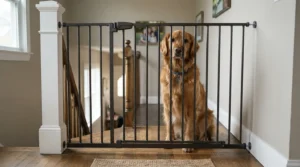
The standout here is the ability to mount at angles up to 30 degrees, a small feature that solves a very common headache. The Cardinal Gates SS30 Stairway Special is all aluminum, adjusts from 27 to 42.5 inches, stands roughly 29.5–30 inches tall, and includes a stop bracket to prevent opening over the stairs.
What does the angle adjustment mean in practice? When the stud you found sits a few inches off from where the hinge wants to go, you can rotate the mounting point to land on solid wood instead of trusting a drywall plug. Aluminum won’t rust, and the bars are spaced about 2.5 inches apart. The gate also lifts off while the brackets stay on the wall.
This is the pick for older houses with odd framing, plaster quirks, or banisters that don’t line up. Reviewers’ roundups frequently call it the gold standard for stairways, and Reviewed named it best overall in its baby gate guide. Retailer listings show well over a thousand ratings averaging around 4.5 stars.
Pros:
- ✅ 30-degree angle mounting finds studs
- ✅ Rust-proof aluminum frame
- ✅ Gate lifts off, brackets stay put
Cons:
- ❌ Highest price in this guide
- ❌ Sold as a baby and pet gate, so verify certification marks
Price range: around $95–$115 at the time of research. Verdict: worth the premium if your wall geometry is awkward.
3. KidCo Safeway G2001 — a stop pin built for stair tops
The hook is simplicity. The KidCo Safeway G2001 has a directional stop pin that physically prevents the door from swinging out over the stairs. It’s heavy-duty powder-coated steel, 30.5 inches tall, and adjusts from 24.75 to 42.5 inches. It also has quick-release hardware, a mounting template, and one-handed adult operation.
That narrow 24.75-inch minimum is useful for tight hallway landings where most gates simply won’t compress far enough. The mounting template is more than a convenience, because it keeps the hinge and latch sides aligned so the door closes square. KidCo also sells an angle-mount version for crooked openings.
Honest take: this is the “don’t make me think” option. It does one job and does it without extra mechanisms to break. Retailer listings show about 4.2 stars across roughly 130 reviews. Common complaints in roundups mention a plastic mounting bracket that can crack and a template that can leave the gate looking slightly crooked if you center it on uneven jambs.
Pros:
- ✅ Physical stop pin blocks over-stair swing
- ✅ Fits narrow 24.75-inch openings
- ✅ Quick-release removal
Cons:
- ❌ Plastic bracket can crack
- ❌ Template can look crooked on uneven jambs
Price range: around $65–$80 at the time of research. Verdict: strong value for a single-purpose safety gate.
4. Evenflo Walk-Thru Top of Stairs — the budget option that stands tallest
The standout is height per dollar. The Evenflo Walk-Thru Top of Stairs is 32 inches tall, slides to fit openings from 30 to 48 inches, and mounts with hardware. It comes in plain and wood-look finishes. The door can swing in both directions, but a removable swing stop prevents it from opening over the stairs.
That tall frame is a real advantage for a child nearing the climbing stage. The “removable” part of the swing stop, however, is a double-edged detail. It’s easy to install correctly and just as easy to forget during a reinstall. A pediatrician-led review described the gate as durable with one-handed operation and easy installation, though that review is several years old.
Current retailer averages hover between 4.0 and 4.3 stars across a few hundred ratings, a notch below the metal premium picks. Buyers who value price over polish tend to land here, and that’s a legitimate way to shop.
Pros:
- ✅ Tallest gate in this guide
- ✅ Lowest price of the seven
- ✅ Wide 30–48-inch fit
Cons:
- ❌ Swing stop is removable, so don’t forget it
- ❌ Ratings trail the premium metal gates
Price range: around $40–$55 at the time of research. Verdict: the smartest first gate if cash is tight.
5. Safety 1st Top of Stairs Expanding Metal Gate — frameless metal with a one-way gate stop
The hook is a frameless metal design with an adjustable gate stop. The Safety 1st Top of Stairs Expanding Metal Gate lets you choose one-direction swinging for stair tops or both directions for use between rooms. It fits 27 to 42 inches, stands 28 inches tall, and has a quick-release button.
Frameless means the floor stays clear when the door is open, which supports that all-important walk-through feel. At 28 inches, though, this is among the shortest options here, so it suits younger crawlers and early walkers better than a determined climber.
Be aware that the review pool is the weak spot. I couldn’t verify a reliable, model-specific review set, so rather than invent sentiment, here’s what’s checkable: the spec sheet, the one-way stop, and Safety 1st’s own guidance that hardware-mounted gates belong at the top of stairs.
Pros:
- ✅ Selectable one-way swing setting
- ✅ Frameless, clear walkway
- ✅ Quick-release removal
Cons:
- ❌ Short 28-inch height
- ❌ Little verifiable model-specific review data
Price range: roughly $60–$85 depending on retailer and model (check current price). Verdict: a solid mid-range choice, best for toddlers who aren’t yet climbers.
6. Cumbor Hardware Mounted No Bottom Bar Gate — auto-close without a trip bar
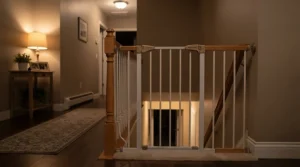
The standout is auto-close combined with a bar-free floor line. The Cumbor Hardware Mounted No Bottom Bar Gate is carbon steel, 28 inches tall, fits roughly 29.2–43 inches, and uses a double-lock latch with a hold-open position at about 90 degrees. It requires drilling.
Auto-close removes the “did I latch it?” failure mode, which is a big deal at stair tops where a half-latched gate is invisible until it isn’t. The double-lock demands a deliberate two-step motion, which keeps small hands out but is easy for adults carrying a baby.
One caution: auto-close hinges often swing both ways, so verify that your model includes a swing stop or can be restricted to open toward the landing only. Roundups cite ratings in the 4.6–4.7 range. Those sites are affiliate-driven, and Cumbor has a shorter track record than brands like KidCo and Cardinal.
Pros:
- ✅ Auto-close prevents forgotten latches
- ✅ Bar-free, trip-free floor
- ✅ Hold-open at 90 degrees
Cons:
- ❌ Only 28 inches tall
- ❌ Confirm one-way swing stop before buying
Price range: around $50–$70 at the time of research. Verdict: great convenience-per-dollar if you confirm the swing stop.
7. Toddleroo by North States StepSafe Auto-Close Extra Wide — extra-wide opening, near-flat threshold
The hook is width. The Toddleroo by North States StepSafe Auto-Close Extra Wide stretches from 29 to 55 inches, stands 30 inches tall, and is built of steel. It auto-closes, holds open past 90 degrees, and includes a swing control stopper for stair-top use. Listings cite JPMA certification and ASTM compliance.
The maker touts a threshold of just 0.5 inches, far lower than typical bars. That’s impressive, but it isn’t zero, so it doesn’t strictly meet the no trip threshold ideal. Think of it as the compromise that makes a 55-inch span possible.
Honest take: choose it for wide landings, open balconies, or hallways where a standard gate can’t reach. I couldn’t find reliable rating data for this model, so I won’t pretend otherwise.
Pros:
- ✅ Spans up to 55 inches
- ✅ Auto-close with 90-degree hold-open
- ✅ Included swing control stopper
Cons:
- ❌ Tiny but real floor threshold
- ❌ Little verified review data
Price: not verified at the time of research; expect a premium over standard-width gates. Check current price. Verdict: the right answer when width forces your hand.
Top 7 Comparison: Specs, Price Ranges and Ratings
| Product | Height | Threshold | Price Range | Review Snapshot | Best For |
|---|---|---|---|---|---|
| Toddleroo by North States Easy Swing & Lock | 31″ | None | ~$60–$75 | ~4.5 in roundups | All-rounders |
| Cardinal Gates SS30 Stairway Special | ~30″ | Reported none | ~$95–$115 | ~4.5, 1,000+ ratings | Odd framing |
| KidCo Safeway G2001 | 30.5″ | None | ~$65–$80 | ~4.2, ~130 ratings | Narrow landings |
| Evenflo Walk-Thru Top of Stairs | 32″ | None reported | ~$40–$55 | ~4.0–4.3 | Tight budgets |
| Safety 1st Top of Stairs Expanding Metal Gate | 28″ | Frameless | ~$60–$85 | Not verified | Younger toddlers |
| Cumbor Hardware Mounted No Bottom Bar Gate | 28″ | None | ~$50–$70 | 4.6–4.7 in roundups | Hands-full parents |
| Toddleroo by North States StepSafe Auto-Close Extra Wide | 30″ | 0.5″ | Check price | Not verified | Wide landings |
Looking at the table, the Evenflo Walk-Thru Top of Stairs delivers the most height for the lowest price, while the KidCo Safeway G2001 offers a sturdier stop-pin design for a modest step up. The Cardinal Gates SS30 Stairway Special costs the most, but its angle mounting can save you from a bad drilling situation. Remember that rating averages from roundups and retailers measure satisfaction, not safety, so prioritize the stair-top rating and the swing stop first.
How to Install a Baby Gate for Top of Stairs Hardware Mount: Step-by-Step Guide
Installation is where good gates fail. Follow the manual for your exact model, and use this as a sanity-check sequence.
- Measure at mounting height. Measure the opening where the hinge and latch will actually sit, not at the baseboard, and make sure it falls within the gate’s range.
- Pick the spot on the landing. Some manuals call for a setback from the top step (one top-of-stairs manual specifies six inches), and others forbid mounting on any lower stair. Never place it below the top level.
- Find your studs. Use a stud finder, mark both sides, and hold the mounting template or bracket up with a level.
- Pre-drill and fasten. Drive screws into solid wood: a stud, door jamb, or banister post. Don’t overtighten into soft material.
- Set the swing direction. The door must open toward the landing. Install the swing stop, pin, or bracket included with your gate.
- Stress-test it. Push, pull, and lean on it. Check the latch with one hand, and look for gaps a child could climb or slip through.
- Recheck monthly. Wood shifts with the seasons, and loosened screws are the quiet killer of stair gates.
A tip from the spec comparison: gates that lift off their brackets, like the Cardinal Gates SS30 Stairway Special and the KidCo Safeway G2001, make guest visits and spring cleaning far easier.
Real-World Scenarios: Three Households, Three Gates
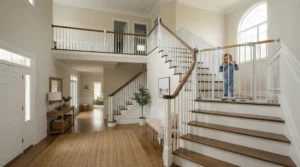
Scenario one: first-time parents, tight budget. A 1960s split-level, studs on both sides of the landing, an eight-month-old, and about $50 to spend. The Evenflo Walk-Thru Top of Stairs fits the budget and its 32-inch height buys runway as the baby grows. The swing stop goes in on day one and stays in.
Scenario two: the laundry-basket household. Two working parents, a one-year-old, and twenty trips a day up and down with their arms full. Auto-close and a flat floor line matter more than anything else. The Cumbor Hardware Mounted No Bottom Bar Gate or the Toddleroo by North States Easy Swing & Lock fits, as long as the swing-stop question is settled before drilling.
Scenario three: awkward walls, wider landing. An older home where the stud sits a few inches off and the landing runs wide. If it’s under 42 inches, the Cardinal Gates SS30 Stairway Special and its angle mount are the answer. If the span reaches 50-plus inches, the Toddleroo by North States StepSafe Auto-Close Extra Wide is the one that actually reaches.
✨ Don’t Miss These Exclusive Deals!
🔍 Take your stair safety to the next level with these carefully selected gates. Click on any highlighted item to check current pricing and availability. These picks will help you create a safer landing your whole family will love!
How to Choose a Baby Gate for Top of Stairs Hardware Mount
Consumer Reports’ buying guide describes the ideal stair-top gate as a hardware-mounted swing gate with one-handed opening, no threshold or bar at the bottom, and an auto-close feature. That’s a handy north star. Here’s the checklist built around it:
- Confirm the stair-top rating. The box or listing must say “top of stairs.” A pressure-mount model with an optional hardware kit is a different animal.
- Measure twice. Choose a gate whose adjustable range sits comfortably around your measurement, not at its extreme ends.
- Demand a swing stop. It should block opening over the stairs. Avoid gates where the stop is optional and easy to omit.
- Insist on a flat floor line. A bottom bar is a trip hazard. A near-flat threshold, like the 0.5-inch version on the Toddleroo by North States StepSafe Auto-Close Extra Wide, is a compromise for wide spans.
- Check height and certification. Look for current ASTM and JPMA or Baby Safety Alliance marks, and go taller if your child already tests limits.
- Test the latch logic. A deliberate two-step latch you can operate with one hand beats a clever mechanism you can’t operate while carrying a baby.
Walk Through Gate for Top of Stairs: What the Door Really Has to Do
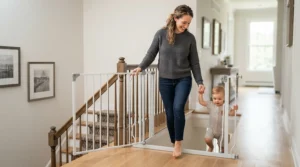
A walk through gate for top of stairs does more than swing. It needs to open wide enough for you, a laundry basket, and possibly a baby carrier, without forcing you to turn sideways. A gate that makes you step over a frame fails the “walk through” promise, however much the listing says otherwise.
Look at the door itself. Hold-open at about 90 degrees, a feature on both the Cumbor Hardware Mounted No Bottom Bar Gate and the Toddleroo by North States StepSafe Auto-Close Extra Wide, keeps the door out of your way during moves, parties, or grocery hauls. Then judge the latch: a lift-and-push action is meant to be hard for toddlers but easy for adults.
Here’s the trade-off nobody mentions. A bigger door opening usually means a longer swing arc, so make sure the landing has room for the door to travel without hitting a wall, a door, or the stair itself. A walk through gate for top of stairs is only convenient if the swing zone is clear.
Stair Gate That Does Not Swing Over Stairs: How a Swing Stop Really Works
A stair gate that does not swing over stairs relies on a small, humble part: the swing stop. Different brands implement it differently. The KidCo Safeway G2001 uses a directional stop pin. The Cardinal Gates SS30 Stairway Special includes a stop bracket. The Safety 1st Top of Stairs Expanding Metal Gate uses an adjustable gate stop, and the Toddleroo by North States Easy Swing & Lock uses a swing control setting.
Whichever style you have, the goal is the same: the door can only open toward the landing. If it opens toward the steps, a child leaning on the gate, or an adult stumbling into it, can send it open over the drop. As Vanderbilt University Medical Center’s stair safety tips point out, not all gates are designed for the top of the stairs, so check the manufacturer’s instructions for yours.
The Evenflo Walk-Thru Top of Stairs deserves a special warning, because its swing stop is removable. The swing stop is the whole point at a stair top, so treat it like a seat belt and verify it every time you touch the gate. Test by pushing the door toward the stairs with real force; it should not budge.
No Trip Threshold: Why the Bottom Bar Is the Sneaky Hazard
Most gates started life as doorway gates, and doorway gates have a bottom bar. At the top of stairs, that bar becomes a toe-catcher right where a stumble is most dangerous. This is why no trip threshold shows up on every serious stair-gate checklist, including Consumer Reports’ ideal-gate description.
The numbers back up the instinct. The Nationwide Children’s data showed that nearly a quarter of stair injuries in babies under one occurred while they were being carried, and those children were more than three times as likely to be hospitalized. A trip at the gate while holding a baby isn’t a small risk. It’s the scenario the whole category is trying to prevent.
Gates like the KidCo Safeway G2001, Toddleroo by North States Easy Swing & Lock, and Cumbor Hardware Mounted No Bottom Bar Gate go bar-free. The Toddleroo by North States StepSafe Auto-Close Extra Wide shrinks the bar to 0.5 inches to enable its wide span. Whichever you choose, keep the floor gap within the manual’s limits, since too much space under the gate creates a different hazard.
Wall Stud Anchors: What to Know Before You Drill
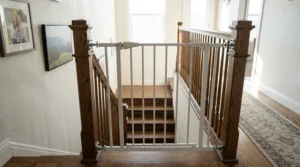
The best “anchor” for a stair gate is wood. Screws driven into a real stud, a door jamb, or a solid banister post bite into material that doesn’t crumble. Wall stud anchors and drywall plugs come into play only when the stud isn’t where the gate needs it.
Drywall alone is the villain here. Every time the door opens and shuts it pries at the hole, and eventually the hole rounds out and the bracket wobbles. Several installation guides say plainly that plastic drywall anchors aren’t enough for a stair-top gate. If you must use anchors, many sources suggest heavy-duty types such as toggle or molly bolts, and only where the manufacturer allows.
That caveat matters. North States says in its FAQ for one of its stair gates that its hardware-mounted gates should not be installed using anchors. Read your manual first. Better still, solve the stud problem with geometry: the angle mount on the Cardinal Gates SS30 Stairway Special or the KidCo Safeway G2001 angle-mount variant lets you shift the mounting point onto wood. Metal studs call for different fasteners, so check the instructions before drilling.
Baby Gate for Top of Stairs Hardware Mount vs Pressure Mount: A Direct Comparison
| Feature | Hardware Mount | Pressure Mount |
|---|---|---|
| Top of stairs | Recommended | Not recommended |
| Security | Fixed with screws into solid wood | Relies on friction, can loosen |
| Floor bar | Often none | Usually has a bottom bar |
| Wall damage | Screw holes | Minimal |
| Best For | Stair tops, permanent setups | Doorways, bottom of stairs |
Looking at the table, a hardware mount wins on security and trip risk, which is exactly why guidance from safety groups and manufacturers like Safety 1st points to screw-in gates at the top. Pressure gates remain a perfectly good choice at the bottom of stairs or in doorways. The honest trade-off is a few screw holes in exchange for a barrier that won’t pop loose when a child, a pet, or a tumbling adult hits it.
Safety, Regulations & Certification: What the Labels Mean
Gates sold in the U.S. fall under a mandatory standard, 16 CFR part 1239, which incorporates ASTM F1004. The CPSC’s gates and enclosures guidance explains the rule. Published notices indicate that the 2025 revision, ASTM F1004-25, became the mandatory version on July 19, 2026, and it adds a ban on pet-entry openings within the gate.
Those standards cover children roughly six to 24 months old. They are not a guarantee for older, climbing kids, and they do not cover pet gates. Safety summaries of CPSC guidance add practical rules: use a hardware-mounted gate at the top of stairs, never use a pet gate as a child safety gate, and replace older accordion-style gates with V-shaped openings.
Check the packaging for ASTM and JPMA or Baby Safety Alliance marks, and the manufacture date if you’re buying older stock. Gates are barriers, not babysitters. Supervision still does the real work.
Common Mistakes When Buying a Stair Gate
- Using a pressure gate at the top. It’s the most dangerous error, since it can pop free under a child’s weight or an adult’s stumble.
- Mounting into drywall only. Without a stud or approved anchors, the gate works loose over time.
- Letting it swing both ways. Skipping or removing the swing stop defeats the purpose.
- Buying on price alone. A cheap gate with a bottom bar can create the trip you were trying to avoid.
- Forgetting the bottom of the stairs. A gate there stops climbing, and it’s an easy place to use a pressure model.
- Never rechecking. Screws loosen, plastic cracks, and latches wear. A monthly check takes thirty seconds.
- Keeping the gate past its usefulness. Once a child can climb over, a gate becomes a launch pad, so reassess as they grow.
FAQ
❓ Can a hardware mounted baby gate be installed without drilling into the wall?
❓ How far from the top step should a stair gate be installed?
❓ Is a walk through gate safer than a step-over gate at the top of stairs?
❓ Can I use a pet gate as a baby gate for top of stairs?
❓ How often should I check a hardware mounted stair gate?
Conclusion
Choosing a baby gate for top of stairs hardware mount comes down to a short list of non-negotiables: screws into solid wood, a swing stop that blocks opening over the steps, and a floor line you can’t trip over. Beyond that, personality takes over. The Toddleroo by North States Easy Swing & Lock is the balanced all-rounder, and the Cardinal Gates SS30 Stairway Special is the problem-solver for awkward walls. The KidCo Safeway G2001 is the no-nonsense specialist, and the Evenflo Walk-Thru Top of Stairs is the budget champion. The Safety 1st Top of Stairs Expanding Metal Gate suits younger toddlers, the Cumbor Hardware Mounted No Bottom Bar Gate brings auto-close convenience, and the Toddleroo by North States StepSafe Auto-Close Extra Wide handles the wide landings others can’t.
Whatever you pick, spend the extra ten minutes finding studs, installing the swing stop, and testing the latch with one hand. A gate is only as safe as its installation.
Recommended for You
- No Drill Baby Gate For Renters: 7 Best Picks In 2026
- Interactive Learning Toys For A 2 Year Old: 7 Proven Picks (2026)
- Tech Toys For 2-3 Year Old Preschoolers: 7 Best Picks (2026)
Disclaimer: This article contains affiliate links. As an Amazon Associate, I earn from qualifying purchases. If you purchase products through these links, we may earn a small commission at no additional cost to you.
✨ Found this helpful? Share it with your friends! 💬🤗
