
In This Article
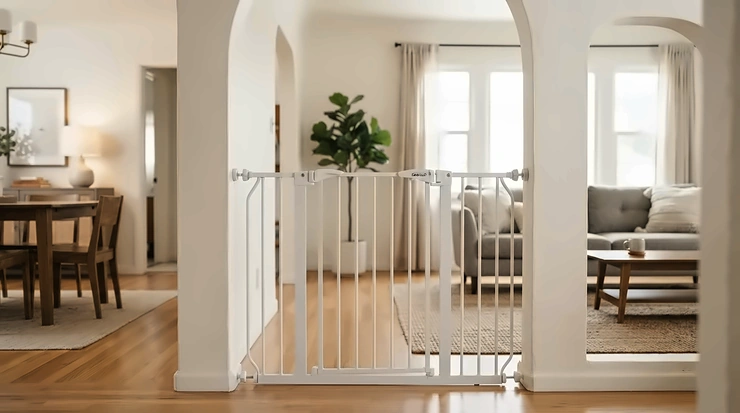
Your lease says “no holes in the walls.” Your nine-month-old says “watch me crawl toward the kitchen.” Somewhere between those two statements sits the no drill baby gate for renters, a humble steel-and-plastic barrier that holds itself in place with tension instead of screws.
The category has improved a lot. Auto-close doors, glow-in-the-dark handles, and wall protector cups are now common features. Safety labeling has also gotten stricter since federal gate rules were tightened.
But the market is still crowded with near-identical gates, and most roundups simply restate listing copy. This guide takes a different route. It leans on real spec sheets, aggregated review patterns from retail listings and published roundups, and honest reasoning about what each design means for a rental. No gate here has been personally tested, and nothing below pretends otherwise.
You’ll find seven real gates ranked by use case, plus deep dives on the features renters ask about most: hallway fit, screw-free setups, wall cups, latch design, and width range. There are also move-in and move-out guides, plus a plain-language safety section on where pressure gates don’t belong.
Pressure gates are the right answer for most doorways and hallways, and the wrong answer for one specific spot. We’ll get to that spot, because it matters more than any feature on a spec sheet.
Quick Comparison: 7 Best Gates at a Glance
| Gate | Width Range | Height | Door Style | Best For |
|---|---|---|---|---|
| Regalo Easy Step Walk Thru | 29–38.5 in. | ~30 in. | Walk-through, lever latch | Standard doorways on a budget |
| Cumbor Auto-Close Baby Gate | ~29.7–46 in. (varies by version) | ~30.5 in. | Auto-close, double-lock | Busy hallways, forgetful hands |
| Toddleroo Bright Choice Auto-Close | 29.75–40.5 in. | ~30 in. | Auto-close, ~22 in. door | Night-time trips, wider door |
| Safety 1st Easy Install Walk-Thru | 29–38 in. | ~28 in. | Walk-through, lock indicator | Parents who want visual confirmation |
| Babelio PressGuard | ~26–40 in. (wider versions exist) | ~30 in. | Auto-close, triple-lock | Wall-conscious renters |
| Regalo Easy Step Extra Wide | 29–49 in. (with extensions) | ~30 in. | Walk-through | Wide hallway openings |
| Evenflo Position & Lock Tall and Wide | 31–50 in. | ~31 in. | No door, lift-and-lock | Cheap, temporary wide spans |
Read the table above as a sorting tool rather than a verdict. The Regalo Easy Step Walk Thru and Safety 1st Easy Install Walk-Thru cover the same standard doorway range, so the choice comes down to latch feel and whether you value a lock indicator. The Cumbor Auto-Close Baby Gate and Toddleroo Bright Choice Auto-Close earn their higher price through self-closing doors that reduce the “did I latch it?” anxiety. The Evenflo Position & Lock Tall and Wide is the only one without a walk-through door, so it only suits spaces you rarely cross.
💬 Just one click — help others make better buying decisions too!😊
What Is a No Drill Baby Gate for Renters?
A no drill baby gate for renters is a pressure-mounted safety gate that stays in an opening by pushing outward against both sides with adjustable tension. It needs no screws, anchors, or wall damage. Most include rubber or plastic wall cups to spread the force, and they suit doorways, hallways, and the bottom of stairs.
That’s the short version. The longer version is that “no drill” describes the installation method, not the safety rating. As Wikipedia’s overview of baby gates notes, pressure gates can be dislodged by children and should not be used at the top of stairs. That limitation shapes everything else in this guide.
For renters, the appeal is obvious. There are no patched holes, no deposit disputes, and no permanent changes. A pressure gate also moves with you. When the lease ends, you wind the tension knobs back, lift the gate out, and carry it to the next apartment.
Three details separate a good one from a frustrating one:
- Contact surface: Cups and bumpers decide whether your paint survives.
- Tension mechanism: Dual spindles or four-point pressure keep the gate square.
- Latch design: A latch you can operate with one hand matters more than any marketing bullet.
Top 7 No Drill Baby Gates for Renters: Expert Analysis
Every gate below is a real product with a real spec sheet. Ratings come from retail listings and published roundups at the time of research, and prices are ranges only, so check current price before buying.
1. Regalo Easy Step Walk Thru Gate — the dependable default for standard doorways
This is the gate that other gates get compared to. It’s a steel walk-through with a lever latch, built around the idea that most renters just need one competent barrier for one ordinary door.
The spec sheet lists a 29–38.5 inch fit once the included 6-inch extension is installed, a height around 30 inches, and four wall cups. In practice, that range covers the typical interior doorway in most rentals without hunting for add-ons. The walk-through door means you pass through standing up instead of stepping over a bar.
Based on the specs, this suits a single kitchen or bedroom doorway where reliability beats bells and whistles. The tradeoff is that it has no auto-close, so the gate is only as safe as your habit of latching it.
Retail listings put it around 4.3 out of 5 across thousands of ratings. Reviewers consistently praise the tool-free setup and smooth one-hand latch. The recurring worry is a plastic latch component that some buyers fear may wear over time.
Pros:
- ✅ Included extension covers most standard doorways
- ✅ Smooth one-hand lever latch
- ✅ Four wall cups included for wall protection
Cons:
- ❌ No auto-close, so you must latch it manually
- ❌ Plastic latch parts raise long-term durability questions
Price runs in the mid-$40s to around $50 range. Verdict: the best default value if your opening is standard.

2. Cumbor Auto-Close Baby Gate — a self-closing door that forgives tired hands
Cumbor sells several versions of this gate, which creates a trap for renters. The pressure-mounted versions fit roughly 29.7–46 inches, stand about 30.5 inches tall, and use a carbon steel frame with an auto-close, double-lock door. Roundups report a walk-through opening of roughly 22–23 inches.
Check the listing title before buying, because Cumbor also sells hardware-only “no bottom bar” versions that require drilling. For a rental, you want the one labeled pressure-mounted.
The wide door matters more than it sounds. Carrying a laundry basket or an infant carrier through a 16-inch gap is an exercise in wall-scraping, while 22 inches is livable. Auto-close also adds a safety layer by removing the failure mode where a gate swings open because someone forgot.
Published roundups put its rating around 4.6 out of 5. Reviewers praise the roomy door and the closing action. One review notes that alignment during installation is fussy, and the auto-close only works properly once the gate is level.
Pros:
- ✅ Wide walk-through door, roughly 22–23 inches
- ✅ Auto-close with double-lock release
- ✅ Wide fit options across versions
Cons:
- ❌ Heavier steel build at roughly 13–14 pounds
- ❌ Installation needs careful alignment
Pricing sits in the mid-range for steel auto-close gates; check current price. Verdict: the best pick for a busy hallway.
3. Toddleroo Bright Choice Auto-Close Gate — a glow-in-the-dark handle for 2 a.m. runs
Nobody designs for midnight until they’ve fumbled a gate latch in the dark. This model’s handle glows, which solves a problem most spec sheets never mention.
It adjusts across 29.75–40.5 inches, stands 30 inches tall, and has a roughly 22-inch walk-through door. The door can swing one way or both, holds open past 90 degrees, and includes a swing-stop bottom lock. The brand also states that the gate is made in the USA.
The hold-open feature is underrated for renters who move furniture, groceries, or a stroller through the same opening daily. Weigh it against the 40.5-inch ceiling, which makes this a standard-width gate rather than a wide-hallway solution.
Retail listings land around 4.3–4.5 out of 5. Buyers frequently mention easy installation and a solid feel, and the glowing handle comes up as a genuine plus.
Pros:
- ✅ Glow-in-the-dark one-hand handle
- ✅ Hold-open feature for easy passage
- ✅ Wide door by pressure-gate standards
Cons:
- ❌ Tops out at 40.5 inches wide
- ❌ Heavy build at about 15 pounds
Price lands around the $60 range. Verdict: worth the premium if night-time use is frequent.
4. Safety 1st Easy Install Walk-Thru Gate — a red-to-green indicator takes out the guesswork
Pressure gates fail quietly when under-tightened. This one answers that with a SecureTech indicator on the top rail that shifts from red to green when the gate is securely locked.
The spec sheet lists a 29–38 inch fit including two extensions, a 28-inch height, four wall cups, and a two-action handle that adults can open with one hand while small fingers struggle. The manufacturer’s listing is explicit that wall cups must be installed and that the gate should never go at the top of stairs.
The indicator reflects a broader safety direction. Federal rules for pressure gates call for visual side-pressure indicators or a warning label about correct installation. A gate that shows you its status removes a layer of uncertainty.
The lower 28-inch height is the compromise. It’s fine for crawlers and early walkers, but climbers may outgrow it sooner than a 30-plus-inch model. One roundup crowned it for “best lock indicator,” which is the right framing.
Pros:
- ✅ Red-to-green indicator confirms a secure lock
- ✅ Swings both directions
- ✅ Two-action handle resists toddler hands
Cons:
- ❌ Shorter at 28 inches
- ❌ Width tops out at 38 inches
Expect a price around the $50–$60 range. Verdict: ideal for cautious first-time parents.
5. Babelio PressGuard Baby Gate — a triple-lock design that treats walls like they matter
PressGuard is aimed squarely at renters. One roundup describes a roughly 12-minute install without a drill and included wall protectors that prevent scuff marks on painted surfaces.
The feature list includes a triple-lock design, auto-close, a 180-degree swing, and a pressure mount that a roundup describes as tested to 260N. Widths vary by version, from roughly 26–40 inches to wider models near 55 inches, so match your exact opening to the exact listing.
A Consumer Reports listing for the gate notes it’s metal, opens with one hand, and includes screws to reinforce its adhesive wall cups. Renters who want zero holes should read the manual to confirm the cups work properly without those screws.
Public review data is thinner than for the Regalo or Cumbor models, so long-term durability is harder to judge. That’s a real caveat rather than a reason to avoid it.
Pros:
- ✅ Triple-lock design with auto-close
- ✅ Wall protectors included for paint
- ✅ Multiple width versions available
Cons:
- ❌ Less public long-term review history
- ❌ Version differences make shopping confusing
Pricing varies by width version, so check current price. Verdict: a smart fit for wall-sensitive rentals.

6. Regalo Easy Step Extra Wide Gate — stretches across the wide hallway openings
Some rentals have awkward openings, like a 46-inch kitchen archway or an open-plan divider. This version stretches the Easy Step formula to cover 29–49 inches using 4-inch and 12-inch extension kits.
Listings describe usable ranges built from extension combinations, so measure your opening and match it to the exact combination the manual specifies. Pressure comes from four spindle rods, with four wall cups included.
The physics deserve a plain-language note. The more extension pieces you add, the more joints sit between the two walls, and each joint adds a little flex. A gate near full extension is simply less rigid than the same gate in the middle of its range, which is why snug fitting and cup placement matter even more here.
Roundups flag a narrower walk-through door as the most common complaint on wide Regalo models, with one citing roughly 16 inches. Retail ratings sit around the high-3s to low-4s out of 5.
Pros:
- ✅ Spans openings up to about 49 inches
- ✅ Familiar one-hand lever latch
- ✅ Wall cups and extensions included
Cons:
- ❌ Narrower walk-through door
- ❌ Extensions reduce rigidity near full width
Price runs in the mid-$40s to around $60 range. Verdict: the budget answer for wide openings.
7. Evenflo Position & Lock Tall and Wide Gate — the cheapest way to span 50 inches
This gate is the odd one out, and that’s deliberate. It has no swinging door. You lift the panel, position it, and lock it in place, so passing through means moving the gate or stepping over.
The wood frame with plastic mesh fits 31–50 inches at around 31 inches tall. It’s lightweight and easy to reposition. That makes it a decent fit for rooms you open and close occasionally, such as a home office, a guest room, or a pet-restricted corner.
It’s a weak fit for the main hallway you cross twenty times a day. Without a latch you can operate with one hand, a walk-through gate will save you more frustration than this one saves in dollars.
Retail ratings hover in the high-3s out of 5 across several hundred reviews. Reviewers often cite value and light weight, while some find it less sturdy than metal gates.
Pros:
- ✅ Widest span for the lowest price
- ✅ Lightweight and easy to reposition
- ✅ Warm wood look suits many rentals
Cons:
- ❌ No walk-through door
- ❌ Mixed ratings on sturdiness
Price falls in the $30s to around $50 range. Verdict: fine for low-traffic wide gaps, not for daily doorways.
Side-by-Side Specs and Value
| Gate | Mount Feel | Door | Rating Snapshot | Price Range | Best For |
|---|---|---|---|---|---|
| Regalo Easy Step Walk Thru | Dual spindle, four cups | Lever walk-through | ~4.3/5 | Mid-$40s–$50 | One standard doorway |
| Cumbor Auto-Close Baby Gate | Pressure (check version) | Auto-close, ~22 in. | ~4.6/5 | Mid-range | Busy hallways |
| Toddleroo Bright Choice Auto-Close | Tension knobs, wall cups | Auto-close, hold-open | ~4.3–4.5/5 | ~$60 | Night-time users |
| Safety 1st Easy Install Walk-Thru | Four cups, indicator | Two-action handle | Not verified | ~$50–$60 | Cautious first-timers |
| Babelio PressGuard | Triple-lock, wall protectors | Auto-close | Limited data | Varies | Wall-sensitive rentals |
| Regalo Easy Step Extra Wide | Spindles plus extensions | Lever walk-through | ~3.9–4.2/5 | Mid-$40s–$60 | Wide openings |
| Evenflo Position & Lock Tall and Wide | Lift-and-lock | None | ~3.7–3.8/5 | $30s–$50 | Low-traffic gaps |
The value story is simple. Under about $60 you can buy a solid walk-through gate, and the Regalo Easy Step Walk Thru delivers the most reliability per dollar for standard openings. Paying more for the Cumbor Auto-Close Baby Gate or Toddleroo Bright Choice Auto-Close buys a self-closing door, which pays off if you cross the opening many times a day. The Evenflo Position & Lock Tall and Wide is cheapest, but you pay for it in daily convenience.
How to Choose a No Drill Baby Gate for Renters
Federal gate rules are written around ASTM F1004, and the CPSC’s gates and enclosures business guidance explains the mandatory standard. Use that as your baseline, then work through these steps.
- Measure the opening three times. Check the top, middle, and bottom, because walls and baseboards are rarely perfectly parallel. Use the narrowest measurement.
- Pick the right location. Pressure gates suit doorways, hallways, and the bottom of stairs. For the top of stairs you need hardware mounting, which means a different category.
- Match width to the middle of the range. A gate near its maximum extension is less rigid. Choose a model where your opening lands comfortably inside the range.
- Decide on a door. If you cross the opening daily, buy a walk-through. If it’s a rarely used room, a no-door gate can save money.
- Test the latch logic. Look for a double-action or two-step release you can operate with one hand while holding something.
- Confirm wall cups. The listing should include them, and you should plan to use them. Add third-party protector cups for delicate paint.
- Check labeling. Look for ASTM F1004 compliance and a Baby Safety Alliance or JPMA mark, plus an age range, typically 6–24 months.
Damage Free Baby Gate for Apartment Hallway: Making It Work
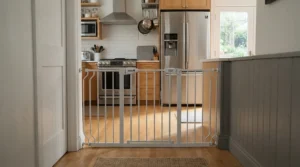
A hallway looks easy because it has two long parallel walls. A damage free baby gate for apartment hallway installs depends on what those walls are made of.
Painted drywall can dent under sustained pressure, old plaster can crumble at the contact point, and textured paint can flake when cups are removed. Baseboards are tempting contact surfaces, but they sit proud of the wall and can pivot under load. Spreading pressure over larger cups, at solid points, is the whole game.
Be honest about the claim, too. No pressure gate is guaranteed damage-free. Damage depends on the contact surface, how hard you crank the knobs, and how carefully you remove it. One reviewer of a wall-cup accessory reported that a gate’s end pieces were scuffing wood and wall until protector cups were added, which fits the physics.
A few habits keep a hallway gate low-impact:
- Photograph the walls first. A dated photo at move-in protects your deposit.
- Find the flattest, hardest contact zone. Avoid trim edges and thin spots.
- Tighten gradually. Stop when the gate holds firm, not when the knob won’t turn.
- Retighten monthly. Temperature and humidity change wall dimensions slightly.
- Wipe the walls at removal. Check for pressure rings before you hand back the keys.
The Babelio PressGuard Baby Gate and Toddleroo Bright Choice Auto-Close Gate both ship with cups designed for this use. Pair either with protector cups if your paint is fragile.
Baby Gate With No Screws for Rental: What “No Screws” Really Means
“No screws” sounds like a single category, but gate listings mean three different things.
- Pressure only: nothing touches the wall except rubber cups. This is the pure renter option.
- Pressure plus optional screw cups: the gate works under tension, but the cups have screw holes for extra security. You can skip the screws, though some manufacturers recommend them.
- Hardware only: the gate requires drilling. These are for the top of stairs and are not renter-friendly.
Renters shopping for a baby gate with no screws for rental should read the product title closely. Cumbor’s no-trip versions, for example, are hardware-mounted and require drilling, while its pressure-mounted version does not. Dreambaby’s own listing notes that its gate must use screwed-in wall cups when installed on a stairway, so that use case can’t be screw-free.
Federal rules also push in the cup direction. The CPSC’s pressure-gate requirements call for visual indicators or a warning label about correct installation using wall cups. In plain terms, wall cups are part of how these gates are meant to be installed, so skipping them is not a renter shortcut.
If your lease allows nothing at all, use the cups without screws and accept that the gate is a doorway barrier, not a stair barrier. The Safety 1st Easy Install Walk-Thru Gate and Regalo Easy Step Walk Thru Gate both work this way.
Wall Protector Cups: Cheap Insurance for Your Deposit
Wall protector cups are wider cups that sit between a gate’s own cups and your wall. They spread the pressure over a larger surface, which lowers the force per square inch and reduces dents and scuffs.
They come as aftermarket four-packs, and Toddleroo sells its own wall guards. One reviewer of a third-party four-pack said the gate’s hard plastic cups fit neatly into the protectors, and that the protectors added grip on a baseboard. That’s anecdotal, but the design logic holds up.
There are tradeoffs worth knowing:
- They add thickness. Each cup eats a fraction of an inch of your width range, so a tight fit may need an extension.
- Mismatched sizes slip. Check that the gate’s cup fits the protector’s recess.
- They don’t excuse over-tightening. More surface area spreads force, but it doesn’t eliminate it.
For a Cumbor Auto-Close Baby Gate or Babelio PressGuard Baby Gate in a hallway with fragile paint, protector cups are cheap insurance. For a sturdy painted door frame, the included cups on a Regalo Easy Step Walk Thru Gate are usually enough.
One Hand Release Latch: The Feature You’ll Touch 40 Times a Day
Spec sheets love to say “one hand,” and almost every gate claims it. The phrase hides real differences.
A one hand release latch ranges from a simple lever, like the Regalo Easy Step Walk Thru Gate uses, to a two-action handle where you press and lift, like the Safety 1st Easy Install Walk-Thru Gate. Others add auto-close, like the Cumbor Auto-Close Baby Gate, or a glow-in-the-dark grip, like the Toddleroo Bright Choice Auto-Close Gate.
The design tension is straightforward. A latch must be easy for an adult holding a baby and impossible for a toddler to defeat. One roundup noted that a stiff locking lever is a feature, not a flaw, because most toddlers can’t operate it.
Run this checklist in the store or during the return window:
- Elbow test: Can you open it using only your forearm while your hands are full?
- Close test: Does it click shut, or can it rest almost closed?
- Dark test: Can you find the release without light?
- Resistance test: Is it stiff enough to frustrate a small child, but still easy for you?
Fussy latches get ignored, and an ignored latch means a gate left open. Choose the one you’ll actually use correctly every time.
Adjustable Width Range: Why the Middle of the Range Wins
Every listing advertises an adjustable width range, but the number on the box is a limit, not a recommendation. A gate performs best near the middle of its range, with the tension rods only partly extended and the extension kits used sparingly.
Fit gaps also exist. One Evenflo walk-through listing warns that the Evenflo Easy Walk-Thru isn’t suitable for openings between 33 and 35 inches, which shows how extension combinations can leave dead zones. Always match your measurement to the exact range chart in the manual, not just the headline.
Use this quick sizing logic:
- Under 38 inches: the Regalo Easy Step Walk Thru Gate or Safety 1st Easy Install Walk-Thru Gate fit comfortably.
- 38–42 inches: the Toddleroo Bright Choice Auto-Close Gate or a mid-range Cumbor Auto-Close Baby Gate version.
- 42–50 inches: the Regalo Easy Step Extra Wide Gate or Evenflo Position & Lock Tall and Wide Gate.
- Beyond 50 inches: look at Cumbor’s wider models, or consider retractable and freestanding options.
If your opening sits at the very edge of two gates, pick the one where you land in the middle. The extra rigidity is worth a few dollars.
Installing a No Drill Baby Gate: A Move-In to Move-Out Guide
A pressure gate is only as good as its installation. Here’s a practical sequence that most manuals support.
Before you install
- Photograph the walls and baseboards.
- Measure the opening at three heights.
- Dry-fit the gate, adding extensions only if needed.
Installation
- Attach the wall cups to the spindles, and the protector cups if you’re using them.
- Position the gate with the door swinging away from the stair or hazard side.
- Tighten each knob a little at a time, alternating sides so the gate stays square.
- Confirm the indicator or push test shows a firm hold.
The first 30 days
- Retighten weekly, because new installs settle.
- Check the latch alignment, since misalignment is the usual cause of auto-close failures.
- Watch for walls creeping out of square.
Maintenance schedule
- Monthly: retighten and check for pressure marks.
- Every few months: wipe the latch and hinges.
- At move-out: loosen the knobs fully before removing, then check the walls.
Common first-month mistakes include over-tightening one side, mounting on baseboard instead of wall, and forgetting to latch a manual gate. The manufacturer’s manual and the CPSC’s gates and enclosures FAQ are worth a skim before you commit.
Real-World Scenarios: Which Gate Fits Which Rental?
Specs only matter in context. Here are three profiles and the gates that fit them.
Scenario 1: The one-bedroom with a crawling baby. A couple in a 700-square-foot apartment has a standard 34-inch kitchen doorway and limited budget. The Regalo Easy Step Walk Thru Gate covers the range, installs without tools, and costs less than a month of takeout. They cross the doorway often, so a lever latch they can operate while holding a bottle is worth more than any extra feature.
Scenario 2: The railroad-style hallway with a dog. A renter with a toddler and a large dog has a 44-inch opening between the living room and bedrooms. The Cumbor Auto-Close Baby Gate version that spans that width, or the Regalo Easy Step Extra Wide Gate on a tighter budget, suits the daily traffic. Auto-close helps here, because a dog pushing through a half-latched gate is a real failure mode.
Scenario 3: The guest-room occasional gate. Grandparents who host the baby a few weekends a year need to block a 48-inch den. The Evenflo Position & Lock Tall and Wide Gate fits the span and the budget, and it stores flat in a closet when not needed.
For late-night parents or a landlord who inspects often, the Toddleroo Bright Choice Auto-Close Gate and Babelio PressGuard Baby Gate are the “protect the walls and the sleep” picks.
✨ Don’t Miss These Exclusive Deals!
🔍 Take your home safety to the next level with these carefully selected gates. Click on any highlighted item to check current pricing and availability. These gates will help you create a safe, deposit-friendly space your family will love!
Safety First: Where a No Drill Gate Does Not Belong
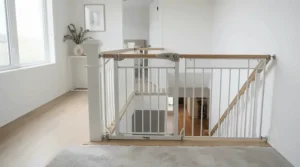
The single most important rule in this guide is also the simplest: never use a pressure-mounted gate at the top of stairs. Wikipedia’s baby gate overview notes that pressure gates have been dislodged by children running into them, and that parents have fallen trying to step over the bottom bar. The Safety 1st listing puts it in all caps for a reason.
The regulatory backdrop is real. The CPSC’s final rule for gates and enclosures incorporated ASTM F1004-19 as a mandatory standard, with extra requirements aimed at correct installation of pressure-mounted gates. The Federal Register notes that the standard has been updated since, so look for current compliance labeling on any gate you buy.
Practical safety rules for renters:
- Stairs: use a hardware-mounted gate at the top, even if it means asking your landlord or choosing a banister-mount option.
- Age: most gates are rated for roughly 6–24 months. Once a child climbs, the gate is no longer a reliable barrier.
- Height: if a child can get a foot on the cross-rail, replace the gate with a taller one.
- Bottom bars: pressure gates have a bottom threshold bar, so step over it deliberately or choose a lower-profile design.
If the opening you need to block is a top-of-stairs opening, a pressure gate is the wrong tool no matter how wall-friendly it is.
No Drill Pressure Gates vs Hardware-Mounted Gates
Both types have a place. The question is which fits the opening.
| Factor | Pressure-Mounted | Hardware-Mounted | Best For |
|---|---|---|---|
| Wall damage | None to minimal with cups | Screw holes | Pressure for renters |
| Top of stairs | Not recommended | Recommended | Hardware for stairs |
| Install time | Minutes | Longer, needs tools | Pressure for speed |
| Portability | Easy to move | Fixed | Regalo Easy Step Walk Thru for flexibility |
| Rigidity | Lower near full width | Higher | Hardware for high-risk spots |
Pressure gates win on flexibility and zero lease risk, while hardware gates win on rigidity and stair safety. For a renter, the sensible split is a pressure gate for doorways and hallways, plus a landlord-approved hardware gate if the apartment has top-of-stair openings.
On cost, a pressure gate in the roughly $40–$60 range is cheap compared with the hassle of patching holes, even if small screw holes are usually easy to fix. The real value is control. You can set up, move, and remove a Cumbor Auto-Close Baby Gate or Toddleroo Bright Choice Auto-Close Gate without a single conversation with your landlord.

FAQ
❓ Will a pressure mounted gate leave marks on painted walls?
❓ How tight should a pressure gate be?
❓ What gate fits a 48-inch hallway opening?
❓ Can I use a pressure gate at the top of stairs if my landlord won't allow drilling?
❓ When should I stop using a baby gate?
Conclusion
The right no drill baby gate for renters comes down to three decisions: where it goes, how often you’ll cross it, and how wide the opening is. For one standard doorway, the Regalo Easy Step Walk Thru Gate is the dependable value pick. For busy hallways, the Cumbor Auto-Close Baby Gate and Toddleroo Bright Choice Auto-Close Gate make daily life smoother with self-closing doors. The Safety 1st Easy Install Walk-Thru Gate adds a lock indicator for peace of mind, and the Babelio PressGuard Baby Gate keeps walls front and center. For wide openings, the Regalo Easy Step Extra Wide Gate and Evenflo Position & Lock Tall and Wide Gate give you two budget routes with different tradeoffs.
Whatever you choose, remember the three non-negotiables. Measure carefully, use the wall cups, and keep pressure gates away from the top of the stairs. Read the CPSC’s gate guidance once, and you’ll know more than most buyers do.
✨ Ready to protect your little one and your deposit?
🔍 Click any highlighted gate above to check current pricing and availability, then pick the one that matches your opening and your daily routine. Safe, simple, and hole-free. Your walls and your peace of mind will thank you!
Recommended for You
- Interactive Learning Toys For A 2 Year Old: 7 Proven Picks (2026)
- Tech Toys For 2-3 Year Old Preschoolers: 7 Best Picks (2026)
- Budget Tech Gifts For Baby’s First Birthday: 7 Smart Picks 2026
Disclaimer: This article contains affiliate links. As an Amazon Associate, I earn from qualifying purchases. If you purchase products through these links, we may earn a small commission at no additional cost to you.
✨ Found this helpful? Share it with your friends! 💬🤗
