In This Article
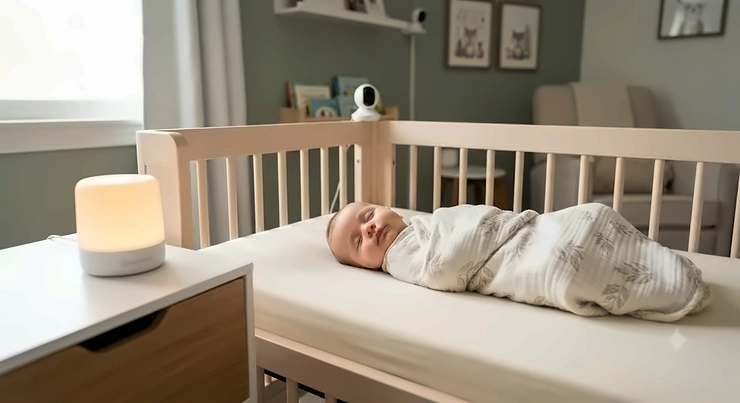
It’s 3 a.m., the hallway floorboard creaks, and you freeze mid-step because one wrong sound could undo forty-five minutes of rocking. This is exactly the scenario a non looping white noise baby machine is built to prevent. Non looping white noise for a baby means sound — generated by a real internal fan or produced through long, dynamically varied digital audio — that never audibly restarts or repeats on a short, detectable cycle. That distinction matters enormously in a nursery, because a baby’s brain, like an adult’s, can learn the rhythm of a short looped recording, and once it does, the loop’s restart click becomes just another noise capable of causing a stir instead of preventing one.
For infants specifically, the stakes around getting this right are a little higher than for adult bedrooms. White noise is a signal containing all audible frequencies at roughly equal intensity, and volume and placement carry real pediatric guidance behind them — sound options marketed as “for baby” aren’t automatically appropriate at every setting, and the gap between a genuinely non-looping machine and one that just claims to be can mean the difference between a three-hour nap and a forty-minute one. Below, we’ve researched seven real, currently available machines — from a $20 plug-in basic to a $100 app-connected smart device — and broken down what their actual specs mean for a genuinely exhausted parent trying to buy the right thing once, rather than the third time.
Quick Comparison Table: 7 Non-Looping White Noise Machines for Baby
| Product | Sound Type | Price Range | Best For |
|---|---|---|---|
| Yogasleep Dohm Classic | Real mechanical fan | Around $45-$55 | Parents who want zero tech in the nursery |
| HoMedics SoundSpa | Digital, single track | Under $25 | Tightest budgets, battery backup |
| Magicteam Sound Machine | Digital, 20 non-looping sounds | Around $25-$30 | Precise volume dialing on a budget |
| Dreamegg D3 Pro | Digital, 29 sounds | Around $30-$35 | Newborns who like womb-mimicking tones |
| SNOOZ Original | Real fan, app-adjustable | Mid-$90s to low-$100s | Nurseries needing precise, safe volume |
| Hatch Rest 2nd Gen | Digital + nightlight | Around $60-$95 | All-in-one nursery setups |
| Marpac Hushh for Baby | Rechargeable, portable, clip-on | Around $25-$30 | Strollers, car seats, travel cribs |
Looking at this spread, the split that matters most for a nursery isn’t really price — it’s how each machine guarantees its non-looping claim. The Yogasleep Dohm Classic and SNOOZ Original both use a genuine spinning fan, so there’s no audio file to loop in the first place. The Magicteam Sound Machine, Dreamegg D3 Pro, and Hatch Rest 2nd Gen rely on longer, dynamically varied digital tracks engineered specifically to avoid a detectable repeat point. The HoMedics SoundSpa, by contrast, doesn’t publish the same non-looping engineering claims as its pricier rivals, which is worth knowing before you assume “continuous play” and “non-looping” mean the exact same thing.
Just one click — help other tired parents make better choices too!😊
Top 7 Non-Looping White Noise Machines for Baby: Expert Analysis
1. Yogasleep Dohm Classic — non-looping by physics, not programming
The standout feature here isn’t a spec at all — it’s the absence of a speaker. A genuine motorized fan spins inside a plastic housing, and twisting the outer cap opens or closes intake vents to change pitch and volume. Two speed settings are the entire interface, powered by a 7-foot AC cord meant for a fixed spot near the crib rather than a diaper bag.
Because the sound comes from moving air rather than a recorded file, there is no audio loop to detect in the first place — non-looping isn’t a marketing claim here, it’s a mechanical fact. Based on the spec comparison with digital rivals, the honest trade-off is control: two speeds instead of ten or twenty, and no nightlight, timer, or wake alarm bundled in. For a parent who wants one less screen and one less app in an already overstimulating nursery, that simplicity is the actual selling point rather than a limitation.
Aggregated reviewer commentary consistently praises how unapologetically analog the Dohm feels, with no Bluetooth or touchscreen to fuss over during a 2 a.m. reset, while noting the narrower sound range — no rain, no birds, no lullabies — as the clear compromise for that simplicity.
Pros:
- ✅ Genuinely non-looping by mechanical design, not just marketing
- ✅ Six-decade reliability track record since 1962
- ✅ Zero setup, app, or pairing required
Cons:
- ❌ Only two speed settings, no fine volume control
- ❌ No nightlight, timer, or auto-off feature
At around $45-$55, the Yogasleep Dohm Classic is the machine for parents who’d rather trust a fan blade than a firmware update to get through the night.
2. HoMedics SoundSpa — the budget pick for a first nursery setup
The HoMedics SoundSpa offers one white noise track among six total soothing sounds, a simple three-position timer, and runs on either its A/C adapter or four AA batteries for roughly 100 hours — useful during a power outage or an overnight at a relative’s house. At under $25, it’s the least you can spend and still get functional sound masking in a nursery.
Here’s the honest caveat: unlike the fan-based or dynamically generated machines on this list, the HoMedics SoundSpa doesn’t publish specific non-looping or dynamic-audio engineering claims, so budget buyers should treat its “continuous play” setting as good, dependable background noise rather than a verified seamless loop the way pricier rivals are engineered. Aggregated tester notes describe the single white noise option as thinner and harsher-sounding than dedicated non-looping machines, closer to static with the warmer low frequencies removed.
Reviewers consistently describe the build as functional but noticeably lighter-duty in feel than the fan-based or app-connected options, while confirming the buttons and volume dial stay responsive despite the low price. For a spare room, a first apartment nursery, or a backup unit, it remains a reasonable choice — just not the pick if verified non-looping architecture is your top priority.
Pros:
- ✅ Lowest price point of any nursery machine in this roundup
- ✅ Runs roughly 100 hours on AA batteries for outage backup
- ✅ Simple three-setting timer with no learning curve
Cons:
- ❌ Doesn’t publish specific non-looping engineering claims
- ❌ Single white noise track sounds thinner than pricier options
Under $25, the HoMedics SoundSpa is best treated as a functional backup or starter machine rather than the primary pick for parents specifically prioritizing verified non-looping sound.
3. Magicteam Sound Machine — 32 volume levels for genuinely precise dialing
The Magicteam Sound Machine packs 20 non-looping sounds — including white, brown, pink, and blue noise plus fan, brook, rain, ocean, and bird tones — into a compact, 0.37-pound unit powered by AC or USB. What sets it apart on paper is 32 distinct volume levels, timer settings from one to five hours or continuous play, and a memory function that restores your last sound, volume, and timer choice automatically.
What most parents overlook about volume-level count is that it directly affects how precisely you can hit a specific, safe decibel target in a nursery — a two-speed machine forces a compromise, while 32 increments let you creep up in tiny steps until you land exactly where pediatric guidance recommends, rather than jumping straight from “too quiet” to “too loud.” Based on the spec comparison with other budget options here, that level of volume granularity is unusual below the $30 mark.
Reviewers consistently note the sound stays clear at lower volumes but that the maximum output is noticeably weaker than pricier fan-based or app-connected machines, meaning it masks moderate household noise well but won’t compete with loud traffic or construction outside a window. The six-button interface is simple enough for a sleep-deprived parent to operate one-handed in the dark.
Pros:
- ✅ 32 volume levels for precise, incremental adjustment
- ✅ Memory function restores your last exact settings
- ✅ Dual AC/USB power for home or travel flexibility
Cons:
- ❌ Maximum volume weaker than pricier competitors
- ❌ No nightlight included
At roughly $25-$30, the Magicteam Sound Machine is arguably the best value pick here for parents who care more about dialing in an exact safe volume than about raw masking power.
4. Dreamegg D3 Pro — the biggest sound library, including womb-mimicking tones
The Dreamegg D3 Pro offers 29 total sounds across seven white noise variants, seven fan tones, and fifteen nature and relaxation options — including a fetal heartbeat and shushing track specifically designed to echo the sound environment of the womb. Stereo speakers and a memory function that restores last-used settings round out the spec sheet, with tested output reaching roughly 80 dB on louder settings.
For newborns specifically, that fetal-tone option is more than a gimmick — based on the spec comparison with adult-oriented machines, few budget devices bother including womb-mimicking sounds at all, and some parents find these settings soothe a colicky or overstimulated newborn faster than a generic white noise track. Reviewers consistently note the speaker output stays clear and undistorted even at higher volumes, a combination of clarity and loudness that’s uncommon below the $40 mark.
The most-cited drawback in aggregated reviews is that a handful of the nature tracks feel shorter and slightly more prone to a detectable loop point compared to the dedicated white noise and fan tracks, which are engineered for longer, more seamless playback — worth knowing if a specific nature sound becomes your baby’s favorite.
Pros:
- ✅ 29 total sounds, including fetal heartbeat and shushing tones
- ✅ Memory function restores exact last-used settings
- ✅ Clear, undistorted speaker output even at louder volumes
Cons:
- ❌ Some nature tracks loop more noticeably than white noise tracks
- ❌ No companion app for remote scheduling
At around $30-$35, the Dreamegg D3 Pro stands out specifically for newborn households wanting womb-like sound options alongside standard white noise.
5. SNOOZ Original — a real fan with the volume precision a nursery actually needs
The SNOOZ Original pairs a genuine spinning fan — guaranteeing non-looping sound the same way the Dohm does — with 10 distinct volume settings, adjustable tone via a rotating outer shell, and a companion app that includes a “nursery calibration” feature aimed specifically at parents. Measured volume at the device ranges roughly 46 to 87 dBA, and the unit weighs about 1.1 pounds in a compact housing.
What most buyers overlook about a real-fan machine is that adjustable volume solves the single biggest limitation of mechanical white noise historically — a two-speed Dohm ties volume and tone together, while the SNOOZ decouples them into ten discrete steps. For a nursery specifically, that means finding a setting that stays comfortably under recommended pediatric volume thresholds without sacrificing the fuller, richer tone a low fan speed alone might lack.
Aggregated customer feedback frequently highlights the nursery calibration feature and the ten-step volume dial as genuinely useful for new parents trying to hit a precise, evidence-informed target rather than guessing. Some reviewers note the companion app can be slow to connect on setup — a common friction point for Bluetooth-paired nursery devices generally.
Pros:
- ✅ Genuine mechanical fan guarantees non-looping sound
- ✅ Ten adjustable volume settings plus app-based nursery calibration
- ✅ Decouples volume from tone for finer nursery-safe control
Cons:
- ❌ Priced well above budget and mid-range digital alternatives
- ❌ App connectivity occasionally lags during initial setup
Sitting in the mid-$90s to low-$100s, the SNOOZ Original earns its premium price specifically through the combination parents actually need: verified non-looping sound plus fine enough volume control to stay within safe limits.
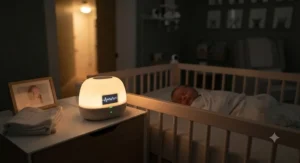
6. Hatch Rest 2nd Gen — non-looping sound, a nightlight, and a routine cue in one device
The Hatch Rest 2nd Gen pairs a WiFi-enabled sound machine — offering White Noise, Ocean, Rain, Birds, Wind, Water, Thunderstorm, Dryer, Heartbeat, and Fan tracks — with a dimmable, color-adjustable nightlight and a “Time-to-Rise” cue that later helps toddlers learn when it’s actually morning. WiFi is required for initial setup and for the expanding content library, but saved sound-and-light settings continue running without an active connection afterward.
For a nursery specifically, that combination solves a real 3 a.m. problem: instead of fumbling for a separate nightlight during a feeding while the sound machine runs on its own timer, one device handles both, with the light dimmed low enough not to fully wake the baby. The base Rest 2nd Gen runs around $60-$70, while the Rest+ 2nd Gen adds a backup battery for roughly $85-$95 — a genuinely useful upgrade for parents in storm-prone areas where outages are common.
Aggregated parent reviews describe years of consistent nightly reliability, with one long-term reviewer citing three straight years of daily use across two children before any issue surfaced. The most consistent critique is that unlocking the full lullaby and story library requires a separate Hatch+ subscription, which some parents feel should be bundled at this price.
Pros:
- ✅ Combines non-looping sound, dimmable nightlight, and clock in one device
- ✅ Keeps saved settings running even without active WiFi
- ✅ Strong aggregated multi-year reliability from real parent use
Cons:
- ❌ Full content library requires a separate subscription
- ❌ Initial setup depends on a WiFi connection
Between roughly $60 and $95 depending on battery backup, the Hatch Rest 2nd Gen earns its higher price by solving sound, light, and routine cues in a single nursery device instead of three separate gadgets.
7. Marpac Hushh for Baby — the clip-on option built specifically for babies on the move
The Marpac Hushh for Baby is a 3.5-inch, 3.8-ounce disc with a rechargeable battery, a baby-safe clip, a child lock, and exactly three sound options: bright white noise, deep white noise, and gentle surf. There’s no app and no WiFi, and for this specific use case, that’s the entire appeal.
What the spec sheet doesn’t say outright, but the design communicates clearly, is that this machine trades sound variety for two very baby-specific safety conveniences: the clip mounts securely to a stroller, car seat, or crib rail without any dangling cord near the baby, and the child lock keeps a curious toddler’s hands from silencing or maxing out the volume mid-nap. Being rechargeable also removes any temptation to run an extension cord near a crib — a small but genuinely relevant nursery safety detail.
Reviewers consistently mention the surprisingly wide volume range for something this compact, along with the convenience of USB recharging for car rides, flights, or hotel stays where an outlet near the crib isn’t guaranteed. The trade-offs are exactly what you’d expect from something built this small: three sounds instead of twenty-plus, and a speaker that won’t fill a large room.
Pros:
- ✅ Clip mounts securely to stroller, car seat, or crib with no dangling cord
- ✅ Child lock prevents accidental volume or setting changes
- ✅ Rechargeable battery removes any cord-near-crib concern
Cons:
- ❌ Only three sound options compared to 20+ on digital rivals
- ❌ Smaller speaker struggles to fill larger rooms
At roughly $25-$30, the Marpac Hushh for Baby is the one built around the specific safety realities of a baby who travels — not the everyday nursery centerpiece, but the machine that goes wherever the crib doesn’t.
Setting Up Seamless Sound Therapy: A Practical Nursery Usage Guide
Getting genuinely seamless sound therapy in a nursery is less about the machine itself and more about where you put it and how you introduce it. Start with placement: position the machine several feet from the crib rather than right against the rail, both to spread the sound more evenly across the room and to stay comfortably under recommended volume thresholds at the baby’s actual ear level (more specifics on that in the safety section below). A machine blasting directly at close range defeats the purpose of “gentle background masking” and turns into its own disruptive noise source.
During the first 30 days, introduce the sound at a lower volume than you might instinctively reach for, then adjust gradually rather than maxing it out because one loud car alarm interrupted a nap. A common mistake new parents make is treating volume like it should scale with how startled they felt by a recent disturbance, when the actual goal is the lowest setting that reliably masks routine household noise — a machine like the Magicteam Sound Machine with 32 volume increments makes finding that exact point far easier than a two-speed unit. If you’re using a real-fan option like the Yogasleep Dohm Classic or SNOOZ Original, wipe the intake vents with a dry cloth every couple of months to prevent dust buildup, which can introduce a subtle rattling sound over time that’s easy to mistake for a hardware problem.
Timers deserve a specific nursery-focused note: run non-looping sound continuously through an entire nap or overnight sleep stretch rather than setting a short auto-off, since a machine that cuts out at 2 a.m. reintroduces the exact silence-to-noise contrast the whole setup was meant to avoid. Save shorter timers, where available on machines like the Dreamegg D3 Pro, for transitional bedtime routines where fading the sound out gradually as the baby settles is actually the goal.
Uninterrupted Audio Sleep for Every Nursery: Case Studies
Consider a newborn still adjusting from the constant ambient hum of the womb to a comparatively silent bedroom. Uninterrupted audio sleep matters enormously here, and the Dreamegg D3 Pro‘s fetal heartbeat and shushing tracks are built specifically to bridge that gap, giving a fussy newborn something closer to the sound environment they’re already used to rather than an unfamiliar white noise substitute.
Now picture a toddler in a shared-wall apartment, where hallway noise and a downstairs neighbor’s late nights are the main disruptors. Here, verified non-looping sound at a genuinely masking volume matters more than variety — the SNOOZ Original‘s ten-step volume control lets parents dial in exactly enough sound to cover the specific disruption without overshooting into territory that could interfere with the baby’s own hearing development. Compare that to a family managing feedings and diaper changes multiple times a night, where the Hatch Rest 2nd Gen‘s combined nightlight and sound machine reduces the number of separate devices and light switches a groggy parent has to manage at 3 a.m., keeping the whole routine smoother and quieter.
Finally, think about a family that travels frequently — visiting grandparents, hotel stays, or a weekly commute between two homes. The Marpac Hushh for Baby‘s rechargeable, clip-on design means uninterrupted audio sleep doesn’t depend on finding an outlet near an unfamiliar crib, and the child lock keeps settings from being accidentally bumped during transport, which matters more than it sounds like it would after the third middle-of-the-night reset.
How to Choose a Non Looping White Noise Machine for Baby
What is non looping white noise for a baby? It’s sound produced by a real internal fan or long, dynamically varied digital audio specifically engineered to avoid an audible restart point — unlike a short recorded loop, which a baby’s brain can learn to notice, weakening the masking effect over a full night’s sleep.
Here’s how to narrow down the right pick:
- Decide between a mechanical fan and verified digital audio. A real fan like the Yogasleep Dohm Classic guarantees non-looping by physics alone; digital machines like the Magicteam Sound Machine trade a little of that guarantee for far more sound variety.
- Check for a documented volume range, not just “adjustable.” The SNOOZ Original‘s measured 46-87 dBA range tells you far more than a vague marketing claim.
- Match power source to your actual routine. Rechargeable, clip-on options like the Marpac Hushh for Baby matter for strollers and travel; AC-only units are fine for a fixed nursery.
- Consider whether a nightlight genuinely fits your nighttime routine. If feedings and diaper changes happen multiple times nightly, a combined device like the Hatch Rest 2nd Gen saves real steps.
- Prioritize volume-level count for precision. More increments — 32 on the Magicteam Sound Machine, ten on the SNOOZ Original — make it far easier to land on a safe, effective setting than a two-speed machine.
- Weigh price against realistic lifespan. A $50 machine that lasts a decade, per the Dohm’s long track record, often beats replacing a $20 unit twice.
- Read aggregated review themes, not star averages alone. A recurring specific complaint — like weaker maximum volume — tells you more than an overall rating. For a broader look at how sleep researchers frame sound-masking evidence generally, Sleep Foundation’s overview of white noise machines is a useful starting point before committing to a purchase.
Non-Looping vs Looping Sound Apps: What Actually Works for Baby
A free white noise app on a parent’s phone feels like the obvious first move — no purchase, no new gadget, just tap play and set the phone on the dresser. But most apps rely on short audio files, often just seconds to a couple of minutes long, looped on repeat — precisely the weakness a dedicated non-looping machine is engineered to avoid.
| Factor | Dedicated Non-Looping Machine | Phone/App Sound |
|---|---|---|
| Looping | Non-looping (real fan or dynamic audio) | Usually loops a short audio file |
| Reliability | Runs independently all night | Depends on phone staying on and charged |
| Interruptions | None | Notifications, calls, low-battery shutoff |
| Volume precision | Documented, often 10-32 levels | Limited by phone speaker and OS volume steps |
| Best For | SNOOZ Original, Magicteam Sound Machine | Occasional, supervised, short-term use |
The clearest read on this table is that a phone’s biggest weakness in a nursery isn’t sound quality — it’s dependency risk. A notification buzzing through, an incoming call, or the phone simply dying overnight can silence the masking sound at the exact moment it’s needed most, a failure mode a dedicated device doesn’t share. A 2025 systematic review found sound machines produced measurable sleep-quality improvements with good tolerability, reinforcing that a dedicated, purpose-built sound source — not a repurposed phone speaker — is where the actual research support lives. For occasional daytime naps under supervision, an app can be a reasonable stopgap; for reliable overnight use, the dependency gap alone makes a strong case for a dedicated machine.
Continuous White Noise Machine vs Traditional Nursery Fans
Before dedicated sound machines were common, a box fan aimed at the wall was the default nursery hack — and it genuinely produces continuous, non-looping sound, just as a real-fan white noise machine like the Yogasleep Dohm Classic does. So why not just use an actual room fan?
The honest answer involves both safety and precision. A full-size box or pedestal fan near a crib introduces cord and blade-access concerns that a purpose-built continuous white noise machine is specifically engineered to avoid, with sealed housings and no exposed moving parts. On top of that, a household fan offers essentially one volume — whatever the motor speed provides — while a dedicated continuous white noise machine like the SNOOZ Original offers a documented, adjustable dB range built around actually hitting a safe nursery target rather than “however loud a box fan happens to run.”
There’s also a practical space argument: a compact machine sits on a dresser or attaches to a crib rail, while a full fan takes up floor space in a room that’s often already tight. For parents who liked the concept of fan-generated white noise but want it built specifically for a nursery, a dedicated continuous white noise machine keeps the genuine non-looping benefit of a real fan while removing the safety and precision compromises of repurposing a household appliance.
Adjustable Volume White Noise: Getting Baby’s Volume Exactly Right
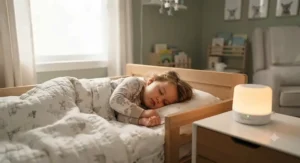
Adjustable volume white noise matters more in a nursery than almost anywhere else it’s used, because the acceptable range for an infant is genuinely narrower than for an adult bedroom. A machine offering only two fixed speeds, like the Yogasleep Dohm Classic, forces a choice between two points that also shift tone, since fan speed changes pitch and volume together. A machine with ten or more discrete increments, like the SNOOZ Original or 32-level Magicteam Sound Machine, decouples those variables, letting a parent find a setting that’s both full-sounding and appropriately quiet.
| Product | Volume Control Type | Approx. Range |
|---|---|---|
| Yogasleep Dohm Classic | Two fixed speeds | Moderate, tone-linked |
| SNOOZ Original | 10 discrete steps | ~46-87 dBA |
| Magicteam Sound Machine | 32 discrete steps | Lower max than fan-based rivals |
| Dreamegg D3 Pro | Button-stepped levels | Up to ~80 dB |
What most parents overlook is that every 3 dB increase roughly doubles perceived sound intensity, meaning the practical gap between “safe” and “too loud” is often just a couple of increments on a well-built dial — not a dramatic, obvious jump. That’s exactly why volume-level count matters so much more for babies than adults: fine increments make it realistic to land at or under recommended thresholds instead of rounding up to the nearest available setting and hoping it’s close enough.
✨ Ready to find your nursery’s match? Compare today’s prices on these picks and set up a calmer, quieter room tonight!
White Noise With Night Light: All-in-One Nursery Devices Worth It?
Combining white noise with a night light sounds like an obvious win for any nursery, and for specific routines, it genuinely is — but it’s worth being clear-eyed about when the combo earns its markup versus when two cheaper, separate devices make more sense. The Hatch Rest 2nd Gen is the strongest case for the combo: frequent nighttime feedings and diaper changes both benefit from a dimmable, low-glow light living on the same device already producing sound, collapsing a groggy 3 a.m. routine down to one device instead of two.
The Marpac Hushh for Baby also includes a nightlight, though a simpler amber glow rather than a full color wheel, aimed more at practical visibility during a diaper change on the go than ambiance. What most parents overlook about this category is that combo devices generally cost more per feature than standalone equivalents — a basic plug-in nightlight runs a few dollars on its own, so the light-and-sound premium built into the Hatch Rest 2nd Gen reflects real added engineering, not just a marketing bundle. The math favors a combo device specifically for newborns and younger infants with frequent nighttime interactions, and favors a sound-only machine like the Dreamegg D3 Pro once a baby is older and nighttime interactions become rare.
Common Mistakes When Buying a Baby White Noise Machine
The most common mistake is assuming every product labeled “for baby” is automatically appropriate at every volume setting straight out of the box. In reality, maximum volume on several popular machines has been found to exceed recommended nursery thresholds, which is exactly why documented, adjustable ranges matter more than a “for baby” label alone.
A second frequent error is prioritizing sound-option count over verified non-looping engineering. A 40-sound machine sounds impressive on a box, but most babies settle into one or two favorite tracks quickly, making a lower sound count with confirmed non-looping playback, like the Yogasleep Dohm Classic‘s mechanical fan, more valuable than sheer variety. Third, parents often overlook power source until a trip is already booked — an AC-only machine works fine at home but becomes a liability at a hotel with an inconveniently placed outlet, which is exactly the gap a rechargeable option like the Marpac Hushh for Baby is built to fill. Finally, many parents set a volume once at purchase and never revisit it as the nursery’s ambient noise changes seasonally — windows open in summer, a heating system humming in winter — and a machine with only two fixed speeds makes that recalibration far more imprecise than one offering ten or more increments.
Safety, Regulations & Compliance: AAP Decibel Guidelines for Babies
Because this category exists specifically for infants, volume and placement guidance deserve their own dedicated section rather than a passing mention. Pediatric hearing guidance generally recommends keeping sound at or below roughly 50 decibels at crib level — comparable to a quiet conversation — and positioning the device several feet away from the crib rather than right beside it. This guidance traces back to a 2014 study that tested infant sound machines and found that several exceeded hospital-nursery noise levels at their loudest settings, prompting the recommendation that’s still cited today.
According to aggregated guidance summarized by Children’s National Hospital, many popular sound machines can exceed recommended limits at maximum volume, which is precisely why a documented, adjustable volume range — like the SNOOZ Original‘s measured 46-87 dBA or the Magicteam Sound Machine‘s 32 discrete steps — matters more for nursery use than an unlabeled “loud enough” claim on the box. It’s also worth turning the machine off once a baby is asleep rather than running it continuously all night at full volume by default, since intermittent, purposeful use reduces total exposure compared to nonstop operation at the loudest available setting.
None of the machines in this roundup are marketed as medical devices, and none should replace guidance from a pediatrician or audiologist regarding a specific child’s hearing health or sleep needs — if you have concerns about sound exposure for your baby, that’s the right resource to consult, not a product review.
Long-Term Cost & Maintenance
Sticker price only tells part of the ownership story in a nursery, where a machine might run every night for a year or more before a baby transitions out of needing it. The Yogasleep Dohm Classic, backed by a one-year warranty and a sales history stretching back to 1962, represents the lowest realistic long-term cost per year of nursery use in this roundup, since mechanical fans have few components that can fail and the brand’s own multi-decade track record suggests genuine durability rather than marketing spin.
App-connected devices like the SNOOZ Original and Hatch Rest 2nd Gen carry a small ongoing dependency on manufacturer software support — if a company were to wind down app updates years down the line, some smart features could degrade even while the core hardware still runs fine. Maintenance costs stay low across this entire category compared to most baby gear, with no filters to replace and no required subscriptions for baseline sound function, aside from the Hatch Rest 2nd Gen‘s optional content library. Rechargeable options like the Marpac Hushh for Baby will eventually hold a bit less charge after a couple years of nightly cycles — a normal lithium-ion aging pattern rather than a defect — but that’s a minor cost against years of reliable nightly use, making even the pricier machines here a genuinely cost-effective piece of nursery gear over time.
Features That Actually Matter (And Those That Don’t) for Baby Sound Machines
Cutting through the marketing noise, a few features consistently deliver real value in a nursery: a documented, adjustable volume range rather than vague “loud/quiet” labels, genuinely verified non-looping audio, and a power option that matches your actual routine rather than an idealized one. Beyond that, returns diminish fast.
Sound-option counts above roughly a dozen rarely translate into meaningfully better sleep for a baby, since most infants settle into one or two favorite tracks within days — the Dreamegg D3 Pro‘s 29 sounds genuinely help for a household still figuring out what soothes a particular baby, but for a family that’s already found their track, that same variety becomes a marketing bullet point rather than a functional necessity. App connectivity is a real convenience for scheduling and nursery calibration, as with the SNOOZ Original, but it introduces a dependency on WiFi and manufacturer servers that a simple button-based machine like the Magicteam Sound Machine never has to worry about. Nightlights matter enormously for households with frequent nighttime feedings and barely at all once a baby is sleeping through — there’s no universal “better,” only a better fit for your specific stage.
✨ Don’t Miss These Exclusive Deals!
🔍 Take your nursery setup to the next level with these carefully selected picks. Click on any highlighted product to check current pricing and availability, and give your baby (and yourself) the uninterrupted, restful nights everyone deserves!
Frequently Asked Questions
❓ What does non-looping white noise mean for a baby monitor or sound machine?
❓ How loud should a white noise machine be for a baby?
❓ Is a real-fan white noise machine better than a digital one for babies?
❓ Can white noise become a sleep dependency for babies?
❓ Should I run white noise all night for my baby or only during naps?
Conclusion
The right non looping white noise machine for your baby depends less on which one has the longest sound list and more on matching the device to your nursery’s actual routine. If you want mechanically guaranteed non-looping sound with zero apps or screens, the Yogasleep Dohm Classic remains the simplest, most proven option after sixty-plus years on the market. If precise volume control matters most, the Magicteam Sound Machine‘s 32 levels or the SNOOZ Original‘s app-calibrated 10-step dial both make it easier to land safely under recommended thresholds. Parents juggling frequent nighttime feedings will likely get the most value from the Hatch Rest 2nd Gen‘s combined sound-and-light setup, while families on the move should look closely at the Marpac Hushh for Baby‘s rechargeable, clip-on design.
Whichever you choose, the underlying goal stays the same: genuinely seamless, non-looping sound at a volume that protects your baby’s hearing while still doing its actual job of smoothing out the disruptions that would otherwise end a nap early. No single machine on this list is the universal right answer, but matched carefully to your baby’s age, your nursery’s noise problems, and your own routine, any of these seven can turn a fragile sleep stretch into a genuinely reliable one.
✨ Found this helpful? Check today’s prices on your top pick and start building calmer, quieter naps tonight! 💬🤗
Recommended for You
- 7 Best White Noise Machine for Nursery Picks (2026 Guide)
- Wireless Breathing Sensor Mattress: 7 Best Picks for 2026
- Infant Breathing Alarm Pad: 7 Top Picks for Safer Sleep (2026)
Disclaimer: This article contains affiliate links. As an Amazon Associate, I earn from qualifying purchases. If you purchase products through these links, we may earn a small commission at no additional cost to you.
✨ Found this helpful? Share it with your friends! 💬🤗
