
In This Article
At 2 a.m., with a screaming baby and a dog barking three houses down, you stop caring about design aesthetics and start caring about one thing: silence, or at least a convincing imitation of it. That’s the whole pitch behind a white noise machine for nursery use — a small, unglamorous box that might be the single highest-value item on your registry that isn’t a crib.
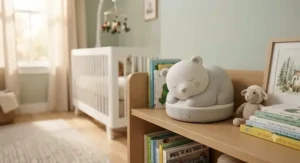
A white noise machine for nursery use is a small speaker or fan-based device that produces steady, unchanging sound to mask sudden noises — doorbells, sirens, a toddler sibling stomping down the hallway — that would otherwise jolt a sleeping baby awake. It works less like a sedative and more like acoustic camouflage, smoothing out the sharp peaks in your home’s soundscape so your baby’s brain has less reason to snap back to alertness.
We looked at fan-based classics that have produced gentle, natural white noise for decades, alongside newer app-connected, battery-powered, and budget digital options, then cross-referenced real spec sheets, verified pricing tiers, and aggregated review sentiment across major retailers. If you searched for a portable white noise machine baby parents actually rely on, a rechargeable white noise machine for late-night room swaps, or something genuinely compact for a shoebox-sized nursery, you’ll find a fit below — plus the safety numbers pediatric researchers wish more parents knew before they cranked the volume to max and walked away for eight hours.
Quick Comparison Table
Here’s the 30-second version before we go deep on all seven.
| Product | Type | Price Range | Best For |
|---|---|---|---|
| Hatch Rest+ 2nd Gen | Plug-in + battery backup | $90–$105 | All-in-one nursery hub |
| Hatch Rest 2nd Gen | Plug-in only | $70–$85 | Budget-conscious smart nursery |
| Yogasleep Dohm Classic | Mechanical fan | $45–$55 | Purists who want real fan noise |
| Yogasleep Rohm | Rechargeable/portable | $25–$45 | Travel and compact rechargeable use |
| Dreamegg D11 | Rechargeable/portable | $25–$35 | Budget rechargeable with nightlight |
| LectroFan EVO | Plug-in, digital | $50–$60 | Widest range of non-looping sounds |
| HoMedics SoundSpa | Plug-in, digital | $18–$28 | Entry-level, no-frills budget pick |
A quick read of the table tells you most of what matters before you spend a dime: budget and portability trade off against smart features and battery independence. The Hatch Rest+ 2nd Gen sits at the top of the price ladder because it’s doing three jobs at once — sound, light, and sleep-training clock — while the HoMedics SoundSpa earns its spot by doing exactly one job for less than the cost of a pizza. Notice, too, that “rechargeable” and “portable” cluster around the same two products; if either of those secondary needs matters to you, that narrows the field fast, and we’ll dig into exactly why later on.
Bookmark this table now — you’ll want to scroll back to it once you’ve read the full breakdowns below. 💤
Top 7 White Noise Machines for Nursery: Expert Analysis
We chose these seven to span every realistic nursery scenario: stationary bedside units, grab-and-go travel companions, mechanical purists, and rock-bottom budget options. Every product below is real, currently sold, and cross-checked against manufacturer specs and aggregated buyer feedback.
1. Hatch Rest+ 2nd Gen — battery backup keeps routines running through outages
The standout here is simple: this is the only machine on our list that keeps working when the power doesn’t. Reviewers and product testers note the rechargeable backup battery delivers roughly 8 to 12 hours of cordless operation depending on brightness and volume settings, which turns a stationary nursery gadget into something you can carry room to room during a diaper change or a power blip.
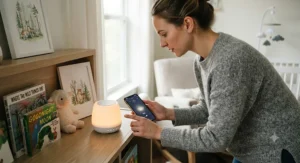
Beyond the battery, the Hatch Rest+ 2nd Gen runs a full sound library — white noise, rain, ocean, wind, heartbeat, dryer hum — controlled from a phone app, plus a dimmable, color-customizable nightlight and a “time-to-rise” clock feature that becomes genuinely useful once your toddler starts negotiating wake-up times. What most buyers overlook is that this device is meant to grow with your kid: newborn sound machine today, toddler alarm clock in two years. That’s a longer useful life than most single-purpose nursery gadgets, which changes the cost-per-year math even at the higher sticker price.
Aggregated buyer feedback is largely positive on reliability and app control, though a recurring theme in reviews is frustration that some advanced content (guided sleep stories, curated playlists) sits behind an optional paid membership — the core white noise and nightlight functions do not require a subscription, but it’s worth knowing going in. One long-term parent user reported using their unit daily for three years before handing it down to a friend, which speaks to build durability more than any spec sheet could.
Pros:
- ✅ Rechargeable battery keeps routines going during outages
- ✅ App-controlled sounds, nightlight, and time-to-rise clock in one device
- ✅ Durable enough to hand down after years of nightly use
Cons:
- ❌ Optional content subscription can feel like upselling
- ❌ Requires WiFi and an app for full functionality
The Hatch Rest+ 2nd Gen typically sits in the $90–$105 range. If your nursery has awkward outlet placement or you plan to travel with the routine intact, the battery premium over the standard Rest earns its keep.
2. Hatch Rest 2nd Gen — same smart features, no battery premium
Strip the backup battery out of the Rest+ and you get the Hatch Rest 2nd Gen, which is functionally identical in every other way: the same sound library, the same customizable nightlight, the same time-to-rise clock for toddler wake windows. The standout feature is value — you get roughly 90% of the flagship experience for a noticeably lower price.
Reviewers who compared both directly conclude that the difference comes down to one variable: the Rest 2nd Gen requires a constant connection to a power outlet, full stop. For a stationary nursery setup where the device lives permanently on a dresser near an outlet, that limitation is mostly theoretical — you’re plugging in a lamp anyway. Where it becomes a real constraint is during travel, camping, or a power outage, situations where the Hatch Rest 2nd Gen simply goes dark.
Aggregated review sentiment mirrors the Rest+: parents like the multi-function design and the toddler clock feature specifically, since it doubles as a “stay in bed until the light turns green” tool once kids are old enough to understand it. A smaller but consistent complaint theme involves WiFi setup friction on first use, which is common across most app-connected nursery gadgets and not unique to Hatch.
Pros:
- ✅ Nearly identical features to the Rest+ at a lower price
- ✅ Toddler-friendly time-to-rise clock extends its useful life
- ✅ Simple wall-outlet setup for a permanent nursery spot
Cons:
- ❌ No power during outages or while unplugged
- ❌ Initial WiFi pairing can be fiddly for some users
Expect to pay in the $70–$85 range. This is the pick for parents sold on the Hatch ecosystem who don’t need cordless flexibility.
3. Yogasleep Dohm Classic — the original mechanical fan sound, nothing digital about it
Every roundup of this category eventually circles back to one machine, and for good reason: this fan-based sound machine has been known for decades for its gentle, natural white noise. The Yogasleep Dohm Classic is the original — an actual two-speed fan spinning inside a housing, not a speaker playing a recording of a fan.
That distinction matters more than it sounds. Digital sound machines, even good ones, eventually loop or reveal a faint digital “hiss” pattern if you listen closely enough at 3 a.m. A real fan mechanism can’t loop, because it’s producing genuinely continuous mechanical noise in real time. What most buyers overlook is that this also means zero screens, zero WiFi, and zero firmware — for parents who specifically want one less connected device in the house, that’s a feature, not a limitation.
The trade-off is flexibility: you get exactly two speed settings and no scheduling, no nightlight, no app. Reviewers consistently report satisfaction with sound authenticity but note it’s bulkier and heavier than the compact rechargeable options on this list, and — since there’s an actual moving fan inside — it’s not something to leave within reach of curious toddler fingers once your child starts climbing.
Pros:
- ✅ Authentic, non-looping mechanical fan sound
- ✅ No app, WiFi, or subscription required, ever
- ✅ Decades-long reputation for reliability
Cons:
- ❌ Bulkier and heavier than portable alternatives
- ❌ Only two speed settings, no nightlight or timer
Pricing typically runs $45–$55. If sound authenticity is your top priority and you don’t need smart features, this is the category benchmark.
4. Yogasleep Rohm — the compact, rechargeable version of the classic fan brand
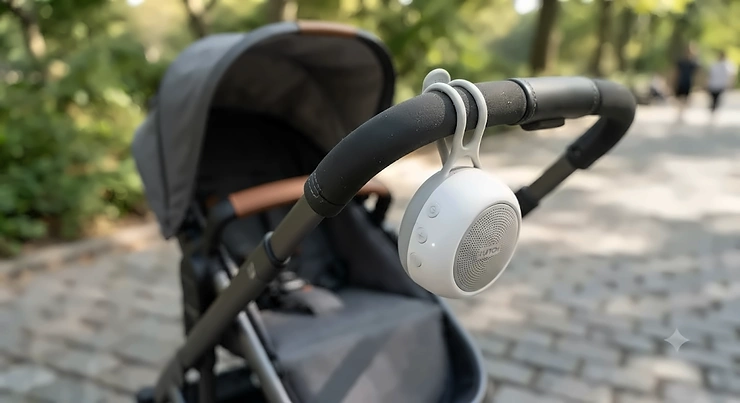
If you love the Dohm’s pedigree but need something you can toss in a diaper bag, the Yogasleep Rohm is the answer. It shrinks the format down to a genuinely pocketable size and swaps the wall cord for a rechargeable battery, making it the most literal answer to “portable white noise machine baby” searches on this whole list.
Reviewers directly comparing it against similarly sized rivals note that the Rohm is portable and rechargeable, but point out it ships with a notably narrower sound menu — essentially two white-noise variations and one ocean setting — compared to newer compact competitors that pack in nature sounds and nightlights. There’s also no built-in timer, so it runs until you manually switch it off, which matters if you’re used to auto-shutoff conveniences.
Where the Yogasleep Rohm earns its spot is size and battery independence combined with brand trust: it’s small enough to clip to a stroller or car seat, charges over USB, and delivers the same non-digital philosophy as its bigger sibling in miniature form. For parents whose priority is a genuinely compact white noise baby solution for travel cribs, hotel stays, or grandma’s house, this is a strong, no-frills pick — just don’t expect a nightlight or a dozen sound options.
Pros:
- ✅ Genuinely pocket-sized and rechargeable
- ✅ Trusted mechanical-sound brand lineage
- ✅ USB charging works anywhere, no outlet hunting
Cons:
- ❌ Only three total sound options
- ❌ No auto-off timer, so it runs until switched off manually
Price typically falls between $25–$45 depending on retailer and bundle. Buy this one for the diaper bag, not the permanent nursery shelf.
5. Dreamegg D11 — budget-friendly rechargeable pick with a built-in nightlight
The Dreamegg D11 solves a specific complaint parents have about compact rechargeable machines: most of them skimp on sound variety or skip the nightlight entirely. This one bundles a soft nightlight with roughly 24 sound options into a budget-friendly package, undercutting the premium smart options by a wide margin.
What that means in practice: you get a genuinely broad sound library — nature ambiance, fan tones, and white noise variants — plus a soft nightlight, all wrapped in a compact rechargeable housing, for roughly a third of what a Hatch device costs. Reviewers analyzing the Dreamegg lineup broadly describe the brand as delivering a wide range of sound options across its models, with speaker quality that’s good but not audiophile-grade — perfectly adequate for masking hallway noise, less impressive if you’re trying to fill a large room.
The honest trade-off compared to Hatch’s ecosystem: it lacks app control, scheduling, and a toddler clock. Button placement is a recurring minor complaint in aggregated reviews — several users mention needing to feel around in the dark to find the right control the first few nights. Once you learn the layout, that friction disappears.
Pros:
- ✅ Large sound library for a budget rechargeable device
- ✅ Built-in nightlight most rivals in this price tier skip
- ✅ Roughly a third of the cost of app-connected competitors
Cons:
- ❌ No app control or sleep-training clock features
- ❌ Buttons can be hard to locate in the dark at first
Expect a price range of $25–$35. This is the pragmatic pick for parents who want variety and a nightlight without paying for a smart-home ecosystem.
6. LectroFan EVO — the widest non-looping sound library in the category
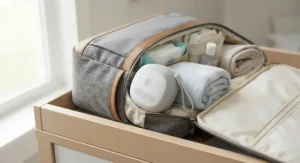
For parents who’ve tried a cheap digital machine and noticed the same 30-second clip repeating every night, the LectroFan EVO exists specifically to fix that annoyance. It generates 22 non-looping sound variations, including white, pink, and brown noise, and even supports Bluetooth streaming — a meaningfully larger and more technically sophisticated library than most nursery-specific competitors offer.
Here’s what the spec sheet won’t tell you outright: “non-looping” doesn’t mean the machine invents new sound forever — it means the algorithm generates variations complex enough that most human ears never catch a repeat, which functionally solves the looping-fatigue problem cheaper machines have. A built-in headphone jack also makes this a smart pick for shared bedrooms, letting a partner listen privately while the nursery gets the speaker version. One head-to-head comparison of the category concluded that the Yogasleep Dohm wins on acoustic authenticity since nothing digital sounds exactly like a real fan, the HoMedics SoundSpa wins on price, and the LectroFan EVO sits comfortably in between on variety and build quality.
The catch: this is a plug-in device with no internal battery, so travel means finding an outlet, not tossing it in a bag. For a permanent nursery installation, that’s irrelevant. For families who move the machine between rooms often, it’s worth knowing upfront.
Pros:
- ✅ 22 genuinely non-looping sound variations
- ✅ Headphone jack enables private listening for a partner
- ✅ Reliable, quiet operation reviewers praise consistently
Cons:
- ❌ No internal battery — outlet access required
- ❌ No app or smart nightlight features
Pricing runs $50–$60. Choose this if sound variety and technical sound quality matter more to you than portability.
7. HoMedics SoundSpa — the no-frills classic that’s outlasted smartphones
Sometimes the right answer is the simplest one. The HoMedics SoundSpa has been a nightstand fixture for decades, and its staying power comes down to doing one job without asking anything extra of you: six sounds, an auto-off timer, and physical buttons you can operate in the dark without ever looking at a screen.
There’s real value in that simplicity for a nursery. No app to download during a 3 a.m. setup panic, no WiFi credentials to remember, no firmware updates interrupting a nap. Aggregated feedback across tens of thousands of buyers points to genuine long-term reliability, which is about as strong a signal as review data gets in this category. The honest downside is sound fidelity: the six tones are digital loops, not the non-looping algorithms of pricier competitors, and sensitive listeners may eventually notice the repeat pattern.
For a first white noise machine, a backup unit for a second bedroom, or a low-stakes trial before committing to a pricier smart device, the HoMedics SoundSpa removes almost every barrier to entry. It’s the machine you buy when you’re not sure you’ll even need one — and it usually turns out you did.
Pros:
- ✅ Extremely low price point for a proven, reliable design
- ✅ Physical buttons work perfectly in a dark room
- ✅ Auto-off timer prevents all-night continuous play
Cons:
- ❌ Sounds are looping digital recordings, not non-looping
- ❌ No portability, nightlight, or app features
Typical pricing sits between $18–$28, making it the cheapest legitimate entry point on this list.
Practical Usage Guide: Setting Up Your Nursery Sound Machine Right
Getting a white noise machine for nursery use isn’t the hard part — using it correctly for the first month is. Start by placing the machine at least seven feet from the crib, ideally across the room rather than clipped to the rail, since sound intensity drops sharply with distance. Set volume by ear first, then verify: a free decibel-meter phone app gives you a rough reading, and you’re aiming for something in the neighborhood of a running shower, not a vacuum cleaner.
A common first-30-days mistake is running the machine at maximum volume to drown out a new baby’s fussing, then never turning it back down once things settle. Dial it in during week one and leave it there. For maintenance, mechanical fan machines like the Dohm benefit from an occasional gentle dusting of the intake vents, while rechargeable units should get a full charge cycle every few weeks even during periods of lighter use, since lithium batteries degrade faster when left fully depleted for long stretches. One underrated optimization trick: pair the sound machine with a consistent “on” cue — the same track or tone every night — so it becomes part of the sleep-routine signal rather than just background filler.
Real-World Scenarios: Matching the Machine to Your Household
Consider three household types. First, the apartment-dwelling new parent with thin walls and a hallway that echoes every neighbor’s footsteps — here, a plug-in unit with strong, varied sound like the LectroFan EVO or Hatch Rest 2nd Gen earns its keep by masking a genuinely noisy acoustic environment night after night.
Second, the family that travels often — visiting grandparents most weekends, the occasional flight — benefits most from something like the Yogasleep Rohm or Dreamegg D11, both compact and rechargeable enough to recreate the same sleep cues in an unfamiliar room. Third, the budget-conscious parent expecting a second child soon, who wants to test whether white noise even helps before investing further: the HoMedics SoundSpa offers a rock-bottom way to find out, and if it works, upgrading later to a smarter unit is an easy next step rather than a wasted purchase.
Problem → Solution: Fixing Common Nursery Noise Complaints
Problem: The machine sounds too tinny in a large nursery. Solution: move it closer to the center of the room rather than a corner, or size up to a model with a stronger speaker, like the LectroFan EVO.
Problem: Baby seems to need it louder every week. Solution: this is often habituation, not need — try holding volume steady rather than escalating, since louder isn’t more effective past the masking threshold.
Problem: Battery dies mid-trip. Solution: charge rechargeable units like the Dreamegg D11 to full before travel days specifically, not just as part of a general routine.
Problem: Sound loops are noticeable and distracting. Solution: switch to a non-looping digital machine such as the LectroFan EVO, or a mechanical fan unit like the Yogasleep Dohm Classic, which physically cannot loop.
Problem: Multiple devices cluttering the nursery shelf. Solution: consolidate with an all-in-one unit like the Hatch Rest+ 2nd Gen, which replaces a nightlight, clock, and sound machine with one plug.
How to Choose a White Noise Machine for Nursery
- Decide plug-in versus rechargeable first. This single choice eliminates roughly half the market immediately and should be based on where the machine will actually live most nights.
- Check the volume ceiling, not just the sound list. A wide sound library means little if the machine can’t be safely dialed down to a low, steady level.
- Weigh app dependence honestly. Smart features are convenient until the WiFi drops at bedtime — decide how much you’re willing to troubleshoot at 9 p.m.
- Match size to your actual travel habits. Don’t pay for portability you won’t use, and don’t skip it if weekend trips are a regular part of life.
- Consider the nightlight as a real feature, not an afterthought. If you’re doing overnight feeds, a built-in dimmable light saves you from fumbling for a lamp switch.
- Read the timer and auto-off options. Some parents want all-night sound; others want it to shut off once baby’s asleep — know which camp you’re in.
- Budget for the whole first year, not just the purchase price. Factor in any optional subscriptions, replacement batteries, or accessories before comparing sticker prices directly.
Common Mistakes When Buying a White Noise Machine
The most frequent misstep is buying based on sound-count marketing alone — a “30 sounds!” headline means little if you’ll use exactly one setting every night for two years. Second is ignoring placement distance entirely, assuming any machine is automatically safe regardless of how close it sits to the crib rail. Third is skipping the return policy check; sound preference is deeply personal, and what soothes one baby can genuinely irritate another, so a no-hassle return window matters more here than in most baby-gear categories. Finally, some parents buy the most expensive smart option available assuming it must be objectively “better,” when a simpler mechanical or budget digital machine often serves a straightforward stationary nursery just as well for a fraction of the cost.
White Noise Machines vs. Sound Masking Alternatives
A white noise machine for nursery use is one way to build a quieter sleep environment, but it isn’t the only sound masking baby sleep tool available. Fans, air purifiers, and even a hallway humidifier all produce steady ambient sound as a side effect of their primary function, and some parents rely on these instead of a dedicated device. The trade-off is control: a general-purpose fan can’t be dialed to a specific safe decibel range the way a purpose-built machine can, and it wasn’t engineered with infant hearing safety in mind at all.
Dedicated white noise machines also typically offer non-looping or mechanically genuine sound, which generic appliances can’t replicate — a box fan hums at one fixed pitch and volume, full stop. Where general appliances win is dual purpose: an air purifier masking noise while also filtering allergens offers value a single-purpose sound machine can’t match. For most nurseries, though, a dedicated machine remains the more predictable, safety-conscious choice specifically because volume and distance can be measured and controlled deliberately.
Portable White Noise Machine for Baby: What Changes on the Road
A portable white noise machine for baby travel needs to solve different problems than a bedside unit. Battery life matters more than sound variety — a machine that dies three hours into an overnight flight is worse than useless, since it disrupts a sleep cue baby now expects. Clip attachments and drop resistance matter too, given how often travel gear ends up on a car floor or stroller tray. Both the Yogasleep Rohm and Dreamegg D11 are built around this exact use case, prioritizing size and battery independence over the sprawling sound libraries found in stationary units. The trade-off worth accepting: fewer sounds and simpler controls in exchange for genuine grab-and-go reliability.
Rechargeable White Noise Machines: What Actually Matters
Not all rechargeable white noise machine claims are equal. The real variables to check are charge time, runtime per charge at a realistic (not maximum) volume, and charging port type — USB-C has become the practical standard, and a machine still using an older micro-USB port is a minor but real inconvenience. Battery chemistry also degrades over years of nightly cycles, so a rechargeable unit used every single night for two years may show noticeably shorter runtime by year three; this is normal lithium-ion wear, not necessarily a defect. Buyers prioritizing longevity should look for models with USB-C charging and realistic (not inflated) runtime claims rated at typical, not maximum, volume settings.
Compact White Noise Machines for Small Nurseries
In a small nursery, footprint matters as much as function. Compact white noise baby machines like the Yogasleep Rohm free up dresser space that larger app-connected hubs like the Hatch Rest+ 2nd Gen simply can’t match, and a smaller housing is also easier to position at a safe distance from the crib without it dominating a tight room. The trade-off, again, is feature density — compact models tend to sacrifice sound variety and nightlight brightness for their smaller size. For nurseries doubling as a guest room or shared space, that size-first trade-off is usually the right call.
Building a True Acoustic Sleep Environment (Beyond the Machine)
An acoustic sleep environment is bigger than one device. Heavy curtains, a rug instead of bare flooring, and even a bookshelf against a shared wall all reduce the sharp echoes that make sudden sounds more jarring in the first place — noise blocking nursery strategies work best layered together rather than relying on a single machine to do all the work. Soft furnishings absorb high-frequency noise that a white noise machine can mask but not eliminate, meaning a nursery with hard floors and bare walls will need the machine turned up louder to achieve the same masking effect as a softly furnished room. Positioning the crib away from shared walls with a noisy sibling’s room or a street-facing window also reduces the raw noise your sound machine has to compete against nightly.
Safety, Decibel Limits & What the Research Actually Says
This is the section most product pages skip. A widely cited pediatric research study measuring 14 infant sleep machines at close range found that every single one exceeded the 50-decibel limit recommended for hospital nurseries at close distance, and three of them topped 85 decibels — a level that, sustained for hours, exceeds adult occupational noise exposure limits. That’s not a reason to avoid white noise machines; it’s a reason to be deliberate about volume and placement.
The practical takeaway repeated across pediatric guidance: keep the device at least seven feet from the crib, set volume closer to a quiet conversation than a vacuum, and avoid running it at maximum output overnight regardless of how “safe” the sound seems. As the CDC’s hearing-loss prevention guidance puts it, noise-induced hearing damage is usually caused by exposure to excessively loud sound and cannot be medically or surgically reversed, which is exactly why the distance-and-volume rule matters more than which specific machine you buy. None of the seven products above are inherently unsafe — the safety outcome depends almost entirely on how you set them up, not which brand name is on the box.

Frequently Asked Questions
❓ Is white noise safe for a baby all night, every night?
❓ How loud should a nursery white noise machine be?
❓ Do rechargeable white noise machines lose battery life over time?
❓ Can a white noise machine cause a baby to become dependent on it?
❓ What's the difference between white noise and pink or brown noise?
Conclusion
Choosing a white noise machine for nursery use ultimately comes down to matching the device to your actual routine, not the longest feature list on the box. Stationary households with reliable outlet access get the most value from all-in-one units like the Hatch Rest+ 2nd Gen or Hatch Rest 2nd Gen, while families who travel often should lean toward compact, rechargeable options like the Yogasleep Rohm or Dreamegg D11. Purists chasing the most authentic possible sound will keep coming back to the Yogasleep Dohm Classic, and budget-first parents have two genuinely solid entry points in the HoMedics SoundSpa and LectroFan EVO.
Whichever you land on, the research is consistent on one point: volume and distance matter more than brand. Set it up thoughtfully, keep it at a sensible level, and let the science — not the marketing copy — guide how you use it.
✨ Ready to build a calmer nursery tonight? Check current prices on your top pick above before they change! 🌙
Recommended for You
- Wireless Breathing Sensor Mattress: 7 Best Picks for 2026
- Infant Breathing Alarm Pad: 7 Top Picks for Safer Sleep (2026)
- Breathing Monitor Mattress Pad: 7 Picks That Actually Deliver (2026)
Disclaimer: This article contains affiliate links. As an Amazon Associate, I earn from qualifying purchases. If you purchase products through these links, we may earn a small commission at no additional cost to you.
✨ Found this helpful? Share it with a fellow tired parent! 💬🤗
