
In This Article
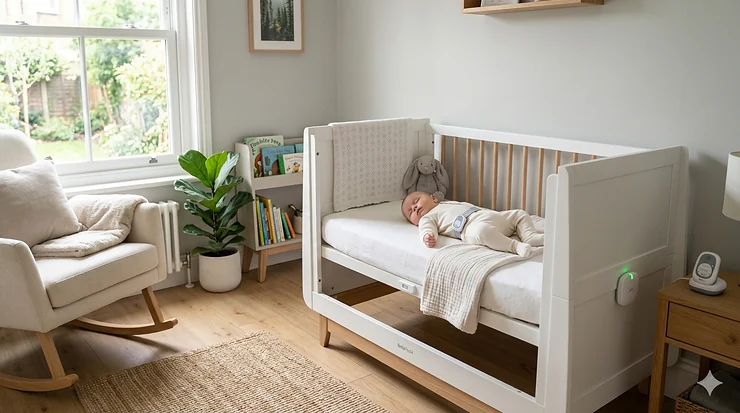
Here’s a scenario every new parent knows viscerally: it’s 2 a.m., the house is silent, and you haven’t heard a sound from the nursery in a suspiciously long time. Your rational brain says everything’s fine. Your parental brain has already sprinted down the hallway three times. Sleep deprivation and instinct make a combustible combination — and that’s precisely the problem that a crib with movement sensors is designed to solve.
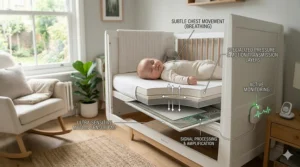
A crib with movement sensors is any sleep system — whether a fully integrated smart crib or a standard crib paired with a sensor device — that continuously monitors your baby’s physical micro-movements (typically breathing-related abdominal motion, body position shifts, or vital signs like oxygen and heart rate) and alerts you if something falls outside safe parameters. The technology ranges from simple under-mattress pressure pads that cost around $100 to AI-powered cribs approaching $1,500 that self-soothe your baby before a single cry. That’s a wide spectrum, and knowing where to land on it is exactly what this guide is for.
According to the American Academy of Pediatrics (AAP), infant sleep safety remains a critical concern, with sleep-related causes contributing significantly to infant mortality in the U.S. Movement monitoring technology doesn’t prevent every risk, but it dramatically shortens the response window when something goes wrong — and that window matters enormously in those fragile early months.
In this guide, I’ve researched and evaluated seven real, currently available products on Amazon spanning every price point and monitoring approach: from a clip that costs less than a fancy dinner out to a full-on AI crib that honestly sounds like science fiction. Whether you’re a first-time parent convinced you’ll never sleep again or a second-timer who’s simply done with basic audio monitors, there’s a right option here. Let’s find yours.
Quick Comparison: Top 7 Cribs with Movement Sensors at a Glance
| Product | Type | Monitoring Method | Night Vision | Two-Way Audio | Sleep Analytics | Price Range |
|---|---|---|---|---|---|---|
| Cradlewise Smart Crib | Integrated AI Crib | Built-in sensors + AI | ✅ HD | ✅ Yes | ✅ Advanced | $1,400–$1,700 |
| Nanit Pro Smart Baby Monitor | Camera Monitor | Computer vision + band | ✅ 1080p | ✅ Yes | ✅ Premium | $280–$330 |
| Owlet Dream Duo Gen 3 | Monitor Bundle | Sock (SpO2 + HR) + 2K cam | ✅ 2K | ✅ Yes | ✅ FDA-cleared | $380–$430 |
| Babysense True Sleep HD | Bundle Pack | Under-mattress pads + video | ✅ IR | ✅ Yes | ❌ Basic alerts | $150–$200 |
| Babysense 7 (Standalone) | Under-Mattress Sensor | Pressure pads (2) | ❌ N/A | ❌ N/A | ❌ Alert only | $90–$130 |
| Snuza Hero SE | Wearable Clip-On | Direct abdominal contact | ❌ N/A | ❌ N/A | ❌ Alert only | $95–$120 |
| Sense-U Pro Baby Monitor | Wearable Clip-On | Abdominal + temp + position | ❌ N/A | ❌ N/A | ✅ App-based | $100–$135 |
What this table tells you that the specs alone don’t: the biggest fork in this road isn’t price — it’s philosophy. Non-WiFi, hardware-only solutions like the Babysense 7 and Snuza Hero SE are actually more reliable in certain ways: no app crashes, no WiFi outages, no subscription fees. Meanwhile the AI-powered options give you data you didn’t know you needed, at the cost of ongoing monthly charges and a learning curve. Neither path is wrong. They just serve different parents.
💬 Just one click — help others make better buying decisions too!😊
✨ Don’t Miss These Exclusive Deals!
🔍 Take your baby’s sleep safety to the next level with these carefully selected products. Click on any highlighted item to check current pricing and availability. These tools will help you monitor your little one with confidence every single night!
Top 7 Cribs with Movement Sensors: Expert Analysis
1. Cradlewise Smart Crib — The All-In-One AI Sleep System
If you want a single piece of furniture to do the job of a crib, a baby monitor, a sound machine, a sleep tracker, and a part-time night nanny, the Cradlewise is what that looks like in 2026. This Silicon Valley-designed system is frankly the most ambitious product in this entire category — recognized by Forbes Vetted’s Best Cribs 2026, TIME Magazine’s Best Inventions, and CES Editors’ Choice.
The built-in movement sensor suite uses proprietary SmartSoothe™ technology trained on over 50 million hours of sleep data. It doesn’t wait for crying. Instead, it detects the micro-behavioral cues that precede a wake-up — subtle movement patterns, restlessness signatures — and initiates a gentle bounce before your baby fully rouses. The difference in practice isn’t small: it’s the difference between a baby who drifts back to sleep and one who works themselves up to a full crying jag at 3:14 a.m. The built-in HD monitor provides live video, motion detection, and sleep tracking through the Cradlewise app. Room temperature sensors are also integrated, so you’re getting environmental monitoring alongside movement data. Converts from bassinet to crib through 24 months.
This product makes most sense for parents who are designing a nursery from scratch, have the budget for a premium investment, and want one box to open instead of seven. It’s not ideal for parents who already own a crib or who plan to co-room with a simple setup. The price point — in the $1,400–$1,700 range on Amazon — is significant, but it genuinely replaces $800+ worth of gear you’d otherwise buy separately. Two years of Nurture Core subscription included.
✅ Full nursery-in-one system
✅ AI learns your specific baby’s sleep patterns over time
✅ Converts from bassinet to crib — use from birth to 24 months
❌ High upfront cost
❌ Not portable; won’t travel to Grandma’s easily
2. Nanit Pro Smart Baby Monitor — The Sleep Data Nerd’s Dream
The Nanit Pro is what happens when engineers who love data become parents. Mounted overhead, it provides a bird’s-eye view of the entire crib — a perspective that sounds minor until you realize you can see exactly how your baby is positioned, whether the swaddle is still secure, and how much they’re moving at any given hour of the night. Most wall/stand-mounted cameras give you a side-angle feed that captures maybe 60% of the crib. The overhead Nanit view captures all of it.
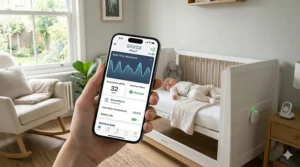
Its movement monitoring works through computer vision rather than contact sensors — the camera’s algorithm analyzes chest rise and fall patterns via the Breathing Band (a special patterned garment included in most bundles). The 1080p resolution with infrared night vision is genuinely impressive; colors and edges stay sharp even in a pitch-black room, unlike budget cameras that go blurry and grainy after dark. In 2026, Nanit updated its firmware with faster app response times, expanded Apple HomeKit/Google Home integration, and new Sound & Motion alerts. The sleep analytics dashboard in the Nanit Insights app tracks total sleep time, wake events, and environmental factors night over night — data that pediatric sleep consultants actually use.
The Nanit Pro is the perfect pick for data-driven parents who want actionable insights, not just alarms. If you’re the type who would actually look at a sleep efficiency chart at 6 a.m. and adjust your routine accordingly, this pays for itself in better sleep within a week. Downside: the subscription fees ($49.99–$149.99/year depending on tier) are real, and the breathing monitoring requires their specific sleepwear.
✅ Best sleep analytics of any standalone monitor
✅ Overhead view shows entire crib surface
✅ Strong encryption and privacy controls
❌ Annual subscription required for full features
❌ Breathing tracking depends on Nanit-specific clothing
Price range: $280–$330 on Amazon (varies by bundle)
3. Owlet Dream Duo Gen 3 — FDA-Cleared Vitals Monitoring + Video
The Owlet Dream Duo Gen 3 is the closest thing to hospital-grade monitoring available to everyday parents — because the Dream Sock component is literally FDA-cleared as a medical device. It tracks heart rate and blood oxygen saturation (SpO2) via pulse oximetry, the same technology used on adult patients in clinical settings. That distinction matters enormously: the Nanit Pro tracks breathing motion (is the chest moving?), but the Owlet Dream Sock tracks oxygen levels (is that breathing actually effective?). These are related but genuinely different things, and for parents of premature babies or infants with respiratory histories, the Owlet’s approach is the one pediatricians tend to recommend.
The Gen 3 2026 update brings an 18-hour battery life on the sock, a redesigned sensor that significantly reduces false alarms (historically the Owlet’s biggest complaint), and a cleaner app experience with the Dream Lab sleep coaching program. The paired 2K HD camera handles night vision cleanly and includes two-way audio, cry detection, and motion alerts. The Owlet app aggregates all of this into live health dashboards and trend reports. For a bundle in the $380–$430 range, you’re genuinely getting two sophisticated products that would cost more purchased separately.
Best for: parents of newborns, preemies, or babies with any cardiac or respiratory monitoring history. Also excellent for anxious first-time parents who want the most reassurance modern consumer technology can offer. Not ideal for parents bothered by putting a sock on a squirming infant every single night — because yes, you have to do that every single night.
✅ FDA-cleared heart rate + SpO2 monitoring
✅ 2K video camera with two-way audio included
✅ 18-hour sock battery (Gen 3 upgrade)
❌ Sock must be put on nightly (fiddly for active babies)
❌ Limited to 5–30 lb weight range
Price range: $380–$430 on Amazon
4. Babysense True Sleep HD — The No-WiFi Fortress of Peace of Mind
Some parents don’t want their baby’s breathing data routed through a cloud server in California. Fair. The Babysense True Sleep HD is for them. This bundle pairs a 5″ HD video monitor with the Babysense 7 under-mattress sensor system — all running on a secure, encrypted 2.4GHz FHSS frequency with zero WiFi dependency and zero cloud exposure. Hackers can’t access what isn’t connected to the internet.
The under-mattress component places two sensitive sensor pads beneath the crib mattress, covering the entire sleeping surface without any contact with your baby. It monitors micro-movements — the tiny abdominal shifts that accompany every breath. If no movement is detected for 20 seconds, it alarms. Below 10 micro-movements per minute, it alarms. The threshold is conservative by design; this is technology that has been trusted in hospitals across Europe and Japan since 1992, and that pedigree shows in the sensitivity calibration. The video monitor side delivers pan/tilt control, two-way audio, a night light, lullaby sounds, and white noise — a full comfort toolkit, not just surveillance. FSA/HSA eligible, which meaningfully reduces the effective cost.
What I particularly value about this system is the separation of concerns: the movement sensor does one thing extraordinarily well and doesn’t try to be an AI sleep coach. For parents who want reliable, hardware-first monitoring without subscriptions, app dependencies, or technology lock-in, this is the most practical buy on the list.
✅ No WiFi = no hacking, no outages, no subscription fees
✅ FSA/HSA eligible — reduces effective out-of-pocket cost
✅ Hospital-pedigree under-mattress sensor technology
❌ No sleep analytics or trend data
❌ Under-mattress pads require a firm, flat crib mattress
Price range: $150–$200 on Amazon
5. Babysense 7 — The Original Under-Mattress Monitor, Still Unbeaten
If you already own a video monitor you love and just need movement detection added to your crib setup, the Babysense 7 standalone is one of the most logical $100 purchases in the baby gear universe. This is the original — the monitor that established the category in 1992 — and decades of iteration show in how clean and reliable the core technology has become.
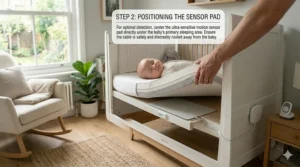
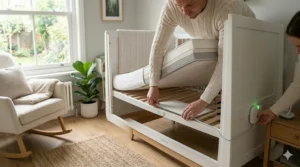
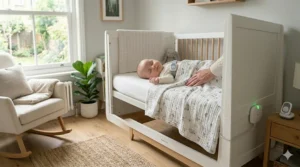
Two sensor pads slide under a standard crib mattress. No installation, no wiring complexity. The monitor unit sits on a nearby surface and displays a green light as long as movement is detected. No apps to configure, no WiFi credentials to enter. The alarm triggers at 20 seconds of no detected movement OR if movement rate drops below 10 micro-movements per minute — giving you a brief vibration warning followed by an audible alarm if movement doesn’t resume. What most buyers don’t realize is that the dual-pad system provides coverage across the entire crib surface, not just a center zone; this matters because babies move around, especially as they get bigger.
The Babysense 7 won’t tell you your baby’s sleep quality score. It won’t trend their overnight data. It does exactly one thing: make sure something is still moving under that mattress. For parents already using a Nanit or another camera monitor, this $100-ish addition is probably the highest-ROI safety upgrade available.
✅ Trusted technology with 30+ years of hospital use history
✅ Full crib surface coverage with dual sensor pads
✅ No WiFi, no subscription, no apps — just works
❌ No video or audio component (add your own)
❌ Can generate false alarms on very soft or non-standard mattresses
Price range: $90–$130 on Amazon
6. Snuza Hero SE — The $100 Wearable That’s Been to a Million Cribs
The Snuza Hero SE solves a problem the under-mattress monitors can’t: portability. Clip it to your baby’s diaper waistband and it goes wherever the baby goes — crib, bassinet, Pack ‘n Play at a hotel, portable crib at the grandparents’ house. The sensor tip rests directly against your baby’s abdomen and detects actual physical movement rather than inferring it through mattress vibration. This direct-contact approach is technically more sensitive to subtle motion than a pad two inches below a mattress.
The alarm logic is clever: 15 seconds of no detected movement triggers a gentle vibration on the device (which often physically stimulates the baby enough to cause movement — and movement is logged, alarm averted). If another 5 seconds pass without movement, the audible alarm fires. That two-stage response exists specifically to reduce false alarm panic while still maintaining meaningful response time. No WiFi. No charging dock required for the base function. No subscription. It runs on a single AAA battery. On Amazon, it sits around the $95–$120 range and consistently earns 4.5-star ratings, with parents in particular praising the low false alarm rate compared to earlier generations.
The Snuza Hero SE is the best choice for families who travel frequently, parents who move babies between sleep locations throughout the day, or anyone whose primary anxiety is “will I know immediately if something stops?” rather than “how many minutes of light sleep did she get last night?”
✅ Fully portable — travels to any sleep surface
✅ Direct abdominal contact = highly sensitive detection
✅ Two-stage alert (vibration → alarm) reduces false-alarm panic
❌ No video, audio, or sleep data
❌ Must remember to re-clip after each diaper change
Price range: $95–$120 on Amazon
7. Sense-U Pro Baby Monitor — The Clip-On That Actually Thinks
The Sense-U Pro occupies a fascinating middle ground: it’s a clip-on wearable like the Snuza Hero, but it adds a layer of data and app integration that pushes it toward the Owlet’s territory at roughly a third of the price. In a single clip-on device, it monitors abdominal breathing movement, sleep position (including rollover alerts if your baby flips onto their face), body temperature with overheating notifications, and generates sleep analysis data through the Sense-U app.
The rollover detection is genuinely useful and unique at this price point. Back-to-sleep guidelines from the CDC consistently emphasize supine sleeping position as protective, and getting an alert when a young baby rolls to prone is meaningful safety information that neither the Babysense 7 nor the basic Snuza Hero provides. Battery life is strong — expect a full week between charges on normal use — and the gentle vibration arousal feature works similarly to the Snuza: stimulate before alarming. Parents who have used both often describe the Sense-U Pro’s app as more polished and data-rich than expected for the price, though the sleep analysis lacks the depth of the Nanit’s algorithms.
Best for: budget-conscious parents who want some data, app integration, and multi-parameter monitoring without committing to an Owlet-tier investment. The $100–$135 price range makes it an easy add-on to a basic crib setup.
✅ Rollover detection — alerts if baby moves to prone position
✅ App-based sleep analysis included at no extra subscription cost
✅ Temperature and overheating alerts built in
❌ App connectivity required — unreliable WiFi = missed alerts
❌ Sleep analytics less detailed than premium options
Price range: $100–$135 on Amazon
Real-World Scenarios: Which Crib with Movement Sensors Fits Your Life?
The spec sheet tells you what a product does. This section tells you who should actually buy it.
The Anxious First-Timer (Budget: $300–$450): You’re a first-time parent who hasn’t slept a full night in three months, Google “is this normal” approximately forty times per day, and would pay a reasonable premium for genuine peace of mind. The Owlet Dream Duo Gen 3 is your product. The FDA-cleared SpO2 monitoring provides a level of clinical reassurance that camera-only monitors simply can’t match, and the video monitor means you don’t need to buy anything else. Yes, it’s in the $380–$430 range. No, you won’t regret it during those first three months.
The Data-Driven Parent (Budget: $280–$350): You are the kind of person who has already downloaded a sleep tracker app for yourself. You want to understand your baby’s sleep architecture — total sleep, wake events, environmental correlations — and use that data to make informed decisions. The Nanit Pro is your monitor. Its sleep analytics dashboard is the most actionable I’ve seen in this category, and it pairs naturally with the AAP-aligned sleep guidance resources at HealthyChildren.org if you want to contextualize what you’re seeing.
The Pragmatic Minimalist (Budget: $90–$200): You have a good video monitor already, you’re not interested in sleep coaching apps, and you just want a reliable movement alarm running under the mattress every night. Buy the Babysense 7 if your baby stays in one crib. Buy the Babysense True Sleep HD bundle if you want a non-WiFi all-in-one. Buy the Snuza Hero SE if you travel constantly. All three are straightforward, proven, and won’t need a firmware update at 4 a.m.
The Build-It-Once Family (Budget: $1,400+): You want to buy one thing, set it up once, and have it intelligently handle the rest — including auto-soothing in the middle of the night so you don’t have to. You’re comfortable with the premium. The Cradlewise Smart Crib is the only product on this list that genuinely delivers on that promise. Its AI learns your specific baby, not a generic baby, and that personalization compounds in value over weeks and months.
Problem → Solution Guide: Fixing the 5 Most Common Movement Monitoring Failures
Even the best setup runs into real-world friction. Here are the problems parents actually encounter — and what to do about them.
Problem 1: Too many false alarms, ruining sleep more than helping. False alarms usually mean the sensor is losing contact. For under-mattress pads (Babysense 7), confirm your mattress is firm and flat — memory foam or overly soft mattresses absorb movement before it reaches the pads. For wearables (Snuza, Sense-U), ensure the clip is secured snugly at the diaper waistband, not the clothing layer. The sensor tip needs actual abdominal contact.
Problem 2: App keeps disconnecting or missing alerts. WiFi-dependent monitors (Nanit, Sense-U Pro app features) are only as reliable as your router. Dedicate a 2.4GHz channel to the nursery camera. If your home network is inconsistent, a non-WiFi option like the Babysense True Sleep HD eliminates this failure mode entirely.
Problem 3: Sensor works in the crib but not the travel bassinet. This is where the Snuza Hero SE wins cleanly — clip-on wearables don’t care what surface your baby sleeps on. Under-mattress systems require a specific firm surface; they won’t work reliably in soft-sided travel bassinets.
Problem 4: Baby keeps rolling over and triggering rollover alarms at night. If your baby is consistently rolling (typically 4+ months), the monitor is doing its job. But if you want the alerts without the sleep disruption, the Sense-U Pro lets you adjust alert sensitivity thresholds in the app — you can set it to only alarm for sustained prone position rather than momentary rolls.
Problem 5: Monitor works great, but you’re still not sleeping. Honestly? This is the most common problem, and no sensor can fix it alone. The AAP safe sleep guidelines emphasize that movement monitors supplement — they don’t replace — a safe sleep environment. Firm mattress, no loose bedding, correct room temperature (68–72°F), back-to-sleep positioning: these environmental factors matter as much as any sensor.
How to Choose a Crib with Movement Sensors: 7 Criteria That Actually Matter
Not all movement sensors are equal. Here’s a framework for evaluating any product in this category:
1. Monitoring method — contact vs. non-contact vs. computer vision. Direct-contact (Snuza) offers highest sensitivity to subtle movement. Under-mattress (Babysense) offers non-contact coverage with high reliability. Computer vision (Nanit) requires no attachment but depends on camera quality and clothing patterns. Medical-grade wearables (Owlet) add physiological data no camera can replicate.
2. Alarm logic — what triggers it and how fast? Look for a product that distinguishes between “no movement detected” and “movement rate too low.” The 20-second/10-movements-per-minute dual threshold on Babysense is well-calibrated. Some cheaper alternatives only alarm after 30+ seconds, which is meaningfully different.
3. WiFi dependency — what happens when the internet is down? If your router goes offline at 2 a.m., does your monitor still work? Non-WiFi options (Babysense, Snuza) function independently. Cloud-dependent options need fallback behavior clearly understood before you rely on them.
4. False alarm rate — what do real parents report? Check Amazon reviews specifically for mentions of false alarms. The Snuza Hero’s patented direct-contact sensors have been engineered over multiple generations specifically to reduce them.
5. Portability requirements. If your baby sleeps in multiple locations — bedside bassinet, main crib, grandparent’s house, hotel — a wearable clip-on is far more practical than any under-mattress system.
6. Subscription cost — what’s the five-year total? A $299 Nanit with a $49.99/year subscription costs $550 over five years. A $100 Babysense 7 with zero subscription costs $100. That gap matters when you’re also buying diapers, formula, and every other thing babies need.
7. Integration with your existing setup. If you already have a video monitor you love, a standalone movement sensor (Babysense 7 or Snuza) is a smarter buy than replacing an entire system. If you have nothing yet, bundles or all-in-ones typically offer better value per feature.
Crib with Movement Sensors vs. Traditional Baby Monitors: What’s Actually Different?
| Feature | Traditional Audio/Video Monitor | Crib with Movement Sensors |
|---|---|---|
| Detects sound/crying | ✅ Yes | ✅ Most options |
| Detects pre-cry movement | ❌ No | ✅ Core function |
| Alerts to breathing pause | ❌ No | ✅ Yes |
| Sleep analytics | ❌ No | ✅ Premium options |
| Works without WiFi | ✅ Most | ✅ Some options |
| Subscription required | ❌ Usually no | ⚠️ Some (Nanit, Owlet) |
| Price range | $30–$200 | $90–$1,700 |
| Best for | General awareness | Safety + sleep insight |
The critical insight here is this: traditional monitors react to what already happened. By the time crying registers on an audio monitor, a baby has already reached full distress. Movement sensors — at every price point — are designed to intervene earlier in that chain. Even the $90 Babysense 7, the most stripped-down option on this list, catches a breathing pause before it becomes an emergency. That’s the fundamental value proposition of the entire category.
According to research reviewed by the National Institutes of Health, maintaining awareness of infant breathing patterns, particularly in the first six months, is one of the practical steps parents can take alongside safe sleep environment practices.
Features That Actually Matter (And Honestly, Those That Don’t)
Features worth paying for:
🔑 Dual alarm thresholds (movement absence + rate-based) — More accurate than single-trigger systems; dramatically reduces false alarms.
🔑 Full crib coverage — Under-mattress systems need two pads; single-pad systems miss the corners where babies migrate.
🔑 Two-way audio — Being able to whisper through the monitor before entering the room is genuinely useful for settling without fully waking.
🔑 FSA/HSA eligibility — The Babysense True Sleep HD is eligible; this effectively makes it 20–35% cheaper for families with these accounts.
🔑 Medical-grade SpO2 monitoring — If you have specific medical concerns about your baby, this is worth the Owlet premium.
Features the marketing makes sound essential but aren’t:
❌ Pan/tilt remote zoom — Useful in theory, used about three times before you stop bothering.
❌ Sleep “scores” — These are calculated from movement patterns, not physiological measurements. Interesting but not clinically meaningful for most babies.
❌ Lullaby playlists of 50 songs — You will use two. Both will be white noise variants.
❌ HD video for a black-and-white night mode — Night vision cameras all look similar after dark regardless of “HD” labeling. The quality gap appears during daytime use, which matters less for safety monitoring.
✨ Don’t Miss These Exclusive Deals!
🔍 Ready to protect your baby’s sleep tonight? Click on any highlighted product above to check current pricing and availability on Amazon. Peace of mind is only a few clicks away!
Frequently Asked Questions
❓ What is a crib with movement sensors and how does it work?
❓ Are movement sensor monitors safe for newborns?
❓ What is the best crib with movement sensors for twins?
❓ Do I need WiFi for a crib with movement sensors to work?
❓ How accurate are crib movement sensors at detecting breathing problems?
Conclusion: The Right Crib with Movement Sensors Exists for Every Family
Here’s what I want you to walk away with: the best crib with movement sensors is the one you’ll actually use consistently, configured correctly, every single night. A $1,500 AI crib doing exactly its job beats an $800 smart monitor switched off because the WiFi disconnected again.
If I had to make one recommendation by parent type, it’s this: new parents with no existing baby gear should seriously look at the Owlet Dream Duo Gen 3 or Cradlewise if budget allows, because the combination of movement monitoring plus video plus analytics is genuinely transformative in those first months. Parents adding monitoring to an existing crib will find the Babysense 7 or Snuza Hero SE delivers extraordinary value with no complexity overhead. And parents who travel should add a Snuza Hero SE to any existing setup — clip it on, pack it in a pocket, never worry about whether the hotel bassinet is compatible.
Sleep. Your baby has a system watching over them now.
Recommended for You
- 7 Best Smart Crib with App Monitoring Systems in 2026
- Best Crib With Built In Camera: 7 Top Picks for 2026
- 7 Best Heated Cooling Crib Mattress for Year-Round Comfort 2026
Disclaimer: This article contains affiliate links. As an Amazon Associate, I earn from qualifying purchases. If you purchase products through these links, we may earn a small commission at no additional cost to you.
✨ Found this helpful? Share it with your friends! 💬🤗
