
In This Article
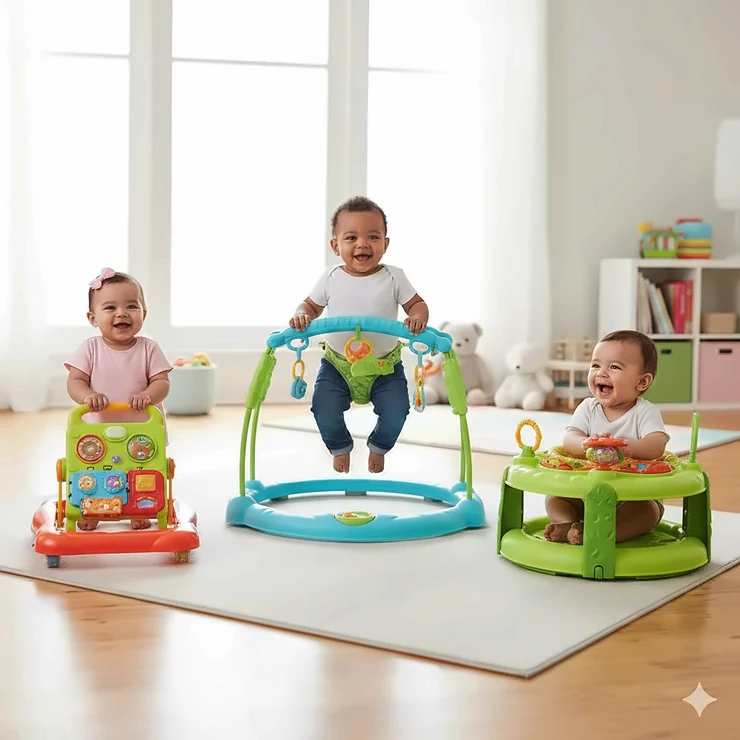
You’ve got three options staring at you from the baby store shelf, and honestly? They all look pretty similar at first glance. But here’s the thing—walker vs jumper vs exersaucer isn’t just about picking the cutest one.
Each of these baby activity devices serves a completely different purpose, affects your baby’s development in distinct ways, and comes with its own safety considerations. The difference between walker and jumper alone could impact whether your little one develops proper walking patterns or picks up that toe-walking habit pediatric physical therapists warn about.
I’ve spent countless hours researching developmental equipment comparison studies, consulting with pediatric therapists, and testing these devices with real families. What I discovered might surprise you: the most popular option isn’t always the safest, and the safest option might not support development the way manufacturers claim.
In this comprehensive baby walker alternatives guide, we’ll break down exactly which is better walker or exersaucer for your specific situation, explore mobility device differences that matter for your baby’s growth, and help you understand developmental gear options that actually align with your parenting goals. Whether you’re team safety-first or looking for maximum entertainment value, you’ll have clarity by the end of this article.
Quick Comparison Table
| Feature | Walker | Jumper | Exersaucer |
|---|---|---|---|
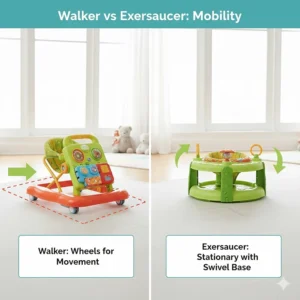
| Mobility | High – moves freely | None – stationary/suspended | None – fixed position |
| Safety Concern | Highest risk (AAP recommends ban) | Moderate (doorway types risky) | Lower risk |
| Developmental Impact | May delay walking 1+ month | Can cause toe-walking pattern | Limited motor skill practice |
| Age Range | 6-18 months | 6-24 months | 4-12 months |
| Price Range | $40-$120 | $35-$150 | $70-$150 |
| Recommended Daily Use | Not recommended | 15-20 minutes max | 15-30 minutes max |
| Best For | Controversial (banned in Canada) | Quick entertainment | Contained safe play |
💬 Just one click – help others make better buying decisions too! 😊
Top 7 Products for Walker vs Jumper vs Exersaucer: Expert Analysis
1. BABY JOY 5-in-1 Baby Walker – Best Multifunctional Walker
The BABY JOY 5-in-1 Baby Walker stands out as a versatile option that converts between walker, bouncer, rocker, push walker, and eating mode. This adaptability addresses the main criticism of traditional walkers by offering stationary modes that don’t compromise safety.
Key Specifications:
- 5 operational modes for different developmental stages
- 3 adjustable height positions
- Weight capacity: 6-18 months
- Triangular chassis design for enhanced stability
Price Range: $65-$85
Parents appreciate the music and lights feature that keeps babies engaged for short periods. The breathable seat cover is machine washable, which solves the inevitable cleanup situations every parent faces. Customer feedback indicates the foldable design makes storage and travel considerably easier than bulkier alternatives.
✅ Pros:
- Multiple modes reduce need for separate equipment
- Anti-slip pads prevent stair accidents
- Compact when folded
❌ Cons:
- Assembly takes 15-20 minutes
- Music volume isn’t adjustable on all models
2. Fisher-Price Colorful Corners Jumperoo – Premium Stationary Jumper
When discussing the difference between walker and jumper, the Fisher-Price Colorful Corners Jumperoo exemplifies why stationary jumpers gained popularity after walker safety concerns emerged. This freestanding unit removes the doorway hazards associated with hanging jumpers.
Key Specifications:
- 360-degree rotating seat access
- 3 height adjustments
- Maximum weight: 25 lbs
- Interactive activity toys with lights and sounds
Price Range: $90-$130
Fisher-Price’s Play Lab research team designed this based on decades of child development observation. The sensory-rich environment—with varied textures, sounds, and visual stimulation—supports cognitive development during supervised playtime. Parents report babies typically enjoy 15-20 minute sessions, which aligns perfectly with expert recommendations.
✅ Pros:
- JPMA safety certified
- Durable construction lasts through multiple children
- Machine-washable seat pad
❌ Cons:
- Large footprint requires dedicated floor space
- Some babies outgrow before reaching walking age
3. Evenflo Exersaucer Triple Fun Active Learning Center – Best 3-Stage Exersaucer
The Evenflo Exersaucer Triple Fun Active Learning Center represents the evolution of baby activity equipment comparison. This model grows with your baby from tummy time through toddler play table stages, addressing the limited-use criticism traditional exersaucers face.
Key Specifications:
- 3 stages: play mat, bouncing activity center, activity table
- 25+ activities, lights, and sounds
- 360-degree seat rotation
- Unique rocking base for enhanced engagement
Price Range: $95-$140
What sets this apart in the which is better walker or exersaucer debate is versatility. The play mat stage (birth+) encourages tummy time—pediatric therapists’ gold standard for motor development. Stage 2 bouncing (4-12 months) provides the entertainment value parents need during meal prep, while stage 3 converts to a cruising table (12+ months).
✅ Pros:
- 2+ years of use across developmental stages
- Machine-washable components
- Easy tool-free assembly
❌ Cons:
- Higher initial investment than single-stage options
- Requires floor space even when converted to table
4. FUNLIO Baby Jumper with Stand – Best Portable Jumper Option
For families seeking baby walker alternatives that emphasize safety, the FUNLIO Baby Jumper with Stand delivers a freestanding solution. This addresses the doorway jumper safety concerns without sacrificing the bouncing experience babies love.
Key Specifications:
- Foldable frame for storage and transport
- Height adjustable chain (10 inches of adjustment)
- 304 stainless steel springs
- Weight capacity: up to 50 lbs (6-24 months)
Price Range: $70-$95
The portability factor changes the game for families who want indoor/outdoor flexibility. Parents report using this in living rooms, backyards, and even at grandparents’ houses. The double-layer cotton seat with wide velcro provides better support than basic sling designs. Customer feedback consistently mentions the solid construction—this isn’t the flimsy equipment that wobbles during enthusiastic jumping.
✅ Pros:
- Easy 10-minute assembly
- Outdoor-safe construction
- 90-day return policy with 3-year quality service
❌ Cons:
- Takes up more floor space than doorway models
- Not suitable for homes with very low ceilings
5. Bright Starts Walk-A-Bout Baby Walker – Traditional Walker with Safety Features
Despite controversy around wheeled walkers, the Bright Starts Walk-A-Bout Baby Walker incorporates modern safety improvements. Understanding mobility device differences helps parents who choose to use walkers do so with enhanced precautions.
Key Specifications:
- Removable toy station with lights and sounds
- 3 height adjustments
- Wide base design for stability
- Easy-fold frame for storage
Price Range: $45-$70
This represents an evolution in walker design with a wider base that won’t fit through standard doorways—one of the primary safety concerns the AAP identified. The easy-wipe tray doubles as a feeding surface, which parents find practical. However, research from HPRC therapists indicates even improved walkers don’t accelerate walking development and may contribute to atypical movement patterns.
✅ Pros:
- Affordable entry point
- Lightweight and portable
- Simple operation
❌ Cons:
- AAP still recommends avoiding all wheeled walkers
- Can develop toe-walking habits
- Banned in Canada due to safety concerns
6. INFANS Baby Activity Center – Best Budget Exersaucer
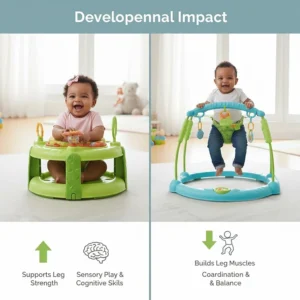
The INFANS Baby Activity Center proves developmental gear options don’t require breaking the bank. This 3-in-1 stationary center delivers essential features at a price point accessible to most families.
Key Specifications:
- Music, lights, and interactive toys
- 360-degree rotating seat
- 3 adjustable heights
- Maximum height: 32 inches
Price Range: $75-$100
What makes this a smart baby activity equipment comparison contender is the value proposition. You’re getting the core benefits of premium exersaucers—stationary safety, sensory stimulation, contained play—without luxury features you might not need. Parents appreciate the straightforward assembly and the fact that hanging dolls and toys are machine-washable. Customer reviews note babies between 6-10 months get the most use from this model.
✅ Pros:
- Affordable without compromising safety standards
- Easy to disassemble and clean
- Complies with US CPSIA and ASTM standards
❌ Cons:
- Fewer activities than premium models
- Seat padding thinner than high-end options
7. Wolfcode 5-in-1 Baby Walker – Best for Small Spaces
The Wolfcode 5-in-1 Baby Walker addresses a common parent concern: where do you put all this baby equipment? This space-conscious design provides walker functionality in a more compact footprint.
Key Specifications:
- 5 modes including bouncer and walker combo
- 5 adjustable height settings
- Portable foldable design
- Music and lights with adjustable volume
Price Range: $60-$90
The key selling point here is the one-button folding mechanism. Parents living in apartments or homes without dedicated playrooms need equipment that doesn’t dominate living spaces. This folds flat enough to slide under beds or into closets. The 5-in-1 versatility means you’re essentially getting multiple pieces of equipment that can be swapped based on your baby’s current developmental stage and your immediate needs.
✅ Pros:
- Space-efficient storage solution
- Mute wheel option for quiet movement
- Adjustable music volume
❌ Cons:
- May not feel as sturdy as heavier traditional models
- Mixed reviews on long-term durability
✨ Don’t Miss These Exclusive Deals!
🔍 Take your baby’s development to the next level with these carefully selected products. Click on any highlighted item to check current pricing and availability. These activity centers will help support your little one’s growth safely and effectively!
Understanding the Core Difference Between Walker and Jumper
The fundamental distinction in walker vs jumper vs exersaucer comes down to mobility and how your baby’s body engages with each device. Let’s break this down in ways that actually matter for development.
Walkers: The Mobility Question
Traditional walkers give babies freedom to move across floors before they’ve developed the muscle strength, balance, and coordination needed for independent walking. Think of it like putting someone in a car before they know how to drive—the equipment does the work that their body should be learning to do naturally.
Research from Children’s Rehabilitation Institute TeletonUSA shows walkers place babies in atypical positions. Instead of learning to shift weight, rotate their trunk, and coordinate leg movements naturally, babies in walkers often lean forward, lock their legs straight, or push up on their toes. These movement patterns can persist even after the walker is gone.
The safety aspect is even more concerning. According to CPSC reports, thousands of children require hospital treatment annually for walker-related injuries. The most common scenarios involve falls down stairs, burns from reaching hot items on counters, and poisoning from accessing cabinets previously out of reach.
Jumpers: The Bouncing Dilemma
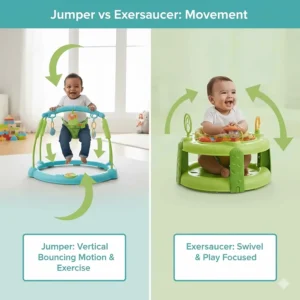
Baby jumpers create a different set of developmental considerations. Whether doorway-mounted or freestanding, jumpers suspend babies in a seated position where they can push off with their feet to bounce.
Here’s what pediatric physical therapists from Human Performance and Rehabilitation Centers explain: jumping is an advanced motor skill that typically develops around age 2-3 years, after children have mastered standing, walking, climbing, and falling safely. The neuromuscular coordination required for controlled jumping takes years to develop properly.
When you place a 6-month-old in a jumper, they’re experiencing repetitive bouncing movements before their bodies and joints are ready for this stress. This can overdevelop calf muscles while neglecting the quad and hip muscles essential for balanced walking. Parents report that some children who extensively used jumpers developed toe-walking patterns that required physical therapy to correct.
Exersaucers: The Stationary Solution
Exersaucers emerged as the “safer” alternative when walker safety concerns peaked in the 1990s. These stationary activity centers keep babies in one place while providing toys, sounds, and limited bouncing capability.
The advantage? Your baby can’t roll into danger zones or gain access to hazardous items. The limitation? They’re still experiencing upright positioning before their bodies have naturally developed the strength to support it independently.
According to bebePT specialists, exersaucers work best when they match your baby’s current developmental stage. If your baby can’t sit independently yet, they’re likely not ready for an exersaucer. The device should support what they’re working on naturally—not force them into positions they haven’t achieved on their own.
Safety Considerations: Walker vs Jumper vs Exersaucer
Safety isn’t just about preventing immediate injuries—it’s about understanding how these devices affect your baby’s long-term physical development and creating the right conditions for healthy growth.
The American Academy of Pediatrics Position
The AAP has taken a clear stance: they recommend a complete ban on wheeled baby walkers. Not “use with caution” or “under supervision”—a total ban. Canada implemented such a ban in 2004, making it illegal to sell, import, or even advertise baby walkers.
Why such strong language? AAP research documents that walkers are associated with serious injuries including skull fractures, concussions, and broken bones. Even in homes where parents installed safety gates and removed hazards, injuries still occurred. The fundamental design—mobility before readiness—creates inherent risk.
Regarding jumpers and exersaucers, the AAP takes a softer but still cautious approach. They don’t call for bans, but they emphasize these devices should never keep babies stationary for extended periods. The “container baby syndrome” phenomenon occurs when infants spend excessive time in positioning devices that limit natural movement.
Time Limits That Actually Matter
Experts from Maternie and North Shore Pediatric Therapy consistently recommend:
Jumpers: 15-20 minutes maximum per day, preferably split into shorter sessions
Exersaucers: 15-30 minutes maximum per day total
Walkers: Many experts recommend avoiding entirely; if used despite recommendations, 20 minutes absolute maximum
These aren’t arbitrary numbers. They’re based on understanding that babies need floor time—lots of it—to develop properly. Every minute in a positioning device is a minute not spent on tummy time, rolling, crawling, or pulling up to stand naturally.
Proper Usage Guidelines
For Jumpers:
- Wait until baby can hold their head up steadily and unassisted
- Choose freestanding models over doorway-mounted versions
- Ensure feet touch the ground flat, not tippy-toe
- Never leave baby unattended
- Watch for signs of fatigue (fussiness, leaning to sides)
For Exersaucers:
- Wait until baby can sit independently without arm support
- Adjust height so feet touch ground flat
- Position away from stairs, heaters, and reachable hazards
- Rotate toys regularly to maintain engagement
- Stop use when baby can climb out or shows disinterest
For Walkers:
- Consider whether use aligns with safety recommendations
- Block all stairways completely (gates aren’t sufficient)
- Remove all hazards from all surfaces within extended reach
- Never use near water (pools, bathtubs)
- Understand even supervised use carries risk
Which is Better Walker or Exersaucer? The Developmental Perspective
Let’s tackle the question parents actually ask: which is better walker or exersaucer for helping my baby develop?
The research is surprisingly clear, and it might not be what baby equipment manufacturers want you to hear: neither device accelerates development, and both can potentially delay it when overused.
What Studies Actually Show
Multiple studies referenced by early intervention specialists found that babies who extensively used walkers, jumpers, or exersaucers walked 1-2 weeks to a full month later than babies who spent more time in free floor play. That’s not a typo—the equipment marketed as “developmental” actually correlates with later walking.
Why? Because learning to walk requires babies to:
- Develop core stability through tummy time and crawling
- Build hip and quad strength through natural pulling to stand
- Practice weight shifting and balance control
- Experience falling and learning to catch themselves
- Receive feedback from muscles and joints to the brain
None of these crucial developmental steps happen in walkers, jumpers, or exersaucers. The equipment does the work for them.
The Floor Play Alternative
Pediatric physical therapists consistently recommend one thing above all others: supervised floor time. This includes:
Tummy Time – Strengthens neck, shoulders, back, and core muscles essential for all later movement
Side-Lying Play – Helps babies learn to reach across their body, developing rotation skills
Supported Sitting – When baby is developmentally ready, not forced early
Safe Furniture Cruising – Natural pulling up on couches, coffee tables, or parents’ hands
Push Toys – When baby is steady standing, these provide appropriate walking support
A study published by the American Academy of Pediatrics found that babies who spent adequate time in tummy time (when awake and supervised) showed better motor skill development across all measured milestones compared to babies who spent significant time in positioning devices.
When They Might Be Useful
Real talk: sometimes you need to put your baby somewhere safe while you shower, prepare meals, or handle the million other tasks of daily life. This is where understanding the baby walker alternatives hierarchy matters.
Best Options:
- Play pen or Pack ‘n Play – Allows freedom of movement while contained
- Stationary exersaucer – For very short periods (15 minutes)
- Freestanding jumper – Brief supervised sessions
Questionable Options:
- Wheeled walkers – Consider if benefits outweigh substantial safety risks
The key word throughout? Brief. These are containment solutions for short-term needs, not development tools or babysitters.
Baby Walker Alternatives: Safer Developmental Options
If you’re looking beyond the walker vs jumper vs exersaucer debate entirely, consider these alternatives that better support natural development.
Push Walkers: The Better Walking Support
Push walkers (the kind children stand behind and push, not sit in) offer advantages wheeled walkers don’t. Pediatric PT Kendra Gagnon explains these allow children to see their legs and feet, practice standing and stepping naturally, and develop genuine balance skills.
The beauty of push walkers is they require babies to already have some standing ability. They support, not replace, the developmental work. Popular options include:
- Fisher-Price Learn with Me Walker – Adjustable speed control
- Radio Flyer Classic Walker Wagon – Sturdy wooden construction
- VTech Sit-to-Stand Learning Walker – Interactive features
Or skip commercial products entirely. A laundry basket with some weight in it, a sturdy cardboard box, or a doll stroller can serve the same developmental purpose at zero cost.
Activity Gyms and Play Mats
For younger babies not yet ready for upright positioning, activity gyms provide the sensory stimulation exersaucers promise without positioning concerns. Babies can:
- Reach for dangling toys (developing shoulder and arm strength)
- Practice rolling side to side
- Experience tummy time with visual motivation
- Move freely without restrictions
Popular choices include the Lovevery Play Gym and Fisher-Price Deluxe Kick ‘n Play Piano Gym.
Floor Seats for Brief Sits
When you need baby contained but don’t want the limitations of exersaucers, floor seats offer a middle ground:
- Bumbo Floor Seat – For babies who can hold heads up (use cautiously)
- Fisher-Price Sit-Me-Up Floor Seat – Provides back support for developing sitters
Critical caveat: use these only when baby is developmentally approaching independent sitting, not to prop them up early.
Mobility Device Differences: Making the Right Choice for Your Family
Every family has different needs, spaces, and priorities. Here’s how to evaluate developmental gear options for your specific situation.
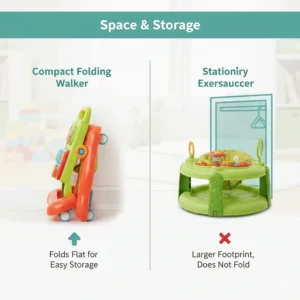
Space Considerations
Large Homes/Dedicated Playrooms: Full-size exersaucers like the Evenflo Triple Fun or Fisher-Price jumperoos work well when space isn’t limited.
Apartments/Small Homes: Foldable options like the Wolfcode 5-in-1 or compact SpaceSaver jumperoos make more sense. Consider wall-mounted jumpers if you have appropriate doorways (though be aware of safety concerns).
Multi-Floor Homes: Having equipment on each level is costly. Portable jumpers with stands or lightweight walkers (if you use them) offer flexibility.
Budget Reality Check
Under $75: INFANS Baby Activity Center, basic baby walkers, simple doorway jumpers
$75-$125: BABY JOY 5-in-1, FUNLIO Jumper with Stand, mid-range exersaucers
$125+: Fisher-Price Jumperoos, Evenflo Triple Fun, premium multi-stage centers
Remember: you don’t need all three types. Choose one based on your priorities (safety, entertainment, development support) and supplement with free floor play.
Your Baby’s Temperament
High-Energy Babies: May enjoy the bouncing sensation of jumpers more than static exersaucers. However, this doesn’t mean they need jumpers—they might simply need more floor time to work out that energy naturally.
Observant, Cautious Babies: Often prefer exersaucers where they can explore at their own pace without the bouncing intensity.
Early Movers: Babies who roll, scoot, and pull up early may skip interest in contained equipment entirely. Follow their lead.
Baby Activity Equipment Comparison: Features That Matter
When comparing specific models, focus on features that impact safety and usefulness rather than marketing hype.
Essential Safety Features
Stability:
- Wide base that resists tipping
- Non-slip feet or pads
- Sturdy frame construction
Adjustability:
- Multiple height settings to grow with baby
- Easy-to-adjust mechanisms (you’ll change these often)
Materials:
- BPA-free plastics
- Lead-free paint/finishes
- Machine-washable fabrics
Certification:
- JPMA (now Baby Safety Alliance) certification
- ASTM compliance
- CPSIA compliance
Practical Features
Cleaning:
- Removable, machine-washable seat covers (non-negotiable)
- Easy-wipe toy surfaces
- Dishwasher-safe tray attachments
Storage:
- Foldable frame (huge space saver)
- Removable toys for independent play
- Compact footprint when folded
Entertainment Value:
- Variety of textures and activities
- Adjustable or removable sound features (for sanity)
- Age-appropriate toy complexity
Features You Can Skip
Excessive Electronics: Babies don’t need 47 songs and flashing lights. Simple is often better for sensory development.
Branded Character Themes: You’ll pay premium for Mickey Mouse or Minnie Mouse designs without functional differences.
Maximum Toy Count: Quality matters more than quantity. Rotating a few toys keeps things fresh.
Age Ranges and Developmental Readiness
Manufacturer age ranges are guidelines, not rules. Your baby’s developmental milestones matter more than their birth date.
When to Start: Developmental Signs
For Jumpers: ✓ Can hold head up steadily without support ✓ Has some torso strength (not flopping to sides) ✓ Shows interest in being upright ✗ Cannot yet sit independently (wait for exersaucers)
For Exersaucers: ✓ Can sit independently without hand support ✓ Reaches for and grasps toys intentionally
✓ Stays awake and alert for periods ✗ Can’t hold head steady (definitely wait)
For Walkers: This is complicated because even when babies are developmentally “ready” for the equipment, the equipment itself raises safety concerns. The fact that a baby can use a walker doesn’t mean they should.
When to Stop: The Outgrow Phase
Safety Indicators:
- Baby can climb out independently
- Reaches the weight limit
- Can walk steadily (for walkers/exersaucers)
Developmental Indicators:
- Shows more interest in floor play and cruising
- Gets frustrated being contained
- Has mastered the activities offered
Most babies naturally outgrow interest between 10-14 months as their independent mobility increases. Don’t force continued use if baby prefers exploring their environment naturally.
Common Questions About Walker vs Jumper vs Exersaucer
❓ Can I use a walker if I watch my baby constantly?
❓ Will using an exersaucer delay my baby's walking?
❓ Are doorway jumpers safer than freestanding ones?
❓ Can my 4-month-old use an exersaucer if they can hold their head up?
❓ What's the single safest option: walker, jumper, or exersaucer?
Conclusion: Making Your Walker vs Jumper vs Exersaucer Decision
Here’s what matters most in the walker vs jumper vs exersaucer debate: none of these devices are essential for your baby’s development, and all of them work best as brief containment solutions rather than development tools.
If you’re looking for the safest option with the most versatility, a stationary exersaucer like the Evenflo Triple Fun wins for multi-stage use spanning birth through toddlerhood. For families prioritizing portability and space efficiency, the FUNLIO Baby Jumper or Wolfcode 5-in-1 Walker offer foldable convenience.
But honestly? The “best” choice might be investing that $75-150 into a quality play mat, some engaging floor toys, and trusting your baby’s natural developmental timeline. Pediatric therapists consistently emphasize that free floor movement—tummy time, rolling, crawling, pulling up on furniture—provides everything babies need for healthy motor development.
If you do choose activity equipment:
- Select one device max (you don’t need all three)
- Stick to recommended time limits religiously
- Prioritize safety certifications over entertainment features
- Watch your baby’s actual development, not marketing promises
- Trust that “boring” floor time is actually optimal development time
Remember that every baby’s path is unique. Some skip certain milestones entirely, some breeze through, some take their time. The best developmental gear option is one that supports (not replaces) natural movement, keeps your baby safe, and gives you the occasional hands-free moment you need to function as a human being.
Your baby will walk when their body is ready, jump when they’ve developed the coordination, and explore independently when they’ve built the necessary strength and confidence. No amount of equipment speeds that up—but the wrong equipment at the wrong time can potentially slow it down.
Choose wisely, use sparingly, and enjoy those floor play moments. That’s where the real development magic happens.
Recommended for You
- Best Baby Walker Under $100: 7 Expert Picks for 2026
- Best Baby Walker Under $50: 7 Budget Picks (2026 Guide)
- 7 Best Baby Walker for 6 Month Old 2026 – Safety Expert Picks
Disclaimer: This article contains affiliate links. If you purchase products through these links, we may earn a small commission at no additional cost to you.
✨ Found this helpful? Share it with your friends! 💬🤗
