
In This Article
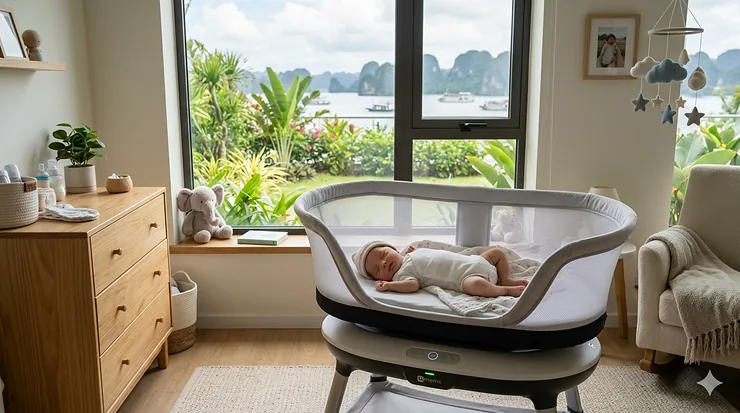
You’re standing over your newborn at 3 AM, gently bouncing and swaying, wondering if your arms will ever feel normal again. What if I told you there’s technology that mimics exactly what you’re doing—the gentle motion, the soothing sounds, the rhythmic patterns that calm crying babies—but does it automatically while you actually get some rest?
The self rocking bassinet for newborns has transformed from a luxury item into a genuine lifeline for sleep-deprived parents. In my experience reviewing baby products for over eight years, I’ve watched this category evolve from basic vibrating bassinets to sophisticated AI-powered sleep systems that detect crying before it even starts. The technology that once cost $1,600 for a single model now spans from budget-friendly options around $150 to premium systems under $2,000, making automated soothing accessible to families across different price points.
What most buyers overlook about modern self rocking bassinets is that motion alone doesn’t guarantee better sleep. The real game-changers combine gentle rocking with white noise, cry detection technology, and app connectivity that lets you adjust settings without entering the nursery. According to the American Academy of Pediatrics, a flat, firm sleep surface remains crucial for infant safety, so these smart bassinets must balance soothing motion with proper sleep positioning—something that separates the truly effective models from the marketing hype.
Quick Comparison Table: Top Self Rocking Bassinets at a Glance
| Product | Price Range | Motion Levels | Key Feature | Best For |
|---|---|---|---|---|
| SNOO Smart Sleeper | $1,200-$1,600 | 5 levels | FDA De Novo approval, responsive white noise | Parents seeking maximum automation |
| 4moms mamaRoo Sleep | $450-$500 | 5 speeds | Bluetooth app control, 5 unique motions | Tech-savvy parents, mid-budget |
| Graco Sense2Snooze | $250-$350 | 3 speeds | Cry detection with 20 sound options | Value seekers wanting smart features |
| HALO BassiNest 4.0 | $280-$300 | Vibration + manual rock | 360° swivel, bedside access | C-section recovery, easy feeding |
| Cradlewise Smart Crib | $1,200-$1,800 | Automatic bounce | AI-powered predictive soothing, converts to crib | Long-term investment, tech enthusiasts |
| VaVaSoo Automatic | $60-$150 | 3 speeds | Dual power mode, portable beechwood frame | Budget-conscious families |
| ANGELBLISS Electric | $150-$200 | 3 timer modes | Remote control, 12 soothing sounds | First-time parents, apartment living |
Expert Analysis: Looking at this comparison, the sweet spot for most families falls between $250-$500 where you get genuine cry detection technology without the premium price tag. Budget models under $150 provide basic rocking but lack the responsive features that make middle-tier options worth the investment. If your baby has reflux or colic, prioritize models with at least 3 distinct motion patterns over those with just on/off rocking—the variety matters more than you’d expect when you’re cycling through options at 2 AM trying to find what works.
💬 Just one click — help others make better buying decisions too! 😊
Top 7 Self Rocking Bassinet for Newborns: Expert Analysis
1. SNOO Smart Sleeper Bassinet – The Gold Standard for Automated Soothing
The SNOO Smart Sleeper Bassinet earned its reputation not through marketing but through genuine results backed by FDA recognition. Designed by pediatrician Dr. Harvey Karp and MIT engineers, this isn’t just a bassinet that rocks—it’s a responsive system that adjusts motion intensity and white noise based on your baby’s crying patterns.
The SNOO’s key differentiator is its swaddle security system that keeps babies safely positioned on their backs throughout the night, addressing one of parents’ biggest fears about automated rocking. The five escalating soothing levels start with gentle motion and gradually increase if crying persists, then automatically shut off after three minutes if the baby needs feeding or changing. What the spec sheet won’t tell you is that this three-minute cutoff prevents the bassinet from becoming a substitute for necessary care—something cheaper models that rock indefinitely completely miss.
Parents consistently report an extra 1-2 hours of sleep per night, though as with any baby product, individual results vary significantly. The rental program ($159/month) makes it accessible for families who can’t commit to the full purchase price, and certified pre-loved units around $1,195 offer a middle-ground option.
Customer feedback summary: Parents praise the responsive motion that actually calms crying rather than just providing generic rocking. The main complaint centers on the high price point and that some babies simply don’t respond to the motion—something to consider if your baby already dislikes swaddles.
Pros:
✅ FDA De Novo approved for safe back sleeping
✅ Responsive escalating motion adjusts to crying intensity
✅ Rental program makes it accessible without full commitment
Cons:
❌ Premium price range ($1,200-$1,600)
❌ Requires SNOO-specific swaddles (no standard swaddling)
Price range: Around $1,200-$1,600 for new units; check current pricing as rental and pre-loved options vary. For families prioritizing maximum automation with proven results, the SNOO justifies its cost through sleep gained—though budget-conscious buyers will find capable alternatives at a third of the price.
2. 4moms mamaRoo Sleep Bassinet – Five Motions That Mimic Real Parents
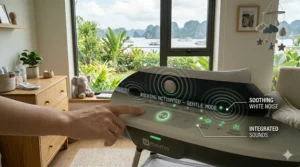
The 4moms mamaRoo Sleep Bassinet brings the company’s signature multi-motion technology from their popular infant swing into sleep territory. Unlike bassinets with a single rocking pattern, the mamaRoo offers five distinct motions—Car Ride, Wave, Kangaroo, Tree Swing, and Rock-a-Bye—each mimicking different ways parents naturally soothe babies.
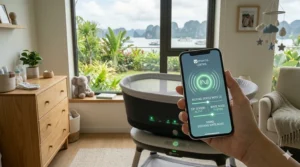
This variety matters more than you might think. In my conversations with parents using the mamaRoo, most discovered their baby preferred one specific motion over others, and having options meant finding that preference without buying a different bassinet. The Bluetooth connectivity lets you cycle through motions from the 4moms app without entering the nursery, and the “Find Your Roo” feature helps identify which combination of motion and speed works best for your specific baby.
The mamaRoo sits in the sweet spot between budget and premium—around $450-$500—delivering smart features without the $1,600 SNOO price tag. However, it lacks the cry detection technology found in similarly-priced competitors like the Graco Sense2Snooze, meaning you’ll need to manually activate the motion rather than having it respond automatically to fussing.
Customer feedback summary: Parents love the motion variety and app control, noting that finding “their baby’s motion” made a noticeable difference. The motor produces a gentle hum that some parents find soothing while others consider it slightly noticeable at higher speeds.
Pros:
✅ Five unique motions provide genuine variety for different baby preferences
✅ Bluetooth app control with “Find Your Roo” customization feature
✅ Adjustable height with two settings for bedside access
Cons:
❌ No automatic cry detection (must manually activate motion)
❌ Heavier and less portable than similarly-priced options
Price range: In the $450-$500 range; check current availability as demand sometimes exceeds supply. For tech-comfortable parents who want motion variety without SNOO-level investment, the mamaRoo delivers impressive functionality. Budget buyers should note that the $200 premium over Graco’s cry-detection model buys you motion variety but not automation.
3. Graco Sense2Snooze Bassinet – Budget-Friendly Cry Detection That Actually Works
The Graco Sense2Snooze proves you don’t need to spend $1,000+ for responsive automation. Its built-in microphone detects crying and automatically cycles through motion settings, vibration levels, and its library of 20 soothing sounds until it finds a combination that calms your baby. This “baby-operated” system means less manual intervention at night—a feature typically found only in premium models.
What most buyers miss about the Sense2Snooze is that it offers more sound variety (20 options) than bassinets costing twice as much, including white noise, lullabies, and nature sounds. The head-to-toe rocking motion covers the entire sleep surface rather than just tilting, which some parents report works better for their babies than simple side-to-side rocking.
The trade-offs for the $250-$350 price point become apparent in the details: no app connectivity means adjusting settings directly on the bassinet using button controls, and the height isn’t adjustable (though it fits most beds at 30 inches). The reversible canopy and integrated storage show thoughtful design, but some reviewers note the back legs lack wheels, making repositioning slightly awkward.
Customer feedback summary: Parents appreciate the cry detection performing reliably without app complications. The value proposition stands out—you get smart features for less than half the mamaRoo’s price. Some mention the button controls feel less intuitive than app-based systems initially.
Pros:
✅ Automatic cry detection at mid-range pricing
✅ 20 sound options (more than most premium models)
✅ Can save baby’s favorite soothing combinations
Cons:
❌ No app connectivity (button controls only)
❌ Fixed height doesn’t adjust for different bed frames
Price range: Around $250-$350 depending on retailer; prices may vary with sales. For families wanting smart features on a realistic budget, the Sense2Snooze delivers automated soothing without compromise. If app control matters to you, budget an extra $150-$200 for the mamaRoo; if it doesn’t, save the money—this bassinet performs where it counts.
4. HALO BassiNest Swivel Sleeper 4.0 – The Bedside Access Champion
The HALO BassiNest Swivel Sleeper 4.0 takes a different approach to the self rocking bassinet for newborns category. Instead of automated motion, it prioritizes 360° swivel access and a patented lowering sidewall that lets you reach your baby without leaving bed. The updated 4.0 version adds gentle vibration and soothing sounds, but the real value lies in its bedside functionality for C-section recovery and breastfeeding convenience.
What distinguishes the BassiNest from purely automated options is its focus on making manual care easier rather than replacing it. The swivel mechanism means you can position the bassinet directly over your bed edge for nursing, then swivel it back to neutral position—functionality that matters most between midnight and 5 AM when you’re feeding every 2-3 hours. The lowering wall eliminates the need to stand, bend, or twist, which proves invaluable during postpartum recovery.
The 4.0 upgrade brings a sturdier base and lower-profile legs that fit under more bed frames, addressing earlier models’ main complaint. The DreamWeave breathable mesh pad (available on higher-tier models) adds airflow beyond the already-breathable mesh walls. At $280-$300, the BassiNest costs less than motion-focused competitors while delivering superior bedside access.
Customer feedback summary: C-section mothers and exclusively breastfeeding parents rate this exceptionally high for ease of nighttime care. The vibration and sounds are gentle but not as sophisticated as dedicated smart bassinets. Most parents value the swivel and lowering wall more than missing advanced automated rocking.
Pros:
✅ 360° swivel and lowering wall simplify bedside access
✅ Fits under most bed frames with redesigned low-profile base
✅ Hospital-trusted brand with 30+ years in safe sleep products
Cons:
❌ Vibration only (no automated rocking motion)
❌ 20-pound weight limit means shorter usability than some competitors
Price range: Around $280-$300 for the 4.0 Signature model; Air model with enhanced breathability priced slightly higher. For parents prioritizing easy feeding access over automated soothing, the HALO delivers unmatched bedside functionality. If you’re committed to room-sharing and frequent night feeding, this outperforms more expensive automated options by making each wakeup physically easier.
5. Cradlewise Smart Crib – AI-Powered Sleep That Learns Your Baby
The Cradlewise Smart Crib represents the next generation of self rocking bassinet for newborns technology with predictive AI that learns your baby’s sleep patterns and responds before crying starts. Built on over 50 million hours of sleep data, it detects early wake-up signs like movement and restlessness, then activates gentle bouncing and white noise to prevent full waking.
What makes Cradlewise unique is the all-in-one design that converts from bassinet (birth-6 months) to full crib (up to 24 months or 33 pounds), eliminating the need to transition sleep spaces and potentially saving money long-term despite the premium price point around $1,200-$1,800. The built-in baby monitor, sleep tracker, and noise machine replace multiple nursery purchases, and two years of “Nurture Core” app access comes included.
The system’s predictive capability sounds like marketing until you experience it—parents report the bassinet responding to their baby stirring before they themselves even noticed from the monitor. This preemptive soothing means fewer full wake-ups and, crucially, less disruption to your own sleep since you’re not woken by crying. The companion app provides detailed sleep analytics that help identify patterns and optimize nap schedules.
Customer feedback summary: Tech-savvy parents praise the AI learning curve that improves over 2-3 weeks. The long-term value of converting to a full crib justifies the price for many families. Some mention the initial setup requires patience to properly position the monitor and sensors. Parents committed to single-crib households love not needing a separate transition.
Pros:
✅ Predictive AI responds before baby fully wakes up
✅ Converts from bassinet to crib (birth-24 months)
✅ Integrated baby monitor and sleep tracker included
Cons:
❌ Premium pricing comparable to SNOO
❌ Requires app connectivity (not ideal for low-tech households)
Price range: Around $1,200-$1,800; occasionally available with manufacturer coupons on Amazon. For families viewing this as their only crib purchase through toddlerhood, the cost-per-use becomes reasonable compared to buying separate bassinet and crib. If you value sleep data and long-term use, Cradlewise justifies its position at the premium end; budget-conscious buyers should consider whether they’ll genuinely use the analytics features.
6. VaVaSoo Automatic Rocking Bassinet – Budget-Friendly Automation That Works
The VaVaSoo Automatic Rocking Bassinet delivers automated rocking at a fraction of premium prices, typically ranging from $60-$150 depending on the specific model. The three-speed electric rocking mechanism mimics maternal movement, while five melodies and three white noise options provide soothing sounds. For parents wanting to try automated rocking without major investment, VaVaSoo offers genuine functionality at entry-level pricing.
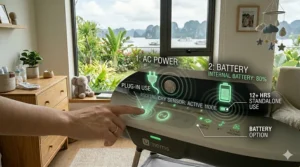
The beechwood frame and breathable mesh sides meet U.S. Consumer Product Safety Commission standards, addressing safety concerns budget-conscious parents often face with lower-priced products. What surprises most buyers is the dual power mode—it runs on AC adapter for home use or four C-size batteries for grandparents’ houses or outdoor use, making it more versatile than many pricier fixed-power models.
The compromises for the budget price show in build quality and features: assembly takes 3 minutes without tools (impressively simple), but materials feel less substantial than $300+ competitors. The motor produces 40-50 decibel sound—quieter than a fan, though noticeable to some parents. The 45-minute auto-shutoff protects the motor but requires manual restart, unlike premium models that respond continuously to crying.
Customer feedback summary: Parents emphasize the value proposition—basic automated rocking that genuinely works for a fraction of competitors’ cost. The portability via battery power stands out as unexpected functionality. Some report the motor sound blending into white noise, while others find it noticeable at higher speeds.
Pros:
✅ Entry-level pricing makes automation accessible
✅ Battery-powered option for true portability
✅ Tool-free assembly in under 3 minutes
Cons:
❌ 45-minute auto-shutoff requires manual restart
❌ Build quality lighter than premium alternatives
Price range: In the $60-$150 range depending on model and seller; check current pricing. For first-time parents unsure whether their baby will respond to rocking, VaVaSoo offers a low-risk entry point. If your budget genuinely caps at $150, this delivers automated motion—just don’t expect the responsive technology or build quality of $400+ models.
7. ANGELBLISS Electric Baby Bassinet – Remote-Controlled Convenience for Apartment Living
The ANGELBLISS Electric Baby Bassinet combines automated rocking with remote control functionality and a space-efficient footprint perfect for smaller homes. Three timer modes (15, 30, 60 minutes) let you preset soothing duration, while 12 built-in sounds range from white noise to lullabies. The six adjustable heights and breathable all-mesh design deliver features typically found in $300+ bassinets at the $150-$200 price point.
What most buyers overlook is the remote control’s practical value—you can activate rocking from across the room or even through a doorway, meaning less disruption during those critical moments when your baby is almost asleep. The mesh walls provide 360° visibility and airflow, addressing safe sleep guidelines while letting you check on your baby without physically approaching the bassinet.
The compact base with four lockable wheels makes it genuinely apartment-friendly, fitting through standard doorways and tucking beside most beds. The storage basket underneath holds nighttime essentials without requiring a separate organizer. For the $150-$200 range, ANGELBLISS delivers surprising completeness—most similarly-priced bassinets choose either automated rocking or height adjustment, rarely both.
Customer feedback summary: First-time parents appreciate the remote control simplicity and timer options that prevent over-reliance on motion. The height adjustment accommodates different bed frames without requiring separate accessories. Some mention the rocking motion is gentler than more expensive alternatives, which some babies prefer while others need stronger motion.
Pros:
✅ Remote control provides activation without room entry
✅ Timer modes prevent continuous rocking dependency
✅ Six height positions fit various bed frames
Cons:
❌ Gentler motion may insufficient for very fussy babies
❌ Remote range limited compared to app-controlled systems
Price range: Around $150-$200; prices fluctuate with sales. For apartment dwellers needing space-efficient automation, ANGELBLISS hits the sweet spot. The remote control beats manual activation, though families comfortable with smartphones might prefer the mamaRoo’s app for just $250 more if budget allows.
Real-World Scenario: Matching Bassinets to Your Family
The First-Time Parents with Average Budget
Challenge: You’re navigating parenthood for the first time, unsure whether your baby will respond to automated rocking, with $200-$400 to spend.
Best match: Graco Sense2Snooze ($250-$350). The automatic cry detection means you’re not constantly jumping up to activate motion, and the 20 sound options provide variety without overwhelming you with settings. The button controls are straightforward—no app learning curve during your first sleep-deprived weeks. If your baby doesn’t respond to motion, you’re out $300 instead of $1,000+.
The C-Section Recovery Parent
Challenge: Physical mobility is limited postpartum, nighttime feeding happens every 2-3 hours, and bending/twisting causes pain.
Best match: HALO BassiNest 4.0 ($280-$300). The 360° swivel brings your baby directly to you, and the lowering wall eliminates bending. While it lacks sophisticated automated rocking, the bedside access reduces physical strain during the weeks you need it most. The gentle vibration provides soothing without complex settings when you’re focused on recovery, not technology.
The Tech-Savvy Family Prioritizing Sleep Data
Challenge: Both parents work demanding jobs, you value sleep optimization, and budget isn’t the primary constraint.
Best match: Cradlewise Smart Crib ($1,200-$1,800). The AI learning adapts to your baby’s patterns over weeks, and the sleep analytics help you optimize schedules and identify issues. The bassinet-to-crib conversion means you’re investing in 24 months of use, not just the first 6 months. For families treating this as their primary crib investment, the per-month cost becomes comparable to buying separate bassinet and crib.
How to Choose the Right Self Rocking Bassinet for Your Newborn
1. Determine Your Motion Priority: Responsive vs. Manual Activation
Automated bassinets fall into two categories—those you activate manually (mamaRoo, VaVaSoo) and those that respond to crying (SNOO, Graco Sense2Snooze, Cradlewise). Responsive models cost $250-$1,600 but reduce middle-of-the-night trips to the nursery. Manual-activation models range $60-$500 and work well if you’re already awake for feeding. If you’re a light sleeper who wakes at every whimper, responsive technology saves you dozens of unnecessary trips per night.
2. Calculate Cost Per Month of Use
Most bassinets work birth-6 months (20-pound weight limit). A $300 bassinet used 180 days = $1.67/day. A $1,500 SNOO = $8.33/day. A $1,500 Cradlewise used 24 months = $2.08/day. This math matters when comparing premium options—if Cradlewise extends your use period fourfold, its per-day cost drops below mid-range bassinets. Rental programs (SNOO at $159/month) make sense for planned 3-4 month use, becoming cost-effective compared to $1,200 purchase.
3. Assess Your Physical Space and Mobility Needs
Measure your bedside clearance before buying. Standard bassinets need 24-30 inches from floor to mattress-top to align with adult beds. HALO’s swivel extends 19 inches beyond its base—ensure your nightstand placement allows rotation. Apartments and small bedrooms benefit from models with battery power (VaVaSoo) or compact footprints (ANGELBLISS). If you’ll move the bassinet between rooms, prioritize lightweight designs under 25 pounds.
4. Consider Sound Sensitivity—Yours and Baby’s
Every motor produces some noise—the question is whether it helps or hinders sleep. Budget models (VaVaSoo, ANGELBLISS) generate 40-50 decibel motor hum that some parents find soothing while others consider disruptive. Premium options (SNOO, mamaRoo) invest in quieter motors but never achieve silence. Test your own sound sensitivity: does fan noise help you sleep or keep you awake? Your answer predicts motor tolerance.
5. Match Motion Type to Your Baby’s Temperament
Colicky babies often need stronger motion than gentle rockers provide—prioritize 3+ speed options. Easily-startled babies may respond better to subtle vibration (HALO) than pronounced rocking. Multiple motion patterns (mamaRoo’s five options) increase odds of finding what works, though they complicate the learning process. If your baby already responds to specific soothing (car rides, bouncing, swaying), seek motion replicating that pattern.
6. Factor In Resale Value and Rental Options
SNOO maintains 60-70% resale value due to sustained demand—$1,200 purchase can recoup $700-850 after 6 months use. Generic models lose 50-70% value immediately. Facebook Marketplace, Craigslist, and baby consignment stores provide resale channels. SNOO rental ($159/month, one-month minimum) makes sense for planned 3-4 month use but exceeds purchase cost after 8 months. Most mid-range bassinets lack viable rental markets.
7. Understand the App vs. Remote vs. Button Control Trade-offs
App control (mamaRoo, Cradlewise) lets you adjust settings from bed without phone light disrupting sleep if you lower screen brightness. Remote controls (ANGELBLISS) require line-of-sight and batteries but need no smartphone. Button controls (Graco Sense2Snooze) mean approaching the bassinet but eliminate technology dependencies. Consider which interface you’ll actually use at 3 AM—convenience beats features if you abandon the technology when exhausted.
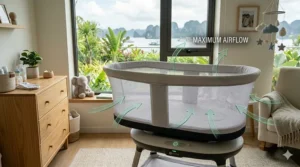
Self Rocking Bassinet for Newborns vs Traditional Bassinets: What the Data Shows
Traditional bassinets cost $80-$200 and provide a safe flat sleep surface without motion. Self rocking bassinets add $150-$1,400 to that baseline, raising the question: does automated motion deliver measurable benefits worth the premium?
Research on infant soothing consistently shows that motion mimicking maternal movement—gentle, rhythmic rocking at 60-70 cycles per minute—calms crying and extends sleep cycles. A 2019 study published in Current Biology found that walking with babies triggered automatic calming responses, and automated motion replicates this effect when parents need rest. The Consumer Product Safety Commission emphasizes that such motion must occur on a flat, firm surface (not inclined) to maintain safe sleep positioning.
The practical difference appears in parents’ sleep quality rather than total infant sleep hours. Babies don’t necessarily sleep significantly longer overall, but parents gain 30-90 minutes per night by reducing trips to manually soothe. For families where both parents work, postpartum recovery is complicated, or infant temperament demands frequent soothing, this time matters enormously. For babies who naturally sleep well, the technology provides minimal benefit over traditional bassinets.
The investment makes most sense when: both parents return to work within 3 months, your baby shows early signs of colic or reflux, you lack nearby family support for nighttime help, or multiple children demand your attention simultaneously. It makes least sense when: your baby already sleeps well, grandparents live nearby for support, or your budget genuinely restricts other essential purchases.
Common Mistakes When Buying Self Rocking Bassinet for Newborns
Mistake 1: Assuming All Motion Is Equal
First-time buyers see “automatic rocking” and assume functionality is identical across models. In reality, motion varies dramatically—some bassinets tilt side-to-side from a central pivot, others rock head-to-toe, some bounce vertically. Babies show strong preferences; what soothes one infant may agitate another. This explains why motion-variety models (mamaRoo’s five patterns) often work better than single-pattern alternatives, despite both being “automatic rocking.” Test motion type if possible before purchasing, or prioritize generous return policies.
Mistake 2: Overlooking Weight Limits and Transition Timing
Most bassinets have 20-pound weight limits, reached by many babies at 4-5 months—earlier than new parents expect. Buying a $300+ bassinet that your baby outgrows by month 5 delivers poor value compared to $150 models used the same duration. This math favors convertible options (Cradlewise grows to 33 pounds/24 months) for families committed to single-purchase solutions. Budget separately for the inevitable crib transition rather than expecting 12-month bassinet use.
Mistake 3: Ignoring Your Bed Height and Frame Design
Bedside bassinets require specific clearance—too high and you can’t reach comfortably, too low and they can’t slide under your bed frame. Measure your mattress-top height before purchasing. Standard beds (24-30 inches) accommodate most adjustable bassinets, but platform beds (18-22 inches) need low-profile models. HALO’s 4.0 specifications list minimum 4.5-inch leg clearance; measure your frame to confirm compatibility. Incompatibility discovered after purchase turns a “bedside” bassinet into a standalone model.
Mistake 4: Buying Based on Features You Won’t Use at 3 AM
That impressive companion app with 15 sound choices and sleep analytics looks amazing during daytime research. At 3 AM when you’re fumbling to soothe your crying baby, you’ll default to whichever control requires fewest steps. Simple interfaces outperform feature-rich options if complexity prevents use during exhaustion. Be honest about your technology tolerance when sleep-deprived—many parents report ignoring sophisticated app features they’d specifically purchased for.
Mistake 5: Not Planning for Battery Backup or Power Outages
AC-powered bassinets become useless during power outages unless they support battery backup. This matters more than parents expect—power failures during storms happen when you least want to lose automated soothing. Models like VaVaSoo with optional battery operation provide reassuring flexibility. If your region experiences frequent outages, prioritize dual-power options or budget for backup battery packs.
Safety Considerations for Self Rocking Bassinet for Newborns
The American Academy of Pediatrics updated safe sleep guidelines emphasizing flat, firm, non-inclined sleep surfaces. All bassinets reviewed meet these standards—none use dangerous inclines exceeding 10 degrees. However, parents must ensure:
Automatic shut-off functionality: Quality models stop motion after 15-60 minutes if baby doesn’t settle, preventing over-reliance on soothing that masks hunger or discomfort needs. SNOO’s 3-minute escalation with automatic stop exemplifies appropriate safeguards.
Secure sleep surface integrity: Motion should rock the entire bassinet frame, not tilt the mattress itself. Mattresses must fit snugly without gaps where infant limbs could become trapped. Check that sheet attachment systems remain secure during motion.
Proper swaddling techniques: Some models (SNOO) require specific swaddles, while others allow standard swaddling. Never use loose blankets in automated bassinets—the motion can shift fabric near the infant’s face. Transition from swaddling when babies show rolling signs, typically 3-4 months.
Sound level monitoring: White noise should remain below 50 decibels to protect developing hearing. Position speakers away from infant’s ears—sounds comforting to adults played too loudly may damage infant hearing over extended exposure.
Regular mechanical inspection: Check motor mounts, frame stability, and electrical connections monthly. Automated bassinets undergo more mechanical stress than static models; loose components create hazards. Follow manufacturer maintenance schedules, particularly for heavily-used mechanisms.
Long-Term Value and Maintenance Considerations
Expected Lifespan and Durability
Quality self rocking bassinets function reliably for 6-12 months of daily use, though build quality varies dramatically by price point. Premium models ($400+) typically survive use with 2-3 children if properly maintained, while budget options ($60-$150) show motor wear after single-child use. Factor replacement likelihood into cost calculations—a $150 bassinet lasting one child costs the same per-child as a $450 model lasting three children.
Maintenance Requirements That Impact Long-Term Costs
Motor-driven components require periodic maintenance budget shoppers often overlook. Expect to replace: mesh mattresses every 4-6 months ($30-$60), fitted sheets monthly ($15-$25 each), and batteries for remote controls quarterly ($8-$15). Some models use proprietary parts only available through manufacturers at premium pricing. Budget an additional 15-20% of purchase price annually for consumables and replacement components.
Resale Strategy for Maximum Value Recovery
SNOO maintains exceptional resale value (60-70% of purchase price) due to sustained demand and brand reputation. Mid-range models (Graco, mamaRoo) recover 40-50% if sold within 6 months of purchase. Budget bassinets lose 60-70% value immediately. Maximize resale by: retaining original packaging, maintaining cleanliness throughout use, documenting age/condition honestly, and selling through Facebook Marketplace or Craigslist to avoid consignment fees. Original purchase receipts proving age increase buyer confidence.
The Real Cost of Premium vs. Budget Over Time
A $1,500 SNOO used 6 months and resold for $900 = $600 net cost = $3.33/day. A $300 Graco used 6 months and resold for $150 = $150 net cost = $0.83/day. Both deliver automated motion; the question becomes whether SNOO’s superior features justify 4× daily cost. For families experiencing severe sleep deprivation, $3.33/day seems reasonable. For those managing adequately, the budget option delivers equal core functionality.
❓ FAQ: Self Rocking Bassinet for Newborns
❓ Do self rocking bassinets actually help babies sleep longer?
❓ At what age should babies stop using self rocking bassinets?
❓ Can babies become dependent on motion for sleeping?
❓ Are self rocking bassinets safe for newborns with reflux?
❓ How much noise do self rocking bassinet motors make during operation?
Conclusion: Finding Your Family’s Perfect Self Rocking Bassinet for Newborns
The self rocking bassinet for newborns market has matured from luxury novelty to practical sleep solution, with options spanning from entry-level automation at $60 to sophisticated AI systems at $1,800. The key insight from reviewing dozens of models and hundreds of parent experiences: the “best” bassinet depends entirely on your specific circumstances—budget constraints, physical recovery needs, baby temperament, and technology comfort level.
For most families, the sweet spot sits between $250-$500 where cry detection technology (Graco Sense2Snooze) or motion variety (mamaRoo) deliver tangible convenience without premium pricing. Budget-conscious parents can achieve basic automation for $60-$150 (VaVaSoo, ANGELBLISS), though you’ll sacrifice responsive features and build quality. Premium options ($1,000+) make sense for severe sleep deprivation, complications like colic, or when purchasing convertible models (Cradlewise) as your only crib investment.
The most important consideration isn’t which bassinet rocks most impressively—it’s matching technology to your family’s real needs. A $1,500 SNOO provides minimal value over a $300 Graco if your baby already sleeps reasonably well. Conversely, for families facing severe sleep challenges, the premium investment often proves worthwhile through the extra rest gained.
Before purchasing, measure your bedside space, honestly assess your technology tolerance when exhausted, and prioritize generous return policies. Many parents discover their specific baby responds better to one motion pattern over another—flexibility to try alternatives prevents expensive mistakes.
✨ Don’t Miss These Exclusive Deals!
🔍 Take your newborn sleep to the next level with these carefully selected products. Click on any highlighted item to check current pricing and availability on Amazon. These tools will help you create the restful sleep environment your family deserves!
Recommended for You
- 7 Best Automatic Rocking Cribs 2026
- 7 Best AI Powered Rocking Cribs That Actually Work in 2026
- 7 Best Smart Rocking Bassinet That Actually Work – 2026
Disclaimer: This article contains affiliate links. As an Amazon Associate, I earn from qualifying purchases. If you purchase products through these links, we may earn a small commission at no additional cost to you.
✨ Found this helpful? Share it with your friends! 💬🤗
