
In This Article
What if you could get an extra hour or two of sleep every night during those exhausting newborn months? That’s not wishful thinking anymore. Modern automatic rocking crib buying guide research shows these smart parenting tools can genuinely transform how babies sleep, and more importantly, how parents recover from the relentless demands of infant care.
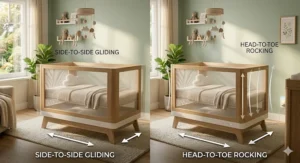
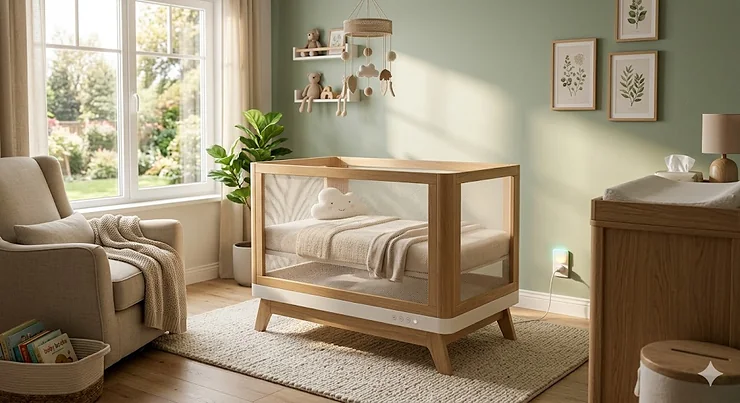
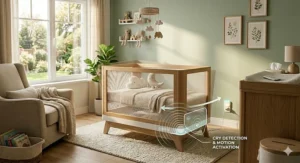
An automatic rocking crib is a bassinet or cradle equipped with motorized motion that mimics the gentle swaying babies experienced in the womb. Unlike traditional bassinets where you manually rock your baby back to sleep at 2 AM, these wireless nursery devices do the work for you. Many now include cry detection, adjustable rocking speed bassinet controls, bluetooth rocking crib connectivity, and even AI-powered features that adapt to your baby’s specific needs.
The science backs this up. Studies have shown that rhythmic motion helps babies transition between sleep cycles more smoothly, reducing those frustrating midnight wake-ups. When you combine automated infant care with modern safety standards, you get equipment that doesn’t just soothe babies—it gives exhausted parents their sanity back. Whether you’re considering a budget-friendly option or a premium remote control baby rocker, understanding what separates marketing hype from genuinely useful features will help you invest wisely in your family’s sleep quality.
Quick Comparison Table: Top 7 Automatic Rocking Cribs at a Glance
| Product | Price Range | Motion Types | Cry Detection | Best For |
|---|---|---|---|---|
| SNOO Smart Sleeper | $1,500-$1,700 | 5 levels responsive | Yes (automatic) | Premium investment, desperate parents |
| 4moms MamaRoo Sleep | $400-$500 | 5 unique motions | No | Tech-savvy families wanting customization |
| HALO BassiNest Connected 3.0 | $300-$400 | Gentle rocking + vibration | Yes (AutoSoothe) | Bedside access, C-section recovery |
| Graco Sense2Snooze | $250-$350 | 3-speed head-to-toe | Yes (basic) | Budget-conscious first-time parents |
| Maxi-Cosi Starling | $900-$1,000 | 5 natural motions | Yes (AI CryAssist) | Design-focused homes, eco-conscious buyers |
| Chicco LullaGlide Plus | $200-$250 | Electronic gliding | No | Portable travel needs, grandparents’ houses |
| VaVaSoo Electric | $120-$180 | 3-speed rocking | No | Tight budgets, testing before premium purchase |
Looking at this comparison, the pricing spectrum tells a story about priorities. The SNOO commands its premium because it’s addressing peak desperation—new parents who’ll pay almost anything for sleep. But the Graco Sense2Snooze at roughly one-fifth the price proves you don’t need to empty your savings account to access automated soothing. The middle tier occupied by 4moms and HALO represents the sweet spot where features meet affordability, while the VaVaSoo demonstrates that even budget models now include technology that was premium-only five years ago.
💬 Just one click — help others make better buying decisions too! 😊
Top 7 Automatic Rocking Cribs: Expert Analysis & Real-World Performance
1. SNOO Smart Sleeper Bassinet by Happiest Baby
The SNOO Smart Sleeper isn’t just expensive—it’s polarizing. At around $1,600, it represents a significant investment that parents either swear by religiously or dismiss as overpriced marketing. Here’s what the spec sheet won’t tell you: the SNOO’s five-level responsive system doesn’t just rock your baby; it actively listens and escalates soothing intensity based on crying patterns, something the cheaper alternatives simply can’t match.
The technical specifications include a built-in swaddle attachment system that clips directly to the bassinet walls—this isn’t just clever design, it’s the only FDA-authorized bassinet feature that prevents rolling, addressing the number one safe-sleep concern parents face. The white noise ranges from gentle shushing to more assertive sounds at higher intervention levels, and the motion graduates from barely perceptible rocking to more vigorous jiggling that mimics a car ride. What competitors often miss is the gradual escalation protocol: the SNOO doesn’t jump straight to maximum intervention, it tries gentler approaches first, teaching babies to self-soothe incrementally.
Parents who track their sleep gains report an average of 1-2 additional hours per night, but the real value shows up around week 3-4 when sleep deprivation peaks. Customer feedback consistently mentions the app connectivity as a game-changer—being able to activate or adjust settings from your bed without physically approaching the bassinet preserves those precious moments when baby is almost asleep. The included 9-month premium subscription (usually $20/month) tracks sleep patterns and provides insights that feel genuinely helpful rather than just data noise.
Pros:
✅ Only FDA-authorized safe-sleep swaddle system prevents rolling
✅ Responsive cry detection with five graduated intervention levels
✅ App control means zero disturbances during critical sleep transitions
Cons:
❌ Premium pricing puts it out of reach for many families
❌ Works only until 6 months or 25 pounds—short lifespan for the investment
This bassinet makes sense for parents facing extreme sleep deprivation, those with medical recovery needs (C-sections, difficult births), or families where both parents work demanding jobs and literally cannot function on fragmented sleep. The around $1,600 price tag translates to roughly $10 per night over six months—expensive, yes, but consider what you’d pay for night nursing help.
2. 4moms MamaRoo Sleep Bassinet
The 4moms MamaRoo Sleep Bassinet brings the company’s signature bounce-and-sway technology from their popular infant seats into a safe-sleep environment. Unlike most automatic rockers that move on a single plane, the MamaRoo offers five distinct motion patterns: car ride, kangaroo, tree swing, rock-a-bye, and wave. Each motion type operates at five different speeds, giving you 25 possible combinations to find what works for your specific baby.
Here’s the practical translation: the “car ride” motion bounces up and down subtly, mimicking highway driving vibrations that famously knock babies out. The “kangaroo” mode replicates the chest movement of a parent’s breathing, while “wave” creates that side-to-side ocean swell that some babies find irresistible. This variety matters because babies aren’t identical—what soothes one infant might irritate another. The MamaRoo’s real strength is letting you experiment without buying multiple products.
The Bluetooth connectivity works through the 4moms app, and customer reviews emphasize how useful this becomes during those 3 AM interventions when you’re too exhausted to remember which setting worked last time. The bassinet stores your preferences, so you can activate “Tuesday night’s successful combo” with two taps. Four built-in sounds include white noise and lullabies, though the speaker quality is merely adequate rather than exceptional. Weight limit tops out at 25 pounds, and the firm mattress with mesh sides meets all current safety standards.
Pros:
✅ Five genuinely different motion patterns offer versatility other models lack
✅ Bluetooth app control with memory settings saves parental brain power at 3 AM
✅ Two-height adjustment accommodates different bed frames for bedside positioning
Cons:
❌ No cry detection means you’re manually activating all interventions
❌ The $400-500 price range sits awkwardly between budget and premium tiers
This bassinet targets parents who value customization and are willing to actively manage their baby’s sleep environment. It’s particularly effective for parents who already know their baby responds well to motion but haven’t identified which specific motion works best. The in the mid-$400s range represents fair value for the feature set, though the absence of automated cry response means you’re still waking up to start the soothing manually.
3. HALO BassiNest Connected Swivel Sleeper 3.0
The HALO BassiNest Connected Swivel Sleeper 3.0 solves a problem that doesn’t get enough attention: bedside access after C-sections or difficult deliveries. The 360-degree swivel base means this bassinet rotates completely to position your baby directly over your bed, and the retractable wall lowers for arm’s-reach access without requiring you to sit up or get out of bed. If you’ve never experienced post-surgical abdominal pain, this might sound like a minor convenience. For recovering mothers, it’s the difference between agonizing movement and manageable nighttime feeding.
The AutoSoothe technology represents HALO’s entry into cry detection territory, using a microphone to trigger gentle rocking and vibration when fussing is detected. Unlike SNOO’s sophisticated graduated response, HALO’s system is simpler—it activates, runs its cycle, then stops. The rocking motion is noticeably gentler than competitors, creating barely perceptible movement that works better for light sleepers who startle easily at vigorous rocking. Three soothing sounds and three lullabies play through decent speakers, with a 30-minute timer that prevents all-night operation.
Customer feedback frequently mentions the storage pockets as unexpectedly valuable—having burp cloths, pacifiers, and diaper supplies right there eliminates those stumbling walks across dark rooms. The nightlight feature offers gentle illumination that doesn’t trigger full wakefulness, and the vibration setting works independently of rocking, giving you flexible soothing options. Base height adjustment works for most bed frames, though reviewers with very high platform beds occasionally report alignment challenges.
Pros:
✅ Swivel and drop-wall design provides bedside access unmatched by competitors
✅ Gentle rocking motion suits easily-startled babies who react poorly to vigorous movement
✅ Storage compartments and nightlight add practical convenience often missing in smart bassinets
Cons:
❌ AutoSoothe cry detection is basic compared to SNOO or Maxi-Cosi AI systems
❌ The $300-400 price premium over manual HALO models buys features some parents never use
This bassinet makes the most sense for parents recovering from C-sections, those with mobility limitations, or anyone prioritizing physical comfort during the newborn period. The around $350 asking price delivers genuine value if bedside access matters to your situation, though parents with uncomplicated deliveries and normal mobility might find manual alternatives sufficient.
4. Graco Sense2Snooze Bassinet with Cry Detection
The Graco Sense2Snooze Bassinet entered the smart bassinet market as the affordable alternative, proving that automated infant care doesn’t require luxury pricing. At around $300, it costs roughly one-fifth what the SNOO demands while delivering core functionality that actually works. The cry detection microphone triggers head-to-toe rocking motion that moves the entire bassinet surface rather than just rocking the frame—a subtle distinction that customers report creates more effective soothing.
Three motion speeds give you gentle, moderate, and vigorous rocking options, and the system can combine motion with vibration (two speeds available) for babies who need extra sensory input. The real surprise comes from the sound library: white noise plus 10 lullabies and 10 nature sounds represent more audio variety than bassinets costing twice as much. The control panel offers preset combinations so you can save your baby’s favorite settings—when you discover that “motion level 2 + rainforest sounds + low vibration” works at 11 PM, you can activate it instantly the next night.
However, customer reviews reveal the Sense2Snooze’s Achilles heel: reliability issues crop up more frequently than premium alternatives. Some users report the cry detection becoming oversensitive or failing to trigger after a few months, and the motor occasionally develops noises that defeat the purpose of soothing sleep. Graco’s customer service generally resolves these problems, but the hassle factor matters when you’re sleep-deprived. The reversible canopy blocks light effectively, mesh sides provide visibility and airflow, and the integrated storage keeps essentials accessible.
Pros:
✅ Budget-friendly pricing makes automated soothing accessible to more families
✅ Extensive sound library offers more audio variety than many premium models
✅ Customizable preset combinations let you save and quickly activate successful settings
Cons:
❌ Reliability concerns appear more frequently in reviews than premium alternatives
❌ Eight-hour automatic shutoff can’t be disabled—problematic for parents who want all-night operation
This bassinet targets first-time parents testing whether automated rocking justifies the investment, or budget-conscious families who need smart features without premium pricing. The in the $250-$350 range represents the best value proposition in the category if you’re willing to accept slightly higher reliability risk. Just register your product immediately and understand the warranty terms before your sleep-deprived brain forgets.
5. Maxi-Cosi Starling Smart Bassinet with CryAssist
The Maxi-Cosi Starling Smart Bassinet distinguishes itself through AI-powered cry translation technology that sounds like science fiction but actually delivers meaningful insight. The CryAssist system (powered by Zoundream AI) analyzes your baby’s crying patterns and categorizes them as hungry, gassy, sleepy, fussy, or agitated. This isn’t just clever marketing—the app notification telling you “baby sounds gassy” at 2 AM gives you actionable information rather than generic soothing.
Five distinct natural motions (Cradle, Sway, Flutter, Cascade, and Zephyr) each operate at three speeds, creating nuanced movement options that recognize not all babies respond identically to rocking. The “Flutter” motion creates small circular movements rather than linear rocking, while “Cascade” produces gentle up-and-down lifts. Combine this motion variety with the cry analysis, and you can match specific interventions to identified needs—rocking for sleepiness, different motion for gas discomfort. The EcoCare fabric (100% recycled from plastic bottles) appeals to environmentally conscious parents without sacrificing the soft, breathable texture babies need.
The Connected Family app provides detailed sleep tracking and lets you create “Scenes”—custom combinations of motion, sound, and duration that you name and save. Customer feedback particularly values the two-way talk feature that lets you speak to your baby through the built-in speaker, sometimes preventing full wake-ups with just your voice. The tapered ash wood legs and premium finishes make this bassinet look like intentional furniture rather than medical equipment. Note that CryAssist service includes 6 months free, then requires subscription—factor this into long-term cost.
Pros:
✅ AI cry translation provides actual insight into baby’s needs rather than generic soothing
✅ Five distinct motion patterns with nuanced differences suit particular situations
✅ Premium aesthetic design integrates into home decor rather than looking like baby equipment
Cons:
❌ The $900-$1,000 price point reaches SNOO territory without the swaddle safety feature
❌ CryAssist subscription cost after 6 months adds unexpected ongoing expense
This bassinet makes sense for design-conscious parents who value aesthetics alongside functionality, or tech-enthusiast families who want the latest AI integration. The around $950 price tag positions it as a premium option that competes with SNOO on features while offering superior appearance. Eco-conscious buyers appreciate the recycled materials, though that alone doesn’t justify the premium unless environmental values rank highly in your purchasing decisions.
6. Chicco LullaGlide Plus Electronic 3-in-1 Bassinet
The Chicco LullaGlide Plus takes a different approach than cry-detecting smart bassinets: simple, reliable electronic gliding motion you control rather than automation making decisions for you. The 3-in-1 versatility means it functions as a powered gliding bassinet, locks into stationary position, or detaches completely to become a portable sleeper you can carry room-to-room. This flexibility matters when you need to move baby from bedroom to living room for supervised naps without disrupting sleep.
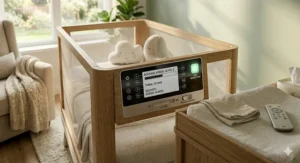
The electronic gliding motion operates via a simple switch—you turn it on, baby glides side-to-side, you turn it off. No smartphone app, no cry detection, no AI analysis. For some parents this simplicity is a feature, not a bug. The console also provides nature sounds and Bluetooth connectivity for streaming your own audio through the built-in speaker. The gliding motion is noticeably gentler than vigorous rocking—think of it as barely perceptible swaying rather than obvious back-and-forth movement. Some babies respond beautifully to this subtle approach while others need more aggressive intervention.
The portable mode transforms this from bedside bassinet to travel sleeper, folding relatively flat and fitting in the included carry bag. Customers particularly appreciate using this at grandparents’ houses or for weekend trips where you need reliable sleep equipment without shipping a full crib. The waterproof mattress with fitted sheet provides practical convenience, and the GREENGUARD Gold Certification confirms low chemical emissions. Weight limit stops at 20 pounds—lower than some competitors but appropriate for the bassinet’s size and intended use period.
Pros:
✅ True portability with detachable bassinet and carry bag suits travel and multi-room use
✅ Simplified operation requires no app or WiFi—just physical controls
✅ The $200-250 price range delivers electronic motion at budget-friendly cost
Cons:
❌ No cry detection means it’s purely manual activation when baby needs soothing
❌ Gliding motion is subtler than vigorous rocking—ineffective for babies needing stronger movement
This bassinet works best for parents who value simplicity over automation, families needing genuine portability for travel, or as a secondary sleeper at grandparents’ houses. The around $220 price makes it accessible while still delivering motorized soothing, though understand you’re trading automated features for straightforward functionality.
7. VaVaSoo Automatic Rocking Bassinet
The VaVaSoo Automatic Rocking Bassinet proves that budget pricing no longer means sacrificing all smart features. At around $150, this represents entry-level investment in automated infant care, making the category accessible to families who simply can’t stretch to $300+ bassinets. Three rocking speeds provide gentle, moderate, and vigorous motion options, and the inclusion of 5 melodies plus 3 white noise sounds exceeds what you’d expect at this price point.
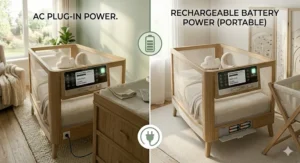
The dual power system (AC adapter plus battery operation using 4 C-size batteries) creates portability that premium bassinets often lack—you can rock your baby outdoors, at the park, or anywhere without electrical outlets. This flexibility matters more than it might initially seem; being able to move your sleeping baby to the backyard deck while you have coffee changes your daily reality during the newborn period. The mesh sides provide visibility and breathability meeting safety standards, and the 5-height adjustments accommodate different bed frames for bedside positioning.
Customer reviews split between “amazing value” and “you get what you pay for.” Build quality doesn’t match premium alternatives—the frame feels lighter, the fabrics are thinner, and the motor noise is noticeable rather than whisper-quiet. The 45-minute auto-shutoff protects the motor and battery life, though some parents want all-night operation. Assembly takes about 3 minutes without tools, and the beechwood frame provides decent aesthetics for the price. Expect this to work for the 0-6 month period, but don’t count on it lasting through multiple children the way SNOO or 4moms might.
Pros:
✅ Budget-friendly pricing makes automated rocking accessible to tight-budget families
✅ Battery operation creates genuine portability beyond typical bassinet limitations
✅ Fast tool-free assembly means grandparents or helpers can set up easily
Cons:
❌ Build quality and materials are noticeably lower than premium alternatives
❌ Motor noise is audible rather than silent—potentially counterproductive for light sleepers
This bassinet makes sense for families testing whether automated rocking justifies investment before committing to premium options, or as a budget solution when finances simply don’t allow higher spending. The around $150 price point won’t break your budget, but temper expectations about longevity and build quality. Consider it a functional starter that gets you through the newborn period rather than a long-term investment.
Real-World Application: Matching Bassinet to Your Family’s Situation
Choosing an automatic rocking crib buying guide isn’t about finding the “best” product—it’s about identifying which bassinet solves your specific problems. Let me walk through three common scenarios that illuminate how features translate to real life.
Scenario 1: The Sleep-Deprived Professional Parents Sarah and Michael both work demanding jobs and returned to work at 12 weeks postpartum. Their budget allowed premium options, but the real decision driver was functionality per hour of sleep gained. They chose the SNOO specifically for its responsive cry detection and graduated intervention system. The bassinet’s ability to soothe without parental intervention meant they could sleep through minor fussing that would previously have required full wake-up and manual rocking. The swaddle security feature addressed Sarah’s anxiety about safe sleep positioning, letting her sleep deeper knowing rolling wasn’t possible. Total sleep gain: approximately 90 minutes per night, which translated to functional cognition for work presentations. The $1,600 investment amortized to $9 per night over six months—they compared this to their $60/hour billing rates and decided immediately.
Scenario 2: The Budget-Conscious First-Time Parents Jessica and David expected their first child while managing student loans and entry-level salaries. Premium bassinets weren’t financially realistic, but they recognized that sleep deprivation would impact Jessica’s postpartum recovery and David’s ability to support while working full-time. They selected the Graco Sense2Snooze for its cry detection at accessible pricing. The preset combinations feature proved crucial—once they discovered that motion level 2 plus ocean sounds worked consistently, they could activate it instantly during night wakings. The reliability issues mentioned in reviews concerned them, but registering the warranty and understanding the 30-day return window provided security. Total sleep gain: approximately 45 minutes per night initially, extending to 75 minutes as their baby grew accustomed to the routine. The around $280 investment felt manageable and delivered measurable value.
Scenario 3: The Multi-Location Family Jennifer’s baby split time between her house, her ex-partner’s apartment, and grandparents who provided regular childcare. Consistency in sleep environment mattered, but she needed true portability rather than shipping full bassinets between locations. The Chicco LullaGlide Plus solved this with its detachable portable mode. The bassinet stayed at Jennifer’s house in electronic gliding mode, but the portable section traveled in the carry bag to other locations. The simplified controls meant grandparents could operate it without smartphone apps or technical confusion. The around $220 price allowed Jennifer to later purchase a second unit for her ex-partner’s place, creating consistent sleep environments without premium spending. The trade-off was manual activation rather than cry detection, but this worked fine with multiple caregivers actively monitoring the baby.
How to Choose the Right Automatic Rocking Crib: 7 Critical Factors
1. Cry Detection vs. Manual Activation: Understanding the Sleep Equation
Cry detection sounds universally desirable until you examine what it actually delivers. Automated response means the bassinet activates when your baby cries, potentially soothing them back to sleep without parental intervention. This matters most between 1-4 AM when you’re deepest in sleep debt—even 60 seconds of consciousness to manually start rocking disrupts sleep architecture and compounds exhaustion over weeks.
However, not all cry detection performs equally. SNOO’s sophisticated graduated system tries gentle approaches before escalating, teaching babies incremental self-soothing. Graco’s simpler detection triggers preset responses without adaptation. Consider your baby’s temperament: high-needs infants who wake frequently benefit enormously from automated response, while easy babies who rarely wake might not justify the premium. If you’re choosing between models, ask yourself honestly: will we use cry detection enough to justify the $200-400 price increase? For parents facing severe sleep deprivation or medical recovery needs, the answer is almost always yes.
2. Motion Types and Baby Temperament: Why One Size Doesn’t Fit All
Linear rocking moves baby back-and-forth like a traditional cradle. Bouncing creates up-down motion like car rides. Swaying goes side-to-side. Gliding produces barely perceptible horizontal movement. Circular motion combines multiple planes. These aren’t interchangeable—babies demonstrate strong preferences for specific motion types, and you often can’t predict which will work until you try.
The 4moms MamaRoo’s five motion patterns exist specifically because roughly 30% of babies don’t respond to traditional rocking. If your baby screams during car rides, that bouncing motion probably won’t soothe them. If they calm immediately when you walk around the house, swaying motion might be ideal. Bassinets offering multiple motion options provide flexibility when your first attempt fails, but they also cost more. Budget models with single motion types work perfectly—if your baby happens to like that specific motion. This unpredictability is why some parents rent SNOO first (yes, rental programs exist) to test before purchasing.
3. Safety Certifications: Beyond the Basics
Every bassinet sold in the US must meet Consumer Product Safety Commission (CPSC) standards codified in 16 CFR Part 1218, which incorporates ASTM F2194 specifications. This isn’t negotiable—products violating these standards face recall and legal action. But minimum compliance doesn’t tell the whole story. Look for specific safety features beyond baseline requirements.
Mesh sides prevent entrapment and ensure breathability if baby somehow repositions their face against the sidewall. Firm, flat, non-inclined sleep surfaces (≤10 degrees from horizontal) meet current American Academy of Pediatrics safe sleep guidelines. Stability testing confirms the bassinet won’t tip even when baby pushes against sides. The SNOO’s swaddle attachment system earned FDA De Novo authorization specifically because it prevents rolling—a safety feature beyond what standard bassinets provide. GREENGUARD Gold Certification (carried by Chicco and Maxi-Cosi models) confirms low chemical emissions for better air quality.
Read the CPSC bassinet guidance to understand what’s actually required versus what’s marketing language. When companies say “meets all safety standards,” that’s the baseline—look for features that exceed minimum requirements.
4. App Connectivity vs. Physical Controls: The Technology Trade-Off
Smartphone apps offer undeniable convenience: activating settings from your bed without approaching the bassinet, tracking sleep patterns over time, and saving custom combinations for one-tap activation. When they work properly, apps enhance usability significantly. When they malfunction, you’re troubleshooting Bluetooth connectivity at 3 AM while your baby screams.
Consider your relationship with technology honestly. If you’re comfortable troubleshooting app issues and value data tracking, connected bassinets deliver measurable advantages. The 4moms and SNOO apps provide sleep analytics that help identify patterns—useful if you’re the type who wants to optimize nap timing and feeding schedules. However, if you’ve ever thrown your phone across the room when an app crashed during critical tasks, physical controls might preserve your sanity better.
The Chicco LullaGlide’s simple switch operation guarantees functionality regardless of WiFi, smartphone updates, or app compatibility. Grandparents and caregivers operate it instantly without downloading apps or creating accounts. Middle-ground options like HALO BassiNest offer both app control and physical buttons, giving you backup when technology fails.
5. Budget Reality: Total Cost of Ownership Beyond Purchase Price
That $150 budget bassinet looks appealing until you factor in the hidden costs that emerge over six months. Replacement batteries for portable operation run $15-25 every few weeks. Subscription fees for premium app features (looking at you, Maxi-Cosi CryAssist after 6 months) add $10-20 monthly. Mattress protectors, extra fitted sheets, and replacement parts compound the initial investment.
Premium bassinets often include what budget models charge extra for: SNOO includes swaddles (S, M, L sizes) and fitted sheets; 4moms includes waterproof mattress and sheet; Maxi-Cosi includes 6 months of CryAssist service. Budget options require purchasing these separately. Calculate total cost by adding: purchase price + required accessories + subscription fees + estimated electricity or battery costs. That $150 VaVaSoo might actually cost $275 over six months when you factor in batteries, extra sheets, and waterproof covers. Meanwhile, the $450 4moms includes everything except extra sheets.
Also consider resale value. SNOO bassinets maintain 50-60% of purchase price on secondary markets because of strong brand reputation and long-term reliability. Budget models depreciate to nearly zero immediately because buyers question whether used electrical components still function safely.
6. Portability and Multi-Room Flexibility: Lifestyle Integration
Automatic rocking cribs range from genuinely portable (Chicco LullaGlide detaches and folds) to heavy stationary furniture (SNOO at 38 pounds isn’t moving without effort). Consider how your family actually lives. Do you need to move the bassinet between bedroom and living room daily? Will you travel with it to family visits? Does it need to fit through narrow doorways or up apartment stairs?
True portability requires: (1) detachable sleeping surface or lightweight frame, (2) compact fold for transport, (3) battery operation option, and (4) included carrying case. The Chicco and VaVaSoo models check all these boxes. Mid-weight options like the Graco and HALO move between rooms via wheels but aren’t travel-friendly. Premium stationary bassinets plant themselves bedside and stay there—fine if that’s your usage pattern, limiting if it’s not.
Battery operation deserves special attention. Parents living in homes with limited bedroom outlets appreciate AC/battery dual power. Those wanting to rock baby outdoors or at parks need battery capability. However, battery models require purchasing C-size or D-size batteries repeatedly—factor this cost and hassle into your decision.
7. Durability for Multiple Children: Investment vs. Single-Use
If this is your only planned child, durability matters less than if you’re hoping to use this bassinet for 2-3 future babies. Premium bassinets built with metal frames, quality motors, and replaceable parts potentially serve multiple children. Budget models with lighter construction might function adequately for one baby but deteriorate before the second.
Ask these questions: Does the manufacturer sell replacement parts (motors, mattresses, fabrics)? Do customer reviews mention multiple-baby usage? What’s the warranty length, and does it cover motor/mechanical failures? SNOO offers rental programs specifically because their bassinets endure hundreds of rental cycles—that’s confidence in durability. Budget brands rarely mention multi-child use because their business model assumes single-use disposability.
Calculate cost-per-baby if planning multiple children. A $1,600 SNOO used for three babies costs $533 per child. A $150 VaVaSoo purchased three times (because it won’t survive) costs $450 total. Premium options start looking financially sensible when viewed across multiple children, especially if you can resell afterward.
Common Mistakes When Buying Automatic Rocking Cribs: Avoid These Pitfalls
Mistake #1: Assuming All Rocking Motion Performs Identically
New parents often think “rocking is rocking” and choose based on price rather than motion characteristics. This misunderstanding leads to purchasing a bassinet with linear rocking when your baby only responds to bouncing, or gentle gliding when they need vigorous swaying. The motion type matters more than the automation itself—a manual bassinet with the right motion beats an automated one with the wrong motion.
Before purchasing, watch videos of the bassinet operating. Manufacturers increasingly provide motion demonstrations on their websites and Amazon listings. The difference between Chicco’s gentle gliding and Graco’s head-to-toe rocking is immediately visible and functionally significant. If possible, visit a store to see motion in person, or ask friends with different models to demonstrate. Some babies are motion-agnostic and sleep with any movement, but plenty demonstrate strong preferences that determine whether your bassinet succeeds or gathers dust.
Mistake #2: Ignoring the Swaddle Transition Problem
Most babies use automatic rocking cribs from birth to approximately 4-6 months. However, around month 3-4, many babies begin attempting to roll over, which signals it’s time to transition from swaddle to sleep sack or arms-out sleeping. Most bassinets don’t account for this transition, creating a scenario where you’ve taught your baby that motion = sleep, but now they need to learn sleeping without swaddling while still in the motion bassinet.
The SNOO specifically includes weaning mode and arms-out swaddle options to manage this transition gradually. Other bassinets don’t, meaning you’re potentially facing simultaneous transitions: from swaddle to sleep sack AND from motion bassinet to stationary crib. This compounds sleep regression risks during an already challenging developmental period. Ask how the bassinet handles swaddle transitions, or plan to start reducing motion dependence around month 3 even if baby seems content.
Mistake #3: Underestimating Assembly and Setup Complexity
Those product photos showing elegant bassinets don’t capture the 45-minute assembly process with unclear instructions and missing parts. Budget bassinets particularly suffer from poor documentation and components that don’t align properly. Premium options generally offer better assembly experiences, but “tool-free assembly” claims vary wildly in accuracy.
Read assembly reviews specifically. Search for phrases like “assembly nightmare” or “easy setup” in customer feedback. YouTube assembly videos reveal what manufacturers don’t advertise—if the bassinet requires three people to assemble or necessitates non-included tools, you’ll see it demonstrated. Account for setup time in your preparation schedule. Having a bassinet arrive two days before your due date and discovering assembly takes 90 minutes creates unnecessary stress.
Also verify space requirements before purchasing. Measure your bedroom floor space and compare against bassinet dimensions. That gorgeous HALO swivel feature requires clearance for rotation. Bassinets positioned too close to walls or furniture can’t swivel properly, negating the feature you paid for.
Mistake #4: Overlooking Noise Levels from Motors and Motion
Automated rocking requires motors, and motors produce noise. Manufacturers rarely specify decibel levels in marketing materials, but the acoustic environment matters enormously. A motor producing 45 decibels might soothe your baby while preventing your sleep in the same room. The VaVaSoo specifically mentions 40-50 decibel operation—that’s roughly equivalent to a quiet office or library. The SNOO’s motor is notably quieter, though expect some audible white noise from the speakers themselves.
Customer reviews provide the most honest noise assessments. Search for “motor noise,” “loud,” or “quiet” in feedback. Videos occasionally capture motor sound, though audio quality in recordings doesn’t perfectly represent real-world experience. If you’re particularly sensitive to ambient noise or if your bedroom setup places the bassinet very close to your head, motor noise deserves serious consideration.
Mistake #5: Failing to Verify Return Policies and Warranty Coverage
Babies are unpredictable. What works brilliantly for your friend’s baby might enrage yours. Purchase from retailers offering legitimate return windows—30 days minimum—and understand the return conditions. Some retailers charge restocking fees on baby equipment (typically 15-20%). Others require original packaging (which you threw away). Amazon’s return policies generally favor buyers, but third-party sellers through Amazon might not.
Register your product immediately after purchase to activate warranty coverage. Warranty terms vary dramatically: SNOO offers 1-year limited warranty; budget brands might offer 90 days or nothing. Specifically verify motor and electrical component coverage, as these failures occur more frequently than frame damage. Save your receipt and registration confirmation email somewhere you can find it at 3 AM when the motor stops working.
Automatic Rocking Cribs vs Traditional Bassinets: Making the Investment Decision
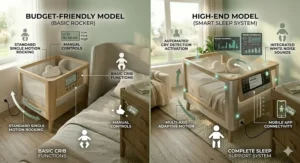
Traditional bassinets cost $50-150 and require manual rocking whenever baby fusses. Automatic versions start around $150 and reach past $1,600, adding motorized motion, cry detection, app connectivity, and smart features. Does the price premium justify the automation?
The sleep deprivation calculation matters most. Manual rocking means you wake up, approach the bassinet, rock until baby settles (2-15 minutes typically), return to bed, then attempt to fall back asleep. This disruption fragments sleep architecture, preventing deep REM cycles necessary for cognitive function and emotional regulation. Repeated 4-6 times nightly, this pattern creates cumulative sleep debt that impairs decision-making, coordination, and mental health.
Automated rocking with cry detection potentially eliminates some wake-ups entirely—the bassinet soothes baby before they fully wake, and you sleep through the intervention. Even when you wake, you’re not physically getting up, which preserves sleep quality significantly. Research on parental sleep deprivation shows that small interventions preventing full wakefulness compound into substantial wellbeing improvements over weeks.
However, traditional bassinets work perfectly fine for easy babies who rarely wake between feedings, or for parents with support systems providing night help. If your partner handles all night wakings while you sleep in another room, automation delivers minimal value to you. If your baby naturally sleeps 4-5 hour stretches from week one, you’re rocking them perhaps once per night—manageable without motorization.
Consider also that automatic features can create motion dependency. Babies learning that sleep requires rocking may struggle with crib transitions later. Traditional bassinets avoid this by teaching babies to sleep in stationary environments from the beginning. Some pediatric sleep consultants advocate for minimal motion intervention precisely to prevent these dependencies.
The honest assessment: Automatic rocking cribs deliver maximum value for parents facing severe sleep deprivation, those without help, and families with high-needs babies requiring frequent soothing. They deliver marginal value for parents with easy babies, strong support systems, or philosophical preferences for minimal intervention sleep training.
Long-Term Costs and Value Analysis: Beyond the Purchase Price
A comprehensive automatic rocking crib buying guide must address the full financial picture beyond initial purchase price. Let’s examine total cost of ownership across the six-month typical usage period.
SNOO Smart Sleeper ($1,600 purchase):
- Required accessories: $0 (includes swaddles and sheet)
- App subscription: $0 (9 months included)
- Electricity costs: ~$5/month × 6 = $30
- Resale value: ~$900 (56% retention)
- Net cost after resale: $730
4moms MamaRoo ($450 purchase):
- Required accessories: $40 (extra sheets, mattress protector)
- App subscription: $0 (free)
- Electricity costs: ~$4/month × 6 = $24
- Resale value: ~$180 (40% retention)
- Net cost after resale: $334
Graco Sense2Snooze ($280 purchase):
- Required accessories: $50 (sheets, waterproof protector, canopy replacement)
- App subscription: $0
- Electricity costs: ~$3/month × 6 = $18
- Resale value: ~$70 (25% retention)
- Net cost after resale: $278
VaVaSoo Budget Model ($150 purchase):
- Required accessories: $45 (sheets, protector, batteries)
- Battery costs: $25/month × 6 = $150 (if using battery mode frequently)
- Electricity costs: ~$2/month × 6 = $12
- Resale value: ~$0 (minimal secondary market)
- Net cost: $357 (with battery use) or $207 (electric only)
This analysis reveals that premium bassinets aren’t necessarily more expensive when you factor in resale value. The SNOO’s strong secondary market means your actual cost is $730 despite the $1,600 initial investment—less than double the budget option after resale. The 4moms represents the efficiency sweet spot: moderate purchase price, decent resale value, net cost under $350.
Budget options seem economical initially but hidden costs accumulate. Battery operation—advertised as portability convenience—costs $25 monthly if you actually use it regularly. Cheap included sheets require replacement faster. Lower resale value means you absorb the full depreciation.
Frequently Asked Questions About Automatic Rocking Cribs
❓ How long can my baby safely use an automatic rocking crib?
❓ Do automatic rocking cribs create sleep dependencies that make crib transition difficult?
❓ Are bluetooth rocking crib features safe regarding radiation exposure?
❓ Can automatic rocking cribs help with colic or reflux babies?
❓ What happens if the smart bassinet loses power during the night?
Conclusion: Choosing Your Automatic Rocking Crib with Confidence
Navigating the automatic rocking crib buying guide landscape in 2026 means understanding that there’s no universally “best” option—only the best option for your specific family circumstances, budget, and baby’s temperament. The $1,600 SNOO delivers maximum automation and safety features that justify premium pricing for families facing severe sleep deprivation or medical recovery needs. The $150 VaVaSoo provides accessible entry into automated soothing for budget-conscious parents willing to accept shorter lifespan and simpler features.
Between these extremes, the smart parenting tools from Graco, 4moms, HALO, Maxi-Cosi, and Chicco each solve specific problems rather than attempting universal appeal. The Graco Sense2Snooze offers cry detection affordably. The 4moms MamaRoo provides motion variety for babies with specific preferences. The HALO BassiNest prioritizes bedside access for recovering mothers. The Maxi-Cosi Starling appeals to design-conscious, eco-aware families. The Chicco LullaGlide delivers portability and simplicity.
Your decision should start with honest assessment of three questions: What’s our realistic budget including hidden costs and resale value? How severe is our sleep deprivation situation—mild inconvenience or health-affecting crisis? Does our baby demonstrate specific motion preferences we’ve already identified? Answer these questions before comparing features, and the right bassinet typically reveals itself.
Remember that automated infant care technology exists to support your family, not to solve all newborn challenges. Even the most sophisticated remote control baby rocker won’t fix colic, eliminate night feedings, or prevent normal newborn sleep patterns. These wireless nursery devices amplify good sleep habits and reduce parental exhaustion—meaningful improvements, but not magic solutions. Set realistic expectations, research thoroughly, and choose the adjustable rocking speed bassinet that fits your life rather than chasing idealized marketing promises.
Recommended for You
- 7 Best AI Powered Rocking Cribs That Actually Work in 2026
- 7 Best Smart Rocking Bassinet That Actually Work – 2026
- Baby Bathtub vs Sink: 7 Best Options – 2026
Disclaimer: This article contains affiliate links. As an Amazon Associate, I earn from qualifying purchases. If you purchase products through these links, we may earn a small commission at no additional cost to you.
✨ Found this helpful? Share it with your friends! 💬🤗
