
In This Article
Remember when baby walkers were just wheeled seats? Those days are gone. Today’s best smart baby walkers are essentially tiny learning laboratories packed with sensors, lights, music, and educational content that would make NASA jealous. I’ve spent weeks researching and comparing models currently available on Amazon, and what I found genuinely surprised me.
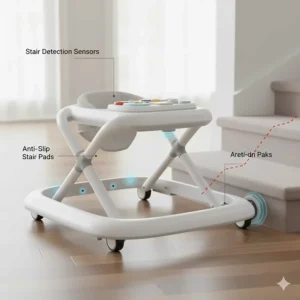
The modern interactive baby walker reviews reveal something fascinating: these aren’t just mobility aids anymore. They’re developmental tools that combine movement with cognitive stimulation, offering everything from language learning in multiple tongues to cause-and-effect lessons through touch-responsive panels. The electronic baby walker with lights and sounds category has exploded with innovation, featuring Bluetooth connectivity, volume controls that save parental sanity, and even adjustable learning modes that grow with your child.
But here’s the reality check—not every high tech baby walker delivers on its promises. Some educational baby walker models are overpriced light shows with minimal developmental benefit, while others pack genuine learning value into every inch. The best musical activity walker options create multi-sensory experiences that keep babies engaged without overwhelming them, and top-tier sensory stimulation walker designs actually align with what pediatric development experts recommend.
After diving deep into specifications, safety certifications, customer feedback, and price points, I’ve identified seven walkers that truly earn the “smart” label. These aren’t just products—they’re carefully engineered companions for your baby’s crucial first steps into independence.
Quick Comparison Table: Smart Baby Walkers at a Glance
| Walker Model | Key Smart Features | Price Range | Age Range | Rating |
|---|---|---|---|---|
| VTech Sit-to-Stand | 75+ songs, detachable panel, piano keys | $30-$40 | 6-36 months | ⭐⭐⭐⭐⭐ 4.7/5 |
| BABY JOY 4-in-1 | Racing car theme, 3 heights, 2-speed wheels | $60-$80 | 6-18 months | ⭐⭐⭐⭐ 4.5/5 |
| Fisher-Price Panda | Smart Stages, 100+ sounds, dual-sided | $60-$75 | 6-36 months | ⭐⭐⭐⭐⭐ 4.8/5 |
| Fisher-Price Puppy | Adaptive learning, Spanish words | $45-$60 | 6+ months | ⭐⭐⭐⭐⭐ 4.7/5 |
| Bright Starts Disney | Mickey/Minnie themes, removable station | $50-$70 | 6-12 months | ⭐⭐⭐⭐ 4.6/5 |
| Delta Children 4-in-1 | Rocker, bouncer, walker modes | $70-$90 | 6-25 lbs | ⭐⭐⭐⭐ 4.4/5 |
| Baby Einstein Opus | 4 languages, octopus design, 3 modes | $80-$100 | 6-24 months | ⭐⭐⭐⭐ 4.5/5 |
💬 Just one click – help others make better buying decisions too!😊
Top 7 Best Smart Baby Walkers: Expert Analysis
1. VTech Sit-to-Stand Learning Walker – Best Budget Smart Walker
This thing is practically a PhD program disguised as a baby toy. For under $40, you get more educational content than some preschools offer.
Key Smart Features:
- 75+ songs, sounds, and phrases
- Detachable activity panel (doubles as floor toy)
- Five piano keys with musical notes
- Light-up shape sorters and spinning gears
- Adjustable speed control
The genius here isn’t just quantity—it’s versatility. When my friend’s nine-month-old wasn’t ready to walk yet, she removed the panel and let him explore shapes and sounds while sitting. Three months later, same walker, different function: full mobility mode with the phone handset keeping him entertained as he cruised.
Customer Insight: Parents consistently praise the durability (survives multiple kids) and the fact that batteries actually last. One reviewer noted their toddler used it for 18 months straight without losing interest.
✅ Pros:
- Exceptional value under $40
- Genuinely educational content
- Grows with baby (floor play to walker)
❌ Cons:
- Can be loud (but volume adjustable)
- Basic design compared to themed models
Price: $29.99-$39.99 | Perfect For: Budget-conscious parents wanting maximum educational value
2. BABY JOY 4-in-1 Baby Walker – Best Racing Car Design
This walker doesn’t mess around with its racing car aesthetic—it commits fully, and babies absolutely love it.
4 Versatile Modes:
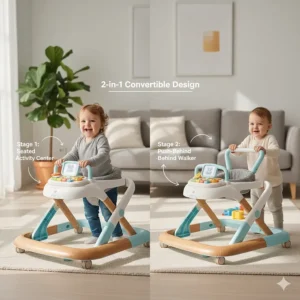
- Seated walker mode
- Push-behind walker
- Push car mode
- Rolling toy car
Smart Tech Highlights:
- Interactive steering wheel with horn
- Gear shifter that clicks and lights up
- Rearview mirror toys
- Music and light synchronization
- 3 adjustable heights (14.5″, 15.5″, 16.5″)
- 2-speed rear wheel control
What sets BABY JOY apart is the speed adjustment feature for rear wheels. Beginners get slower speeds for safety, while confident walkers can increase pace as skills develop. The anti-rollover design includes five non-slip stair pads—a critical safety feature that actually works.
Real Parent Feedback: Multiple reviews mention babies treating this like their first “car,” spending 30+ minutes just playing with the steering wheel and shifter before even attempting to walk.
✅ Pros:
- Realistic car features boost imaginative play
- Folds flat for storage
- Tool-free assembly
❌ Cons:
- Storage compartment is small
- Music requires 2 AA batteries (not included)
Price: $60-$80 | Perfect For: Families wanting a walker that transitions through multiple developmental stages
3. Fisher-Price 2-Sided Steady Speed Panda Walker – Best Dual-Functionality Walker
Here’s something clever: a walker you can push from either side, with different activities on each face. It’s like getting two walkers for the price of one.
Innovative Smart Features:
- 100+ songs, sounds, and phrases across 3 Smart Stages levels
- Friendly panda steering wheel with light-up nose
- ABC/123 buttons
- Three shape blocks with sorting slots
- Steady Speed wheels (slower pace for beginners)
- 10+ bilateral activities
The Smart Stages technology is where this walker truly shines. Level 1 introduces colors and animals through simple songs. Level 2 encourages exploration with questions and prompts. Level 3 (for older toddlers) adds imaginative play scenarios. The content literally grows in complexity as your child develops.
Customer Love: Parents appreciate that shy or cautious babies can ease into walking without the walker running away from them (thanks to Steady Speed wheels). One mom noted her daughter used it for 14 months—from 8 months through nearly age 2.
✅ Pros:
- Walk from either side
- Educational content scales with development
- Sturdy construction
- Amazon-exclusive, recyclable packaging
❌ Cons:
- Heavier than basic models
- Premium price point
Price: $60-$75 | Perfect For: Parents seeking long-term educational value and bilateral coordination development
4. Fisher-Price Laugh & Learn Smart Stages Puppy Walker – Most Engaging Character Design
Characters matter to babies, and this puppy walker proves it. The dog theme isn’t just decoration—it’s integrated into every learning element.
Interactive Learning System:
- 75+ songs, sounds, and phrases
- Barnyard animal friends for company
- Easy-remove activity panel
- Spanish language introduction
- Shapes, colors, numbers curriculum
- Telephone handset for role-play
The panel removal feature turns this into three toys: floor activity center, push walker, and standing play station. Each mode offers different benefits. Floor play builds fine motor skills through button pressing and gear spinning. Walker mode obviously supports gross motor development. Standing play strengthens leg muscles while maintaining engagement.
What Parents Say: The telephone handset is surprisingly popular—babies love mimicking phone conversations. Multiple reviews mention this walker working on tile, hardwood, and even carpet without tipping.
✅ Pros:
- Engaging character design
- Multi-language exposure
- Versatile activity panel
- Smooth-rolling wheels
❌ Cons:
- Puppy theme might not appeal to everyone
- Lots of nooks that collect debris
Price: $45-$60 | Perfect For: Families wanting character-driven engagement and bilingual learning opportunities
5. Bright Starts Disney Baby Mickey/Minnie Mouse 2-in-1 Walker – Best Licensed Character Walker
Disney magic meets developmental science. If your baby already loves Mickey or Minnie, this walker capitalizes on that connection beautifully.
Disney-Enhanced Features:
- Light-up steering wheel
- Spinning bead toys
- Baby-safe discovery mirror
- Removable electronic toy station
- Disney-themed melodies and sounds
- 3 height adjustments
- Link loops for additional toys
The toy station detaches completely, transforming into a portable entertainment center. Take it to restaurants, car trips, or use it as floor play when baby isn’t ready for walker mode yet. The Bright Starts engineering focuses on easy-fold design—genuinely folds flat in seconds without struggling.
Customer Insights: Parents love that the seat pad is machine washable (inevitable spills). The walker includes volume control, which saves sanity during marathon play sessions.
✅ Pros:
- Genuine Disney licensing
- Removable toy station
- Machine-washable seat
- Compact fold for travel
❌ Cons:
- Music selection is limited
- Character designs might date quickly
Price: $50-$70 | Perfect For: Disney-loving families and those prioritizing portability
6. Delta Children Lil Play Station 4-in-1 Activity Walker – Best Multi-Mode System
This isn’t just a walker—it’s a complete activity ecosystem that transforms as your baby grows.
4 Distinct Modes:
- Rocker mode (gentle back-and-forth)
- Stationary activity center
- Bouncer mode
- Walker mode
Tech Integration:
- Music and lights activation buttons
- Flower mirror for visual development
- Crinkle petals for tactile stimulation
- Spinning ball and bead bar
- 360-degree rotating seat
- 3-position height adjustment
The rocker mode is brilliant for younger babies (4-6 months) who aren’t ready for mobility yet. It keeps them entertained while building core strength. As coordination improves, switch to bouncer mode for leg strengthening. Finally, graduate to walker mode when they’re pulling up and cruising.
Real-World Performance: JPMA certified for safety. Parents report this walker lasting through multiple children because the mode versatility extends usable lifespan dramatically. Weight capacity: 25 lbs, max height: 30 inches.
✅ Pros:
- Exceptional mode versatility
- JPMA safety certified
- Grows through multiple developmental stages
- Removable, washable seat pad
❌ Cons:
- Takes up more floor space than basic walkers
- Mode transitions require parent setup
Price: $70-$90 | Perfect For: Families wanting one product that covers 4-6+ months of development
7. Baby Einstein Step & Twirl Opus 4-in-1 Activity Walker – Most Advanced Multi-Language Walker
This octopus-themed walker is perhaps the most intellectually ambitious option available, teaching four languages while supporting physical development.
Advanced Learning Features:
- 4 languages (English, Spanish, French, German)
- 3 educational modes (Walking, Learning, Dancing)
- Octopus character (Opus) that spins and lights up
- 8 interactive arm activities
- Ocean Explorers series melodies
- Twist, press, roll, spin, slide, flip actions
- Detachable floor toy
The multilingual approach starts early language exposure naturally. Walking mode rewards movement with lights and music. Learning mode teaches colors, shapes, numbers in four languages. Dancing mode plays ocean sounds and songs. Each of Opus’s eight arms offers different tactile exploration—genuine sensory richness.
Parent Reviews: The 4-way functionality (sit-in walker, push-behind walker, floor toy, musical toy) gets high marks. Parents appreciate that the walker folds flat and has 3 height adjustments. The machine-washable seat pad survives inevitable mess.
✅ Pros:
- Four-language learning system
- Rich multisensory engagement
- Unique octopus design
- Multiple use modes
❌ Cons:
- Premium pricing ($80-$100)
- Requires 3 AAA batteries
- Complex for very young babies
Price: $80-$100 | Perfect For: Education-focused families and those prioritizing early language exposure
✨ Don’t Miss These Exclusive Deals!
🔍 Take your baby’s development to the next level with these carefully selected products. Click on any highlighted item to check current pricing and availability. These tools will help you create authentic developmental progress your family will love!
Understanding Smart Baby Walker Technology
The term “smart” gets thrown around carelessly in baby products, but genuine innovation separates gimmicks from game-changers. Real smart walker technology integrates developmental science with interactive features that respond to your baby’s actions, creating feedback loops that encourage exploration and learning.
What Makes a Walker “Smart”?
Responsive Technology: The best electronic baby walker with lights and sounds doesn’t just play random music—it responds to specific actions. When baby presses a button, turns a wheel, or takes a step, the walker acknowledges that action with immediate feedback. This teaches cause-and-effect thinking, a foundational cognitive skill.
Adaptive Content: High quality educational baby walker models adjust complexity based on mode or setting. Fisher-Price’s Smart Stages technology exemplifies this: Level 1 provides simple identification (“That’s a dog!”), Level 2 adds questions (“Can you find the red shape?”), and Level 3 introduces imaginative scenarios (“Let’s drive to the park!”). Content sophistication increases as children master earlier concepts.
Multi-Sensory Integration: Top-tier sensory stimulation walker designs combine visual (lights, colors, shapes), auditory (music, sounds, words), and tactile (textures, buttons, gears) elements simultaneously. Research from the National Institutes of Health demonstrates that multi-sensory learning strengthens neural pathways more effectively than single-sense experiences.
Technology Features Worth Paying For
Volume Control – Non-negotiable for sanity. The best musical activity walker options offer at least three volume levels, including off.
Language Options – Multilingual exposure during critical language acquisition windows (birth to 3 years) enhances phonetic discrimination. Even if you only speak English at home, hearing Spanish, French, or German introduces your baby to diverse sound patterns.
Detachable Panels – Transforms one product into multiple toys, extending usability and value. Floor play engages different muscle groups than walker mode.
Adjustable Speed Wheels – Safety feature that slows walker movement for beginners, preventing runaway scares that discourage walking attempts.
Light-Up Feedback – Visual confirmation of actions helps babies understand they caused an effect. Particularly valuable for cause-and-effect learning.
Features That Are Mostly Marketing Hype
Bluetooth Connectivity – Unless you’re frequently updating educational content (rare in walker category), Bluetooth adds complexity without meaningful benefit.
Excessive Button Count – Twenty buttons aren’t better than eight if baby can’t process that many options. Cognitive overload reduces learning effectiveness.
“HD” Speakers – Babies don’t need concert-quality audio. Decent speaker clarity matters, but audiophile-grade components are overkill.
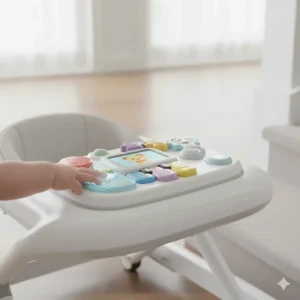
Safety First: Smart Walker Precautions
Let’s address the elephant in the room: traditional wheeled baby walkers have serious safety concerns, and the American Academy of Pediatrics has called for their ban since 2001. Between 1990 and 2014, over 230,000 children under 15 months were treated in emergency rooms for walker-related injuries, according to a Pediatrics journal study.
Understanding the Risks
The primary danger? Stairs. Approximately 74% of walker injuries result from babies rolling down stairs while in wheeled walkers. Additional risks include reaching hot objects, accessing poisonous substances, and falling into pools—all because walkers increase mobility before babies have the judgment to assess danger.
Modern Safety Standards
The Consumer Product Safety Commission implemented mandatory federal safety standards in 2010, requiring:
- Walkers wider than standard doorways (preventing stair access)
- Grip-strip brakes that stop walkers at step edges
- Stability testing to prevent tip-overs
- Parking brake systems
Every walker in this article meets or exceeds these standards, with JPMA (Juvenile Products Manufacturers Association) certification where applicable.
Safe Walker Usage Guidelines
Even with modern safety features, parents must maintain vigilance:
Always Block Stairs – Use gates or closed doors. Don’t trust walker brakes as the only protection.
Clear the Floor – Remove cords, toys, and obstacles that could cause tripping or tipping.
Supervise Constantly – Babies in walkers move up to 3 feet per second. Adult supervision isn’t optional.
Limit Walker Time – The AAP recommends against prolonged walker use. Sessions of 15-20 minutes allow exploration without delaying natural walking development.
Choose Stationary Alternatives When Possible – Activity centers without wheels offer similar engagement with significantly reduced injury risk.
The Developmental Delay Controversy
Research published in BMJ and cited by Harvard Health indicates traditional walkers may actually delay independent walking by removing the need to develop balance and weight-shifting skills naturally. Babies in walkers push forward with their toes rather than placing feet flat, reinforcing improper walking mechanics.
Modern push-behind walkers (like the VTech and Fisher-Price models reviewed here) mitigate this concern by requiring babies to maintain balance while providing support, more closely mimicking natural walking development.
Important Note: Canada banned baby walkers entirely in 2004. While they remain legal in the United States, informed parents should carefully weigh risks against benefits and consider stationary activity centers as safer alternatives for early development.
Features to Prioritize in Smart Baby Walkers
Shopping for baby products often feels like decoding alien technology specifications. Here’s what actually matters when evaluating smart walkers.
Educational Content Quality
Don’t just count songs—evaluate content. The best educational baby walker models teach foundational concepts through repetition and variation. Look for walkers that:
- Introduce ABCs, numbers, shapes, and colors systematically
- Teach cause-and-effect through interactive responses
- Include multiple language options
- Scale complexity across developmental stages
Cheap walkers blast generic music. Quality walkers integrate learning into play naturally, without feeling like lessons.
Adjustability and Growth Potential
Babies grow fast—approximately half an inch per month in the first year. Three-position height adjustment is minimum; more positions mean better fit throughout usable lifespan. Check whether:
- Seat adjusts without tools
- Height range accommodates your baby’s current and projected size
- Walker converts into different modes (floor toy, push walker, activity table)
A walker that works from 6 to 24 months delivers far better value than one outgrown in three months.
Build Quality and Durability
Smart features are useless if the walker breaks after two weeks. Examine:
Frame Material: Steel frames outlast plastic. Look for powder-coated metal construction with reinforced joints.
Wheel Quality: Large, rubberized wheels handle carpet and hardwood better than small plastic versions. Ball-bearing wheels roll smoother with less effort.
Electronic Durability: Check customer reviews for battery compartment failures, button malfunctions, and speaker breakage. Quality brands use sealed electronic components resistant to drool and spills.
Fabric Resilience: Seat pads should be removable and machine-washable. Babies are messy—non-removable seats become disgusting.
Sensory Design Balance
The best sensory stimulation walker designs engage without overwhelming. Too much stimulation causes stress; too little causes boredom. Optimal walkers offer:
- 3-5 visual focus points (not 20)
- Clear, distinct sounds (not cacophonous noise)
- Varied textures (smooth, bumpy, soft, hard)
- Interactive elements that require different actions (press, turn, slide, flip)
Watch for walkers allowing babies to control stimulus intensity—detachable music panels, volume controls, and pause options let children self-regulate sensory input.
Safety Certifications That Matter
JPMA Certification: Products verified by the Juvenile Products Manufacturers Association undergo third-party testing for safety compliance. This certification is voluntary but indicates manufacturers take safety seriously.
ASTM Standards Compliance: The American Society for Testing and Materials sets safety benchmarks for baby products. ASTM F977 specifically addresses walker safety requirements.
CPSC Compliance: Consumer Product Safety Commission mandates are federal law. All U.S.-sold walkers must comply, but checking for explicit statements ensures accountability.
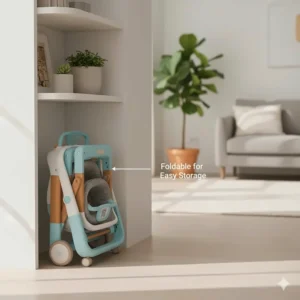
Smart Walkers vs. Activity Centers: Which to Choose?
This question plagues new parents, especially those reading AAP warnings about wheeled walkers. Let’s break down the real differences.
Activity Centers (Stationary)
What They Are: Seats surrounded by toys, secured to a base without wheels. Baby sits in center, rotates 360 degrees, but cannot move across the room.
Advantages:
- Eliminated stair-fall risk
- Can’t reach dangerous items
- Allows safe unsupervised play (brief periods)
- No developmental delay concerns
- Generally less expensive
Limitations:
- No walking practice
- Limited mobility exploration
- Baby may get bored faster
- Doesn’t encourage leg strengthening through movement
Push-Behind Walkers
What They Are: Wheeled toys babies push while walking behind them (think shopping cart for babies). No seat—baby must already walk independently.
Advantages:
- Supports natural walking development
- Provides confidence for early walkers
- No fall-down-stairs risk (baby controls movement)
- Doubles as toy storage or imaginative play prop
- AAP-approved alternative to seated walkers
Limitations:
- Requires baby to already stand/walk somewhat
- Tips backward if baby pulls up on handle
- Can roll away from wobbly walkers
- Usually less educational content than seated walkers
Seated Smart Walkers (What We’re Reviewing)
What They Are: Seats with wheels, allowing pre-walking babies to move around by pushing with feet.
Advantages:
- Early mobility exploration
- Interactive learning while mobile
- Builds leg strength through scooting
- Entertains independently for longer periods
- Multiple modes extend usability
Limitations:
- Stair-fall risk (even with modern safety features)
- Requires constant supervision
- May delay natural walking if overused
- Cannot reach higher surfaces (safety plus and minus)
Making Your Decision
Choose Activity Centers if:
- Your home has multiple levels or open stairs
- You want hands-free supervision options
- You’re concerned about walker safety despite modern standards
- Baby seems content with stationary play
Choose Push-Behind Walkers if:
- Baby already pulls to stand confidently
- You want to support walking rather than pre-walking mobility
- AAP recommendations strongly influence your decisions
- You have smooth floors (hardwood, tile, laminate)
Choose Seated Smart Walkers if:
- You have single-level living or excellent stair blocking
- You commit to constant supervision during use
- Baby is intensely curious about movement before walking
- Educational features align with your parenting priorities
- You’ll limit usage to prevent developmental delays
Many families use different tools for different situations—activity center when making dinner, push walker after baby masters standing, seated walker for special circumstances. No single choice is “right”—context, safety measures, and your specific situation determine the best option.
Maximizing Your Smart Walker Investment
You’ve invested in a smart walker—now get every penny’s worth through strategic usage.
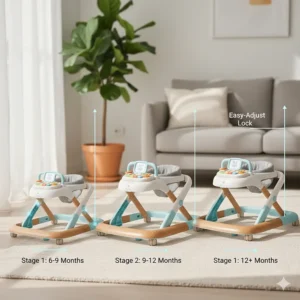
Age-Appropriate Introduction
4-6 Months (If applicable): Use detached activity panels for floor play. Baby isn’t ready for mobility, but can explore buttons, textures, and sounds while developing fine motor skills.
6-9 Months: Introduce seated walker mode once baby sits independently. Start with 10-minute sessions on slow wheel settings. Focus on exploration rather than distance traveled.
9-12 Months: Increase session length to 15-20 minutes as baby gains confidence. Allow more floor types (carpet, tile, hardwood) for varied sensory experiences.
12+ Months: Transition to push-behind mode if walker offers it. Baby may self-select walker time or lose interest as independent walking develops.
Creating Educational Routines
The best interactive baby walker reviews emphasize parental engagement—walkers are tools, not teachers. Try these approaches:
Morning Learning Mode: Start the day with alphabet or number mode. Point to letters as the walker sounds them out. Repeat after the walker together.
Afternoon Music Time: Switch to musical modes during post-nap energy surges. Dance together, clap to rhythms, introduce instrument names.
Evening Wind-Down: Use lower volume settings and slower-paced songs as bedtime approaches. Walker time becomes part of calming routine.
Language Days: Dedicate specific days to different languages if your walker is multilingual. Monday is Spanish day, Wednesday is French, etc.
Maintenance and Longevity
Smart walkers last longer with proper care:
Weekly Tasks:
- Wipe down surfaces with baby-safe cleaner
- Check wheel functionality and remove hair/debris
- Test all buttons and lights for responsiveness
- Inspect frame for cracks or loosening screws
Monthly Tasks:
- Remove and wash seat pad according to manufacturer instructions
- Replace batteries if sounds become distorted
- Tighten all hardware
- Test height adjustment mechanism
Storage Practices:
- Fold walker when not in use (if foldable)
- Store in climate-controlled area (not garage/basement)
- Keep battery compartment free from corrosion
- Avoid stacking heavy items on folded walker
Extending Play Value
Babies get bored when interaction becomes predictable. Refresh engagement by:
Rotating Attached Toys: If walker has link loops, swap hanging toys monthly. New visual stimuli reignite curiosity.
Changing Locations: Move walker between rooms. New backgrounds create different play experiences even with same toy.
Mode Switching: Don’t default to one setting. Rotate between educational modes daily to prevent habituation.
Adding Challenges: As baby masters walker basics, create gentle obstacles (soft pillows to navigate around) that require problem-solving.
Parent Commentary: Narrate baby’s actions. “You pressed the yellow button! It made a sound!” Language exposure multiplies learning.
Common Smart Walker Mistakes to Avoid
Even well-intentioned parents make these errors. Learn from others’ experiences:
Mistake #1: Using Walkers as Babysitters
Smart walkers engage babies effectively, tempting parents to extend “just a few more minutes” into hour-long sessions. Problems:
- Overuse delays natural walking development
- Babies miss floor time critical for crawling strength
- Risk increases with each unsupervised minute
- Missed parent-child bonding opportunities
Solution: Set a timer for 15-20 minutes maximum. When it beeps, walker time ends regardless of baby’s contentment.
Mistake #2: Ignoring Height Adjustments
Your baby grows half an inch monthly. An improperly fitted walker forces uncomfortable posture and reduces toy accessibility.
Solution: Adjust height when baby’s feet transition from flat-on-floor to tiptoe position. Feet should be flat with knees slightly bent.
Mistake #3: Assuming “Smart” Means “Safe”
Technology doesn’t eliminate physics. Smart walkers still move fast, reach high, and access danger.
Solution: Block all stairs with gates rated for pressure-mounted or hardware-mounted installation. Remove hazards from walker-accessible areas before each session.
Mistake #4: Neglecting Battery Maintenance
Low batteries cause flickering lights, distorted sounds, and sporadic function—frustrating for babies and parents alike.
Solution: Keep spare batteries on hand. Replace all batteries simultaneously rather than mixing old and new. Use quality alkaline batteries, not dollar-store bargains.
Mistake #5: Comparing Development Timelines
Your friend’s baby walked at 9 months while using a walker. Yours is 11 months and still crawling. Walkers don’t control developmental timelines—genetics and individual variation do.
Solution: Focus on your baby’s progress relative to their own milestones, not other children’s. Walkers supplement development; they don’t drive it.
Mistake #6: Skipping Manual Reading
Those instruction books seem obvious until you discover your walker has hidden features you’ve never activated.
Solution: Spend 10 minutes reading the manual. You might find adjustable learning levels, sound variety options, or safety tips specific to your model.
Mistake #7: Buying Based on Cuteness Alone
That dinosaur walker is adorable, but does it offer educational content? Adjustable heights? Safety certifications?
Solution: Prioritize function over aesthetics. A well-designed educational walker delivers value long after cute novelty wears off.
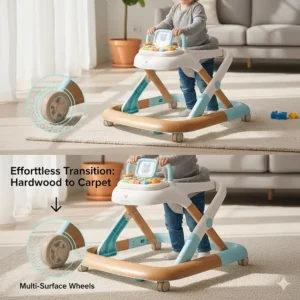
Budget Breakdown: What to Expect at Each Price Point
Smart walker pricing spans $30 to $100+. Here’s what each tier typically offers:
Budget Tier ($25-$45)
Representative Example: VTech Sit-to-Stand Learning Walker
What You Get:
- Basic educational content (alphabet, numbers, shapes)
- 20-70 songs/sounds
- Simple lights
- Single height adjustment or none
- Plastic construction throughout
- Limited or no mode versatility
What You Don’t Get:
- Character licensing
- Multiple languages
- Premium materials
- Advanced adaptive learning
- Extensive adjustability
Best For: Budget-conscious families, second/third children, families testing whether baby likes walkers before investing heavily.
Mid-Range ($45-$75)
Representative Examples: Fisher-Price Puppy Walker, BABY JOY 4-in-1, Bright Starts Disney
What You Get:
- 75-100+ songs/sounds/phrases
- Character themes or licensed designs
- Multiple height adjustments (2-3 positions)
- Some mode versatility (detachable panels, 2-3 modes)
- Mix of materials (metal frame, plastic components)
- Better build quality than budget tier
What You Don’t Get:
- Extensive language options (maybe one additional language)
- Premium safety certifications beyond basic CPSC
- True 4+ mode versatility
- Highest-end educational curriculum
Best For: Most families seeking balance between features and affordability, those wanting recognizable brand names, parents prioritizing specific features (Disney characters, car themes, etc.).
Premium Tier ($75-$100+)
Representative Examples: Baby Einstein Opus, Fisher-Price Panda (deluxe versions), Delta Children 4-in-1
What You Get:
- 100+ songs/sounds/phrases
- Multiple languages (3-4 options)
- Extensive mode versatility (4+ modes)
- Advanced adaptive learning systems
- Premium materials (reinforced frames, quality fabrics)
- JPMA certification
- Unique design elements (octopus features, dual-sided functionality)
- Superior adjustability
What You Don’t Get:
- Dramatically different safety (all must meet same federal standards)
- Guaranteed longer lifespan (depends on usage)
- Inherently “better” development (parental engagement matters more than price)
Best For: Education-focused families, those wanting maximum versatility and longevity, families planning multiple children who’ll share walker, parents who prioritize early language exposure.
Finding the Sweet Spot
For most families, mid-range ($50-$70) delivers optimal value. You get quality construction, meaningful educational content, and useful features without paying for premium branding or excessive complexity.
Exceptions:
- Tight budgets: VTech Sit-to-Stand at $30-$40 provides exceptional bang-for-buck
- Multi-child households: Premium models ($80-$100) justified if three kids will use it
- Minimalists: Budget tier prevents buyer’s remorse if baby shows little interest
Pro Tip: Wait for sales. Black Friday, Prime Day, and end-of-season clearances often drop mid-range walkers into budget territory and premium models into mid-range pricing.
FAQ: Smart Baby Walker Questions Answered
❓ What age is best to start using a smart baby walker?
❓ Do smart walkers really help babies learn to walk faster?
❓ Are electronic baby walkers with lights and sounds safe for my baby's development?
❓ Can smart walkers help with speech development?
❓ How long should my baby use a walker each day?
Conclusion: Choosing Your Perfect Smart Baby Walker
After weeks of research, product comparisons, and diving deep into customer experiences, one truth emerges: the best smart baby walkers balance safety, education, engagement, and value in ways that match your family’s specific needs and priorities.
If you’re working with a tight budget, the VTech Sit-to-Stand Learning Walker delivers genuine educational content and surprising versatility for under $40—you honestly won’t find better value anywhere. For families wanting mode flexibility that grows through multiple developmental stages, the Delta Children Lil Play Station 4-in-1 transforms from rocker to bouncer to walker, justifying its $70-$90 price through extended usability. And if early language exposure tops your priority list, the Baby Einstein Step & Twirl Opus teaches four languages while engaging eight different tactile exploration points through its clever octopus design.
The interactive baby walker reviews we’ve analyzed reveal consistent patterns: babies don’t care about brand names or premium pricing—they care about immediate engagement, responsive feedback, and variety that keeps their naturally curious minds exploring. The high tech baby walker features that matter most aren’t the flashiest ones; they’re the thoughtful implementations of adjustable heights, detachable panels, volume controls, and educational content that scales with development.
Remember the safety fundamentals we discussed: block all stairs, supervise constantly, limit session duration, and prioritize stationary activity centers when supervision isn’t guaranteed. Modern electronic baby walker with lights and sounds models meet rigorous federal safety standards, but physics remains physics—a rolling seat near stairs will always carry inherent risks no amount of engineering fully eliminates.
Your baby will walk when developmentally ready, regardless of walker choice. These tools exist to support exploration, provide entertainment, and enhance learning during the fascinating pre-walking mobility phase. Choose based on your priorities—whether that’s budget constraints, educational philosophy, character preferences, or mode versatility—then commit to active, engaged use that maximizes whatever walker you select.
The best educational baby walker isn’t necessarily the most expensive or technologically complex option. It’s the one you’ll use consistently, safely, and enthusiastically while maintaining the constant supervision and engagement that turns mechanical features into meaningful developmental experiences.
Now you have the knowledge to make that choice confidently. Your baby’s first adventures in independent mobility await—make them safe, enriching, and joyful.
Recommended for You
- 7 Best Baby Walkers in 2026: Top Rated Picks for Your Little One
- 7 Best Summer Sleep Sacks Keeping Babies Cool in 2026
- 7 Best Long Sleeve Sleep Sacks for Cozy Baby Sleep 2026
Disclaimer: This article contains affiliate links. If you purchase products through these links, we may earn a small commission at no additional cost to you.
✨ Found this helpful? Share it with your friends! 💬🤗
