
In This Article
Watching your little one attempt those first wobbly steps is pure magic. But here’s a parenting secret most don’t tell you until you’re three walkers deep and still not satisfied: not all baby mobility devices are created equal. The difference between a frustrating purchase and a genuinely helpful tool often comes down to one critical feature—height adjustability.
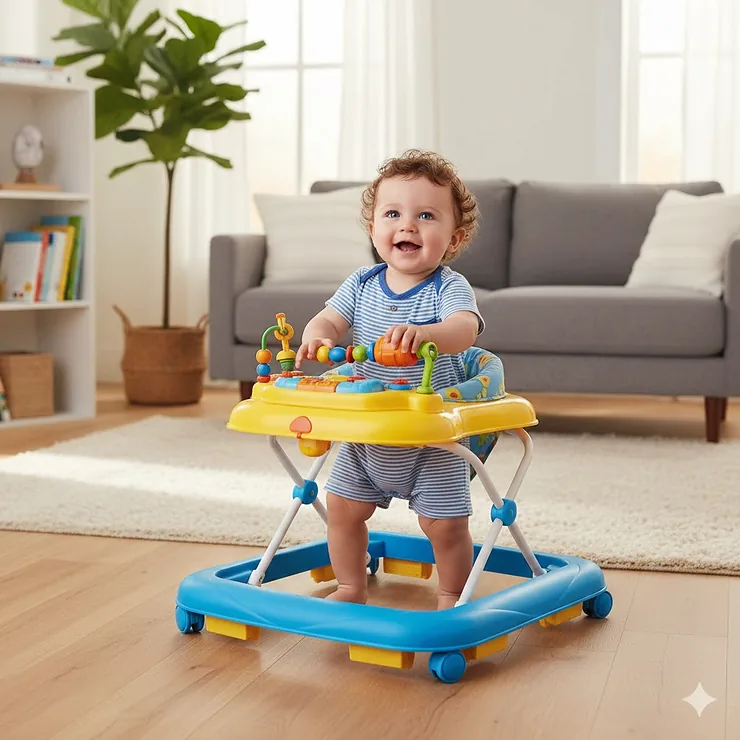
An adjustable height baby walker isn’t just another baby gear purchase. It’s an investment in your child’s comfort, safety, and developmental journey. Think about it: babies grow at wildly different rates. My neighbor’s six-month-old towers over my nine-month-old like a small giant. A walker that worked perfectly last month might leave your baby’s knees bent awkwardly or toes barely scraping the floor by next week.
The beauty of height customization lies in its ability to adapt. Whether you’re shopping for a petite six-month-old or a robust toddler pushing 18 months, the right adjustable walker ensures proper posture, prevents developmental issues like bow legs, and keeps your baby engaged longer. I’ve watched countless parents regret buying fixed-height models, only to replace them within weeks as their babies outgrew them.
This guide cuts through the marketing fluff to deliver what you actually need: real product recommendations based on current Amazon availability, honest pros and cons, and practical advice from someone who’s been in the trenches of baby gear decisions. We’ll explore seven top-rated walkers that truly deliver on adjustability, safety, and value. You’ll discover which features matter most, how to match walkers to your specific needs, and why spending an extra thirty dollars now might save you two hundred later.
Quick Comparison Table
| Walker Model | Height Positions | Price Range | Weight Capacity | Best Feature |
|---|---|---|---|---|
| Boyro Baby 5-in-1 Walker | 3 levels | $60-$80 | Not specified | 5-mode versatility |
| Foldable 5-in-1 Activity Walker | 3 levels | $55-$75 | Not specified | Compact folding |
| HAPYOOY 4-in-1 Walker | 3 levels | $65-$85 | Not specified | Sunshade included |
| Multi-Height Activity Center | 5 levels | $70-$95 | Not specified | 5-level customization |
| BABY JOY Activity Walker | 3 levels | $50-$70 | 30 lbs | Budget-friendly |
| Dream On Me Aloha Walker | 3 levels | $55-$80 | 26 lbs | Extended age range (6-36 mo) |
| Joovy Spoon Walker | 3 levels | $90-$120 | 30 lbs | Premium durability |
💬 Just one click – help others make better buying decisions too!😊
Top 7 Adjustable Height Baby Walkers: Expert Analysis
1. Boyro Baby 5-in-1 Baby Walker
When versatility meets adjustability, you get the Boyro Baby 5-in-1 Baby Walker. This isn’t just a walker—it’s a chameleon of baby entertainment that transforms through five distinct modes: Walk, Bouncer, Rocking, Push, and Eating.
The three adjustable height positions ensure your baby maintains proper posture throughout their growth spurts. What impressed me most during research was the thoughtful engineering: a triangular design with an enlarged chassis that screams stability, plus six separate anti-slip cushions to prevent stair accidents.
Parents consistently praise the music and toys integration, noting how the adjustable 2-step volume control saves sanity during those early morning play sessions. The breathable seat cover addresses a common complaint about traditional walkers—sweaty, uncomfortable babies. Price range sits comfortably at $60-$80, making it a mid-range option that delivers premium features.
✅ Pros:
- Five versatile modes grow with developmental stages
- Enhanced safety features with anti-slip pads
- Volume-adjustable entertainment system
❌ Cons:
- Music quality described as “Chinese carnival music” by some reviewers
- Some assembly complexity reported
2. 5-in-1 Foldable Baby Activity Walker
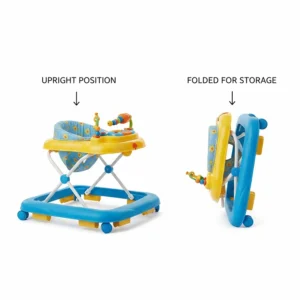
Space-conscious parents, meet your match. The 5-in-1 Foldable Baby Activity Walker combines multi-functionality with impressive storage capabilities, folding down to an ultra-thin profile that slides under beds or into closets effortlessly.
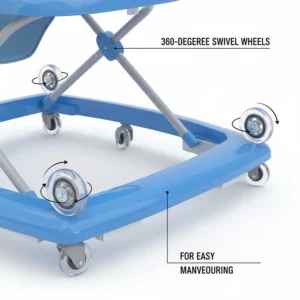
This grow with me baby walker features three height positions that accommodate babies from 6 to 18 months, effectively preventing O-leg development through proper positioning. The detachable trampoline mat adds a unique bouncing dimension that keeps babies engaged during play sessions.
Customer feedback highlights the smooth operation across various surfaces—carpet, hardwood, tile—all handle equally well thanks to the adjustable-speed rear wheels. The activity center components provide sensory stimulation through shape recognition toys, colorful gears, and musical elements. Priced between $55-$75, it represents solid value for families needing multi-functional gear.
✅ Pros:
- Exceptional space-saving folding design
- Smooth multi-surface maneuverability
- Comprehensive activity panel for development
❌ Cons:
- Toy quality concerns noted by some users
- Assembly instructions could be clearer
3. HAPYOOY 4-in-1 Baby Walker with Sunshade
The HAPYOOY 4-in-1 Baby Walker introduces a feature rarely seen in walkers: an integrated sunshade. This thoughtful addition makes outdoor playtime significantly more comfortable, whether you’re supervising in the backyard or visiting the park.
Three adjustable height settings ensure proper leg development as your baby grows, while the mode versatility (walker, rocker, activity center, and push mode) maximizes your investment. The large push handle simplifies transportation, and the compact 8-inch folded profile fits easily in car trunks for family trips.
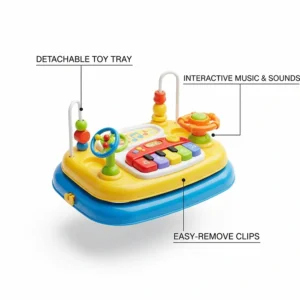
Real-world testing by parents reveals strong performance in both walker and rocker modes, with the adjustable height mechanism operating smoothly through all positions. The multi-functional aspect shines when the toy tray transforms into a feeding surface, eliminating the need for separate dining equipment. Price point ranges from $65-$85, positioning it as a premium mid-range option.
✅ Pros:
- Unique sunshade for outdoor use
- Ultra-compact folding for travel
- Dual-purpose toy tray/feeding surface
❌ Cons:
- Slightly higher price point
- Limited weight capacity information
4. Baby Walker with 5 Adjustable Heights
For parents obsessed with perfect customization, the Baby Walker with 5 Adjustable Heights delivers unparalleled flexibility. While most walkers settle for three positions, this multi-height baby walker offers five distinct levels, accommodating body heights from 16 to 20 inches with precision.
The 360-degree swivel seat creates a dynamic play environment where babies can access all toys without repositioning the entire unit. Universal silent wheels glide smoothly across various flooring types without scratching surfaces or creating noise that disrupts household peace.
Customer experiences paint a picture of engaged, entertained babies who rarely tire of the multifunctional toy table featuring owls, flowers, and colorful piano keys. However, some users report build quality concerns, with broken parts appearing within the first month. The adjustable height mechanism receives mixed reviews—some find it intuitive, others struggle with adjustment. Typical pricing falls between $70-$95.
✅ Pros:
- Five adjustment levels for ultimate customization
- 360-degree rotating seat maximizes toy access
- Silent wheels preserve household tranquility
❌ Cons:
- Build quality inconsistencies reported
- Excessively loud music volume
5. BABY JOY Baby Walker
Budget-conscious families appreciate the BABY JOY Baby Walker for delivering essential features without premium pricing. This best adjustable baby walker focuses on fundamentals: three reliable height positions, a large removable tray for versatile use, and ASTM & CPSIA safety certification for peace of mind.
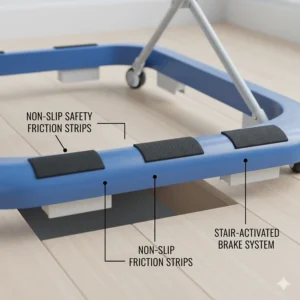
The six anti-slip pads address the primary safety concern with mobile walkers—stair falls. An extra-wide footprint prevents finger pinching incidents that occur when walkers roll against walls. The enlarged base ensures stability even during enthusiastic baby movements.
Parents consistently mention the straightforward assembly process and easy cleaning—the removable interactive toys pop off for washing, and the tray insert handles dishwasher cycles without warping. Customer reviews note impressive mobility across carpet and tile, with babies mastering reverse movement before forward propulsion. Price range of $50-$70 makes this an accessible entry point for families watching budgets.
✅ Pros:
- Excellent value for money
- ASTM certified safety features
- Simple assembly and maintenance
❌ Cons:
- Basic toy selection compared to premium models
- Limited to 30 lbs weight capacity
6. Dream On Me Aloha Baby Walker
The Dream On Me Aloha Baby Walker stands out for its exceptional age range—6 to 36 months—making it the longest-lasting option on this list. This 2-in-1 design transforms from activity center to supportive walker, adapting to developmental milestones seamlessly.
Three position height adjustment maintains proper foot alignment throughout your child’s growth, while the removable foot mat enables smooth transitions from seated play to active walking practice. The interactive musical toy tray features lights, melodies, and tactile elements that support motor skills and sensory development.
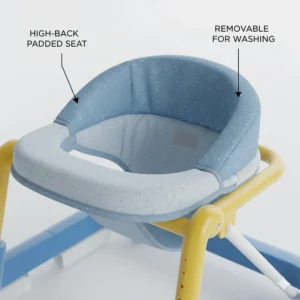
Real user experiences emphasize the comfort factor—the soft, padded seat cradles babies gently during extended play sessions. Skid-resistant friction pads provide secure movement across different floor types. Compact folding design (when collapsed) facilitates storage and travel. Priced $55-$80, it represents solid mid-range value, especially considering the extended usability window.
✅ Pros:
- Extended 6-36 month age range
- 2-in-1 convertible functionality
- Comfortable padded seating
❌ Cons:
- 26 lbs weight limit lower than some competitors
- Requires 2 AA batteries (not included)
7. Joovy Spoon Baby Walker
Premium quality commands premium pricing, and the Joovy Spoon Baby Walker justifies its $90-$120 range through superior construction and thoughtful design. This height customizable walker represents the gold standard in baby walker engineering.
Three adjustable heights accommodate babies up to 30 lbs and 33.5 inches tall—more generous than most competitors. The super-sized dishwasher-safe tray serves double duty for meals and play, while the steel-reinforced frame withstands daily wear that destroys lesser walkers.
What sets Joovy apart is the luggage-grade seat material—tough enough for countless washes while remaining soft against baby skin. The machine-washable design means major messes become minor inconveniences. Rubber safety guards protect tiny fingers from wall pinching, and the extra-wide footprint prevents tippin incidents.
JPMA certification confirms this walker exceeds government safety standards. The flat-fold design compresses to just 9 inches wide for storage. Customer loyalty runs deep with Joovy—parents who purchase one product often return for others, trusting the brand’s quality commitment.
✅ Pros:
- Premium build quality with steel-reinforced frame
- JPMA safety certification
- Super-sized, dishwasher-safe tray
❌ Cons:
- Highest price point in this comparison
- No built-in toys (tray-only design)
✨ Don’t Miss These Exclusive Deals!
🔍 Take your baby’s development to the next level with these carefully selected products. Click on any highlighted item to check current pricing and availability. These walkers will help you create authentic developmental milestones your family will cherish!
Benefits Comparison: Adjustable vs Traditional Walkers
| Feature | Adjustable Height Walker | Traditional Fixed Walker |
|---|---|---|
| Usability Period | 6-18+ months (12+ mo avg) | 6-10 months (4-6 mo avg) |
| Growth Adaptation | Adjusts to baby’s size | Limited to single height |
| Investment Value | $60-$120 (single purchase) | $40-$55 (multiple purchases) |
| Resale Value | High (60-70% original) | Low (30-40% original) |
| Posture Support | Maintains proper alignment | May cause poor positioning |
| Leg Development | Reduces bow-leg risk | Higher developmental concern |
Understanding Adjustable Height Baby Walkers: What Makes Them Essential
An adjustable height baby walker represents more than convenience—it’s a developmental tool designed to accommodate your child’s rapid growth while promoting proper physical development. But what exactly qualifies a walker as truly adjustable, and why does this feature matter so much?
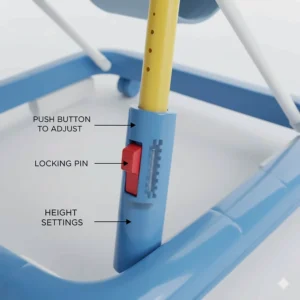
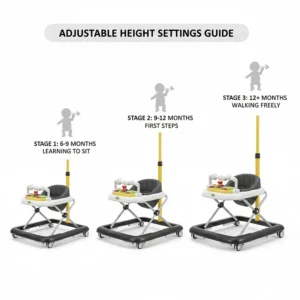
At its core, an adjustable height baby walker contains mechanisms allowing caregivers to raise or lower the seat position as their child grows. Most models offer three to five distinct height settings, though the quality of these adjustments varies dramatically between manufacturers. The goal is maintaining optimal leg positioning—feet flat on the ground, knees slightly bent—throughout the baby’s developmental journey.
Here’s the reality check: babies don’t grow uniformly. Some shoot up like bamboo, others take their sweet time. A fixed-height walker that perfectly fits a six-month-old might leave an eight-month-old dangling uncomfortably or an especially tall baby with cramped knees. This improper positioning doesn’t just cause discomfort; it can potentially contribute to developmental concerns like bow legs when babies consistently push off incorrectly.
The ergonomic baby walker philosophy centers on adaptability. Traditional walkers become obsolete quickly, often within 4-6 weeks as babies outgrow their limited adjustment range. In contrast, a well-designed multi-height system extends usability from 6 months through 18+ months, sometimes even to 36 months for models like the Dream On Me Aloha.
Modern height adjustment mechanisms fall into two categories: button-release systems and pin-lock designs. Button-release models offer quicker adjustments but sometimes lack the robust security of pin-lock systems. Premium walkers like the Joovy Spoon utilize reinforced adjustment points that maintain integrity through countless height changes.
The long-lasting walker design incorporates height adjustability as a foundational feature, not an afterthought. When shopping, test the adjustment mechanism in-store if possible. It should operate smoothly with one hand while remaining secure enough that a determined baby can’t accidentally disengage it. Cheap adjustment systems develop wobble over time, compromising both safety and user experience.
Safety First: ASTM Standards and What They Mean for Your Purchase
Safety isn’t sexy, but it’s absolutely critical when discussing baby walkers. The U.S. Consumer Product Safety Commission enforces strict regulations codified in 16 CFR Part 1216, which incorporates ASTM F977 standards. Understanding these requirements helps you identify genuinely safe products versus marketing fluff.
The mandatory federal safety standards that took effect in 2010 include measures to help prevent walkers from falling down stairs or tipping over, ensuring babies inside are well-supported and cannot become stuck. The standards also require features like parking brakes and specific wheel specifications to enhance stability.
Despite these regulations, according to research from Cleveland Clinic, even after new safety standards were issued in 2010, infant walkers remain associated with thousands of injuries to children each year, with studies showing they’re still responsible for many head and neck injuries including skull fractures. The American Academy of Pediatrics has called for a complete ban on wheeled walkers, citing ongoing safety concerns.
Key safety features to verify:
Wider Base Design: The walker should be too wide to fit through standard doorways (24 inches minimum width), preventing access to stairways or other hazardous areas. This specification alone dramatically reduces stair-related falls.
Stair Grip Mechanism: Look for friction pads or gripping strips on the base that activate when wheels encounter a step edge. These create resistance, theoretically preventing downward tumbles. However, no safety feature substitutes for constant supervision.
Seat Support: ASTM standards mandate specific crotch openings and torso restraints preventing babies from slipping through or tipping sideways. Quality walkers feature reinforced seat attachment points that won’t fail under stress.
Height Adjustment Security: Each height position should lock firmly with an audible click. Test this personally—if you can dislodge the setting with moderate pressure, it’s inadequate. Babies generate surprising force when bouncing or pushing.
Look for JPMA (Juvenile Products Manufacturers Association) certification, which indicates third-party testing beyond basic ASTM compliance. Products like the Joovy Spoon carry this designation, demonstrating commitment to exceeding minimum standards.
Remember: safety certifications establish baselines, not guarantees. Research indicates that babies can move several feet per second in walkers—faster than running adults can react. Never leave a child unattended in any walker, regardless of safety features. Install stair gates religiously, remove hazards from baby’s expanded reach, and maintain arm’s-length supervision during walker use.
Price Range & Value Analysis
| Budget Tier | Price Range | Example Products | Best For |
|---|---|---|---|
| Budget-Friendly | $50-$70 | BABY JOY, Basic 3-position models | First-time buyers, short-term use |
| Mid-Range | $70-$90 | Boyro 5-in-1, HAPYOOY, Dream On Me | Most families, balance of features |
| Premium | $90-$120 | Joovy Spoon, Advanced 5-position | Multiple children, maximum durability |
🎯 Ready to Give Your Baby the Best Start?
These adjustable height baby walkers represent the perfect blend of safety, comfort, and developmental support. Don’t compromise on your child’s early mobility journey—choose a walker that grows with them and keeps them safe every step of the way!
How to Choose the Right Adjustable Height Baby Walker
Selecting the perfect adjustable height baby walker involves balancing safety, functionality, budget, and your specific household needs. Here’s a systematic approach to making an informed decision:
Step 1: Assess Your Space
Measure your narrowest doorways and typical play areas. Wider walkers offer better stability but may not navigate tight spaces. If you live in a compact apartment, prioritize foldable models like the 5-in-1 Foldable Activity Walker that collapse for storage. Homes with multiple levels require extra attention to stair safety features.
Step 2: Evaluate Your Budget
Quality walkers range from $50 to $120. Budget options like BABY JOY deliver essential features reliably. Mid-range models ($60-$85) add entertainment systems and multi-mode functionality. Premium choices like Joovy Spoon justify higher costs through superior durability and materials. Consider cost-per-month-of-use rather than absolute price—a $120 walker lasting 12 months costs the same monthly as a $60 walker lasting 6 months.
Step 3: Determine Feature Priorities
Make a list ranking importance of: entertainment value, portability, ease of cleaning, storage convenience, and multi-functionality. Parents prioritizing developmental stimulation lean toward activity-rich models like Boyro Baby 5-in-1. Those valuing simplicity prefer straightforward designs like BABY JOY.
Step 4: Match Walker Type to Your Baby’s Temperament
Energetic babies benefit from bouncer modes and extensive toy panels that channel enthusiasm productively. Calmer babies might find simpler designs less overwhelming. Consider your child’s engagement style—do they focus intensely on single toys or prefer variety?
Step 5: Research Safety Certifications
Verify ASTM F977 compliance at minimum. JPMA certification provides additional confidence. Read recent reviews on Amazon and consumer safety sites for real-world safety performance, not just manufacturer claims.
Step 6: Check Height Range Against Growth Projections
Standard three-position walkers typically accommodate 6-18 months. Five-position models like the Multi-Height Activity Center extend this range. If your baby tracks tall on growth charts, invest in more adjustment positions upfront. Petite babies might thrive with standard three-position models.
Step 7: Consider Long-Term Value
Multi-mode walkers offering bouncer, rocker, and push walker configurations deliver better value than single-purpose units. The Dream On Me Aloha’s 6-36 month range potentially eliminates need for separate toddler equipment, saving money long-term despite higher initial cost.
Maintenance and Care Tips for Extended Walker Lifespan
Proper maintenance transforms a good walker into a great long-term investment. These practices extend product lifespan while ensuring safe, hygienic use:
Daily Maintenance: Wipe down trays and seat surfaces with baby-safe cleaning wipes after each use. Food residue attracts bacteria and causes material degradation. Check wheel movement—remove hair, string, and debris that accumulate around axles. Inspect seat fabric for tears or weak points in stitching.
Weekly Deep Clean: Remove all toy components and wash according to manufacturer instructions. Most electronic toys tolerate gentle hand-washing; avoid submerging battery compartments. Machine-wash removable seat covers in cold water with mild detergent. Air dry to prevent shrinkage. Clean wheel wells thoroughly with damp cloths, ensuring smooth rotation.
Monthly Inspection: Test height adjustment mechanisms under load. The walker should remain stable when your baby bounces vigorously. Tighten any loose screws or bolts—vibration from daily use gradually loosens connections. Examine anti-slip pads for wear; replace if friction has diminished. Check battery compartment covers for security.
Storage Best Practices: When folding for storage, ensure all locking mechanisms engage fully. Store in dry areas away from direct sunlight, which degrades plastic and fabric. If storing long-term between children, remove batteries to prevent corrosion. Cover with breathable fabric to repel dust without trapping moisture.
Troubleshooting Common Issues: Squeaky wheels respond well to silicone-based lubricant applied sparingly to axle points. Avoid oil-based products that attract dirt. Sticky adjustment buttons often result from food spills—clean thoroughly with cotton swabs dipped in rubbing alcohol. Faded seat fabrics benefit from gentle oxiclean soaks, but always test colorfastness first.
Multi-Mode Versatility: Beyond Basic Walking Support
The evolution from simple walkers to multi-mode systems represents the baby gear industry’s response to parent demands for versatile, space-efficient products. Understanding these modes helps maximize your investment:
Walker Mode: The traditional configuration where babies sit upright, feet touching the ground, propelling themselves forward. This remains the primary function, promoting leg strength and spatial awareness. Modern versions incorporate wide bases preventing doorway passage and enhanced wheel systems for smooth movement.
Bouncer Mode: Transforms the unit into a stationary bouncing platform, often featuring removable foot mats or trampoline-style surfaces. This mode entertains younger babies (4-6 months) who aren’t yet ready for mobile exploration. The bouncing motion soothes fussy periods while developing core strength.
Rocker Mode: Gentle rocking replaces bouncing for calmer play sessions. This mode works well for wind-down periods before naps, providing soothing motion without excessive stimulation. Some models like HAPYOOY integrate this seamlessly into their design philosophy.
Activity Center Mode: Remove wheels or lock them entirely, creating a stationary play station. This configuration offers walker benefits without mobility risks, ideal for younger babies or situations requiring containment. The elevated seating position provides better visual access to household activities than floor play.
Push Walker Mode: The seat area transforms into a sturdy push-behind walker for toddlers mastering independent walking. This extends product utility into 18-24 month range, supporting balance development during the crucial transitional period from assisted to independent walking.
Feeding Mode: Several models, including the Boyro Baby 5-in-1, convert into feeding surfaces when you remove toy trays. This eliminates need for separate dining equipment, particularly useful during travel or in small living spaces.
The key to multi-mode success lies in transition ease. Quality designs allow mode changes in under two minutes without tools. Test this before purchasing if possible—complicated transitions guarantee the modes won’t get used despite good intentions.
Adjustable Height vs. Fixed Height: The Real Cost Comparison
The price difference between adjustable and fixed-height walkers often seems negligible—typically $15-$30. However, the true cost comparison extends far beyond initial purchase price:
Fixed Height Walker Economics: Budget fixed-height walkers retail around $40-$55. They work perfectly… until they don’t. Most parents report 6-8 weeks of optimal use before babies outgrow them. Purchasing a replacement runs another $40-$55. Over a typical 12-month walker usage period, families often buy 2-3 units, totaling $80-$165. Add the hassle factor of shopping, assembling, and disposing of multiple units.
Adjustable Height Walker Economics: Quality adjustable models cost $60-$120 upfront. The three-to-five height positions accommodate growth from 6-18 months minimum, potentially extending to 36 months for extended-range models. Total cost over the same period: $60-$120. The math speaks clearly—even premium adjustable walkers cost less over time than cycling through multiple fixed units.
Hidden Costs: Fixed walkers force earlier transitions to other equipment. An adjustable walker’s extended utility delays purchases of push toys, activity centers, or other mobility devices. This ripple effect multiplies savings throughout your baby’s first two years.
Resale Value: Adjustable walkers maintain stronger secondary market value. Parents shopping used gear actively seek adjustable models, knowing they’ll fit multiple growth stages. Fixed-height walkers sell quickly only when height matches buyer’s specific needs—a narrower market.
Environmental Consideration: Manufacturing three walkers consumes more resources than producing one adjustable unit. For eco-conscious families, choosing adjustable models aligns with sustainability values while saving money—a rare win-win scenario.
Quality Factor: Manufacturers building adjustable mechanisms typically invest in better overall construction. The engineering required for safe, smooth height adjustment pushes companies toward higher quality standards across all components. Budget fixed walkers often cut corners on materials and safety features to hit low price points.
Common Mistakes Parents Make When Buying Baby Walkers
Learning from others’ experiences saves money and frustration. Here are the most common purchasing errors and how to avoid them:
Mistake 1: Prioritizing Entertainment Over Safety Flashy lights and musical panels seduce parents into overlooking fundamental safety features. The most entertaining walker becomes useless if it tips easily or lacks proper stair protection. Evaluate safety certifications before considering entertainment value.
Mistake 2: Ignoring Weight and Height Limits All walkers specify maximum weight and height capacities. Exceeding these limits creates tipping hazards and material stress. Parents of larger babies should verify generous limits upfront—discovering weight restrictions too late necessitates premature replacement.
Mistake 3: Underestimating Cleaning Requirements Those adorable fabric seats? They become disgusting remarkably fast. Walkers lacking removable, machine-washable components create ongoing maintenance headaches. Budget an extra ten minutes weekly for proper cleaning or accept living with permanently stained equipment.
Mistake 4: Buying Before Baby Can Sit Unassisted Walkers require babies capable of sitting upright independently, typically around 6 months. Earlier use risks spinal strain and improper development. Resist premature purchasing despite attractive sales—store that walker until developmental readiness.
Mistake 5: Choosing Style Over Substance Cute patterns and trendy colors attract buyers, but these aesthetics don’t affect functionality. Premium pricing for designer collaborations rarely delivers proportional quality improvements. Allocate budget toward features, not fashion.
Mistake 6: Forgetting to Measure Doorways Wider walkers offer better stability but may not navigate your home effectively. Measuring doorways before purchasing prevents the frustration of a walker that doesn’t fit your floor plan. This particularly matters in older homes with narrower passages.
Mistake 7: Overlooking Folding Requirements If storage space is limited, folding capability becomes essential, not optional. Some “foldable” walkers collapse minimally, still occupying considerable space. Verify folded dimensions match your available storage before committing.
Age-Appropriate Usage: When to Start and When to Stop
Understanding appropriate walker timing optimizes both safety and developmental benefits:
Starting Timeline: Most manufacturers recommend walker use beginning around 6 months, but chronological age matters less than developmental milestones. Your baby should demonstrate: independent sitting without support for several minutes, good head and neck control, and interest in upright positioning. Premature walker use when babies lack these skills risks injury and developmental delays.
Pediatricians generally agree that 6-7 months represents the earliest safe introduction for most babies. However, if your six-month-old still struggles with sitting balance, wait another month. The walker will still be there; your baby’s spinal health won’t forgive rushed timelines.
Peak Usage Period: Between 7-14 months, walkers provide maximum value. Babies possess sufficient strength for safe use while lacking independent mobility that makes walkers redundant. This window offers the sweet spot where walkers genuinely enhance development and entertainment without competing with natural walking progression.
Transitioning Out: Once babies demonstrate confident independent walking, walker utility diminishes rapidly. Most children achieve this milestone between 12-15 months, though normal variation extends from 9-18 months. Watch for these transition signs: preferring to walk holding furniture over using the walker, repeatedly trying to climb out, or showing frustration with the walker’s movement limitations.
Don’t force transitions prematurely. Some babies enjoy walkers well into their second year, using them as comfortable seating for play or meals. If your toddler still finds value and uses it safely within weight limits, there’s no developmental harm in continued access.
Extended Range Models: Products like Dream On Me Aloha market 6-36 month ranges. This extended timeline reflects their convertibility to push walkers and activity tables rather than traditional mobile walker usage throughout this period. Interpret these ranges as product lifespan, not continuous walker mode use.
Safety Consideration: Experts including the American Academy of Pediatrics recommend against walker use entirely, citing injury data. Research from Harvard Health confirms that walkers don’t help babies learn to walk faster and may actually delay independent walking. If choosing to use walkers despite these recommendations, limit sessions to 15-20 minutes under constant supervision. Never use walkers as childcare substitutes or to “keep baby busy” while you’re distracted.
Storage Solutions for Small Spaces
Living in compact quarters doesn’t preclude walker ownership if you choose wisely and implement smart storage strategies:
Vertical Storage: Install wall-mounted hooks capable of supporting 15-20 pounds. Many foldable walkers hang vertically when collapsed, consuming floor space equivalent to a picture frame. This works particularly well in closets or behind doors. Ensure hooks mount into wall studs for secure weight support.
Under-Bed Storage: Walkers folding to 8-10 inches thickness slide under most beds without issue. The 5-in-1 Foldable Activity Walker excels here, compressing to ultra-slim profiles. Protect stored walkers with breathable covers preventing dust accumulation while allowing moisture escape.
Overhead Solutions: Garage or basement ceiling storage utilizes often-wasted vertical space. Pulley systems designed for bicycles adapt perfectly for walkers. This approach works for seasonal storage between children but proves impractical for daily use given retrieval effort.
Multi-Purpose Furniture: Some families repurpose walkers as stationary activity tables when not using walker mode, eliminating storage needs. Remove wheels or engage locks, positioning against walls as dedicated play stations. This strategy works best with models featuring substantial toy panels.
Closet Organization: Dedicate closet shelf space to folded walker storage. Measure shelf depth against folded walker dimensions before assuming fit—some “compact” designs still measure 25+ inches lengthwise. Door-mounted organizers work for walker accessories like removable toys and seat covers.
Seasonal Rotation: If your climate permits extensive outdoor play, consider rotating walkers into outdoor equipment storage during warm months. Weather-protected garage or shed space provides temporary homes, freeing interior square footage. Always clean thoroughly and dry completely before outdoor storage to prevent mold.
Quick-Access Zones: For daily users, designate a “walker corner” in your main living area. Folded walkers lean against walls occupying minimal footprint while remaining accessible. This approach acknowledges that frequent setup/breakdown discourages use—if getting the walker out requires major effort, it won’t get used regardless of benefits.
The ideal storage solution balances accessibility with space efficiency. Families using walkers daily benefit more from convenient quick-access positioning than maximum space savings requiring five-minute retrieval processes.
Frequently Asked Questions
❓ How many height positions should an adjustable height baby walker have?
❓ Can adjustable height baby walkers prevent bow legs?
❓ What is the weight limit for most adjustable baby walkers?
❓ Are 5-in-1 walkers better than traditional single-mode walkers?
❓ How often should I clean my adjustable height baby walker?
Conclusion: Making Your Final Decision
Choosing the right adjustable height baby walker ultimately comes down to matching product features with your specific family needs, budget, and values. There’s no universal “best” walker—only the best walker for your situation.
For families prioritizing versatility and developmental features, the Boyro Baby 5-in-1 Walker delivers exceptional value through its multiple modes and thoughtful safety engineering. The combination of entertainment, functionality, and mid-range pricing makes it an excellent all-rounder.
Budget-conscious parents will appreciate the BABY JOY Baby Walker, which proves you don’t need premium pricing for solid safety features and reliable height adjustment. Its straightforward design eliminates unnecessary complexity while maintaining essential functionality.
Those willing to invest in premium quality should seriously consider the Joovy Spoon Baby Walker. Yes, it costs more upfront, but the superior construction, JPMA certification, and luggage-grade materials justify the investment. This walker genuinely lasts through multiple children, making the cost-per-use remarkably competitive.
Compact living spaces benefit most from the 5-in-1 Foldable Activity Walker, whose ultra-slim folded profile solves storage challenges without sacrificing features. The ability to tuck away easily encourages consistent use rather than becoming permanent floor obstacles.
Families planning outdoor supervised play should explore the HAPYOOY 4-in-1 Walker with its unique integrated sunshade. This seemingly small feature transforms outdoor play sessions, protecting sensitive baby skin while maintaining engagement.
For those seeking maximum height customization, particularly parents of taller babies, the Baby Walker with 5 Adjustable Heights provides precision that three-position models can’t match. The 16-20 inch range accommodates wider growth variation.
Finally, if extended usability matters most, the Dream On Me Aloha Baby Walker earns consideration through its remarkable 6-36 month range. While you won’t use walker mode throughout this period, the convertible functionality extends practical lifespan significantly.
Remember: regardless of which model you choose, safety requires constant supervision. No walker, however well-designed, substitutes for attentive parenting. Use stair gates religiously, remove hazards from expanded reach, and maintain arm’s-length supervision during all walker sessions. The adjustable height baby walker serves as a tool for development and entertainment, not a babysitter.
Your baby’s first steps represent incredible milestones worth supporting thoughtfully. Choose equipment that grows with them, maintains safety as priority one, and fits seamlessly into your family’s lifestyle. The right walker makes this journey safer, more enjoyable, and more economically sustainable.
Recommended for You
- 7 Best Foldable Baby Walker Models in 2026: Safe & Space-Saving Picks
- 7 Best Smart Baby Walkers 2026 (Tech Features That Actually Help!)
- 7 Best Baby Walkers in 2026: Top Rated Picks for Your Little One
Disclaimer: This article contains affiliate links. If you purchase products through these links, we may earn a small commission at no additional cost to you.
✨ Found this helpful? Share it with your friends! 💬🤗
