
In This Article
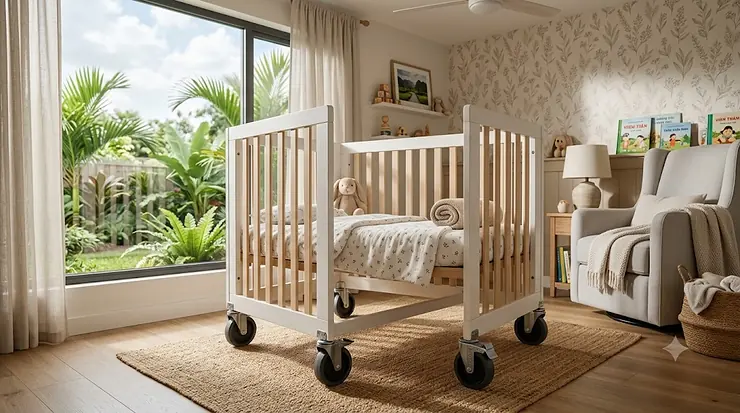
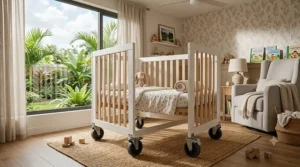
If you’ve ever tried to soothe a fussy baby at 2 a.m. while shuffling between the bedroom and the nursery, you already know why mobility matters in a crib. A rolling crib with locking wheels is exactly what it sounds like: a crib built on a set of casters that let you roll it from room to room, then lock in place so it stays put — no creeping, no rocking, no surprise midnight slides across a hardwood floor.
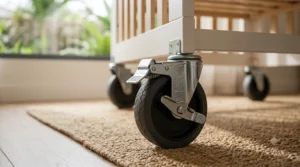
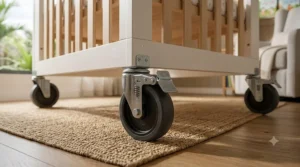
The appeal is obvious for small apartments, multi-level homes, and parents who want the baby nearby during the newborn stage without buying a separate bassinet. But “wheels” can mean very different things depending on the crib — some models lock two of four casters, some lock all four, and a few (like the premium oval-shaped designs) use swivel casters that lock with a single foot-tap. That distinction matters more than most buying guides admit, and it’s where we’ll spend a good chunk of this guide.
Below, we’ve pulled together seven real, currently available cribs on Amazon with genuine locking-wheel systems — spanning budget folding mini cribs to a $900 heirloom-style design — plus a full breakdown of how to choose, what mistakes to avoid, and what the spec sheets actually mean once the crib is in your nursery.
Quick Comparison Table
| Crib | Wheel System | Price Range | Best For |
|---|---|---|---|
| Dream On Me Full-Size 2-in-1 Folding Crib | 2 locking + 2 free-rolling casters | $150–$220 | Budget full-size shoppers |
| Dream On Me 3-in-1 Mini Crib (Stationary Side) | 4 locking casters | $150–$200 | Small spaces, max stability |
| Child Craft London Mini Folding Crib | 2 locking “Easy Roll” casters | $150–$230 | Grandparent’s house, travel |
| Dream On Me Carson Classic 3-in-1 | Locking casters, full-size | $200–$300 | Long-term primary nursery crib |
| Babyletto Origami Mini Crib | Removable, lockable casters | $300–$400 | Urban apartments, design-focused parents |
| Namesake Winston 4-in-1 Mini Crib | Removable, lockable wheels | $300–$400 | Families wanting long convertibility |
| Stokke Sleepi Bed V3 | Lockable swivel casters | $800–$950 | Premium buyers, newborn-to-5-years use |
Looking at the spread above, the two Dream On Me mini and full-size models dominate the budget tier and are the only ones here where all four wheels lock simultaneously — a real advantage if your floors aren’t perfectly level. The Babyletto Origami and Namesake Winston sit in the mid-range and trade a bit of price for better materials and longer usable life through conversion kits. The Stokke Sleepi is in a different category altogether: its swivel locking casters maneuver more like an office chair than a traditional crib, which is the main reason it costs roughly three times as much as the next closest option.
💬 Just one click — help others make better buying decisions too! 😊
Top 7 Rolling Cribs With Locking Wheels: Expert Analysis
1. Dream On Me Full-Size 2-in-1 Folding Baby Crib (Espresso)
The Dream On Me Full-Size 2-in-1 Folding Crib is the closest thing to a “no-frills, just-works” option in this lineup, and it’s also one of the only full-size cribs here under $250.
It’s built from New Zealand pinewood, measures 54″L × 31″W × 46″H, and holds up to 50 lbs — enough to take a toddler comfortably past the newborn stage. The wheel setup is worth understanding before you buy: two of the four casters lock and two roll freely, which is a common configuration on folding cribs because it lets the crib pivot on the locked pair when you need to angle it through a doorway, then lock fully flat once it’s positioned. In practice, that means you get easier maneuvering in tight hallways, but slightly less “set it and forget it” stability than a crib where all four wheels lock.
Who it’s for: Parents who want a real full-size crib (not a mini), need to move it occasionally between rooms, and are working with a tight budget. It’s also a sensible pick for grandparents thanks to the patented folding system for storage between visits.
Pros: GREENGUARD Gold certified, two adjustable mattress heights, genuinely fast tool-free folding, meets current ASTM/CPSC standards. Cons: Only half the wheels lock; pinewood shows wear faster than hardwood over years of use.
Price range: $150–$220 — a strong value pick if full-size is non-negotiable.
2. Dream On Me 3-in-1 Portable Folding Mini Crib
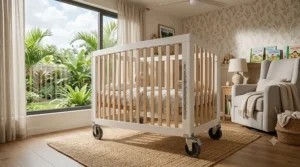
If you want every wheel to lock, the Dream On Me 3-in-1 Portable Folding Mini Crib is the more stable choice in the Dream On Me lineup. All four casters lock here, which removes the guesswork around uneven flooring entirely.
This is also a genuine 3-in-1: crib, changing station, and playpen in one footprint, with three mattress height settings and a firm mattress included. For nurseries where floor space is tight, the mini-crib dimensions matter as much as the wheels — you’re not just gaining mobility, you’re saving square footage.
Who it’s for: Apartment dwellers and parents converting a small spare room into a nursery, who want one furniture piece to do three jobs.
Pros: All four wheels lock, doubles as a changer and playpen, GREENGUARD Gold and JPMA certified.
Cons: Mini-crib size means a shorter usable lifespan before your child outgrows it; mattress is firm by design (which is correct for safety, but surprises some first-time buyers).
Price range: $150–$200 — one of the most budget-friendly options with full four-wheel locking.
3. Child Craft London Mini Compact Folding Crib
The Child Craft London Mini Crib leans into portability harder than almost anything else on this list. It’s built around two “Easy Roll” locking casters and a compact folding frame finished in matte white, with a 2-inch mattress included in the box.
What the spec sheet doesn’t tell you: compact folding mini cribs like this one are the go-to choice for “second location” use — a grandparent’s house, a vacation rental, or a home office that occasionally becomes a nap room. The two-wheel lock system is plenty for a crib this light, since the smaller footprint means less leverage and less risk of unwanted drift compared to a full-size frame.
Who it’s for: Families who need a true second crib for travel or a relative’s house, not a primary everyday nursery piece.
Pros: Genuinely compact and light, durable pine construction, mattress included.
Cons: Two-wheel lock (not four), smaller sleeping area limits how long it’s usable.
Price range: $150–$230.
4. Dream On Me Carson Classic 3-in-1 Convertible Crib
The Dream On Me Carson Classic steps up from the budget tier into something meant to be your child’s primary crib for years, not just a mobility solution. It’s a full-size 3-in-1 that converts to a daybed and toddler bed, with four mattress height settings and GREENGUARD Gold plus Baby Safety Alliance certification.
The locking wheels here matter most during the newborn stage, when you’ll likely want the crib in your bedroom before transitioning it to the nursery — after that, most families lock it in place permanently and rarely move it again. That’s a useful way to think about wheels in general: on a long-term convertible crib, mobility is a phase-one feature, while the conversion options are what you’re really paying for over the next 2–3 years.
Who it’s for: Parents who want one crib from newborn through toddlerhood and appreciate mobility during the early bedside-bassinet phase.
Pros: Converts through multiple stages, classic design works in most nurseries, solid certifications.
Cons: Heavier and bulkier to move than the mini options; conversion kits for daybed/toddler stages are typically sold separately.
Price range: $200–$300.
5. Babyletto Origami Mini Crib
The Babyletto Origami is where this list shifts from “budget folding crib” to “designed furniture piece.” It uses removable, lockable casters, FSC-certified wood, and a folding mechanism aimed at small or secondary living spaces, with two adjustable mattress heights and GREENGUARD Gold certification.
Several real buyer reviews we came across consistently call out how smoothly the casters roll and how easy repositioning is within a nursery — a detail that matters more than it sounds, since cheaper caster hardware on budget cribs can stick, squeak, or roll unevenly on carpet. The Origami’s casters are also removable once your child reaches the standing/climbing stage, converting the crib into a stationary mini bed.
Who it’s for: Urban apartment dwellers and parents who want a Scandinavian-style nursery aesthetic without sacrificing real mobility.
Pros: Notably smooth-rolling casters, modern design, GREENGUARD Gold certified, converts to a twin bed later (kit sold separately).
Cons: Mini-crib sizing limits long-term use; price jump versus the Dream On Me options.
Price range: $300–$400.
6. Namesake Winston 4-in-1 Mini Crib
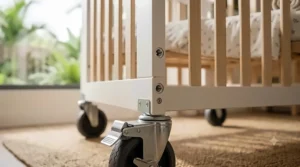
The Namesake Winston pairs a metal frame with removable, lockable wheels and four adjustable mattress heights, and converts through four stages: mini crib, toddler bed, daybed, and twin-size bed.
The practical upside of a metal frame versus the pinewood options above is rigidity — metal doesn’t warp or loosen at the joints the way wood can after years of rolling and locking. That makes the wheel-locking mechanism itself stay tighter and more reliable over time, which is a detail spec sheets rarely mention but matters if you plan to use this crib daily for two-plus years.
Who it’s for: Families wanting the longest conversion runway in the mini-crib category, plus a more contemporary metal-frame look.
Pros: Four-stage conversion, durable metal build, GREENGUARD Gold certified.
Cons: Metal frame runs cooler/harder aesthetically than wood for traditional nursery themes; wheels are removable rather than permanently fixed, so they can be misplaced.
Price range: $300–$400.
7. Stokke Sleepi Bed V3
The Stokke Sleepi Bed V3 is the outlier here, and deliberately so — it’s the one crib on this list where the wheels aren’t an add-on feature but central to the design. Its oval beech-wood frame sits on lockable swivel casters, which maneuver more like a hospital bed than a typical four-corner crib, letting you rotate and reposition it in tight spaces with one hand.
It’s suitable from newborn through age 5 thanks to a height-adjustable base and removable side rails for the toddler-bed stage, and it’s GREENGUARD Gold and FSC certified. The trade-off is obvious: this is a premium, heirloom-style purchase, not a budget mobility fix.
Who it’s for: Buyers who want one crib to last from infancy through early childhood and who are willing to pay for design and swivel-caster maneuverability that the other six cribs on this list simply don’t offer.
Pros: True swivel locking casters (best-in-class maneuverability), longest usable age range (0–5 years), premium materials.
Cons: Significantly higher price point; oval shape means non-standard mattress and sheets sold separately.
Price range: $800–$950.
✨ Don’t Miss These Exclusive Deals!
🔍 Take your nursery setup to the next level with these carefully selected cribs. Click on any highlighted item to check current pricing and availability — these rolling, locking-wheel designs make it easier to build a safe, mobile sleep space your whole family will love.
Practical Usage Guide: Setting Up and Maintaining a Rolling Crib
Getting a rolling crib with locking wheels into daily use smoothly comes down to a few habits most buying guides skip entirely.
At setup: Always assemble the crib on the flooring you intend to use it on — wheels that lock perfectly on hardwood can sit slightly differently on thick carpet, so test the lock on all casters before the first night, not after.
Locking technique: Lock diagonally opposite wheels first on two-wheel-lock cribs (like the Dream On Me Full-Size or Child Craft London), then check for any front-to-back rock before locking the second pair, if applicable. This diagonal-first approach is the most common cause of a crib that “still wobbles” even though the wheels are technically locked.
Maintenance schedule: Check caster hardware monthly — the same screws that hold a crib’s locking lever in place can loosen with repeated rolling, especially in the first 60 days of heavy use. A quarter-turn with a screwdriver every few weeks keeps the lock mechanism snug.
Common first-30-day mistake: Rolling the crib by pushing on the rail instead of the frame’s base. This puts uneven lateral stress on the caster stems and is the single biggest cause of caster wobble showing up early in a crib’s life.
Real-World Scenarios: Matching the Right Crib to Your Family
The apartment-dwelling new parent: Limited square footage, baby sleeping in the bedroom for the first months, eventual move to a nursery down the hall. The Dream On Me 3-in-1 Mini Crib or Babyletto Origami both fit this profile well — small footprint, full or partial wheel-locking, and minimal floor damage risk.
The multi-room family with mixed flooring: Hardwood in the hallway, carpet in the nursery, tile near the kitchen. This is where four-wheel locking (Dream On Me 3-in-1, or the swivel system on the Stokke Sleepi) earns its keep, since two-wheel-lock cribs can feel less secure when only the free-rolling pair sits on carpet.
The grandparent or frequent traveler: Needs a crib that sets up fast, folds flat, and doesn’t need to be a long-term investment. The Child Craft London Mini Crib is built almost exactly for this use case.
Problem → Solution: Common Rolling Crib Issues
Problem: The crib still rocks slightly after locking the wheels. Solution: Check that all locked casters are touching the floor evenly — on uneven hardwood or older subfloors, one corner can sit a hair higher, which no wheel lock can fully correct. A thin furniture shim under the low corner solves this in minutes.
Problem: Wheels roll unevenly or drag on carpet. Solution: This is almost always carpet pile catching the caster’s swivel base rather than a defective wheel. Cribs with larger-diameter casters (like the Stokke Sleepi’s swivel design) handle thick carpet noticeably better than the smaller fixed casters on budget folding cribs.
Problem: A toddler learns to push the crib themselves once they can stand. Solution: This is exactly the point at which most manufacturers recommend locking all wheels permanently or removing them altogether — both the Babyletto Origami and Namesake Winston are designed with this transition in mind, since their casters are removable once your child reaches the standing stage.
How to Choose a Rolling Crib With Locking Wheels
- Count how many wheels actually lock. Two-wheel-lock cribs are fine for light, occasional moves; four-wheel-lock or swivel-lock systems suit daily repositioning or uneven flooring.
- Match crib size to your space. Mini cribs save floor space but offer a shorter usable window; full-size cribs cost more in square footage but last longer.
- Check certifications first. Look for GREENGUARD Gold (chemical emissions) and JPMA or Baby Safety Alliance verification before comparing style or price.
- Decide how long you need it to last. Convertible 3-in-1 or 4-in-1 models cost more upfront but can replace a toddler bed later.
- Factor in your actual flooring. Hardwood, tile, and thick carpet each interact differently with caster size — bigger casters generally handle carpet better.
- Set a realistic budget band. Budget folding cribs ($150–$250), mid-range design-forward cribs ($300–$400), and premium heirloom designs ($800–$950) each solve a different problem — more expensive isn’t automatically “better” for your situation.
Common Mistakes When Buying a Crib With Locking Wheels
- Assuming all casters lock. Several budget cribs only lock two of four wheels — always check the listing’s wheel description, not just the word “wheels” in the title.
- Ignoring weight limits when planning for a toddler. A mini crib’s lower weight ceiling (often 40–50 lbs) can mean retiring it sooner than expected.
- Overlooking mattress compatibility. Oval or non-standard-shaped cribs like the Stokke Sleepi require specific mattresses sold separately — standard crib sheets won’t fit.
- Skipping the certification check. Not every crib on Amazon carries GREENGUARD Gold or JPMA certification; it’s worth filtering for this rather than assuming it.
Rolling Crib vs. Traditional Stationary Crib
A traditional stationary crib has no casters at all — it’s set once and stays in one spot for its entire lifespan. The upside is rigidity: with no moving parts at the base, there’s nothing to lock, loosen, or maintain. The downside is obvious the first time you need to vacuum behind it, repaint the room, or move the baby closer to your bed during a rough sleep week.
A rolling crib with locking wheels gives up a small amount of that rigidity in exchange for real flexibility, and on any of the seven models above, the locking mechanism is specifically engineered to restore that stability once the crib is positioned. For most modern households — especially in apartments or homes without a dedicated, permanent nursery — the mobility trade-off is worth it. The exception is a family with a fixed, finished nursery from day one and zero need to ever relocate the crib; in that narrow case, a stationary crib can be marginally simpler.
What to Expect: Real-World Performance on Different Floors
On hardwood or laminate, every crib on this list rolls and locks predictably — this is the easiest surface for any caster type.
On mid-pile carpet, two-wheel-lock budget cribs (Dream On Me Full-Size, Child Craft London) can feel slightly less planted than four-wheel-lock or swivel-caster models, simply because the free-rolling pair has more give.
On thick or plush carpet, larger swivel casters — like those on the Stokke Sleepi — noticeably outperform the smaller fixed casters common on folding mini cribs, since the caster’s larger diameter rolls over pile instead of sinking into it.
On tile or stone, locking mechanisms hold reliably across every model here, though the crib will be louder to move (and to accidentally bump) than on carpet.
Safety, Regulations & Compliance Guide
Every crib sold in the U.S. — wheels or no wheels — has to meet the federal standards the Consumer Product Safety Commission updated in 2011. Crib slats must be no more than 2-3/8 inches apart, about the width of a soda can, so a baby’s body can’t slip through and no missing or cracked slats are allowed. Traditional drop-side rails have been banned outright since that rule took effect, and all of the cribs reviewed here use fixed, non-drop sides as a result.
Locking wheels themselves aren’t separately regulated the way slat spacing is, but they’re covered under the same general crib-stability and hardware-durability testing every model has to pass before it can legally be sold. When shopping, two certifications are worth checking independently of the federal minimum: GREENGUARD Gold (low chemical emissions) and JPMA or Baby Safety Alliance verification (independent third-party safety testing). All seven cribs above carry at least one of these.
For broader safe-sleep guidance — firm mattress, no soft bedding, back-sleeping — Nemours KidsHealth is a solid plain-language resource worth bookmarking alongside the CPSC’s own crib regulation page.
Long-Term Cost & Maintenance
Budget folding mini cribs ($150–$250) typically have the shortest usable life — most families outgrow the weight or size limit within 18–24 months, meaning a second purchase (toddler bed, etc.) is likely down the line. Mid-range convertible cribs ($300–$400) spread cost over a longer window since they convert into a toddler bed or daybed, often extending usable life to 3–5 years for roughly $100–$150 more upfront.
The Stokke Sleepi’s $800–$950 price tag looks steep next to the rest of this list, but its 0–5-year usable range and resale value (Stokke cribs hold value unusually well on the secondhand market) can make its effective cost-per-year competitive with — or lower than — buying and replacing two budget cribs over the same period.
Maintenance costs across all seven are minimal: occasional hardware tightening, no specialized parts beyond a replacement mattress when needed.
Benefits vs. Traditional Alternatives
| Feature | Rolling Crib w/ Locking Wheels | Stationary Crib (No Wheels) | Crib on Unlocked Casters |
|---|---|---|---|
| Room-to-room mobility | Yes | No | Yes |
| Stability once positioned | High (when locked) | Highest | Low — can drift |
| Maintenance needed | Occasional hardware check | None | Occasional |
| Best for | Apartments, multi-room use | Fixed, permanent nursery | Not generally recommended for nurseries |
The clearest takeaway from this comparison is that unlocked casters are rarely worth the trade-off for a baby’s sleeping space — without a true lock, a crib can drift over time from normal movement in the house. A stationary crib wins only on raw simplicity; everything else favors a properly locking rolling crib for most households.
FAQ
❓ Are locking wheels on a crib safe for babies?
❓ Can I move a crib with locking wheels myself?
❓ Do crib wheels work on carpet?
❓ How much does a rolling crib with locking wheels cost?
❓ Is a mini crib with wheels good for small apartments?
Conclusion
A rolling crib with locking wheels isn’t just a convenience feature — it’s a genuinely practical solution for the way most modern families actually live, moving between rooms, floors, and life stages faster than a fixed crib can keep up with. Whether you land on a $150 Dream On Me folding mini crib for your first apartment or splurge on the Stokke Sleepi’s swivel-caster design for a nursery meant to last five years, the real decision point is simple: count the wheels that lock, match the crib to your actual flooring, and don’t pay for certifications or conversion stages you won’t use.
✨ Found a crib that fits your nursery?
Check current pricing and availability on Amazon before you decide — availability and pricing can shift quickly on popular nursery items.
Recommended for You
- 7 Best Convertible Toddler Bed From Crib Picks That Won’t Let You Down (2026)
- 7 Best Crib to Bed Conversion Kits in 2026
- 6 in 1 Convertible Crib: 7 Best Picks for 2026
Disclaimer: This article contains affiliate links. As an Amazon Associate, I earn from qualifying purchases. If you purchase products through these links, we may earn a small commission at no additional cost to you.
✨ Found this helpful? Share it with your friends! 💬🤗
